Modern marketing is problematic AF. It’s not just annoying pop-ups or shady sales funnels – it’s the exclusion, the inaccessibility, and the subtle (or not-so-subtle) ways it reinforces systems of oppression. And while there’s been progress, especially as more folks call for change, the truth is this: marketing as we know it still leaves a lot of people out.
As a neurodivergent entrepreneur and advocate for ethical business, I’ve seen firsthand how traditional marketing practices can feel manipulative, confusing, or downright harmful. For people who are multiply marginalized – whether by race, ability, gender, class, or neurotype – the messages we see (or don’t see) shape how welcome we feel in a brand’s community.
But here’s the good news: marketing can be a tool for justice.

When we build campaigns that center ethics, inclusion, and accessibility, we’re not just growing our businesses – we’re creating authentic relationships and actively contributing to a more equitable world. And yes, this is possible even if you're a small business owner with limited resources.
In this post, we’ll explore:
- Why traditional marketing misses the mark (and who it leaves behind),
- What Just Marketing® looks like in practice, and
- Actionable steps you can take to build campaigns that connect with diverse audiences and make a meaningful impact.
By the end, you’ll walk away with a practical roadmap to create marketing that’s not only profitable – but radically human, values-aligned, and justice-centered.
The Problem with Modern Marketing

At its core, traditional marketing strategies were built for mass appeal and maximum profit – often at the expense of ethics, equity, and accessibility. And while the landscape is shifting, the roots of harm still show up in subtle (and not-so-subtle) ways. Before we can build something better, we need to understand exactly what’s broken.
Unethical: Prioritizing Profit Over People
From snake oil salesmen to bro marketers, unethical marketing has been around forever. These tactics rely on manipulation, urgency, and shame to drive conversions. They prey on fear, scarcity, and confusion. And while they might boost short-term sales, they erode trust and reinforce extractive, power-over dynamics.
Examples of unethical marketing:
- Snake Oil Salesmen promised miracle cures with zero accountability.
- Infomercials used over-the-top testimonials and exaggerated results to push products.
- Bro Marketing relies on inflated claims, “limited-time” pressure, and aspirational hype that doesn’t reflect real outcomes.
Why it matters: When marketing manipulates, it reinforces systemic harm – especially against vulnerable communities. Justice-centered marketing starts with truth-telling and consent.
Exclusionary: Leaving People Out
Marketing that only centers dominant identities (white, cis, non-disabled, neurotypical, etc.) makes others feel invisible – or worse, unwelcome. Even when brands try to be “diverse,” it often feels performative or tokenizing, lacking the nuance and authenticity of real representation.
Examples of exclusionary marketing:
- People Overlooked: A Forbes article reported that, despite promises of more diversity, television commercials are actually getting whiter again.
- People Excluded: Facebook once allowed ad targeting that excluded racial minorities – reinforcing discriminatory practices.
- People Made to Feel Unwelcome: Aunt Jemima branding relied on racist tropes for decades, depicting a “mammy” figure in service to white families.
Why it matters: Marketing that excludes isn’t just ineffective – it causes harm. If people don’t see themselves reflected in your messaging, they’ll assume they don’t belong. Inclusion isn’t a trend – it’s a responsibility.
Inaccessible: Not Designed for All Bodies & Brains
Accessibility is still treated like an afterthought in most marketing campaigns – if it’s considered at all. That means millions of people are regularly left out, unable to fully engage with your content, products, or services.
Examples of inaccessible marketing:
- Print ads aren’t usable for people who are blind or low-vision.
- Radio ads are inaccessible for Deaf and hard-of-hearing folks.
- TV ads often lacked captions until the late ‘90s – and even today, captions are frequently inaccurate or missing.
- In-store displays can be hard to navigate for wheelchair users or caregivers with strollers.
Why it matters: When content isn’t designed with disabled people in mind, it’s not just inconvenient – it’s exclusionary. Accessibility shouldn’t be an afterthought – it’s foundational.
Modern marketing tends to be unethical, exclusionary, and inaccessible. That’s why we need a new approach – one that centers justice, connection, and care.
The Roadmap to Just Marketing

It’s time to unlearn harmful marketing norms and rebuild from a place of justice. That doesn’t mean you have to burn it all down and start over – but it does mean being intentional about how you communicate, connect, and show up.
Let’s redefine marketing – not as a tool for manipulation, but as a force for equity, connection, and impact.
What Is Just Marketing®?

Just Marketing is an approach rooted in ethics, inclusion, and accessibility. It’s about treating your audience with dignity, honoring diverse experiences, and using your business as a tool for good.
When you lead with justice, your marketing becomes:
- Profitable – because people support brands they trust
- Authentic – because you’re showing up as your full self
- Impactful – because you’re challenging oppressive systems and building real connection
And yes, this is absolutely possible for small businesses with limited time and budgets. You don’t need a massive team or million-dollar campaign to market in a way that matters – you just need a values-aligned strategy.
There are three pillars of Just Marketing:
- Ethical Marketing
- Inclusive Marketing
- Accessible Marketing
Quick Note:
This isn’t about being perfect – it’s about being proactive. Marketing won’t become just overnight. But each step we take toward ethical, inclusive, and accessible practices helps dismantle the old system and co-create something better.

Ethical Marketing: Do Less Harm (Just Marketing Pillar #1)
Marketing doesn’t have the best reputation. Too often, it’s associated with trickery, pressure, and exploitation. From countdown timers that never really expire to exaggerated promises that prey on people’s fears, unethical marketing shows up everywhere… and it’s exhausting.
But it doesn’t have to be that way.
Ethical marketing asks us to shift from manipulation to mutual respect. It invites us to treat our audience not as leads to capture, but as whole humans deserving of honesty, care, and autonomy.
When we market ethically, we build trust – and trust is what leads to sustainable, values-aligned growth.
There are four cornerstones of Ethical Marketing:
- Transparency: Be honest and clear. No bait-and-switches or sleazy sales tricks.
- Responsibility: Consider how your message impacts your audience, society, and the environment.
- Respect: Value your audience’s time and intelligence – don’t overwhelm them or talk down to them.
- Fairness: Make sure everyone has equitable access to your offers and resources.

Ethical Marketing Cornerstone #1: Transparency
Be upfront about what you’re offering, who it’s for, and what it costs. Avoid vague language, fine print, and psychological tricks that pressure people into saying “yes” before they’re ready.
Examples of transparency in action:
- Share the total cost before someone hits “buy.”
- Be clear about results: what’s typical, what’s possible, and what’s just hype.
- Ditch the fake urgency – no more “Only 2 left!” if that’s not true.
Ethical Marketing Cornerstone #2: Responsibility
Your marketing doesn’t exist in a vacuum. It affects your audience, your industry, and the broader culture. Ethical marketing means considering not just what you say, but how it lands – and being willing to learn and adapt when you get it wrong.
Ask yourself:
- Is this message rooted in fear, shame, or urgency?
- Could this language harm someone’s mental health or sense of self-worth?
- Am I reinforcing stereotypes or limiting beliefs?
Pro tip: If you ever catch yourself wondering, “Is this manipulative?” – that’s your sign to pause and reassess.
Ethical Marketing Cornerstone #3: Respect
People don’t want to be tricked or talked down to. Ethical marketing respects that your audience is capable of making their own decisions when given clear, honest information.
Respect shows up when you:
- Offer value without demanding a sale in return.
- Give people space to say “no” without guilt.
- Skip the overly aggressive CTAs that feel more like commands than invitations.
Ethical Marketing Cornerstone #4: Fairness
Ethical marketing also means equity – are your offers accessible across different income levels, tech access, or learning styles? Are you considering barriers that might prevent someone from engaging with your brand?
Fairness in action might look like:
- Offering sliding scale pricing or scholarships.
- Creating low-cost or free resources that still deliver real value.
- Avoiding content that excludes people with disabilities or limited bandwidth.
Reminder: Ethical doesn’t mean perfect.
You will mess up. We all do. What matters is that you stay open to feedback, keep learning, and stay committed to doing better.
Because when your marketing reflects your values – not just your goals – you attract clients and collaborators who are aligned with your mission. And that’s the kind of marketing that actually feels good to do.
Inclusive Marketing: Representation Matters (Just Marketing Pillar #2)
Inclusion is a practice. A commitment. A call to ensure your marketing not only reaches diverse audiences, but resonates with them in meaningful, respectful ways.
Because let’s be real: representation matters. And not just surface-level “check the box” representation – but deep, authentic, culturally responsive connection.
Inclusion means more than dropping in a stock photo of a person of color – it’s about genuinely reflecting and honoring the experiences of your full audience.
When people see themselves reflected in your brand – without being tokenized, or stereotyped – it fosters trust, belonging, and loyalty.
Inclusive marketing intentionally centers the experiences of people who have historically been excluded or misrepresented in mainstream media. It challenges norms, disrupts stereotypes, and makes space for everyone – across race, gender, sexuality, disability, neurodivergence, age, body size, and more.
There are four key considerations of Inclusive Marketing:
- Embracing Diversity: Reflect the full spectrum of identities, experiences, abilities, cultures, and perspectives across your content. Your audience is not a monolith—representation matters.
- Checking Biases: Examine your language, visuals, and offers to uncover unconscious biases. Stay curious, welcome feedback, and center inclusion at every step.
- Being Culturally Responsive: Engage with cultural elements thoughtfully and respectfully. Avoid stereotypes, appropriation, and tokenism by honoring context, challenging harmful narratives, and representing people as their full, complex selves.
- Staying Trauma-Informed: Communicate with care and awareness. Avoid content that shames, pressures, or retraumatizes. Prioritize agency, safety, and empowerment for your audience.

Key Consideration #1: Embrace Diversity
Make sure your visuals, messaging, and partnerships reflect the full spectrum of humanity.
How to embrace diversity:
- Use inclusive imagery that features people of different races, sizes, ages, abilities, and gender expressions.
- Share stories from a variety of voices – not just the dominant narrative.
- Highlight team members, collaborators, or clients from historically marginalized communities (with consent and without tokenizing).
Key Consideration #2: Check Biases
Even with the best of intentions, we all carry unconscious biases that can sneak into our content. The key is to stay curious and open to feedback.
How to check your content:
- Use inclusive language (e.g., “folks” instead of “guys,” “they” instead of assuming gender).
- Review your offers and imagery for who’s being centered – and who’s missing.
- Ask: “Would this message make sense and feel welcoming to someone who isn’t like me?”
Key Consideration #3: Be Culturally Responsive
Cultural references, language, and symbols carry different meanings in different communities. If you’re referencing a cultural tradition or using a phrase with deep roots, make sure you understand it – and that you’re approaching it with respect.
Culturally responsive marketing means:
- Doing your research before using slang, idioms, or holidays outside your own lived experience – and credit the origin of the trend, style, or language.
- Ask: “Am I benefiting from this without honoring its roots?”
- Not making assumptions about people’s values, preferences, or beliefs based on identity alone.
Key Consideration #4: Stay Trauma-Informed
For many people – especially those from marginalized communities – marketing can be triggering. Inclusive marketing is trauma-aware. It avoids shame, fear, or manipulation and honors the lived experiences of your audience.
Practice trauma-informed marketing by:
- Avoiding language that pressures or guilts people into buying.
- Refraining from graphic imagery or triggering language without warning.
- Centering empowerment and agency.
Inclusive marketing makes people feel seen, safe, and valued. It’s not about being “politically correct” – it’s about being human-centered.
And it’s one of the most powerful ways to build genuine connection with your audience and make them feel safe. Because, if people don’t feel safe, they won’t stick around.
Read more about trauma-informed marketing.
Accessible Marketing: Design for Everyone (Just Marketing Pillar #3)
Accessibility is often misunderstood as something “extra” or “nice to have.” But for millions of people, it’s essential. When your marketing isn’t designed with disabled and neurodivergent folks in mind, you're unintentionally saying: this isn’t for you.
That doesn’t mean you need to be perfect or meet every guideline overnight. But it does mean committing to progress over perfection and building a culture of access into your brand from the ground up.
Accessible marketing ensures that all people – regardless of ability – can see, hear, navigate, and understand your content. This includes people who are blind or low-vision, Deaf or hard-of-hearing, neurodivergent, physically disabled, chronically ill, or dealing with cognitive fatigue or sensory overload.
And when you design for access, everyone benefits. Accessibility improves user experience across the board.
Accessibility isn’t a checklist – it’s a commitment. It means creating content that can be engaged with and understood by everyone, regardless of ability or neurotype.
There are four types of Accessibility we design for:
- Visual Accessibility: Use alt text, high contrast, and legible fonts.
- Auditory Accessibility: Provide captions and transcripts for audio/video content.
- Motor Accessibility: Make sure content works with assistive devices and non-mouse navigation.
- Cognitive Accessibility: Simplify navigation and language to reduce overwhelm.

Visual Accessibility: Design for Sight Diversity (Accessibility Type #1)
Not everyone experiences visual content the same way – and most marketing still caters to a narrow “default” vision standard. When we design with visual accessibility in mind, we create content that welcomes people with a wide range of sight experiences, both permanent and temporary. From chronic conditions to everyday disruptions, the need for inclusive design is far more common than many realize.
Permanent disabilities include:
- Blindness
- Low vision
- Color blindness
Temporary or situational impairments include:
- Recovering from eye surgery
- Migraines or light sensitivity
- Screen fatigue
- Bright sunlight on your device
Whether someone uses a screen reader daily or just forgot their glasses, accessible design ensures your message gets through clearly, without barriers.
Modern Marketing’s Visual Inaccessibility
Many brands unknowingly rely on visual elements that exclude a large portion of their audience. These design choices may look stylish – but they can make content unreadable, unclickable, or invisible to people with visual differences.
Common exclusion examples:
- Low-contrast color combinations that make text hard to read
- Text baked into images with no alt text or descriptions
- Trendy decorative fonts that aren’t screen reader friendly
- Color-coded systems that ignore color blindness (like red = bad, green = good without labels)
If someone can’t access your content visually, they’re effectively shut out – no matter how powerful your message might be.
How to Design for Visual Accessibility
Designing with sight diversity in mind isn’t just ethical – it’s also practical. These small shifts can dramatically improve access, trust, and engagement.

1. Use high contrast between text and background.
High contrast makes text easier to read for everyone. Avoid light gray on white, pale text on neon backgrounds, or anything that strains the eyes. Tools like WebAIM’s contrast checker help make sure your palette works for all viewers.
2. Add thoughtful alt text to every image.
Alt text provides a text-based description for images – essential for blind users and helpful for slow internet users, too. Keep it clear, contextual, and relevant. If it’s purely decorative, indicate that with a blank space (“ ”) in the alt field.
3. Avoid non-native or stylized fonts – especially on social.
Those cool, curvy fonts might catch the eye, but they confuse screen readers and are harder to read for people with dyslexia or low vision. Use clean, readable typography and let your message do the heavy lifting.
4. Use descriptive text for links and buttons.
Replace vague phrases like “click here” with meaningful descriptions like “Download the free workbook” or “Read the full blog on inclusive marketing.” This helps users navigating with screen readers and those skimming your content.
5. Don’t rely on color alone to communicate meaning.
If you’re using color to signal information (like green = good), make sure you add symbols, icons, or labels as well. Colorblind users and folks on e-ink screens or grayscale settings will thank you.
Designing for visual accessibility isn’t about lowering standards – it’s about raising them. When you consider different ways people engage with your content, you build marketing that invites more people in, instead of leaving them out.
Accessible visuals say: You belong here. I thought of you.
Auditory Accessibility: Make Sound Optional, Not Essential (Accessibility Type #2)
So much of modern marketing assumes people can hear your message – but that’s not always the case. Auditory accessibility means making sure your content still communicates clearly without relying on sound.
People with hearing differences aren’t the only ones who benefit from accessible audio. Think about anyone navigating a loud space, dealing with a temporary condition, or simply without headphones in a public setting.
Permanent disabilities include:
- Deafness
- Hard-of-hearing (partial hearing loss)
Temporary or situational impairments include:
- Ear infections
- Being in a noisy coffee shop, airport, or playground
- Lost or broken headphones
- Caring for a sleeping baby or being in a shared office
Your audience might not hear your content – and that shouldn’t mean they miss your message.
Modern Marketing’s Auditory Inaccessibility
Audio content is everywhere – videos, podcasts, livestreams – but when it’s not supported with visual alternatives, a huge part of your audience is excluded.
Common exclusion examples:
- No captions on Reels, Stories, or TikToks
- Podcasts or interviews without transcripts
- Important instructions delivered only via voiceover
- Auto-generated captions with embarrassing or confusing errors
Without clear alternatives to audio, your content becomes inaccessible – and your message gets lost.
How to Design for Auditory Accessibility
Creating accessible audio content doesn’t require fancy tech – it requires thoughtful planning. These steps help ensure that everyone, regardless of hearing ability, can fully engage with your message.

1. Always include accurate captions on video content.
Captions aren’t optional – they’re essential. Use tools that allow you to edit and proof captions before publishing. Auto-captions are a starting point, not a solution.
2. Provide transcripts for audio content.
Whether it’s a podcast, Instagram Live, or client testimonial, make sure there’s a full-text version available. Bonus: transcripts improve SEO and are great for people who prefer reading to listening.
3. Use visual cues to support key points.
If you’re giving a tutorial or sharing important info, pair voiceover with text overlays, bullet points, or on-screen animations so people can follow along even if the sound is off.
4. Don’t use sound as the only signal.
Avoid designing content where sound alone communicates success or error (like “ping!” for a notification). Always pair sound with visual feedback, like text or color changes.
5. Be mindful of background noise and music.
Background audio can be overwhelming for people with auditory processing challenges – and even annoying for folks trying to multitask. If you use music, make sure it’s optional or subtle, and always avoid autoplay.
Auditory accessibility is about more than compliance – it’s about connection. When you ensure your content is clear with or without sound, you build a brand that values clarity, autonomy, and inclusion.
Accessible sound says: You deserve to be part of this, no matter how (or where) you engage.
Motor Accessibility: Support Different Ways of Navigating (Accessibility Type #3)
Motor disabilities aren’t limited to wheelchair users or visible impairments. Not everyone can tap, click, scroll, or swipe in the same way. Motor accessibility means designing your marketing so that people with a range of physical abilities can engage with your content independently and comfortably.
Permanent disabilities include:
- Paralysis
- Cerebral palsy
- Muscular dystrophy
- Arthritis or tremors
Temporary or situational impairments include:
- Broken arm or sprained wrist
- Repetitive strain injury (RSI)
- Holding a baby, dog leash, or coffee cup
- Using a device with one hand or on the go
Motor accessibility isn’t just about disability – it’s about flexibility. Your content should be usable regardless of how someone is interacting with it.
Modern Marketing’s Motor Inaccessibility
Most marketing assumes easy and precise physical control. But if someone can’t use a mouse or has difficulty with small, fast movements, they’re often shut out before they even get started.
Common exclusion examples:
- Click targets that are too small or crowded together
- Interfaces that require dragging, pinching, or swiping to navigate
- Popups or carousels that are hard to close without a mouse
- Forms with timeouts or no save feature
If your content requires a very specific way of interacting, it limits who can participate.
How to Design for Motor Accessibility
The goal is flexibility. These strategies help ensure your content is accessible via a range of devices and assistive tools, without adding complexity for anyone else.

1. Ensure full keyboard navigability.
Not everyone can use a mouse or touchscreen. Make sure all buttons, links, forms, and navigation can be accessed via keyboard (using Tab, Enter, etc.). If a user can’t reach a feature without a mouse, it’s not fully accessible.
2. Make tap and click targets large and well-spaced.
Tiny buttons or tightly packed links can be a nightmare for people with limited dexterity – or just big fingers. Follow accessibility guidelines for minimum tap sizes (at least 44×44 pixels is a good standard).
3. Avoid motion-dependent interactions.
Drag-and-drop features, swiping, or hover-only menus often don’t work well with assistive devices. Provide alternatives like buttons or dropdowns that don’t require complex gestures.
4. Eliminate time-sensitive or rapid-click requirements.
If someone needs more time to fill out a form or navigate a popup, they shouldn’t be penalized. Allow users to pause or extend timers, and make sure forms can be saved and returned to later.
5. Use clear, consistent structure.
Keep layouts predictable and easy to follow. Consistency helps users anticipate where to find navigation, buttons, or other key elements – reducing effort and frustration.
Motor accessibility is about honoring bodily diversity. When we build marketing that doesn’t assume fine motor control, we make space for more people to participate – on their terms.
Accessible navigation says: You don’t have to move a certain way to belong here.
Cognitive Accessibility: Make Content Brain-Friendly (Accessibility Type #4)
Cognitive accessibility means designing your content so it’s easy to understand, follow, and act on – especially for folks who think, process, or experience the world differently. Spoiler: that’s most of us at some point or another.
Cognitive accessibility supports people with neurodivergence, cognitive disabilities, and mental health conditions – but also anyone going through stress, overwhelm, or information overload.
Permanent disabilities include:
- ADHD
- Autism
- Dyslexia
- Traumatic brain injury
- Intellectual disabilities
Temporary or situational impairments include:
- Brain fog from illness, medication, or chronic pain
- Sleep deprivation or burnout
- Stress, anxiety, or overwhelm
- Learning in a second language
Cognitive needs are often invisible – but they’re incredibly common. If your content overwhelms or confuses people, it’s not accessible.
Modern Marketing’s Cognitive Inaccessibility
Many marketing strategies rely on urgency, pressure, or long-winded explanations – none of which support people who process differently or struggle to focus.
Common exclusion examples:
- Walls of unformatted text (hello, overwhelm)
- Vague or jargon-heavy language
- Disorganized page layouts with no visual hierarchy
- Animations, popups, or autoplay elements that disrupt focus
- Unclear CTAs or too many choices at once (decision fatigue is real!)
When content is mentally exhausting, people click away – not because they’re not interested, but because it’s just too much.
How to Design for Cognitive Accessibility
Simplifying your content isn’t about “dumbing it down” – it’s about removing friction so more people can engage confidently and comfortably.

1. Break up text with structure and space.
Use heading tags, bullet points, short paragraphs, and plenty of white space to reduce overwhelm. This helps readers scan, pause, and find what they need quickly.
2. Write in plain, clear language.
Avoid industry jargon or overly complex language, and write in plain language. Use short, active sentences. When you do need to explain something more complex, define your terms and give examples.
3. Use consistent, predictable layouts.
Don’t make people hunt for the menu, CTA, or contact form. Keep elements in the same place across pages and platforms to support memory and ease of use.
4. Limit sensory distractions.
Avoid auto-playing videos, flashing animations, or background effects that can create cognitive overload. Let users choose how and when to interact.
5. Provide one clear action at a time.
Too many calls to action can create confusion. Focus on one primary step per page or post – like “Download the guide,” “Read more,” or “Join the newsletter.”
Cognitive accessibility is an act of care. It honors mental and neurological diversity by meeting people where they are – not demanding they “focus harder” or “keep up.”
Brain-friendly design says: I want this to feel easy and empowering for you.
Reminder: Accessibility isn’t just a checklist – it’s a mindset.
You won’t get it all right the first time. And that’s okay. What matters most is that you’re asking the question: “Who might be excluded from this experience, and how can I change that?”
The more you integrate accessibility into your everyday marketing decisions, the more it becomes second nature – and the more people you invite into your brand’s story.
Five Simple (Yet Powerful) Strategies To Start With – especially if you feel overwhelmed
Let’s be real: Just Marketing can feel overwhelming at first – especially if you’re a solopreneur or small team already juggling all the things. But the good news? You don’t have to do it all at once. Small shifts add up to big impact.

This section is all about low-lift, high-impact changes that make your content more ethical, inclusive, and accessible. inclusive, more effective, and more values-aligned.
#1: Avoid non-native fonts on social media
Those stylish “fancy” fonts might look fun, but screen readers struggle to interpret them – and often announce the font name before each character. They're also harder to read for people with visual processing differences or low vision.
Do this instead:
- Use native system fonts in your captions and posts.
- Let your visuals be expressive without compromising readability.
#2 Use CamelCase in hashtags and usernames
Screen readers can't parse all-lowercase hashtags or compound words – they just read them as a string of letters. CamelCase capitalizes the first letter of each word so everyone can understand the message.
Don't use all Lowercase: folks may not understand what you mean Camel Case: it's way more clear! #whoremembers whore members #WhoRemembers #susanalbumparty sus anal bum party #SusanAlbumParty
It makes your hashtags easier to read for everyone.
#3 Limit your emoji use (and use them wisely)
Emojis can be fun and expressive, but for screen reader users, every emoji is read out loud as a description. Overuse – or using emojis to replace words – can create a confusing and exhausting experience.
Best practices:
- Don’t use emojis to replace words – use them to complement.
- Limit the total number of emojis per post.
- Avoid using them as bullet points or line spacers.
- Choose simple, classic emojis with shorter alt descriptions.
- Put emojis after your CTA, not in the middle of important info.
- Be mindful of skin tone selection – use intentionally and respectfully.
#4 Check your color contrast
If your text color and background are too similar, people with low vision or color blindness may not be able to read your content at all. Even “on-brand” colors can be a barrier if they aren’t accessible.
Do this:
- Use a tool like WebAIM's Contrast Checker to test your text/background combinations.
- Adjust your palette if needed to meet WCAG guidelines.
- Avoid placing text over busy backgrounds – use a solid or semi-transparent overlay instead.
#5 Always include alt text for images
Alt text isn’t just for SEO – it’s for people. It’s what makes your visuals accessible to blind users, slow internet users, and anyone using screen readers. And no, AI-generated alt text isn’t good enough.
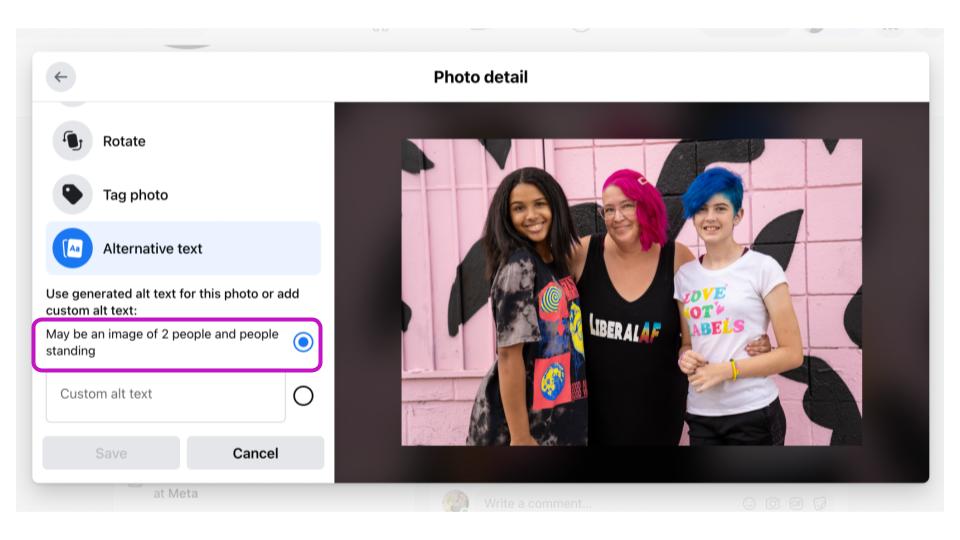
Not only is the automatically generated alt-text void of all context, in this example it miscounts the number of people present. While I can't be certain of why that happened, there have been studies showing that AI was designed with white skin tones in mind, and it's possible my biracial child was not detected by the platform. Yikes.
My Custom Alt-Text for the Above Image Meg Brunson stands with her two eldest children, one on each side of her. All are smiling, in front of a pink and black wall. Meg's shirt says ‘Liberal AF' and one of the kids wears a ‘Love not Labels' shirt.
Best practices:
- Decorative image? Add a space (” “) to the alt field so screen readers skip it.
- Keep it specific and relevant to the context of the post.
- Avoid saying “Image of…” – just describe the image.
- If the image has text, include that text in the caption or alt field.
- Reflect tone and intent. A silly photo can have playful alt text!
- Don’t assume people’s identities. Only describe relevant, observable traits.
Read more about Alt Text best practices.
Remember: Progress > Perfection
You don’t have to do everything right now. Start where you are. Choose one area to improve – maybe it’s your captions this week, or your alt text next week. Bit by bit, you’ll build a brand that feels more welcoming, trustworthy, and aligned with your values.
Because Just Marketing isn’t a one-time checklist – it’s an ongoing commitment to justice.
The Call to Action: Let’s Build a Better Future
If you’ve made it this far – thank you. Seriously. The fact that you’re still here means you care. About your audience, your business, and about building something that’s not just profitable, but just.
So… now what?
Let’s turn awareness into action.
Marketing is one of the most powerful tools we have as entrepreneurs. It shapes how people see the world – and how they see themselves in it. That’s why it’s so important to use that power with intention.
Here’s your roadmap for putting Just Marketing® into practice – starting right where you are.

Step 1: Audit Your Current Practices
Before you overhaul everything, take stock. Where are you doing great? Where could you grow?
Ask yourself:
- Ethics: Is my messaging honest, respectful, and rooted in consent?
- Inclusivity: Does my content resonate with a range of lived experiences?
- Accessibility: Can people of all abilities and processing styles engage with what I create?
This isn’t about shame – it’s about clarity. And clarity is where change begins.
Step 2: Redefine Success
It’s easy to measure likes and clicks. But what about impact?
What if success looked like:
- Comments that say “I feel seen.”
- DMs that say “Thank you for thinking of this.”
- A reputation for care, clarity, and community.
Money still matters – no shame in building wealth – but let’s move beyond vanity metrics and center trust, alignment, and transformation.
Step 3: Align with Your Values
Marketing gets easier (and more joyful) when it’s rooted in what you truly believe. Instead of chasing trends, try this:
- Let your values guide your decisions.
- Be transparent about your commitments.
- Own your mistakes, and share your learnings.
Your audience doesn’t expect perfection. They crave authenticity.
Step 4: Embrace Connection Over Conversion
You don’t have to choose between being kind and being effective.
When you lead with connection – through storytelling, education, and empathy – you create a brand people trust. And trusted brands grow sustainably, without the pushy tactics.
Show your impact. Teach what you know. Tell the real story behind your offers. That’s what builds long-term loyalty.
Step 5: Involve Your Audience
Justice isn’t a solo act. It’s a community effort. The most inclusive brands listen – and they adapt based on what they hear.
Try this:
- Ask for feedback in your emails or social posts.
- Create a short survey asking how you can improve access.
- Respond to DMs and comments with openness and curiosity.
People remember how you made them feel. So make them feel valued – not just marketed to.
Next Steps: Imagine a World Where Just Marketing Is Just Marketing
Picture this:
- A business landscape where ethical practices are the norm – not the niche.
- Where accessibility is built in from the start, not added as an afterthought.
- Where inclusivity isn’t a campaign – it’s your company culture.
In this world, marketing isn’t something people tolerate – it’s something they trust. It feels good to create. And it feels even better to receive.

No gimmicks… or gaslighting… or glossing over harm.
Just real, honest, human connection.
This isn’t a dream. It’s a direction.
And you’re already on the path.
You don’t have to fix everything overnight.
And you don’t need a perfect system or a polished message.
You just need a willingness to do better – and the courage to begin.
Each caption you write with care…
Every image you describe with alt text…
Each voice you uplift or include…
It all matters.
Keep the Movement Going
Just Marketing® isn’t about following a script or a checklist – it’s about building a future. One where all of us, in all our brilliance and complexity, can show up, be seen, and thrive.
So ask yourself:
How will I use marketing as a force for justice this week?
Then: do one small thing.
Share this post.
Audit one page of your website.
Rework your next caption with accessibility in mind.
Ask your community for feedback.
That future is possible. And it starts with us – business by business, post by post, step by step.
The revolution is in the details.
And you're part of it.
Let’s Stay Connected
If this vision resonates with you – let’s keep building it together.