Meg Brunson

  • Let’s GoHome
  • #AllTheThingsAbout Me
  • Read | Listen | WatchContent Library
  • Join TheMembership
  • Let’s WorkTogether

Inclusive Language Guide: Words to Avoid and What to Say Instead

The words we choose can either open doors or reinforce barriers — and as entrepreneurs, creators, and leaders, it's up to us to build spaces where everyone feels seen, respected, and valued. That’s where this Inclusive Language Guide comes in.

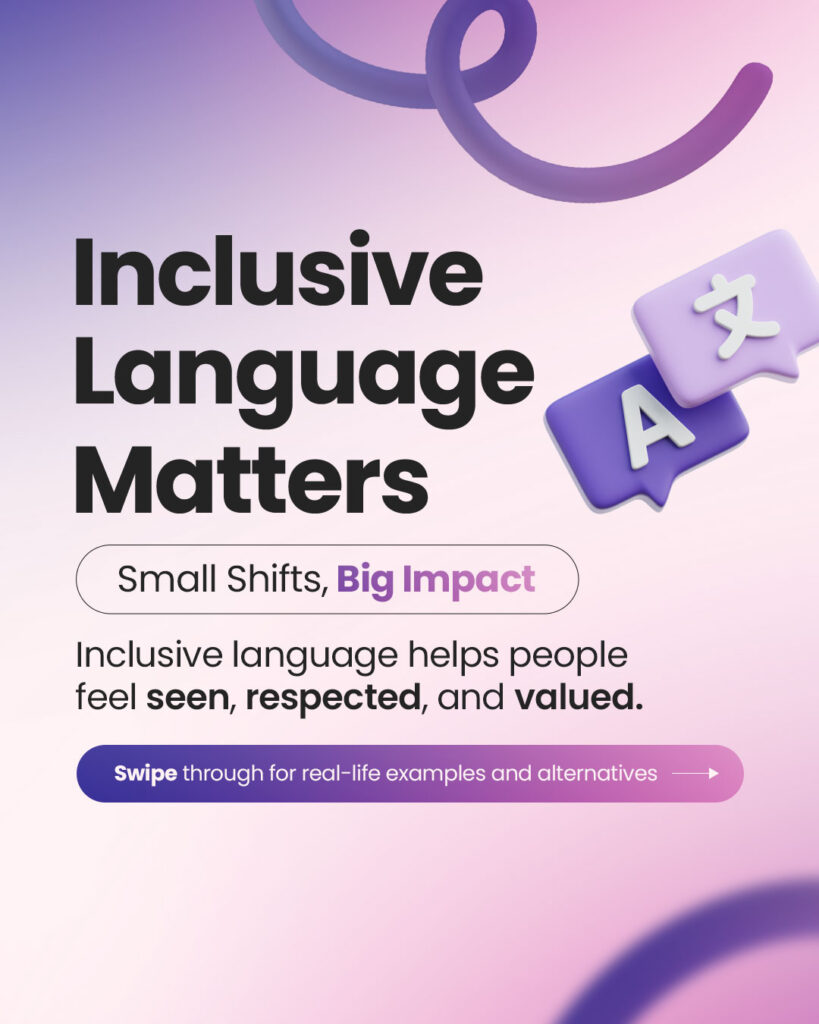
Title: ‘Inclusive Language Matters.’ Subtitle: ‘Small Shifts, Big Impact.’ Text: ‘Inclusive language helps people feel seen, respected, and valued.’ A purple button at the bottom says, ‘Swipe through for real-life examples and alternatives.’ Two speech bubbles with the letter ‘A’ and a Chinese character float to the right. Background is a gradient of purple and pink with abstract loops.

Inclusive language isn't about being “perfect” or walking on eggshells. It's about being intentional, compassionate, and aware of how language shapes the world around us. It's about challenging old systems that hurt people — and using words to build new, better ones.

In this Inclusive Language Guide, you'll find real-world examples of outdated and harmful terms, plus simple, thoughtful alternatives you can start using today. Whether you're writing content, hosting events, chatting with clients, or just updating your website, these small shifts can create a huge impact.

Bookmark this page — I'll keep updating it as language evolves (because growth is a forever thing around here). Plus, I'll link to additional resources if you want to dive deeper into creating truly inclusive, ethical, and accessible communications.

Ready to rethink the way we speak and connect? Let’s get into it!

Prioritize Gender-Inclusive Language

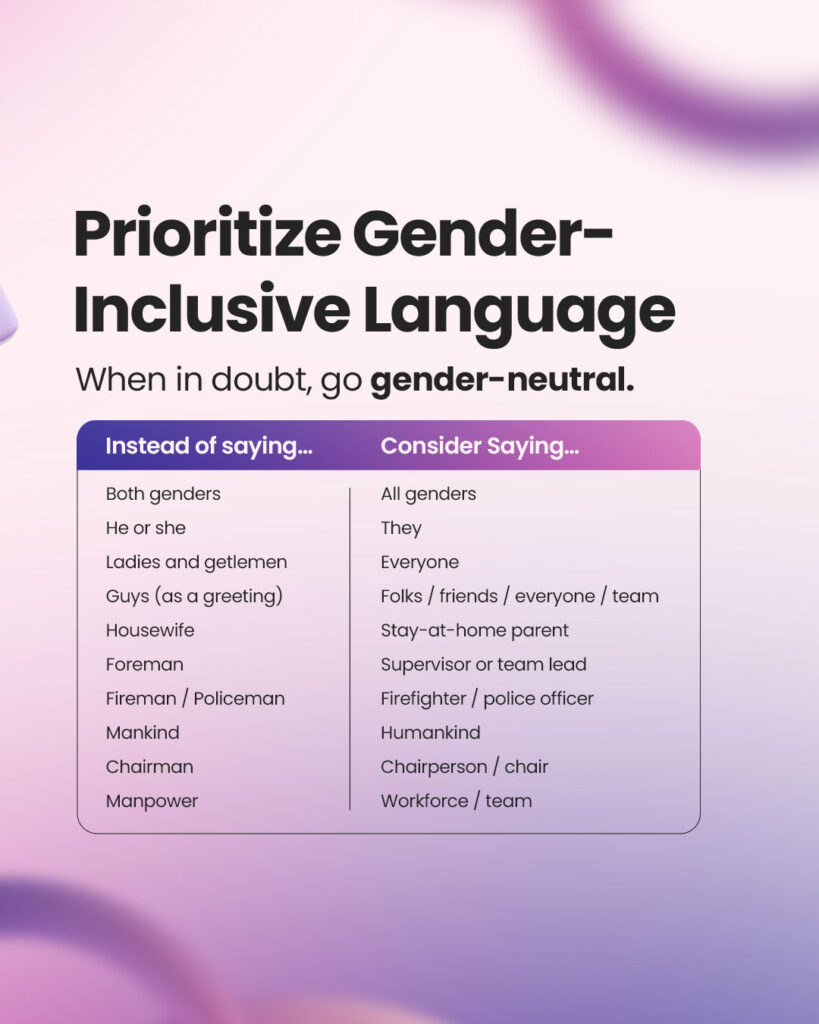
Title: ‘Prioritize Gender-Inclusive Language.’ Subtitle: ‘When in doubt, go gender-neutral.’ A table compares phrases: ‘Instead of saying’ includes terms like ‘Both genders’ and ‘Chairman,’ while ‘Consider Saying’ suggests alternatives like ‘All genders’ and ‘Chairperson/Chair.’ Background features a pink and purple gradient with soft abstract shapes.

For too long, everyday language has centered the gender binary — assuming everyone fits neatly into “male” or “female.” But gender is a spectrum, and using gender-inclusive language helps ensure that everyone, regardless of identity, feels acknowledged and respected.

It’s not just about being “politically correct” — it’s about creating welcoming environments where people don't have to wonder if they belong. Small changes in your greetings, job titles, and descriptions can make a big difference in making your community more inclusive.

Here are some common examples:

Instead of saying:Consider saying:Why it matters:
Both gendersAll gendersRecognizes that not everyone is male or female.
He or sheTheyInclusive of all gender identities.
Ladies and gentlemenEveryone / Distinguished guestsWelcomes all, without gendered expectations.
Guys (as a general greeting)Folks / Friends / Team / EveryoneAvoids male-centered language in mixed groups.
HousewifeStay-at-home parentAcknowledges the role without assuming gender.
ForemanSupervisor / Team LeadUpdates outdated, gendered job titles.
Fireman / PolicemanFirefighter / Police OfficerFocuses on the job, not the gender.
MankindHumankind / HumanityCenters all people, not just men.
ChairmanChairperson / ChairGender-neutral leadership language.
ManpowerWorkforce / TeamInclusive of everyone’s contributions.

Ditch Outdated and Offensive Terms

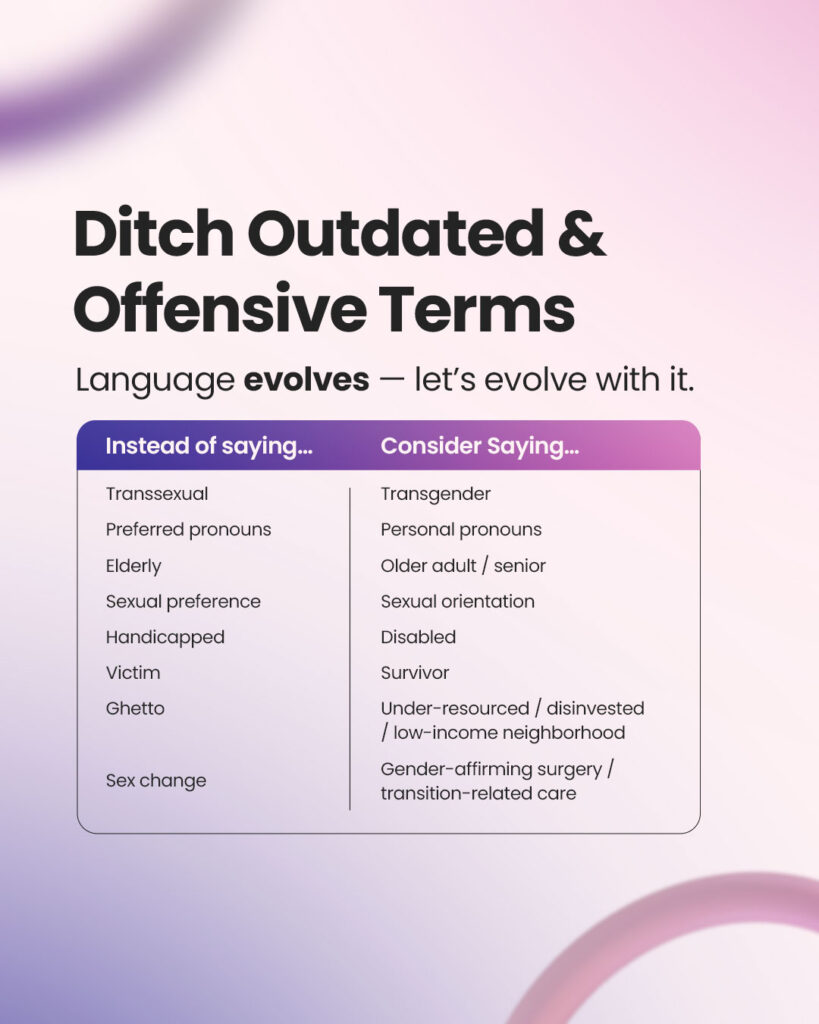
Title: ‘Ditch Outdated & Offensive Terms.’ Subtitle: ‘Language evolves — let’s evolve with it.’ A table contrasts language: ‘Instead of saying’ includes terms like ‘Transsexual’ and ‘Ghetto,’ while ‘Consider Saying’ offers alternatives like ‘Transgender’ and ‘Under-resourced/low-income neighborhood.’ Background is a pink and purple gradient with soft curves.

Language evolves — and that's a good thing. Some words that were once commonly used are now recognized as harmful because they carry histories of stigma, violence, or dehumanization. Updating our language isn’t about policing speech; it’s about showing respect, care, and awareness toward the people we're speaking to and about.

By swapping out outdated terms for more current, affirming alternatives, we send a powerful message: You are seen. You are respected. You belong here.

Here are some common swaps to consider:

Instead of saying:Consider saying:Why it matters:
TranssexualTransgender“Transsexual” is outdated and often pathologizing.
Preferred pronounsPersonal pronouns / PronounsPronouns aren't a preference — they're part of someone's identity.
ElderlyOlder adult / Senior“Elderly” can sound dismissive or patronizing.
Sexual preferenceSexual orientationOrientation is inherent, not a preference.
HandicappedDisabled“Handicapped” is outdated and can feel dehumanizing.
Victim (of trauma or condition)Survivor / Person impacted by [trauma/condition]Centers resilience and agency rather than helplessness.
HermaphroditeIntersex“Hermaphrodite” is outdated, inaccurate, and offensive.
Mentally retardedPerson with an intellectual disabilityReplaces a slur with respectful, people-first language.
Wheelchair-boundWheelchair user / Person who uses a wheelchairHighlights mobility and autonomy, not limitation.
Committed suicideDied by suicide / Lost to suicideReduces stigma by avoiding language of criminality or blame.
Grandfathered / Grandfather clause / GrandfatheringLegacy / Legacy Plan / Existing agreement“Grandfather” references post-slavery laws used to exclude Black Americans from voting.
Master bedroomPrimary bedroom“Master” evokes histories of enslavement and hierarchy.
Blacklist / WhitelistBlocklist / Allowlist / Denylist / SafelistReinforces harmful associations of “black” as bad and “white” as good — racialized coding.

Avoid Assumptive Language

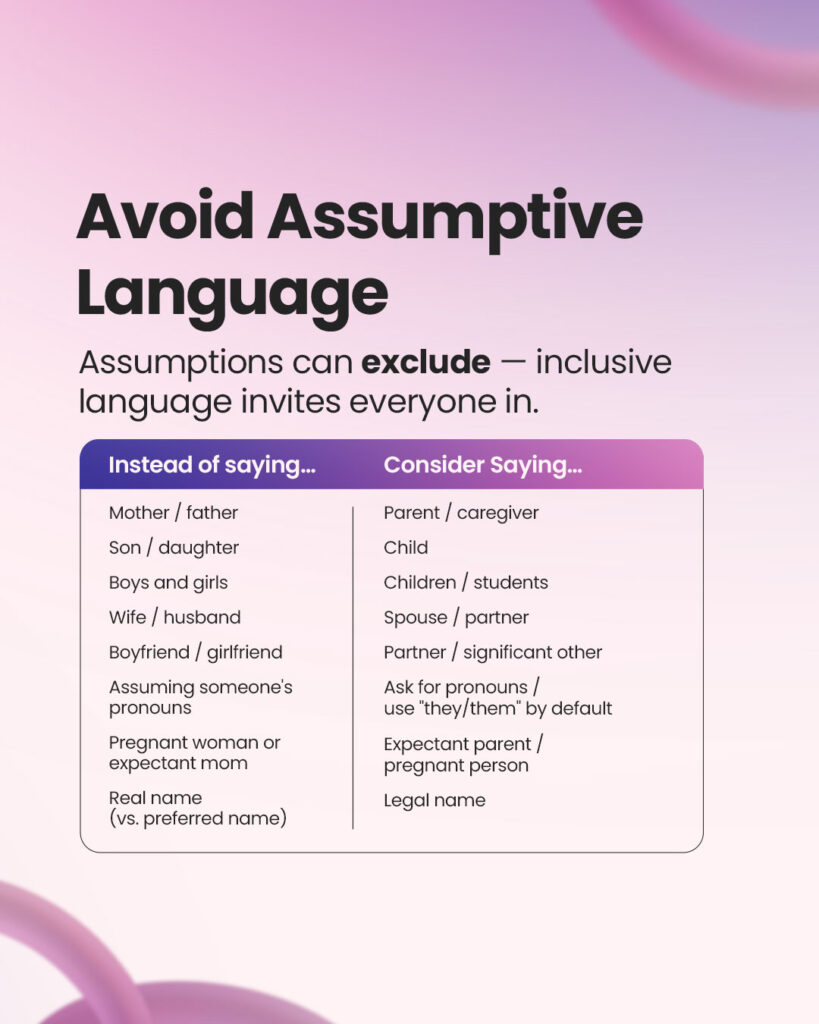
Title: ‘Avoid Assumptive Language.’ Subtitle: ‘Assumptions can exclude - inclusive language invites everyone in.’ A table compares phrases: ‘Instead of saying’ includes terms like ‘Mother/father’ and ‘Boyfriend/girlfriend,’ while ‘Consider Saying’ suggests alternatives like ‘Parent/caregiver’ and ‘Partner/significant other.’ Background features a soft pink and purple gradient with curved accents.

A lot of everyday language quietly makes assumptions about people’s identities, families, abilities, and experiences — often without us even realizing it. When we default to words that assume gender, relationship status, neurotypicality, or family structure, we risk excluding or alienating people whose lives look different from the “default” narratives society has normalized.

Choosing open, non-assumptive language invites more people into our spaces and conversations. It tells your community: You don’t have to fit into a box to belong here.

Here are some examples of assumptions we can rethink:

Instead of saying:Consider saying:Why it matters:
Husband / WifeSpouse / PartnerAvoids assuming gender or marital status.
Mom / DadParent / CaregiverIncludes diverse family structures.
Boys and girlsChildren / Kids / Friends / StudentsWelcomes gender-diverse children.
Son / DaughterChild / Young personSupports non-binary and gender-expansive families.
Boyfriend / GirlfriendPartner / Significant otherInclusive of LGBTQIA+ relationships.
Expecting momsExpecting parents / People who are pregnantNot all pregnant people identify as women.
BreastfeedingChestfeeding / NursingRecognizes and respects gender-diverse parents.
You guys (as a greeting)Y'all / Folks / Team / FriendsMoves away from male-centered defaults.
Real name (on forms)Legal name / Name on IDRespects chosen names, especially for trans and non-binary people.
Preferred pronounsPersonal pronouns / PronounsReflects that pronouns are part of identity, not a preference.

Rethink Ableist Language

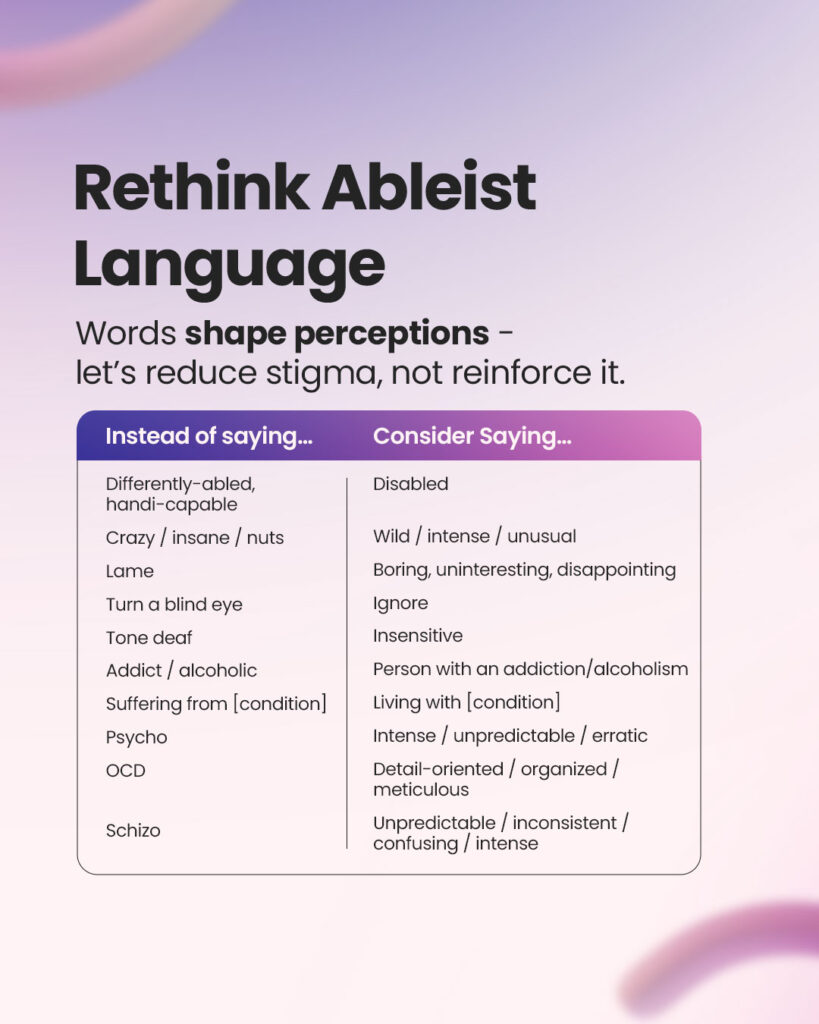
Title: ‘Rethink Ableist Language.’ Subtitle: ‘Words shape perceptions - let’s reduce stigma, not reinforce it.’ A table shows alternatives: ‘Instead of saying’ includes terms like ‘Differently-abled’ and ‘Crazy/insane,’ while ‘Consider Saying’ suggests words like ‘Disabled’ and ‘Wild/intense/unusual.’ Background features a soft purple and pink gradient with curved shapes.

Ableism — discrimination or prejudice against disabled people — shows up in language more often than most of us realize. Words and phrases that frame disability as something negative, pitiful, or broken can be deeply harmful, even when they're used casually or with no bad intent.

By choosing words that honor disability as part of human diversity (instead of something to be “fixed” or “pitied”), we help create a world that's more accessible, respectful, and affirming for everyone. Inclusive language matters not just in disability spaces, but everywhere we show up and communicate.

Here are some examples of ableist terms to rethink:

Instead of saying:Consider saying:Why it matters:
Differently abled / Handi-capableDisabledEuphemisms can feel minimizing — many people proudly identify as disabled.
Crazy / Insane / NutsWild / Intense / Unusual / ImpressiveCasual use of mental health terms stigmatizes real conditions.
LameBoring / Disappointing / Underwhelming“Lame” is ableist and devalues disabled experiences.
Turn a blind eyeIgnore / OverlookAbleist phrase that uses disability as a metaphor for ignorance.
Tone deafInsensitive / Out of touchReduces a sensory condition to a judgment about empathy.
Addict / AlcoholicPerson with a substance use disorder / Person living with alcoholismCenters humanity, not the condition.
Suffering from [condition]Living with [condition]Focuses on agency rather than victimhood.
High-functioning / Low-functioningPerson with support needs / Person who needs minimal supportAvoids ranking or minimizing disabled experiences.
Invalid (referring to disability)Person with a disability“Invalid” implies a person lacks value — deeply harmful framing.
MuteNon-speaking person / Person who uses AACRespectful, accurate descriptions without stigma.
PsychoIntense / Unpredictable / ErraticReduces stigma by avoiding casual use of mental health diagnoses as insults.
OCDDetail-oriented / Organized / MeticulousAvoids trivializing a serious mental health condition by using it casually.
SchizoUnpredictable / Inconsistent / Confusing / Intense“Schizo” is a slur that dehumanizes people living with schizophrenia.

Watch for Cultural Appropriation

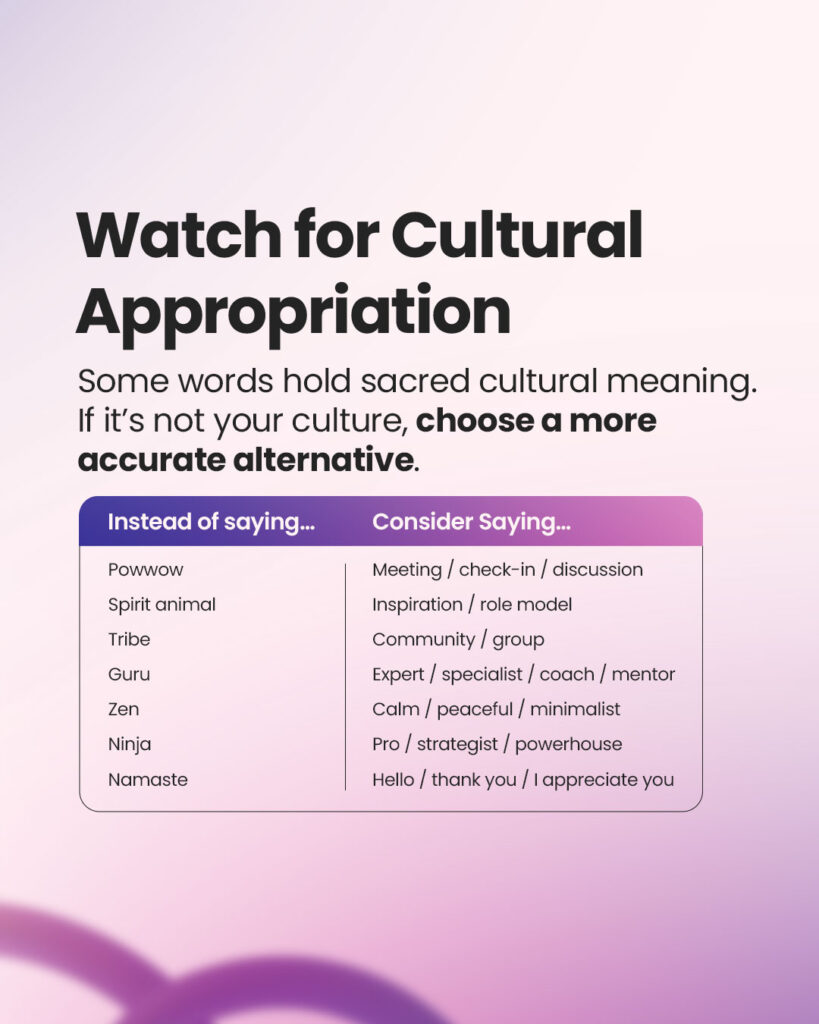
Title: ‘Watch for Cultural Appropriation.’ Subtitle: ‘Some words hold sacred cultural meaning. If it’s not your culture, choose a more accurate alternative.’ A table lists phrases: ‘Instead of saying’ includes terms like ‘Powwow’ and ‘Guru,’ while ‘Consider Saying’ suggests alternatives like ‘Meeting’ and ‘Expert.’ Background is a soft gradient of pink and purple with abstract curves.

Culture is not a costume, a brand aesthetic, or a buzzword. When words, symbols, or traditions from marginalized cultures are borrowed without understanding or respect — especially for profit or trendiness — it’s cultural appropriation.

Using culturally significant language or practices without proper context can feel disrespectful, erase important histories, and reinforce harm against the very communities from which they came. Being mindful helps ensure we're appreciating cultures — not exploiting them.

Here are some commonly appropriated terms and respectful alternatives:

Instead of saying:Consider saying:Why it matters:
Spirit animalInspiration / Role model / Inner guide“Spirit animal” holds sacred meaning in many Indigenous cultures.
Tribe (e.g., my biz tribe)Community / Group / Circle“Tribe” has deep cultural and political significance for Indigenous peoples.
Powwow (for meetings)Gathering / Meeting / Check-inPowwows are ceremonial events, not casual business meetings.
Guru (in business marketing)Expert / Specialist / Mentor“Guru” is a revered spiritual title in Hinduism and Sikhism.
Chief (e.g., marketing chief)Lead / Director / Head“Chief” is a leadership title with deep Indigenous roots.
Zen (as slang)Calm / Minimalist / PeacefulZen is a sacred Buddhist tradition, not just a vibe.
Ninja (e.g., marketing ninja)Pro / Strategist / ExpertUsing “ninja” casually erases cultural and historical meaning.
ShamanHealer / Energy worker (unless referring accurately to Indigenous traditions)“Shaman” is a specific spiritual role, not a general healer.
Namaste (casually)Hello / Thank you / I appreciate you“Namaste” is a sacred greeting — not just a trendy sign-off.
Samurai (as metaphor)Loyal / Protector / DedicatedAvoid reducing historical identities into casual metaphors.

Question Normative Language

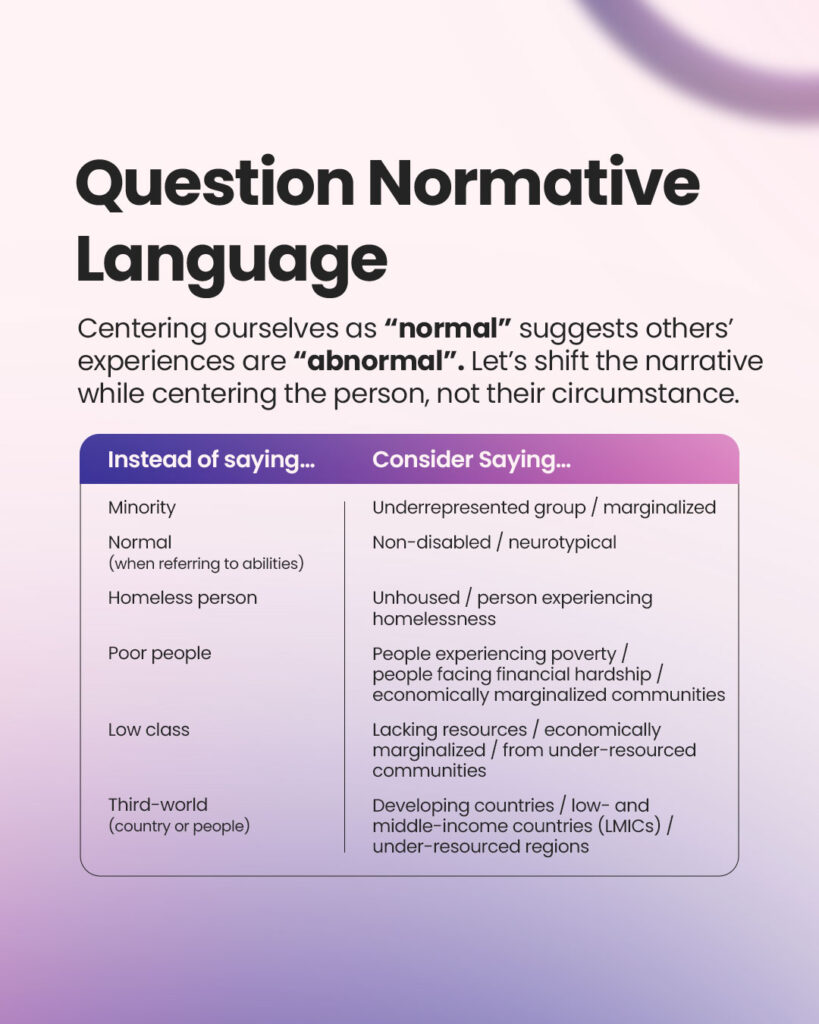
Title: ‘Question Normative Language.’ Subtitle encourages centering people, not circumstances. A table compares phrases: ‘Instead of saying’ includes terms like ‘Minority’ and ‘Homeless person,’ while ‘Consider Saying’ suggests ‘Underrepresented group’ and ‘Person experiencing homelessness.’ Background features a soft purple and pink gradient with abstract curves.

Normative language reflects and reinforces dominant cultural norms — often unintentionally positioning anything outside those norms as “less than” or “abnormal.” This can quietly uphold systems of oppression, create feelings of exclusion, and perpetuate harmful stereotypes.

By choosing words that recognize diversity as natural and valuable, we can challenge these harmful defaults and build more affirming, inclusive spaces.

Here are some common examples of normative language to rethink:

Instead of saying:Consider saying:Why it matters:
MinorityUnderrepresented group / Marginalized“Minority” reinforces the idea of being less than or “othered” and centers whiteness or dominant groups as the norm.
Normal (when referring to abilities)Non-disabled / Neurotypical“Normal” implies that disabled or neurodivergent people are abnormal, reinforcing harmful stereotypes.
Homeless personUnhoused person / Person experiencing homelessnessCenters the person, not their housing status — language that reduces stigma.
Poor peoplePeople experiencing poverty / People with low income / Economically marginalized communities / People facing financial hardshipAvoids defining people by economic status and focuses on systemic issues, not personal failure.
Low ClassLacking resources / Economically marginalized / From under-resourced communities“Low class” is dehumanizing and rooted in elitism and classism.
Third-World (country or people)Developing countries / Low- and middle-income countries (LMICs) / Under-resourced regions“Third-world” is outdated, colonial, and inaccurately frames countries as inferior.

Be Trauma-Informed

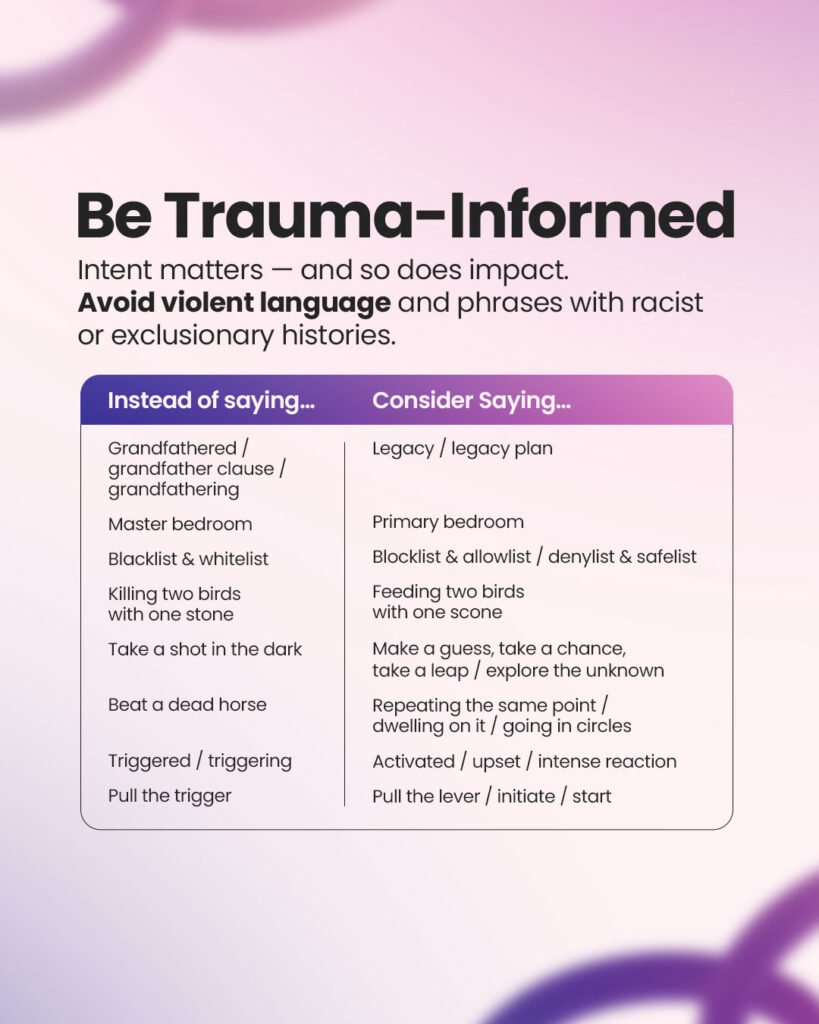
Title: ‘Be Trauma-Informed.’ Subtitle: ‘Intent matters - and so does impact. Avoid violent language and phrases with racist or exclusionary histories.’ A table contrasts language: ‘Instead of saying’ includes terms like ‘Grandfathered’ and ‘Master bedroom,’ while ‘Consider Saying’ suggests alternatives like ‘Legacy’ and ‘Primary bedroom.’

When we communicate, we don't always know what someone’s been through — and language that feels harmless to one person might be activating or retraumatizing to someone else. A trauma-informed approach to language centers choice, agency, and emotional safety.

It's not about walking on eggshells — it’s about leading with compassion and creating spaces where people can engage without feeling forced, shamed, or re-exposed to harm. Using trauma-informed language helps us build more supportive, human-centered communities.

Here are some common trauma-insensitive phrases and what you can say instead:

Instead of saying:Consider saying:Why it matters:
Triggered / Triggering (casually)Activated / Upset / Intense reactionKeeps clinical terms respectful and avoids minimizing trauma.
Safe space (if not fully safe)Brave space / Supportive environmentAcknowledges that safety is co-created and not guaranteed.
Suffering from traumaLiving with trauma / Trauma survivorCenters agency and resilience instead of helplessness.
Let’s dive deepLet’s explore this / We'll go at your pace“Diving” language can feel forceful or overwhelming.
Push past your fearWork with the fear / Move gently through fearRespects pacing and emotional autonomy.
This will transform your lifeThis might support you / You may find this helpfulAvoids unrealistic or high-pressure promises.
No excuses / Show up no matter whatHonor your capacity / You’re welcome as you areReduces shame and acknowledges differing energy levels.
You’re broken and need fixingYou are whole / Let’s build on your strengthsAffirms worthiness rather than framing people as broken.
Committed suicideDied by suicide / Lost to suicideReduces stigma by moving away from criminalized language.
HystericalUpset / Distressed / Activated“Hysterical” is rooted in sexist, pathologizing language.
Killing Two Birds with One Stone
Feeding two birds with one scone
Avoids violent imagery and promotes more gentle, life-affirming metaphors.
Take a Shot in the DarkMake a guess, take a chance, take a leap, explore the unknownRemoves references to guns and shooting, reducing violent metaphors.
Beat a Dead Horse
Repeating the same point, dwelling on it, going in circlesAvoids disturbing, violent imagery and focuses on the behavior, not harm.

Inclusive Language Guide: Next Steps

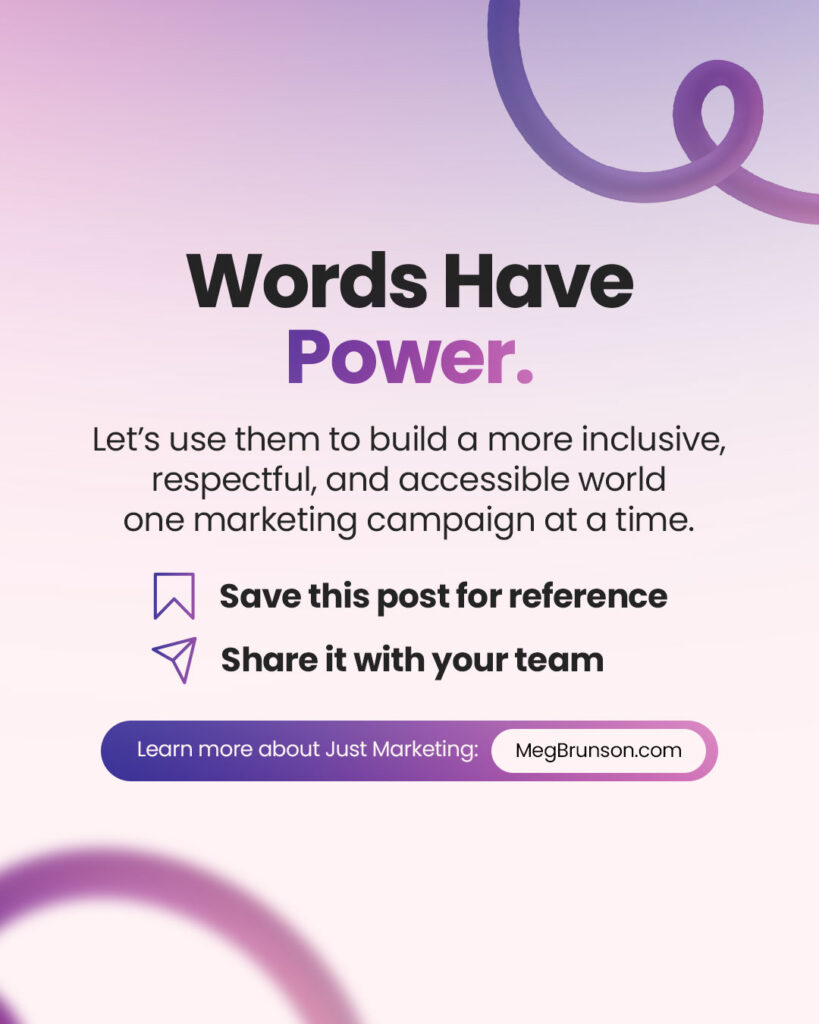
Title: ‘Words Have Power.’ Text: ‘Let’s use them to build a more inclusive, respectful, and accessible world one marketing campaign at a time.’ Icons with text encourage readers to ‘Save this post for reference’ and ‘Share it with your team.’ A button at the bottom reads, ‘Learn more about Just Marketing: MegBrunson.com.’ Background features a pink and purple gradient with abstract loops.

Language isn’t fixed — it grows, it shifts, and it adapts as we learn and unlearn. And that’s a good thing. Choosing inclusive, trauma-informed, and respectful language isn’t about being perfect; it’s about being present, mindful, and willing to do better when we know better.

Small changes in our everyday words can have a powerful ripple effect — building trust, deepening connections, and creating spaces where more people feel welcome, valued, and safe.

This Inclusive Language Guide is just the beginning. I'll be updating it regularly as language continues to evolve and as I learn from the communities leading the way.

Bookmark this page so you can come back anytime you want to check your language or refresh your approach.

And if you're ready to dive deeper, check out these resources on inclusive marketing and communication for even more ways to level up your impact:

  • Your Words Matter — Just Marketing® Inclusive Language 101
  • Marketing Representation Matters: How to Get It Right
  • Inclusive Messaging: Marketing To A Diverse Audience & What To Do When You Mess Up

Together, we can make our words — and our work — part of the movement for justice, equity, and accessibility! 💕

Subscribe to the Newsletter

Categories: All Categories, Content Marketing, Just Marketing®

Tags: Accessible Marketing, Blogging Strategy, Core Content, Email Marketing, Ethical Marketing, Inclusive Marketing, Promotional Content, Social Media Strategy, Values-Aligned Promotions

Prev
Next

About Meg Brunson

Online marketing authority and former Facebook employee Meg Brunson combines their mission to build a more accessible and inclusive world, with their expertise in the digital marketing space.

Meg is on a mission to disrupt the status quo of marketing so that financial success is the byproduct of a genuine commitment to justice, rather than an end goal in itself.

Through Meg’s signature approach, Just Marketing®, businesses are implementing ethical, inclusive, and accessible marketing campaigns that make a positive impact on society and their bottom line, creating a virtuous cycle where profitability and responsible practices reinforce each other.

Meg is a professional speaker, children’s book author, host of the Just Marketing® podcasts, CMO of BetterCEO.app and CEO of Just Marketing®.

Follow me on Instagram @theMegBrunson
Manageable - not stressful. That's the vibe we're Manageable - not stressful.

That's the vibe we're going for over here - and Michelle said it better than I ever could.

Marketing can feel this way. Let me show you…

Comment, DM, or learn more at YourMarketingPerson.co 

ID: A testimonial from Michelle T. reads: 'Meg brings together creativity, strategy, organization, and follow-through in a way that makes marketing feel manageable instead of stressful. I recommend her to any business looking for a skilled, values-aligned marketing partner.' Michelle is smiling in the background. YourMarketingPerson.co

#JustMarketing #EquityForAll #a11y #EquityCenteredBusiness #DiversityInMarketing #SocialJustice #RacialJustice #BeTheChange #DismantleWhiteSupremacy #DiversityEquityInclusion #EthicalMarketing #InclusiveMarketing #AccessibleMarketing #MarketingAccessibility #SocialMediaMarketer #EthicalBusiness #MarketingCoach #CommunityOverCompetition #MarketingWithPurpose #MarketingWithImpact #DEI #DEIMarketing #SocialMediaForAll #ContentCreation #ContentMarketing #ContentMarketingMembership #WeeklySocialContent  #MarketingWithADHD #adhdBusiness #adhdBusinessOwner
Here are five ways to shift your marketing toward Here are five ways to shift your marketing toward messaging that's genuinely empowering, trust-building, and consent-based:

1. Affirm Without Inflating
There's a big difference between "You're a total rockstar who was BORN for this transformation!" and "If you've been looking for support that aligns with your values, this might be it." One tells people who they are. The other meets them where they actually are.

2. Center Autonomy and Consent
Instead of telling your audience they're ready, invite them to decide for themselves. "You know yourself best. If this feels like a fit, I'd love to support you."

3. Empower Without Pressure
Encouragement that says "your work matters whether you buy from me or not" builds genuine trust. 

4. Honor Neurodiversity + Emotional Safety
Not everyone responds well to high-emotion, high-intensity language - choose calm and clear over hype and overwhelm. 

5. Let the Value Speak for Itself
Share real benefits. Tell honest stories. Trust that the right-fit clients will recognize themselves in your words -  not because you told them they were "destined" for it, but because they genuinely felt seen and respected.

These suggestions are not just "nicer" marketing. They're smarter marketing. They build the kind of relationships that lead to referrals, retention, and a reputation you're actually proud of.

And isn't that the whole point?

I share more at: MegBrunson.com/love-bombing

Which of these five shifts feels most relevant to where you are right now?

ID: 'Instead of Love Bombing,' five numbered alternatives are listed: 1) 'Affirm Without Inflating,' 2) 'Center Autonomy and Consent,' 3) 'Empower Without Pressure,' 4) 'Honor Neurodiversity and Emotional Safety,' and 5) 'Let the Value Speak for Itself.' Watercolor hearts in shades of pink and red.

#JustMarketing #EquityForAll #EquityCenteredBusiness #EthicalMarketing #OnlineBusinessMarketing #EthicalBusiness #MarketingWithADHD #ContentMarketing #ContentMarketingMembership #WeeklySocialContent #a11y #ContentStrategy #InclusiveMarketing #AccessibleMarketing #ContentCreation
Struggling to establish your authority and credibi Struggling to establish your authority and credibility online?
An inconsistent online presence might be the culprit.

Symptoms include:
– Sporadic posting
– Unclear branding
– Disjointed messaging

These issues can significantly impact your authority and credibility, leading to missed opportunities for networking, collaboration, and growth.

You’re not broken.
Your systems just weren’t built for you.

You need a system - designed to support neurodivergent brains and values-led business owners - that meets you where you’re at.

Including:
 – A flexible monthly content calendar
 – Ethical, inclusive, customizable prompts
 – Built-in ways to repurpose content so you’re not starting from scratch

Learn more: ContentMarketingMembership.com

ID: A paper that looks like a doctor's prescription pad. Diagnosis is inconsistency. The prescription is for the Content Marketing Membership. Background is light pink with dark pink crosses, a medical theme.

 #JustMarketing #EquityForAll #a11y #EquityCenteredBusiness #DiversityInMarketing #SocialJustice #RacialJustice #BeTheChange #DismantleWhiteSupremacy #DiversityEquityInclusion #EthicalMarketing #InclusiveMarkeitng #AccessibleMarketing #MarketingAccessibility #SocialMediaMarketer #EthicalBusiness #MarketingCoach #CommunityOverCompetition #MarketingWithPurpose #MarketingWithImpact #DEI #DEIMarketing #SocialMediaForAll #ContentCreation #ContentMarketing #ContentMarketingMembership #WeeklySocialContent  #MarketingWithADHD #adhdBusiness #adhdBusinessOwner
Love bombing in marketing isn't just "a little cri Love bombing in marketing isn't just "a little cringe" - it's actually harmful.

A lot of this language gets passed down through traditional sales training as "high-vibe" or "empowering." But when we look closer? The impact tells a different story.

1. Flooding someone with praise to trigger a buying decision isn't connection, it's coercion. Even when the words sound kind, if the goal is to override someone's boundaries and get them to say yes before they're ready? That's manipulation. Full stop.

2. For people who've experienced emotionally manipulative or abusive relationships, love bombing in marketing doesn't just feel uncomfortable, it can be genuinely triggering. It mirrors the same dynamics they've already had to survive.

3. When someone realizes all that validation was just a setup for a pitch, the trust evaporates. And trust is the entire foundation of sustainable, values-aligned client relationships.

Short-term conversions built on manipulation don't grow businesses. They burn bridges.

This isn't about shame - it's about awareness and the willingness to do better.

Your audience doesn't need to be love-bombed into trusting you. 

When your marketing is honest, clear, and genuinely respectful, the right-fit people will find you… and they'll stay.

Read the blog - MegBrunson.com/love-bombing - It covers all of this plus what to do instead of love bombing in your copy.

Which of these three impacts surprised you most?

ID: 'Love Bombing is problematic.' Three broken heart emojis mark the reasons: 'Emotionally Manipulative,' 'Not Trauma-Informed,' and 'Undermines Trust.' The Just Marketing logo appears at the bottom on a light gray background bordered by shiny purple fabric hearts.

#JustMarketing #EquityForAll #MarketingWithHeart #EquityCenteredBusiness #DiversityEquityInclusion #EthicalMarketing #OnlineBusinessMarketing #EthicalBusiness #OnlineMarketingTips #DEI #MarketingWithADHD #ContentMarketing #ContentMarketingMembership #WeeklySocialContent #a11y #InclusiveMarketing #AccessibleMarketing #SocialMediaForAll #ContentCreation
Love bombing is designed to trigger an emotional r Love bombing is designed to trigger an emotional response. 

It floods your nervous system with validation, and then attaches those feelings to a buying decision. So by the time you're reaching for your wallet, it doesn't feel like pressure… it feels like clarity.
But it's not clarity. 

It's a manufactured moment of emotional intensity.

And for folks who've navigated burnout, rejection sensitivity, or trauma… emotionally manipulative marketing doesn't just feel bad - it can cause real harm by mirroring dynamics they've already had to fight their way out of.

Just Marketing® exists because I believe marketing can be better. 

More actually-kind… not performatively kind.

You deserve marketing that respects your autonomy enough to let you decide if something is a fit -  without being emotionally maneuvered into it.

Read more on the topic: MegBrunson.com/love-bombing

What's your gut reaction to love bombing in marketing? 
I'd love to hear your thoughts in the comments.

ID: 'Love Bombing isn't about seeing someone's potential, it's about using praise to pressure them into action.' The Just Marketing logo appears below the text, displayed inside a white decorative lace doily frame on a pink background patterned with hand-drawn hearts.

#JustMarketing #EquityForAll #MarketingWithHeart #MarketingWithIntegrity #EquityCenteredBusiness #SocialJustice #AlignedBusiness #BeTheChange #DismantleWhiteSupremacy #DiversityEquityInclusion #EthicalMarketing #OnlineBusinessMarketing #EthicalBusiness #OnlineMarketingTips #DEI #ValuesMatter #MarketingWithADHD #adhdBusiness #adhdBusinessOwner #ContentMarketing #ContentMarketingMembership #WeeklySocialContent #a11y #ContentStrategy #InclusiveMarketing #AccessibleMarketing #DEIMarketing #SocialMediaForAll #ContentCreation
Love bombing in marketing isn't always obvious. Love bombing in marketing isn't always obvious. 

It doesn't always look like a pushy sales bro screaming "LIMITED TIME OFFER.” 

Sometimes it shows up softly - wrapped in spiritual language, coated in empowerment rhetoric, or disguised as a coach who really believes in you.

Here's what to watch for:
– Language that tells you who you are rather than inviting you to reflect 
– Compliments that seem designed to make you feel obligated to say yes 
– Praise that shows up right before (or during) a pitch

The goal of ethical, Just Marketing® isn't to strip the warmth out of your messaging. It's to make sure the warmth is real - rooted in genuine care, not conversion tactics.

Your audience can feel the difference. And the ones you actually want to work with? They're looking for someone they can trust - not someone who makes them feel temporarily amazing and then asks for their credit card.

Real connection doesn't need to manufacture emotional dependency. It builds naturally, over time, through honesty and respect. 

Want to understand love bombing in marketing more deeply - including why it's especially problematic for neurodiverse and trauma-impacted communities? 

Read about it: MegBrunson.com/love-bombing

And then come back here and tell me: has any of this show up in marketing you've encountered recently?

ID: 'Love Bombing' is defined through three overlapping hearts labeled 'excessive praise,' 'inflated compliments,' and 'positive attention,' followed by the phrase '...used to create emotional dependency or fast-track trust.' The Just Marketing logo appears at the bottom on a white background scattered with pink hearts.

#JustMarketing #EquityForAll #MarketingWithHeart #MarketingWithIntegrity #EquityCenteredBusiness #DiversityEquityInclusion #EthicalMarketing #OnlineBusinessMarketing #EthicalBusiness #OnlineMarketingTips #DEI #ValuesMatter #MarketingWithADHD #ContentMarketing #ContentMarketingMembership #WeeklySocialContent #a11y #ContentStrategy #InclusiveMarketing #AccessibleMarketing #DEIMarketing #SocialMediaForAll #ContentCreation
You may have heard of “love bombing” in the contex You may have heard of “love bombing” in the context of toxic relationships, but it shows up in marketing too.

Love bombing in marketing is when brands flood you with over-the-top praise, inflated compliments, and feel-good validation... all designed to fast-track your trust and nudge you toward a "yes" before you're actually ready.

It sounds like:
– "You're clearly meant for more - don't waste your potential by saying no."
– "I only work with soul-aligned visionaries, and I just KNOW that's you."
– "You're so ready for the next level. Why wait?"

A lot of marketers aren't doing this on purpose. It gets taught as "high-vibe connection" in traditional sales spaces. But good intentions don't cancel out harmful impact.

And for neurodiverse folks, people navigating burnout, or anyone with a history of emotionally manipulative relationships… This kind of language can be genuinely triggering, not just uncomfortable.

Your audience deserves to feel seen and respected -  not love-bombed into a buying decision.

Read more: MegBrunson.com/love-bombing 

And I want to hear from you: Have you ever noticed love bombing in marketing… either in someone else's content or (no judgment!) in your own?

ID: 'Love Bombing: Over-the-Top Praise Isn't as Kind as It Seems.' A cartoon pink bomb with a red heart and a sparkling lit fuse sits in front of a glowing white heart outline on a pastel pink and purple gradient background with sparkles.

#JustMarketing #EquityForAll #MarketingWithHeart #MarketingWithIntegrity #EquityCenteredBusiness #SocialJustice #AlignedBusiness #BeTheChange #DismantleWhiteSupremacy #DiversityEquityInclusion #EthicalMarketing #OnlineBusinessMarketing #EthicalBusiness #OnlineMarketingTips #DEI #ValuesMatter #MarketingWithADHD #adhdBusiness #adhdBusinessOwner #ContentMarketing #ContentMarketingMembership #WeeklySocialContent #a11y #ContentStrategy #InclusiveMarketing #AccessibleMarketing #DEIMarketing #SocialMediaForAll #ContentCreation
When we talk about the EIEIO Marketing Framework - When we talk about the EIEIO Marketing Framework - a lot of people think Engage and Interact sound like the same thing, but they're not - and understanding the difference can really change how you approach your time on social media.

* Engaging your ideal audience is about showing up for the people you want to serve (your ideal clients).

* Interacting with relevant accounts is about showing up alongside the people who influence, serve, or exist in the same ecosystem as your ideal clients.

When building your interaction list, consider:
-- Complementary service providers who serve the same audience
-- Thought leaders or educators your ideal clients follow and trust
-- Organizations or communities your ideal clients are part of
-- Potential collaborators, podcast hosts, or referral partners
-- Accounts that are already creating content your ideal clients love

When you interact consistently with these accounts - a few things start to happen:
-- Their audience sees your name. Repeatedly. In a positive context.
-- The account owner notices you. Relationships form. Collaborations become possible.
-- You become part of a larger ecosystem, rather than a lone voice posting into the void.

The more genuinely you support others in your ecosystem, the more you become a recognized, trusted presence in the spaces your ideal clients already inhabit. That’s visibility through community. And when we lift each other up, everyone benefits.

Your Challenge This Week:
Identify 3-5 accounts in your ecosystem that you're not currently interacting with regularly. Follow them, and engage with their content authentically. The relationships you build through consistent interaction often turn into collaborations, referrals, and friendships you didn't see coming. Show up with no agenda and see what grows!

Comment or DM:
Has "Interact" been on your radar, or is this a missing piece for you?

ID: Meg is smiling with long pink hair wearing a black tank top with pink lettering reading 'Angry Liberal Feminist Killjoy.' Their arm is covered in colorful tattoos. They accessorize with rainbow bracelets. Trees and urban buildings are visible behind them.
Credentials aren't the villain. I want to be real Credentials aren't the villain.

I want to be really clear about that because this conversation can feel uncomfortable, especially if you've worked hard for your experience, your certifications, and your results.

You should share those things. Your audience deserves to know you know your stuff.

But there's a difference between building genuine credibility and performing authority in a way that manipulates, excludes, or overwhelms the people you're trying to serve.

So let's make it practical. Here's the swap:

1. Instead of leading with extreme, cherry-picked success stories... Try sharing client transformations with honest context -  who it worked for, how, and why.

2. Instead of inflated claims designed to impress... Try transparency about your actual journey, including the learning edges.

3. Instead of hype-heavy messaging that creates urgency and pressure... Try relatable stories that help your audience see themselves in your work.

These aren't just "nicer" ways to market. They're more effective -  because they build the kind of trust that actually converts, without leaving people feeling manipulated or excluded after the fact.

Read more: MegBrunson.com/authority-bias

Which of these three swaps feels most relevant to where you are right now in your marketing?

ID: 'Authority is not the problem... it's how we use it that deserves our attention.' Three pairs of thumbs-down and thumbs-up labels contrast approaches: 'extreme examples of success v. client transformations with context,' 'inflated claims v. transparency about your journey,' and 'hype-heavy messaging v. relatable stories.'

#JustMarketing #EquityForAll #EquityCenteredBusiness #SocialJustice #AlignedBusiness #DiversityEquityInclusion #EthicalMarketing #OnlineBusinessMarketing #EthicalBusiness #OnlineMarketingTips #DEI #MarketingWithADHD #adhdBusiness #adhdBusinessOwner #ContentMarketing #ContentMarketingMembership #WeeklySocialContent #a11y #ContentStrategy #InclusiveMarketing #AccessibleMarketing #SocialMediaForAll #ContentCreation
Growth doesn't have to come at the cost of your me Growth doesn't have to come at the cost of your mental health or your bandwidth. 

The right marketing support should help you expand your capacity, not drain it.

If you're ready for results that feel good and work well, I'd love to connect. 

Comment, DM, or learn more at YourMarketingPerson.co

ID: A testimonial from Michelle T. reads: 'Bringing Meg on was one of the best decisions I made... I doubled my group class offerings and increased demand for 1:1 sessions, while feeling less overwhelmed by marketing.' Michelle is smiling and kneeling outdoors with three dogs beside her. YourMarketingPerson.co

 #JustMarketing #EquityForAll #a11y #EquityCenteredBusiness #DiversityInMarketing #SocialJustice #RacialJustice #BeTheChange #DismantleWhiteSupremacy #DiversityEquityInclusion #EthicalMarketing #InclusiveMarketing #AccessibleMarketing #MarketingAccessibility #SocialMediaMarketer #EthicalBusiness #MarketingCoach #CommunityOverCompetition #MarketingWithPurpose #MarketingWithImpact #DEI #DEIMarketing #SocialMediaForAll #ContentCreation #ContentMarketing #ContentMarketingMembership #WeeklySocialContent  #MarketingWithADHD #adhdBusiness #adhdBusinessOwner
Name-dropping. Revenue flexing. Credential overloa Name-dropping.
Revenue flexing.
Credential overloading.

We've been taught this is what authority looks like… But a lot of it is just authority bias - a psychological shortcut that nudges people to trust you before you've actually earned it.

And when those signals are inflated or inaccessible? 

It's not just manipulative. It quietly tells entire communities of entrepreneurs that their expertise doesn't count.

Prestigious degrees, elite networks, and revenue milestones aren't equally accessible to everyone. 

Neurodivergent entrepreneurs, BIPOC business owners, disabled creatives -  many hold deep, hard-earned expertise that simply doesn't look flashy on a bio. 

When we only recognize authority in one narrow, traditional form, we're quietly telling everyone else their experience doesn't count.

It does. 

I’m unpacking how authority bias shows up in marketing -  and what the Just Marketing® alternative looks like on the blog…

Check it out and let me know what resonates: MegBrunson.com/authority-bias

Which of these four tactics bothers you the most when you see it in someone's marketing?

ID: 'Authority Bias: A psychological shortcut that makes people more likely to believe or buy from someone who seems like an expert.' Four items follow: 'Name-dropping big brands,' 'Overloading bios with degrees, certifications, or awards,' 'Highlighting revenue milestones,' and 'Sharing cherry-picked client wins.' The Just Marketing logo appears on a pink to purple gradient background.

#JustMarketing #EquityForAll #MarketingWithHeart #MarketingWithIntegrity #EquityCenteredBusiness #SocialJustice #AlignedBusiness #BeTheChange #DismantleWhiteSupremacy #DiversityEquityInclusion #EthicalMarketing #OnlineBusinessMarketing #EthicalBusiness #OnlineMarketingTips #DEI #ValuesMatter #MarketingWithADHD #adhdBusiness #adhdBusinessOwner #ContentMarketing #ContentMarketingMembership #WeeklySocialContent #a11y #ContentStrategy #InclusiveMarketing #AccessibleMarketing #DEIMarketing #SocialMediaForAll #ContentCreation
If you’re building a business while also unlearnin If you’re building a business while also unlearning perfectionism, healing from burnout, or navigating a neurodivergent brain - this is your reminder:

~ Rest is not failure.
~ Pausing is not quitting.
~ You are still making progress, even when you slow down.

Just Marketing® isn’t about pushing through at all costs.

It’s about creating systems that work with your energy, your values, and your capacity.

So if you’re tired today, rest. 
The work will still be here. 
And so will your impact.

ID: Text over an image of a rumpled bed with pillows, tinted with a pink and purple gradient. The text reads: ‘she believed she could, but she was tired, so she rested. ...and you know what? the world went on and it was okay. she will try again tomorrow.'

 #JustMarketing #EquityForAll #a11y #EquityCenteredBusiness #DiversityInMarketing #SocialJustice #RacialJustice #BeTheChange #DismantleWhiteSupremacy #DiversityEquityInclusion #EthicalMarketing #InclusiveMarkeitng #AccessibleMarketing #MarketingAccessibility #SocialMediaMarketer #EthicalBusiness #MarketingCoach #CommunityOverCompetition #MarketingWithPurpose #MarketingWithImpact #DEI #DEIMarketing #SocialMediaForAll #ContentCreation #ContentMarketing #ContentMarketingMembership #WeeklySocialContent  #MarketingWithADHD #adhdBusiness #adhdBusinessOwner
Follow on Instagram


Links

CMM Log In
Mission, Vision, & Values

DEI Statement
Leadership Philosophy
Community Agreements
Press & Media


Beliefs

Black lives matter.
Love is love.
Abortion is healthcare.
No human is illegal.
Free Palestine.
I also Believe…

Circular badge has the name "Meg" in the middle and is surrounded by: "CEO, author, speaker, marketer, leader, & advocate"

Let’s Connect

  • facebook-official
  • instagram
  • bluesky
  • linkedin
  • youtube-play
  • email
Copyright © 2026|All Rights Reserved|Meg Brunson, LLC| Privacy & Terms