Meg Brunson

  • Let’s GoHome
  • #AllTheThingsAbout Me
  • Read | Listen | WatchContent Library
  • Join TheMembership
  • Let’s WorkTogether

Marketing Accessibility Isn’t Optional: 4 Ways to Remove Access Barriers from Your Offers

If your business is rooted in justice, equity, and inclusion, then marketing accessibility is a non-negotiable.

The gist: Marketing accessibility means intentionally reducing barriers that keep people from understanding or buying your offers, from confusing pricing to hard-to-read visuals. Small shifts, like simplifying your pricing and giving people time to decide, make your offers more welcoming and easier for everyone to say yes to.

And yet, so many service-based entrepreneurs unintentionally create offers that leave people behind. Whether it’s confusing pricing, sensory-overloading visuals, scarcity tactics that induce panic, or paywalled community access  –  these common practices create real barriers for folks who already face enough of them in their daily lives.

You don’t have to overhaul your entire business to start making a difference…  You can create offers that feel good, do good, and still get results. And it starts with awareness, intention, and a few small (but powerful) shifts.

In this post, we’re breaking down four of the most common accessibility barriers in offers  –  and how to start removing them in a way that supports your audience and your sustainability. Each section links to a deeper dive, so you can move at your own pace and take what serves you.

Let’s build offers that welcome people in  –  not quietly push them out.

What Is Marketing Accessibility?

When most people hear “accessibility,” they think of ramps, screen readers, or captioned videos. And yes  –  those things matter. But marketing accessibility goes way beyond compliance checklists.
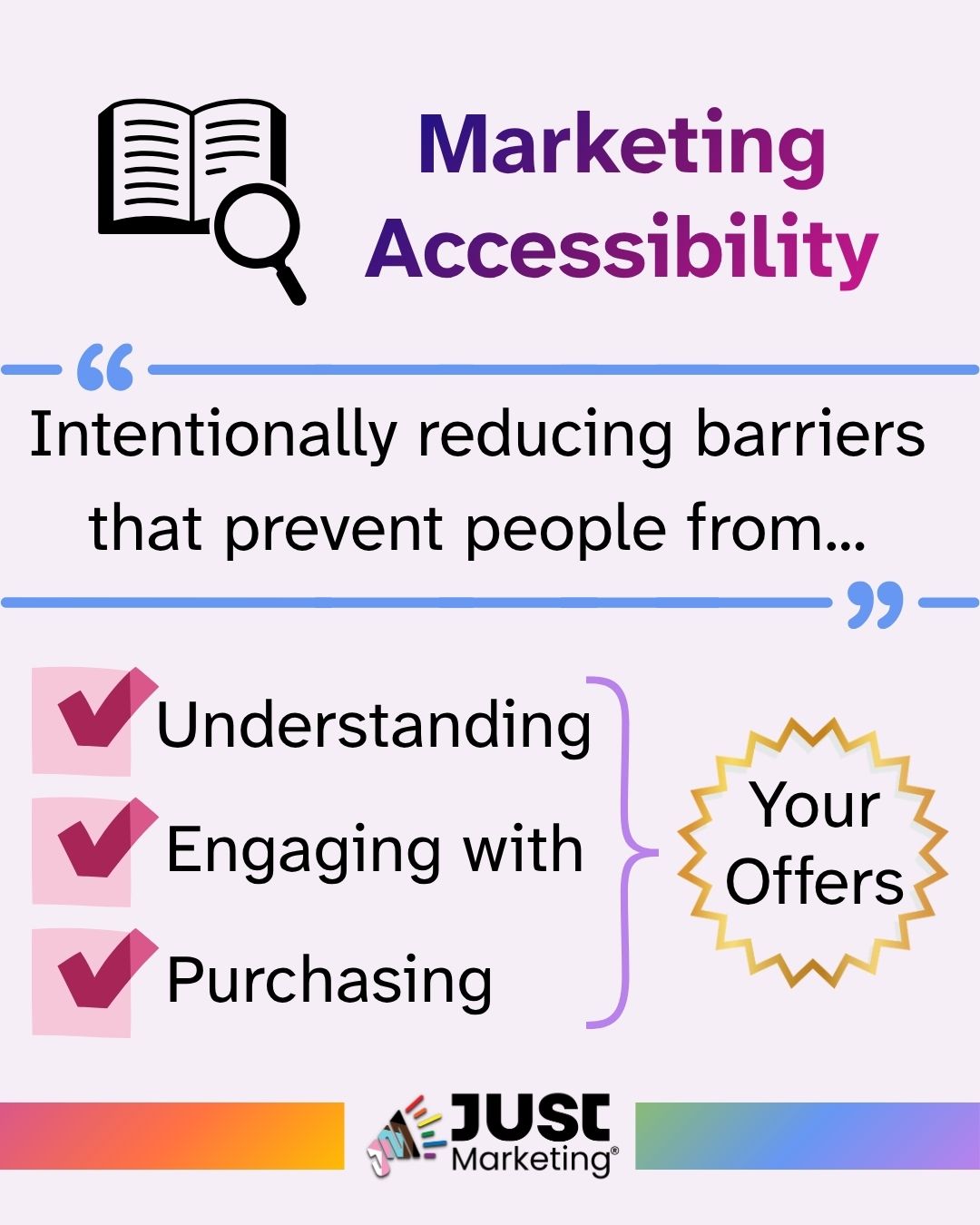
'Marketing Accessibility: Intentionally reducing barriers that prevent people from Understanding, Engaging with, Purchasing Your Offers' appears alongside a book and magnifying glass icon. Three pink checkboxes with purple checkmarks list each action, grouped by a bracket pointing to a gold burst shape. The Just Marketing logo is at the bottom on a multicolor bar.

In the context of ethical business, marketing accessibility means intentionally reducing barriers that prevent people from understanding, engaging with, or purchasing your offers.

It’s not just about disability (though that’s important). It’s also about:

  • Cognitive overload for neurodivergent folks
  • Decision fatigue caused by complex pricing
  • Time or financial constraints for low-income buyers
  • Visual overwhelm for people with sensory sensitivities
  • And access issues for folks who aren’t native English speakers, or who use assistive tech
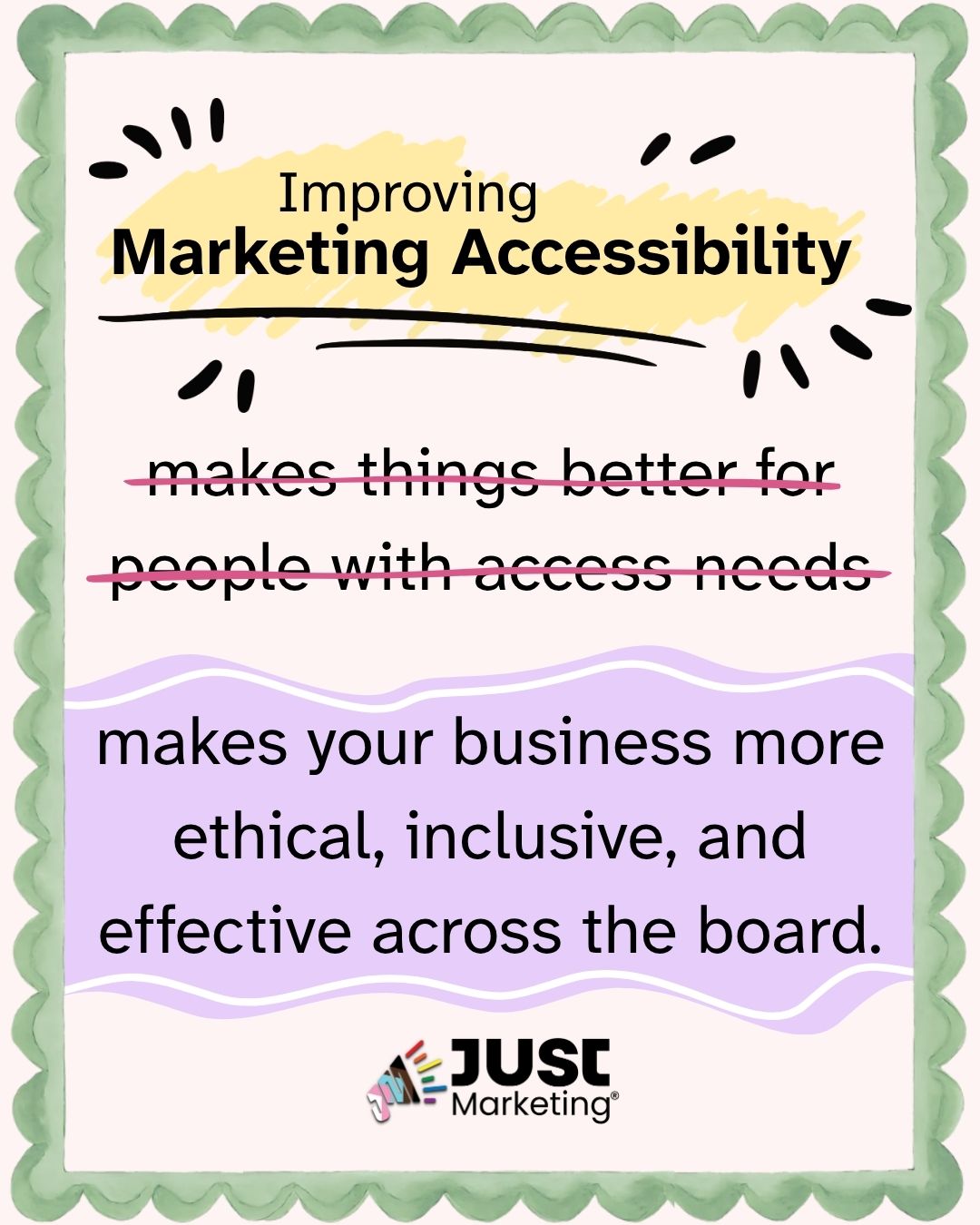
'Improving Marketing Accessibility' is highlighted in yellow at the top. Below, the phrase 'makes things better for people with access needs' appears struck through in pink, replaced by 'makes your business more ethical, inclusive, and effective across the board' on a purple background. The Just Marketing logo is at the bottom, framed by a green scalloped border.

When your offers are easier to understand, easier to engage with, and easier to say “yes” to, everyone wins.

How Can I Remove Access Barriers From My Offers?

Creating accessible offers doesn’t mean doing everything at once  –  it means identifying where your current systems may unintentionally exclude people and making thoughtful adjustments. These four common barriers are a great place to start.

Each one includes a link to a full blog post where we dig deeper with real-world examples, solutions, and inclusive alternatives.

1. Confusing pricing models

Barrier: Too many choices. Unclear payment options. Jargon-filled package names. These things don’t just cause confusion  –  they can create anxiety and shut people out, especially neurodivergent folks or buyers who need more time to process.

Accessibility Shift: Simplify your pricing. Offer clear, tiered options or a pay-what-you-can model. Use plain language to describe what’s included  –  and don’t hide the price behind a sales call.
'Simplified Pricing: A More Accessible Approach to Pricing Your Offers' in bold purple text. A large illustrated pink price tag with a coin graphic sits at the center, while a green dollar sign icon anchors the light green banner at the bottom. Scattered green dollar bill illustrations fill the cream-colored background.

Read: Simplify Your Pricing Options: A More Accessible Approach to Your Offers

2. Visual design that excludes

Barrier: Flashy graphics. Hard-to-read fonts. No captions or alt text. When your visuals prioritize aesthetics over access, you’re unintentionally telling some people, “This isn’t for you.”

Accessibility Shift: Design with inclusion in mind. Use high contrast colors, legible fonts, descriptive alt text, and always caption your videos. Bonus: it boosts SEO and trust.

'Inaccessible Visuals: The Hidden Barrier to Relationships and Revenue' appears in bold purple on rainbow gradient banners. A pixelated, unidentifiable image in a purple frame is crossed out with a red diagonal line, surrounded by colorful question marks scattered across a light pink background.

Read: Inaccessible Visuals: The Hidden Barrier to Relationships and Revenue

3. Manipulative scarcity tactics

Barrier: Countdown timers. “Only 3 spots left!” pressure. 24-hour flash sales. Scarcity triggers urgency  –  but it also triggers stress, especially for folks with decision fatigue, time blindness, or financial limitations.

Accessibility Shift: Practice ethical urgency. Use transparent timelines and give people time to decide. Create evergreen options or low-pressure pathways to work with you.
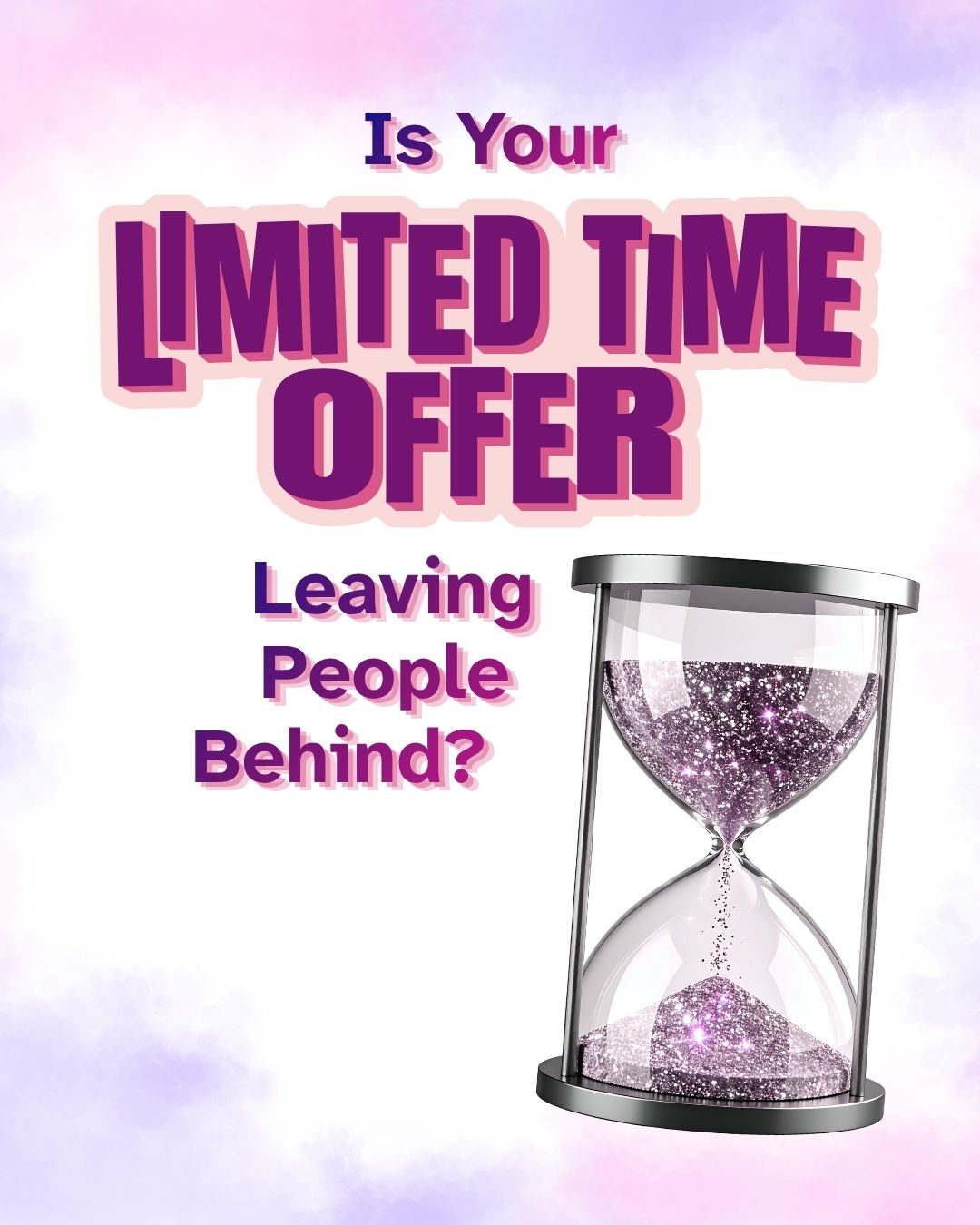
'Is Your Limited Time Offer Leaving People Behind?' in bold purple text with a pink outline. A silver hourglass filled with sparkling purple glitter sand sits to the right, with sand actively falling through the center. The background features a soft pink and purple watercolor wash.

Read: Exclusive Discounts: Is Your ‘Limited-Time Offer’ Leaving People Behind?

4. Paywalled communities and connection

Barrier: High-ticket programs as the only way to get access to you or community. When everything meaningful is locked behind a hefty price tag, it can feel exclusive in the worst way  –  especially to folks who are often excluded elsewhere, too.

Accessibility Shift: Offer multiple levels of access. Consider low-cost community tiers, free office hours, or generous content marketing. Build trust before transactions.
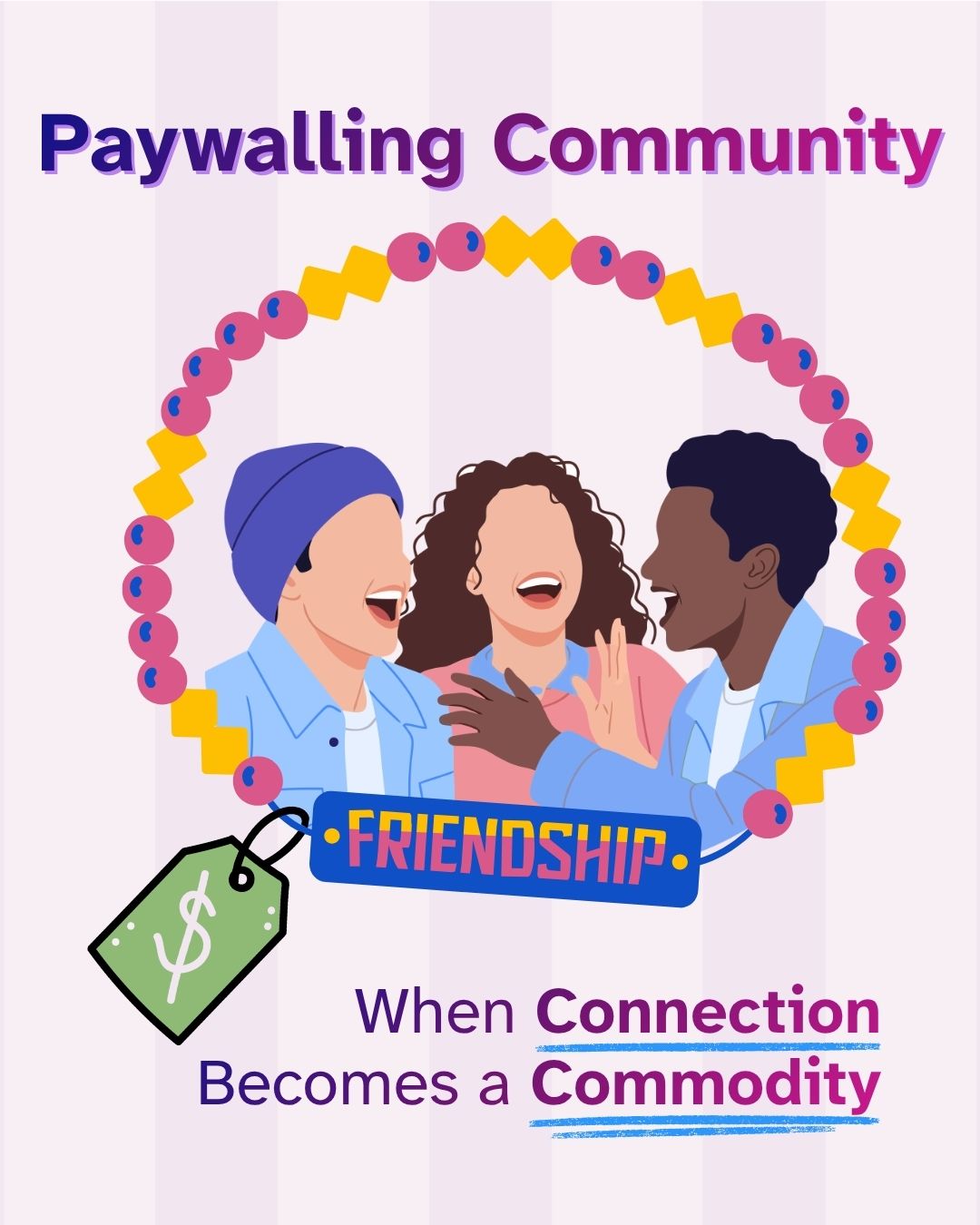
'Paywalling Community: When Connection Becomes a Commodity' appears in bold purple and blue text. Three diverse, laughing people are encircled by a decorative friendship bracelet of pink and yellow beads and a blue badge reading 'Friendship.' A green price tag with a dollar sign is attached. A striped lavender background.

Read: Paywalling Community – When Connection Becomes a Commodity

What Are Quick Ways to Make Marketing More Accessible?

Accessibility doesn’t have to be overwhelming  –  and it definitely doesn’t have to wait until “everything’s perfect.” You can start making small, intentional shifts today that will have a real impact on how your offers are received.
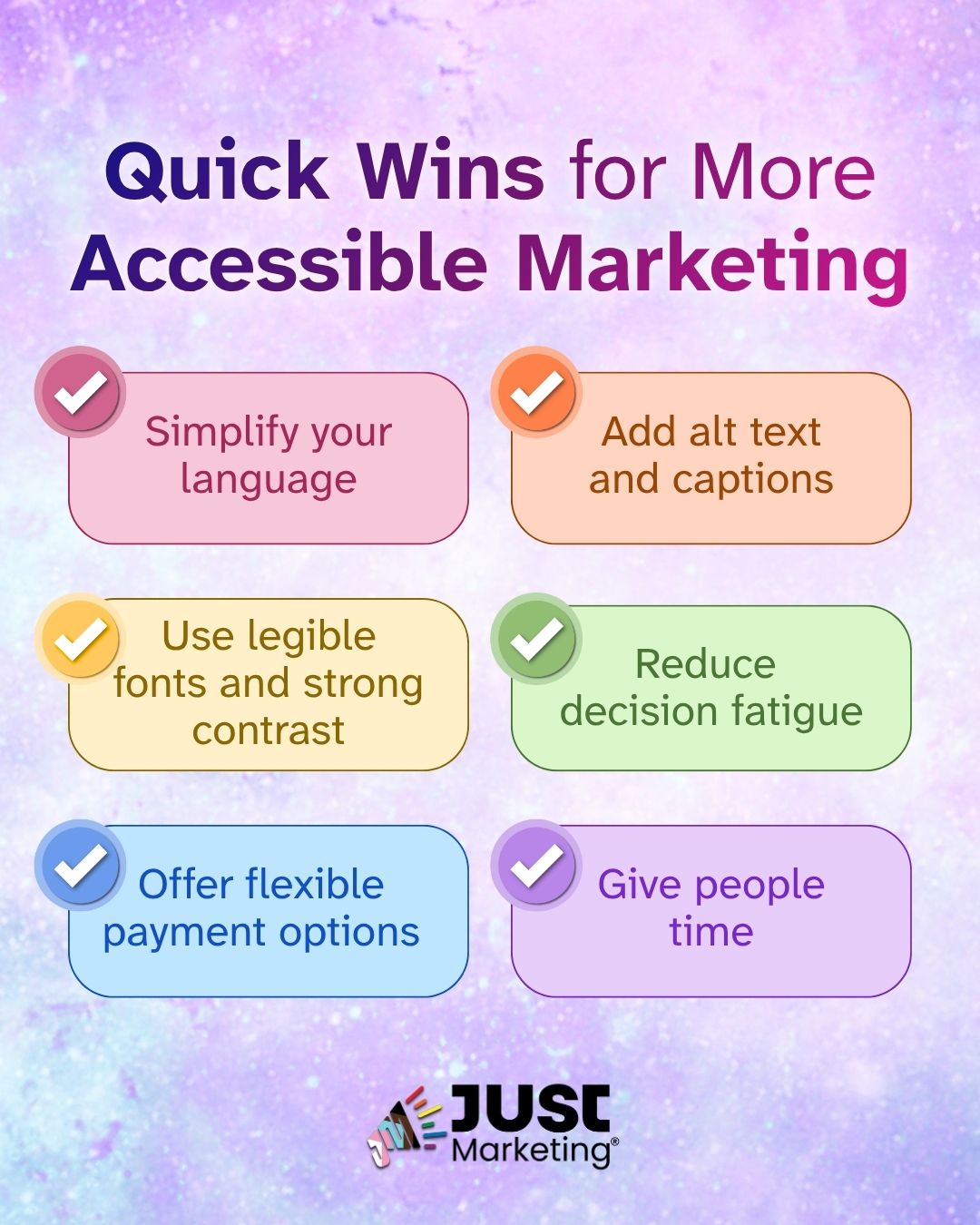
'Quick Wins for More Accessible Marketing' appears in bold purple. Six color-coded rectangles, each with a checkmark, list actionable tips: 'Simplify your language,' 'Add alt text and captions,' 'Use legible fonts and strong contrast,' 'Reduce decision fatigue,' 'Offer flexible payment options,' and 'Give people time.' The Just Marketing logo is at the bottom on a purple background.

Here are a few low-lift, high-impact ways to reduce access barriers in your marketing right now:

1. Simplify your language

Write like you speak. Cut the jargon, skip the fluff, and make it easy for folks to understand what you do and how you can help  –  especially on sales pages.

2. Add alt text and captions

Every image should have descriptive alt text. Every video? Captions, always. Bonus: this improves SEO and increases reach.

3. Use clear, legible fonts and strong contrast

Light gray text on a white background might look aesthetic, but it’s a nightmare for accessibility. Go for readable, high-contrast combinations.

4. Reduce decision fatigue

Too many offers or confusing pricing = instant overwhelm. Try bundling, simplifying, or offering a clear “start here” path.

5. Offer flexible payment options

Sliding scale, extended plans, or even community-funded scholarships can make a big difference  –  especially for values-aligned folks with limited financial access.

6. Give people time

If you’re using deadlines, make them clear and respectful. Skip the countdown clocks and pressure language. Trust that the right people will make empowered decisions when they’re ready.

These tweaks don’t require a rebrand or a full launch overhaul  –  they’re about being more thoughtful, intentional, and inclusive with the way you show up. And they can absolutely coexist with sustainable, profitable business practices.

Marketing Accessibility Is a Journey  –  Not a Checkbox

There’s no “perfectly accessible” offer. And truthfully? Chasing perfection can be its own kind of barrier.

The goal isn’t to check every box  –  it’s to show up with intention, curiosity, and a willingness to do better over time. Because when you commit to making your offers more accessible, you’re not just expanding your reach  –  you’re building deeper trust with the communities you care about most.

Reflect & Take Action:

What’s one small shift you can make this week to reduce friction and increase access in your offers?

It could be swapping your font, updating your pricing page, or reviewing your last Instagram post for alt text and readability. Start small. Stay consistent. It all adds up.

Let’s Keep This Conversation Going

Your work deserves to reach the people who need it most  –  and accessibility helps make that possible.

Want more support, inspo, and community around ethical, inclusive marketing?

  • Let’s connect on LinkedIn and Instagram – I share content there regularly to help you market in ways that feel good and do good.
  • Curious about working together? Learn how I support mission-driven entrepreneurs in building accessible, aligned offers – without the overwhelm.

Join the email list for deeper insights, behind-the-scenes tips, and resources to build sustainable systems that reflect your values.

FAQs

What is marketing accessibility?

Marketing accessibility is the practice of removing barriers that make it hard for people to understand, engage with, or buy what you offer. It covers everything from readable visuals and captions to clear pricing and respectful timelines. The goal is making sure your offers welcome the widest possible range of people.

Is accessibility in marketing only about disability?

Disability access is a central part of it, and accessibility also reaches further. It includes reducing cognitive overload for neurodivergent folks, easing financial barriers, and writing clearly for people reading in a second language. Changes that help one group often make your marketing easier for everyone.

What is pay-what-you-can or sliding scale pricing?

Sliding scale pricing lets clients choose a price within a set range based on what they can afford, while pay-what-you-can models often have no fixed minimum. Both make offers more accessible for people with limited financial access. Short guidance on which tier fits which situation helps buyers choose with confidence.

Does accessible marketing help with SEO?

Yes! Alt text, video captions, and plain language all help search engines and AI tools understand your content, which can improve how often it shows up. Accessible pages also tend to be easier for every visitor to read. Learn more about writing meaningful alt text.

Are there legal requirements for accessible marketing?

In the US, many websites have faced lawsuits under the Americans with Disabilities Act, and the European Accessibility Act began applying to many businesses serving EU customers in June 2025. Requirements vary by location and business type, so checking with a legal professional is wise. Learn why accessibility overlays fall short.

Where should I start making my offers more accessible?

Pick one small shift this week, like checking the color contrast on your sales page or adding alt text to your latest social post. Small, consistent changes add up over time. For a deeper look at one common barrier, see how to simplify your pricing options.


Categories: All Categories, Just Marketing®

Tags: Accessible Marketing, Email Marketing, Promotional Content, Social Media Strategy, Values-Aligned Promotions

Prev
Next

About Meg Brunson

Meg Brunson is a marketing strategist and the creator of Just Marketing®, a justice-centered approach to marketing for impact-driven businesses.

Just Marketing® is ethical, inclusive, and accessible, so your audience feels supported and your business grows sustainably.

Follow me on Instagram @theMegBrunson
“Are you sure you want to say no to growing your b “Are you sure you want to say no to growing your business?” 😬

If a pop-up like that has ever made you close the tab, you already know how pushy CTAs feel. For neurodivergent folks and anyone who’s been pressured into a decision before, that kind of copy is a warning sign.

Consent-based CTAs offer a kinder path. They tell people exactly what they’re being invited to do and what happens after they click, and they treat “not right now” as a perfectly good answer.

Here’s a quick before and after:
Before: “Join now!”
After: “Sign up to get weekly ADHD-friendly marketing tips delivered to your inbox.”

The second version takes a few more words, and it saves your reader the guesswork. That’s what “clear is kind” looks like in action. Clarity does the emotional labor for your audience, so the right people can say yes with confidence.

The blog walks through how to write consent-based CTAs step by step, plus examples you can adapt for social media and your email list: MegBrunson.com/consent-based-ctas

What’s the pushiest CTA you’ve ever come across?

ID: The Just Marketing logo at top. Text reads ‘How to Write Direct, Consent-Based CTAs’ with ‘CTAs’ in large navy-to-magenta gradient letters. Below, colorful icons show a green speech bubble, a pink button with a blue cursor clicking it, a yellow megaphone, and a purple gear. A pastel rainbow banner at the bottom reads ‘Clear is Kind’ on a soft lavender textured background.

#JustMarketing #EquityForAll #a11y #EquityCenteredBusiness #DiversityInMarketing #SocialJustice #BeTheChange #DiversityEquityInclusion #EthicalMarketing #InclusiveMarketing #AccessibleMarketing #MarketingAccessibility #SocialMediaMarketer #EthicalBusiness #MarketingCoach #CommunityOverCompetition #MarketingWithPurpose #MarketingWithImpact #DEI #DEIMarketing #SocialMediaForAll #ContentCreation #ContentMarketing #ContentMarketingMembership #WeeklySocialContent  #MarketingWithADHD #adhdBusiness #adhdBusinessOwner
Normal is overrated. Especially in business. Esp Normal is overrated.

Especially in business. 
Especially in marketing.

The traditional advice?
– Fit the mold
– Follow the formula
– Be palatable to the masses

But for neurodivergent, justice-driven entrepreneurs, that kind of “normal” often means:
– Shrinking your voice
– Suppressing your creativity
– Abandoning your values to “get results”

No, thank you.

You don’t have to be normal to be successful.
You just have to be you - strategically, sustainably, and unapologetically.

When you embrace what makes you different, your audience doesn’t just see content…
They see connection.

And that’s when the magic (and the momentum) really starts.

What part of your marketing have you been “normalizing” that you’re ready to reclaim?

💕

ID: A soft pink background patterned with the word 'amazing' in large, light text. In the center, a white box contains a large purple quotation mark and the quote: 'If you're always trying to be normal, you will never know how amazing  you can be.’ The word ‘amazing’ is highlighted in purple with sparkles. Attribution at the bottom: Maya Angelou.

#JustMarketing #EquityForAll #a11y #EquityCenteredBusiness #DiversityInMarketing #SocialJustice #RacialJustice #BeTheChange #DismantleWhiteSupremacy #DiversityEquityInclusion #EthicalMarketing #InclusiveMarkeitng #AccessibleMarketing #MarketingAccessibility #SocialMediaMarketer #EthicalBusiness #MarketingCoach #CommunityOverCompetition #MarketingWithPurpose #MarketingWithImpact #DEI #DEIMarketing #SocialMediaForAll #ContentCreation #ContentMarketing #ContentMarketingMembership #WeeklySocialContent  #MarketingWithADHD #adhdBusiness #adhdBusinessOwner
Accessibility and equity often show up in the same Accessibility and equity often show up in the same sentences, and each one does a different job in your business.

Accessibility is about getting people in the door. It means your services and content are usable regardless of ability or learning style. Think captions and plain language.

Equity picks up once people are inside, making sure they have the support they need to thrive. That might look like sliding scale pricing or community-supported spots.

Here’s where it gets interesting: an offer can have one without the other. 

A captioned workshop with a price that’s out of reach for many folks still leaves people behind. 
Sliding scale pricing paired with a tiny, hard-to-read font creates a different kind of barrier. 

When both are in place, your offers welcome people and work for them, too.

Two questions to ask about your current offers:
 ~ Who can’t access this right now?
 ~ What am I assuming about people’s time and money?

The blog breaks down how accessibility and equity connect, plus practical ways to build both into your pricing and systems: MegBrunson.com/accessibility-and-equity

Which one feels easier for you to put into practice right now, accessibility or equity? 
Tell me in the comments!

ID: Title, ‘Accessibility vs Equity,’ in black script lettering with a pink not-equal sign behind ‘vs.’ Two arrow banners read ‘Not the same.’ in blue and ‘Both important.’ in purple. Below, a diverse group of illustrated people stands and sits together, including several wheelchair users, a person using a walker, a person with a white cane, and people with prosthetic arms and a prosthetic leg, on a soft pink gradient background.

#JustMarketing #EquityForAll #a11y #EquityCenteredBusiness #DiversityInMarketing #DiversityEquityInclusion #EthicalMarketing #InclusiveMarketing #AccessibleMarketing #MarketingAccessibility #MarketingWithPurpose #MarketingWithImpact #DEI #SocialMediaForAll #ContentCreation #ContentMarketing #ContentMarketingMembership #WeeklySocialContent  #MarketingWithADHD #adhdBusiness #adhdBusinessOwner
Website accessibility can sound like a job for dev Website accessibility can sound like a job for developers. 

But, the basics are totally doable from inside your website builder, and every small fix helps more of your people feel welcome.

Here are four places to start:

1. Alt text - Describe the purpose of each image in a sentence or two. Screen readers already announce that it’s an image, so you can skip “picture of.”

2. Navigation - Keep your menu simple and consistent across pages. Then try tabbing through your site with just your keyboard to see whether links come up in a logical order.

3. Color contrast - Pop your text and background colors into the free WebAIM Contrast Checker. Aim for a ratio of at least 4.5:1 for regular text.

4. Accessible UX - Label buttons with what they do, like “Download the free guide.” Let videos wait for a click before they play.

Bonus for my ADHD crew: pick one item and call it this week’s win. Progress counts, and your visitors will feel the difference.

The blog walks through each basic in more detail, plus free tools for auditing your site and why accessibility overlays tend to create more barriers than they remove: MegBrunson.com/website-accessibility-basics

Which of the four are you tackling first? 
Drop the number in the comments, and I’ll cheer you on!

ID: Title, ‘Website Accessibility Basics for Service Providers,’ in navy-to-magenta gradient text. Three illustrated people in yellow tops and purple or black pants float playfully around website windows showing image icons, text lines, a profile card, and a three-star rating, all connected by dotted lines. One woman wears headphones. Text at the bottom reads ‘A Non-Techy Guide to an Inclusive Online Experience’ on a soft lavender tie-dye background.

#JustMarketing #EquityForAll #a11y #EquityCenteredBusiness #DiversityInMarketing #SocialJustice #EthicalMarketing #InclusiveMarketing #AccessibleMarketing #MarketingAccessibility #MarketingWithPurpose #MarketingWithImpact #DEI #SocialMediaForAll #ContentCreation #ContentMarketing #ContentMarketingMembership #WeeklySocialContent  #MarketingWithADHD
Ever bought a “one size fits all” shirt and discov Ever bought a “one size fits all” shirt and discovered it actually fit... one very specific person?

Digital offers can work the same way. A course delivered only as hour-long videos leaves out a lot of learners: Deaf and hard of hearing folks, neurodivergent people who process best in writing, parents squeezing in a lesson during school pickup, and anyone opening your course on a phone with spotty Wi-Fi.

Flexible formats let people choose what fits their needs and their day:

 → Captioned video for watching on mute
 → Audio versions for learning on a walk or in the car
 → Transcripts for skimmers and screen reader users
 → Printable PDFs for anyone who needs a break from screens
 → Mobile-friendly design for learning from anywhere

Good news for your schedule, too. Many of these formats come from content you already have. One recorded lesson can become a transcript and a printable summary with a little editing, which also gives you fresh material to repurpose.

As the bottom of that tag says, one-size-fits-all can work beautifully when it’s accessible to all. 💜

The blog  walks through each format, plus how accessibility builds trust with your audience: MegBrunson.com/accessible-digital-offers

Then tell me below: what’s your go-to format when you’re learning something new? 👇

ID: Accessible Digital Offers. A white clothing tag reads ‘One Size Fits,’ with ‘All’ and ‘Some’ crossed out and ‘Most?’ written below. Text beneath reads, ‘Because One-Size-Fits-All doesn’t work! (unless it’s accessible to all!)’ The design uses a lavender background with a purple-to-magenta headline and a wavy purple ribbon border tied in bows at each corner.

#JustMarketing #EquityForAll #a11y #EquityCenteredBusiness #DiversityInMarketing #SocialJustice #DiversityEquityInclusion #EthicalMarketing #InclusiveMarketing #AccessibleMarketing #MarketingAccessibility #EthicalBusiness #MarketingWithPurpose #MarketingWithImpact #DEI #SocialMediaForAll #ContentCreation #ContentMarketing #ContentMarketingMembership #WeeklySocialContent  #MarketingWithADHD #adhdBusiness #adhdBusinessOwner
Step 5 says to fix the biggest barriers first, the Step 5 says to fix the biggest barriers first, then keep improving one piece at a time… making progress at your own pace.

Accessibility can feel like a mountain when you picture your whole website, your entire back catalog of posts, and every video you’ve ever uploaded all at once. 

(Overwhelmed achievers, I see you.) 

Starting with whatever blocks the most people turns that mountain into a manageable next step.

Some high-impact places to begin:
 → Captions on your most-watched video
 → Alt text for the images on your homepage
 → Stronger color contrast on your email signup button
 → Descriptive link text on your services page

Choose one this week and another next week. Small fixes stack up faster than you’d expect, and each one makes your marketing easier to use for disabled and neurodivergent folks (and clearer for everyone else, too).

The blog post covers all five steps… Read it at: MegBrunson.com/design-for-the-edges 

Then tell me below: which barrier are you tackling first? 👇

ID: Just Marketing logo above the heading ‘How to Design Your Marketing for the Edges.’ Five numbered steps sit in hexagons shaded pink to purple, each with a matching underline: 1, name your edges. 2, build access into your first draft. 3, run a quick edge check. 4, ask people with lived experience. 5, fix the biggest barriers first. Pastel gradient background.

#JustMarketing #EquityForAll #a11y #EquityCenteredBusiness #DiversityInMarketing #SocialJustice #RacialJustice #BeTheChange #DismantleWhiteSupremacy #DiversityEquityInclusion #EthicalMarketing #InclusiveMarketing #AccessibleMarketing #MarketingAccessibility #SocialMediaMarketer #EthicalBusiness #MarketingCoach #CommunityOverCompetition #MarketingWithPurpose #MarketingWithImpact #DEI #DEIMarketing #SocialMediaForAll #ContentCreation #ContentMarketing #ContentMarketingMembership #WeeklySocialContent  #MarketingWithADHD #adhdBusiness #adhdBusinessOwner
If your marketing isn’t hitting your goals, the pr If your marketing isn’t hitting your goals, the problem probably isn’t your graphics.
It’s not your captions.
It’s not that you need more content.

What you need is a strategy.

One that’s tied to your business goals, aligned with your values, and flexible enough to evolve as you grow.

That’s the difference between someone who just posts for you
…and someone who partners with you to actually grow your business.

– Strategy
– Testing
– Tuning
– Real results

And impeccable work, every step of the way.

If you’re ready to stop guessing and start growing, let’s talk: YourMarketingPerson.co 

(or DM me!)

ID: Mia P. holding a coffee cup, ‘I was going through social media manager after social media manager, until Meg came in with a strategic perspective on how our marketing could achieve our goals and KPIs. We crafted a plan and Meg was there every step of the way to test and tweak until we got the results we wanted. Her work is impeccable, her expertise is top notch.’ YourMarketingPerson.co

#JustMarketing #EquityForAll #a11y #EquityCenteredBusiness #DiversityInMarketing #SocialJustice #RacialJustice #BeTheChange #DismantleWhiteSupremacy #DiversityEquityInclusion #EthicalMarketing #InclusiveMarkeitng #AccessibleMarketing #MarketingAccessibility #SocialMediaMarketer #EthicalBusiness #MarketingCoach #CommunityOverCompetition #MarketingWithPurpose #MarketingWithImpact #DEI #DEIMarketing #SocialMediaForAll #ContentCreation #ContentMarketing #ContentMarketingMembership #WeeklySocialContent  #MarketingWithADHD #adhdBusiness #adhdBusinessOwner
November is here, and with it comes a season of re November is here, and with it comes a season of reflection, gratitude, and connection.

Here’s a look at some of the meaningful holidays and observances this month:

Native American Heritage Month (All November) - A time to celebrate the rich histories, cultures, and contributions of Native American communities while recognizing the resilience and strength that continue to define them. Let’s amplify Indigenous voices, learn from their stories, and commit to supporting their movements for justice.

Diwali (November 8) - Known as the Festival of Lights, Diwali celebrates the triumph of light over darkness and good over evil. This vibrant holiday is marked with candles, fireworks, and family gatherings. It’s a beautiful reminder of hope and renewal that resonates far beyond the cultures that celebrate it.

Transgender Day of Remembrance (November 20) - This solemn observance honors the lives of transgender people lost to violence and prejudice. It’s a call to action to protect and uplift trans voices, ensuring that every member of our community is seen, valued, and safe.

Thanksgiving (November 26) - Yes, Thanksgiving is about gathering, feasting, and expressing gratitude - but it’s also a chance to reflect on its history and recognize the complexities of this holiday for Indigenous communities. Pair your gratitude with education and action to make this day truly meaningful.

The Inclusive Holiday Content Bundle is your go-to resource for creating marketing that matters. Packed with observances and ideas, it’ll help you craft content that connects authentically while celebrating the diversity of your audience.

Instant Access: CelebrateOnSocial.com

Which holiday or observance will you be honoring this month?
I’d love to hear how you’re making November meaningful.

ID - A 6-card carousel highlighting 'Diverse & Inclusive Holidays' in November. Promotional graphic encourages planning inclusive holiday content year-round. Text promotes access to Canva templates, graphics, and guidance for over 470 inclusive holidays. CelebrateOnSocial.com appears in a purple bar.
Titles don’t make leaders. Practice does. Here’s Titles don’t make leaders.
Practice does.

Here’s a look at my own Leadership Philosophy:

I make decisions by …

(1) Leveraging my knowledge & experiences, researching new ideas, and listening to feedback from all who are impacted.

(2) Asking questions & considering the most marginalized community members.

(3) Getting creative and considering innovative & unconventional options. 

I believe …

(1) In being transparent about my feelings and actions, including owning up to my mistakes & lessons learned.

(2) In collaboration & empowering each other so that we’ll become stronger as a collective & as individuals.

(3) We should be asking tough questions & calling out inequities, even when it's uncomfortable.

(4) Through small daily actions, we will influence broad long-term outcomes.

My leadership liberates others by …

(1) Providing a space for marketers & business owners to make mistakes, learn, and grow.

(2) Supporting the growth of business revenue & personal profits.

(3) Changing the landscape of marketing so all feel seen, supported, and respected through the buying process.

Marketers are trendsetters with platforms and influence. By leading the charge with the way we ethically represent our brands, we can help spark a more inclusive & accessible future into existence. That’s Just Marketing®.

💕

Whether you’re leading a team, a classroom, or a solo business…
You are a leader.

And you get to define what leadership looks like - on your own terms.

Take a moment: How would you finish these sentences?

I make decisions by...
I believe...
My leadership liberates others by...

Drop yours in the comments or journal it out. There’s no wrong answer - just truth.

Title: ‘Leadership Philosophy’ on a purple and pink gradient. A smartphone frame displays Meg with pink and purple hair sitting outdoors with a laptop covered in stickers. Their shirt reads “People > Profit.” On the right are three speech bubbles: 'I make decisions by…' 'I believe…' and 'My leadership liberates others by…'
At its heart, marketing is about connection. And l At its heart, marketing is about connection. And language sits right at the center of every connection we make with the people we hope to serve.

When we slow down and notice whose voices we center, we can start building brands that reflect the world we want to live in: one where multilingual, multicultural, and neurodiverse communities are welcomed from the very beginning.

If that feels like a big goal, here's the encouraging part. Language justice is an ongoing practice, and you get to begin at your current capacity. A few low-lift places to start:

– Add captions and transcripts to your videos, in more than one language if you can

– Translate one key page, like your homepage, booking page, or lead magnet

– Poll your community about the languages they speak at home and whether multilingual content would help them

– Choose plain, clear language that works well for neurodivergent readers, multilingual audiences, and translation tools

Pick one and let it be enough for now. A single thoughtful change creates more impact than a dozen performative gestures, and each step makes it more likely someone feels seen and respected by your brand.

You can move toward language justice with the skills you have today. Curiosity and a willingness to learn will carry you a long way.

Find more small, sustainable shifts at MegBrunson.com/language-justice 

Which of these shifts feels most doable for you this month? 
Tell me in the comments, and I'll cheer you on!

ID: Large handwritten-style text on a purple-to-magenta gradient reads 'Language is a Justice Issue, and a Relationship Tool,' with the Just Marketing logo centered below.

#JustMarketing #EquityForAll #a11y #EquityCenteredBusiness #DiversityInMarketing #DiversityEquityInclusion #EthicalMarketing #InclusiveMarketing #AccessibleMarketing #MarketingAccessibility #EthicalBusiness #MarketingWithPurpose #MarketingWithImpact #DEI #SocialMediaForAll #ContentCreation #ContentMarketing #ContentMarketingMembership #WeeklySocialContent  #MarketingWithADHD
Google Translate can help you get the gist of some Google Translate can help you get the gist of something… and when your message really matters, you'll want people who live in the languages and cultures you hope to honor.

Hiring a translator or interpreter works best when you approach it as a relationship grounded in shared values and clear communication. Here are four ways to do that ethically:

1. Hire values-aligned professionals
Look for people who understand your audience and your mission. Experience in marketing or your industry is a big plus. Prioritize the person who gets what you're trying to say and knows how to say it in a way that resonates culturally.

2. Pay fairly and credit contributors
Language work is skilled labor. Translators adapt tone, catch cultural missteps, and often keep you from saying something unintentionally harmful. Compensate them accordingly, and give credit when their work shapes your content.

3. Co-create instead of extract
Invite collaboration from the start with questions like:
– Does this phrase translate well?
– Would this example resonate with your community?
That kind of conversation turns a technically correct translation into one that feels emotionally and culturally right.

4. Expand your definition of "language access"
Language justice includes people who communicate nonverbally or process language differently. Consider ASL interpreters for live events and videos, accurate captions and transcripts (auto-captions miss a lot), alt text and image descriptions, and plain language for neurodivergent readers.

Learn more about ethical translation and inclusive messaging: MegBrunson.com/language-justice 

Have you worked with a translator, interpreter, or language consultant? 
Share what made the collaboration great, or tag someone you'd recommend!

ID: Title, 'Working with Translators, Interpreters, and Creators Ethically.' 4 numbered boxes: hire values-aligned professionals, pay fairly and credit contributors, co-create instead of extract, and expand your definition of 'language access.'
According to the U.S. Census Bureau, about 20% of According to the U.S. Census Bureau, about 20% of people in the U.S. speak a language other than English at home. Zoom out to a global audience and that number climbs dramatically.

Still, much of the online business world treats English as the default. When your marketing only shows up in English, your reach shrinks, even when your services are technically open to anyone.

Language shapes how we process information and whether we feel welcomed or shut out. For some people, English is a second or third language. For others, it carries memories of exclusion in schools, healthcare, and other systems that were supposed to serve them. And for many neurodivergent readers, even "simple" English content can feel dense and hard to follow.

When we treat language as a bridge, we open the door to people who've been left outside the "ideal client" box for far too long.

Here's a quick self-check for your own marketing:
– Do I know which languages my audience speaks or prefers?
– Have I tested whether my message stays clear in translation?
– Would someone using a screen reader or translation app understand my offer?
– Is my writing as plain and direct as it could be?

Centering access starts with asking better questions. From there, you can build marketing that meets people where they are, one thoughtful change at a time.

Explore more ways to make your messaging accessible: MegBrunson.com/language-justice

What languages are spoken in your home or in the communities you serve?

ID: Title, 'Language as Access,' an illustrated smiling mouth has speech bubbles reading 'Annyeong' in Korean, 'Hello,' and 'Bonjour.' The Just Marketing logo appears at bottom right, with text below reading 'Not Everyone Speaks (or Thinks in) English.'

#JustMarketing #EquityForAll #EquityCenteredBusiness #DiversityInMarketing #DiversityEquityInclusion #EthicalMarketing #InclusiveMarketing #AccessibleMarketing #MarketingAccessibility #EthicalBusiness #MarketingWithPurpose #MarketingWithImpact #DEI #ContentCreation #ContentMarketing #ContentMarketingMembership #WeeklySocialContent  #MarketingWithADHD
Follow on Instagram


Links

CMM Log In
Mission, Vision, & Values

DEI Statement
Leadership Philosophy
Community Agreements
Press & Media


Beliefs

Black lives matter.
Love is love.
Abortion is healthcare.
No human is illegal.
Free Palestine.
I also Believe…

Circular badge has the name "Meg" in the middle and is surrounded by: "CEO, author, speaker, marketer, leader, & advocate"
Copyright © 2026|All Rights Reserved|Meg Brunson, LLC| Privacy & Terms