Ever stared at a menu with 37 latte variations and just… froze? Decision paralysis is real – and it doesn’t just show up at the coffee shop. It shows up when your potential clients land on your website and face a wall of pricing options that feel more like a logic puzzle than an invitation.
The gist: Too many pricing options can cause decision paralysis, where buyers feel so overwhelmed by choices that they freeze or leave. Offering two or three clearly different options in plain language, with guidance on which fits whom, helps people choose confidently and makes your offers more accessible.
Part of the Marketing Accessibility series.
As mission-driven entrepreneurs, we want to be helpful. We think more options = more flexibility. But when our pricing structures get too complex, we unintentionally create friction – especially for neurodivergent folks navigating executive dysfunction, anxiety, or overwhelm.
And it’s not usually about being salesy or manipulative. Most of us are simply following the examples we’ve seen in the online business world… even if they don’t align with our values around accessibility, inclusion, and ethical marketing.
Let’s shift that.
In this post, we’ll explore how overloaded pricing options can lead to decision paralysis – and how to simplify your offers in a way that supports clarity, builds trust, and honors your audience’s diverse needs.
What Is Decision Paralysis (and Why It Matters for Pricing)?
Decision paralysis happens when someone is faced with so many choices that making any decision feels impossible. Instead of confidently choosing the best fit, they freeze… or click away altogether. Barry Schwartz's The Paradox of Choice is where the concept originated.
Now imagine this through a neurodivergent lens – maybe ADHD, autism, anxiety, or simply a high level of cognitive fatigue. Executive dysfunction can turn even basic decision-making into a heavy mental lift. Add unclear or excessive pricing options into the mix, and it becomes a recipe for overwhelm.
And it’s not just neurodivergent folks. We're all navigating a world overflowing with choices and information. When your pricing options aren’t streamlined or clearly explained, people spend more energy trying to decode your offers than imagining themselves benefiting from them.
Here’s what this can look like in action:
- Five tiers with slightly different names and unclear distinctions
- Add-ons or “bonus bundles” that feel like pressure
- No guidance on where to start or which option is best for which type of client
- Features listed in industry jargon that assumes background knowledge
It’s not that the offers themselves are bad – they might be exactly what your audience needs. But if the path to understanding them is too foggy or crowded, people may disengage out of self-preservation, not disinterest.
Inclusive marketing means meeting people where they are – and part of that is reducing the mental load it takes to say yes.
How Can Too Many Pricing Options Exclude Buyers?
When someone lands on your pricing page, you want them to feel empowered – not like they’re suddenly on a game show with too many doors to choose from.
But when you present a long list of packages, tiers, bonuses, and upgrades – without clear, accessible guidance – you risk making your potential clients feel confused, overwhelmed, or worse… inadequate.
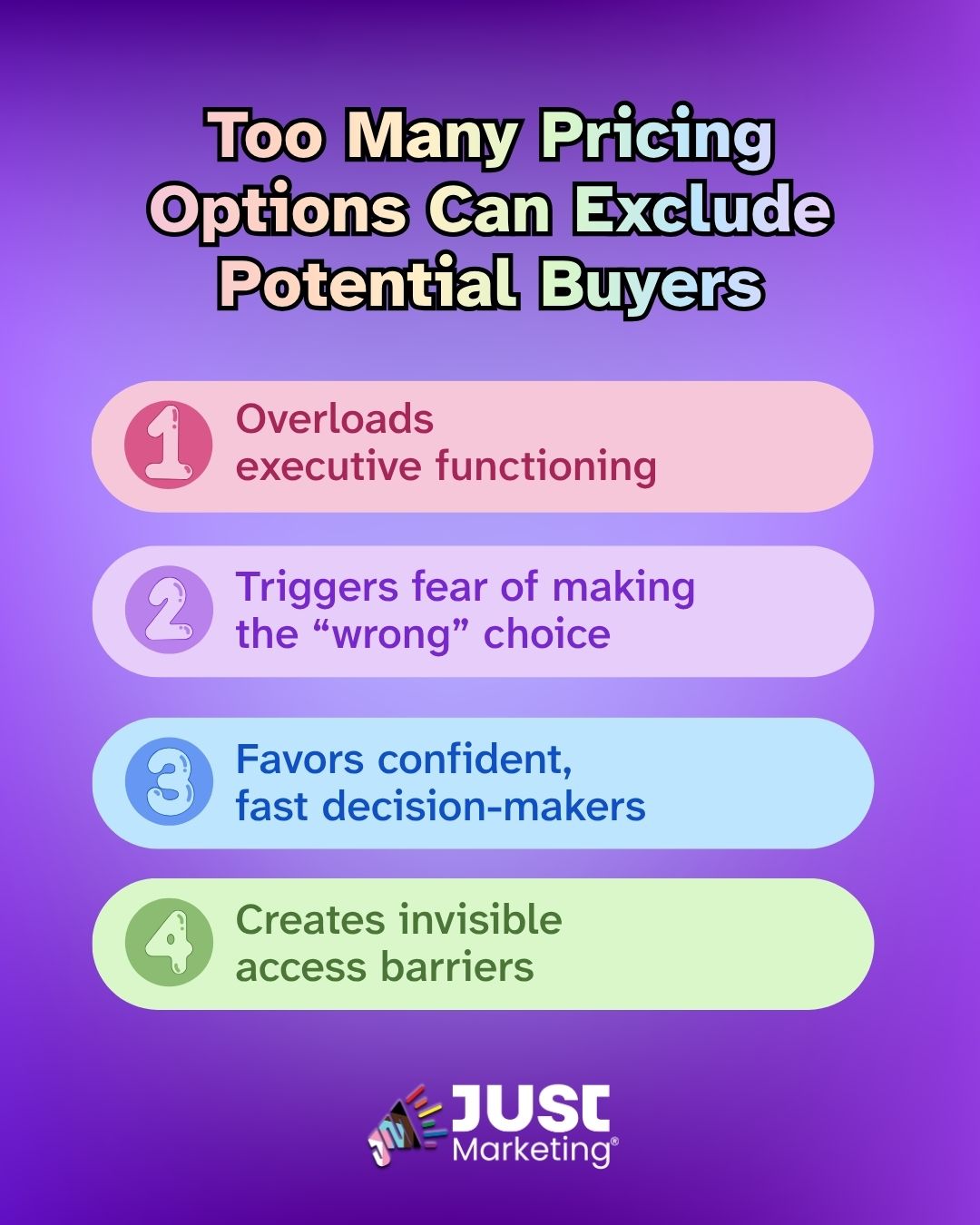
Here’s how too many pricing options can unintentionally exclude the very people you're trying to serve:
1. It overloads executive functioning
Neurodivergent folks (and let’s be honest, many neurotypical folks too) often struggle with working memory, attention regulation, and mental fatigue. Wading through multiple options with subtle differences isn’t just annoying – it can be a cognitive barrier that prevents action.
2. It triggers fear of making the “wrong” choice
When packages are similar or unclear, buyers may start second-guessing themselves. What if I pick the wrong one? What if I’m not “ready” for this tier? That anxiety often leads to abandonment – not conversion.
3. It favors confident, fast decision-makers
Urgency-driven pricing strategies (like early bird tiers with complex bonuses) often reward people who can make quick decisions – and leave behind those who need more time, clarity, or support to feel comfortable investing.
4. It creates invisible access barriers
When pricing info feels like it’s written in code (like feature-stuffed comparison charts), folks who are newer to your industry, speak English as a second language, or process information differently may feel shut out or unsure.
All of this adds up to a bigger problem: people who could be helped by your work leave your site feeling like your offer wasn’t for them.
And that’s the exact opposite of what you’re here to do.
How Many Pricing Options Should I Offer?
You don’t have to choose between accessibility and profitability. In fact, simplifying your pricing increases clarity, builds trust, and often boosts conversions – because people actually feel safe enough to buy.
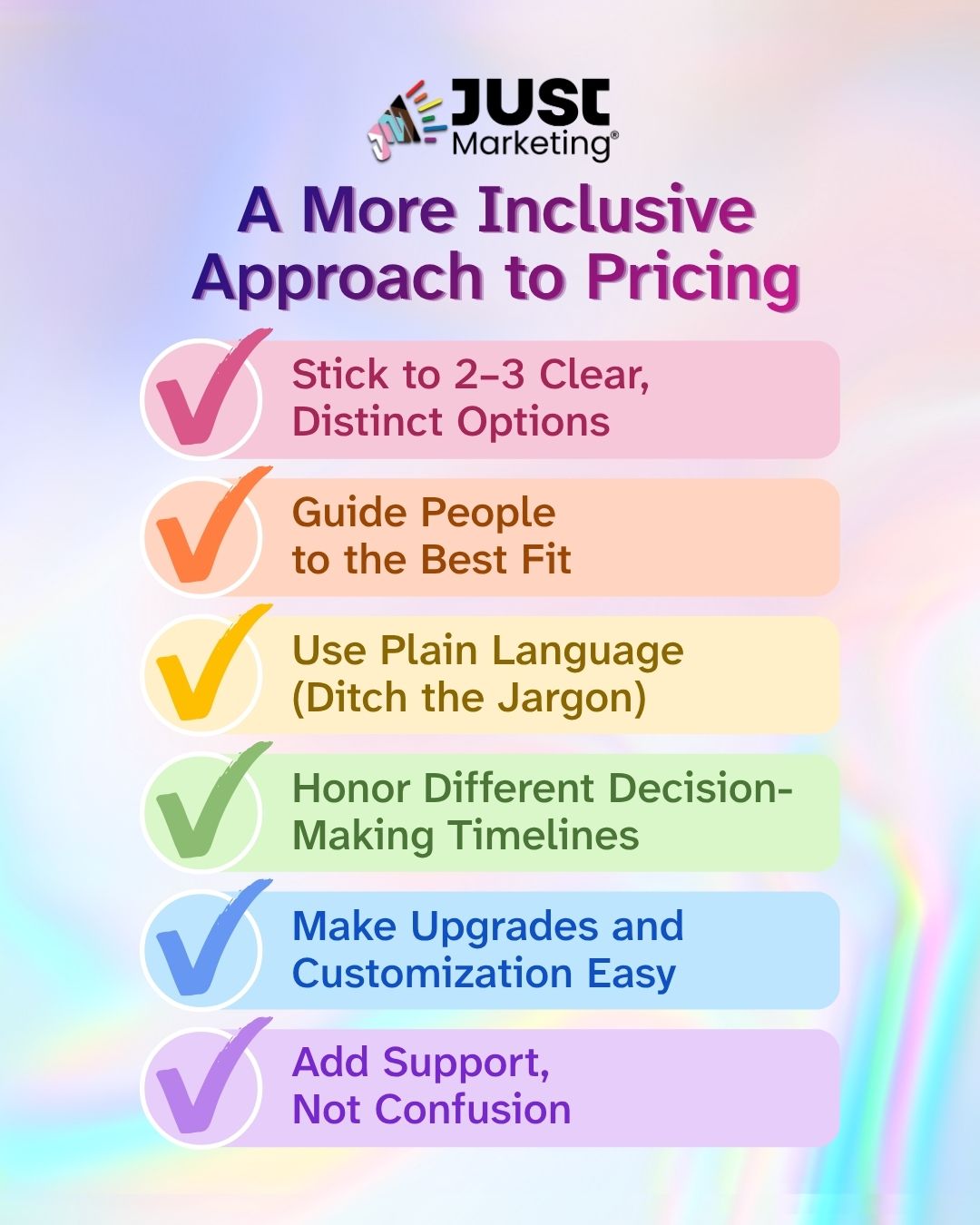
Let’s break down how you can create pricing options that are both inclusive and effective:
1. Stick to 2–3 Clear, Distinct Options
More isn’t always better. Offering two or three thoughtfully crafted options gives people choice without cognitive overload. Make each one meaningfully different so the decision feels intuitive – not like a spot-the-difference puzzle.
2. Guide People to the Best Fit
Don’t assume your audience knows which offer is right for them. Include supportive language like:
- “Start here if you’re just getting started…”
- “This one’s perfect for folks who need 1:1 support…”
- “Best value if you already have momentum and want to scale…”
This removes pressure and builds confidence – without the pushiness.
3. Use Plain Language (Ditch the Jargon)
Your pricing page isn’t the place to flex industry lingo. Speak directly and clearly about what each offer includes and the outcomes it supports. Bonus: this makes your copy more accessible to neurodivergent buyers and non-native English speakers.
Read more about Plain Language.
4. Honor Different Decision-Making Timelines
Not everyone can – or wants to – decide right away. Instead of “act now or miss out” pressure, create offers that leave space for folks to revisit with fresh eyes. You can offer limited-time bonuses without making people feel punished for needing more time.
5. Make Upgrades and Customization Easy
Let people start with a simpler option and grow with you. Consider offering a clear, kind upgrade path (e.g., “If you start here and decide to expand later, we’ll apply your investment toward the next level.”). That’s good business.
6. Add Support, Not Confusion
Optional: consider providing a short video walkthrough, a decision-making quiz, or a quick Q&A call link to help folks choose without second-guessing. These support tools reduce friction and show that you care about accessibility – not just conversion.
The goal here isn’t to strip your offers down to the bare minimum – it’s to clarify the value so your people can self-select with confidence, not confusion.
Because when your pricing options are accessible, your values show up in every click.
Progress Over Perfection
If your current pricing options feel a little cluttered or unclear – take a breath. You’re not doing it wrong. Most of us built our offers by watching what others were doing… often without realizing those models weren’t made with inclusivity in mind.
This isn’t about perfection. It’s about progress.
Shifting toward more accessible, neurodivergent-friendly pricing is a powerful act of Just Marketing®. It’s a way to say, “I see you. I respect your process. I want this to feel good for both of us.”
And here’s the thing: when you simplify your pricing options, you’re not “leaving money on the table.” You’re inviting the right people to say yes – without confusion, shame, or second-guessing.
That’s ethical. That’s sustainable. And yes, that’s inclusive marketing in action.
Let’s Keep the Conversation Going
Got thoughts about pricing overwhelm – or a story of when you bounced off a cluttered offer? I’d love to hear it. Let’s connect on LinkedIn or Instagram.
Ready to simplify your pricing options and align your offers with your values? Learn more about working together.
Want more accessible, ADHD-friendly marketing tips delivered with a side of kindness? Join my email list.
FAQs
Decision paralysis (also called choice overload or analysis paralysis) happens when having too many options makes it hard to choose anything at all. Psychologist Barry Schwartz explored this idea in his book The Paradox of Choice. For buyers, it often leads to clicking away instead of deciding.
Two or three clearly different options work well for most service-based businesses. That gives people meaningful choice while keeping the decision manageable. Each tier should have an obvious purpose so buyers can quickly see where they fit. Read more about psychological pricing.
Sharing prices openly is a big accessibility win, since it lets people decide whether an offer fits their budget without booking a call first. If your work is custom, a “starting at” price or a typical range still gives helpful context. Transparent pricing builds trust from the very first visit.
Add short guidance under each option, like “Start here if you're just getting started” or “Best if you'd like 1:1 support.” A quick quiz, a short video walkthrough, or a link to ask questions can help, too. Clear direction reduces second-guessing.
Decoy pricing adds an option mainly to make another one look like a better deal. A more ethical approach makes sure every tier genuinely serves a type of client and is priced honestly for what it includes. Learn more about the decoy effect and how to price ethically instead.
Use plain language to describe what each option includes, skip industry jargon, and keep comparison charts simple and easy to scan. Leaving room for people to come back later, without pressure, supports different decision timelines. Learn more about writing in plain language.