Ever landed on a sales page only to be hit with a blinking countdown timer and a bold “Limited-Time Offer – Act Now!” – and instead of feeling excited… you felt overwhelmed, pressured, maybe even a little frozen?
The gist: Exclusive discounts are limited-time deals that unintentionally exclude people, like 24-hour flash sales or one-time offers that reward only the fastest deciders. More inclusive offers share timelines in advance and add bonuses for early action, so everyone who needs more time still feels welcome.
Part of the Marketing Accessibility series.
Urgency is a go-to tactic in traditional marketing. And sure, limited-time offers can drive quick decisions – but they can also unintentionally exclude the very people we’re trying to serve, especially folks who are neurodivergent, disabled, or navigating executive dysfunction.
The truth is, while urgency-based promotions aren't always manipulative, they’re often inaccessible. And when we build our offers around pressure and scarcity, we risk creating experiences that feel more stressful than supportive.
In this post, we’re unpacking the hidden accessibility barriers behind the classic limited-time offer – and exploring inclusive, values-aligned alternatives that don’t leave people behind.
Let’s shift from FOMO-fueled sales to trust-based invitations.
Limited-Time Offers – High Conversion, Low Consideration?
The limited-time offer has earned its place in the marketing playbook. It creates urgency, nudges people toward quick action, and can be a powerful tool for boosting conversions. The problem? It often prioritizes speed over accessibility.
When you build your offer around a ticking clock, you're assuming that everyone can make fast decisions, absorb all the info on the spot, and take action within a narrow window. But for many neurodivergent folks – and honestly, for plenty of people outside of that label – this just isn’t how our brains work.
Think about it:
- Someone with ADHD might experience time blindness, making it hard to feel the urgency of a 48-hour sale (until it’s already passed).
- An autistic buyer may need more time to process the details of your offer and weigh the decision before committing.
- Folks with anxiety or trauma backgrounds might feel shut down by high-pressure tactics that mimic manipulative experiences they've had in the past.
What’s meant to spark action can actually spark overwhelm. And when people feel overwhelmed, they’re more likely to bounce than buy.
Accessibility check-in: If your offer only works for fast deciders, who’s being left out?
Why Can Limited-Time Offers Exclude People?
The issue with limited-time offers isn’t that they exist – it’s how they’re used. When urgency becomes the centerpiece of your marketing, it often overlooks the real human beings on the other side of the screen.
Especially in service-based businesses – where trust, clarity, and alignment matter – a pressure-filled “buy now or miss out forever” approach can do more harm than good.
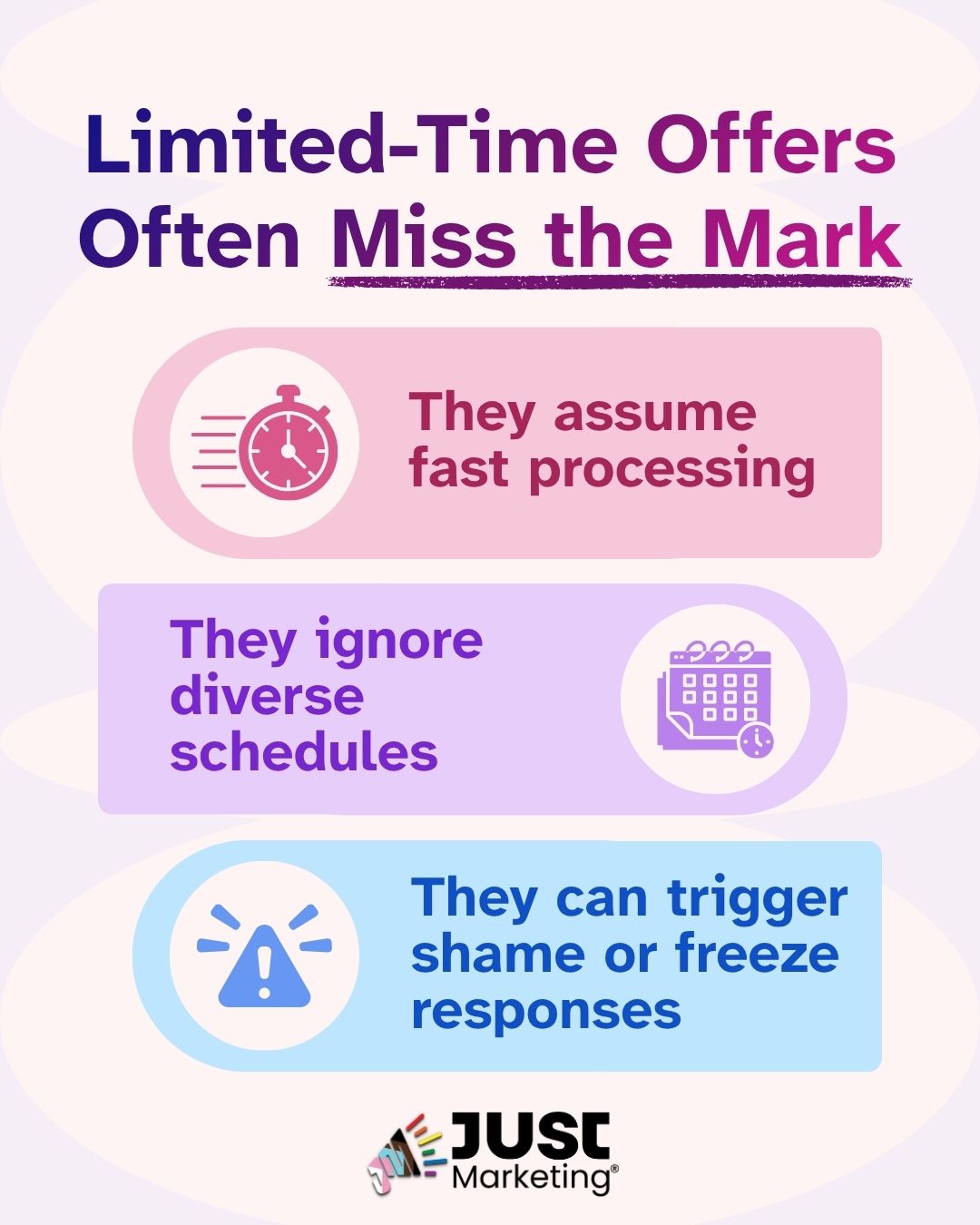
Here’s why limited-time offers can unintentionally exclude people:
- They assume fast processing. Not everyone can take in a bunch of information and make a confident decision in 24 hours. Neurodivergent folks, especially, may need extra time to regulate emotions, process information, or consult support systems.
- They ignore diverse schedules. People in different time zones, parents juggling unpredictable routines, folks navigating chronic illness – all may miss tight deadlines through no fault of their own.
- They can trigger shame or freeze responses. If someone wants to buy but can’t decide fast enough, the offer becomes a source of stress, not empowerment.
This doesn’t mean urgency is inherently unethical – it just means we need to be more intentional about how we use it.
Urgency can drive conversions, but accessibility builds trust.
If we want our work to be inclusive and trauma-informed, we have to ask: Does this limited-time offer invite or exclude?
What Can I Offer Instead of a Limited-Time Discount?
You don’t have to abandon urgency entirely – just rethink how you use it. Ethical marketing doesn’t mean you can’t have boundaries or timelines. It means those timelines are clearly communicated, spacious enough to accommodate more people, and designed to empower rather than pressure.
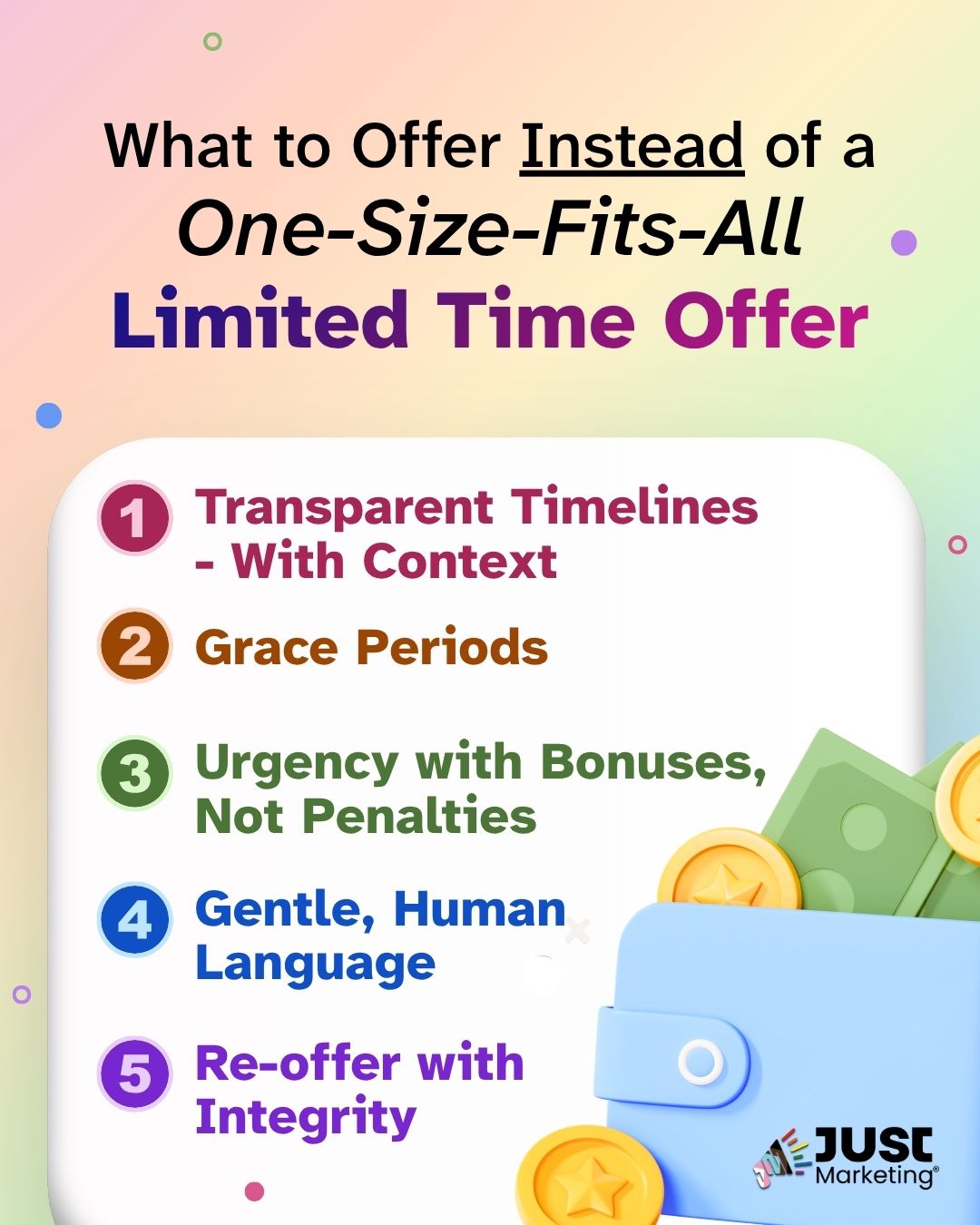
Here are inclusive, values-aligned alternatives to traditional limited-time offers:
1. Offer Transparent Timelines – With Context
Instead of dropping a surprise 24-hour deal, give folks a heads-up. Let your community know when an offer is coming, how long it’ll be available, and why there's a time limit. This builds trust and gives people time to prepare.
Instead of: “Flash Sale! Ends in 12 hours!”
Try: “Doors open Monday and close Friday so I can focus fully on serving the group.”
2. Include Grace Periods
Let people know they can reach out if they need a little extra time – and mean it. A quiet note like, “Need a bit more time? Message me – I’ve got you,” can make someone feel seen, safe, and supported.
This doesn’t hurt your integrity – it reinforces it.
3. Build Urgency with Bonuses, Not Penalties
Rather than discounting for speed, try adding value.
For example: “Sign up by Friday to get a bonus 1:1 call.”
That way, people aren’t punished for needing more time – they’re simply opting in to a slightly different version of the offer.
4. Use Gentle, Human Language
Words matter. The difference between “Only 2 spots left – don’t miss out!” and “This offer is open until Friday or until the final spots are filled – whichever comes first” is subtle, but powerful. One triggers scarcity. The other provides clarity.
Instead of: “Buy now before it’s gone!”
Try: “This offer is available through Friday – come back when you're ready.”
5. Re-offer with Integrity
Don’t pretend something is a once-in-a-lifetime opportunity if it’s not. It’s okay to say, “This round is closed, but I’ll be offering it again next quarter.” Clarity creates calm.
Accessible marketing is still strategic marketing. You’re not losing momentum – you’re gaining long-term trust.
Accessibility Is a Selling Point: Your People Will Thank You for Slowing Down
When you build offers that consider how people actually make decisions, they feel it – and they appreciate it.
For many neurodivergent folks (and let’s be honest, for plenty of neurotypical folks too), fast-paced sales strategies feel more like pressure cookers than invitations. When you remove that pressure and allow space to breathe, you create something radical in the marketing world: Safety.
Safety builds trust.
Trust builds connection.
Connection builds sales – and sustainable relationships.
These are the offers that get bookmarked, shared, and circled back to – because they respect the buyer’s process instead of trying to override it.
Being accessible isn’t just “nice” – it’s a values-aligned business strategy. When your marketing reflects care, flexibility, and trust, you attract clients who value those things too.
You don’t have to shout “BUY NOW!” to be successful. Sometimes, a gentle “I’m here when you’re ready” goes further.
Let’s Redefine What a “Limited-Time Offer” Looks Like

Limited-time offers aren’t inherently unethical – but they’re often inaccessible by default. And if your goal is to build a business rooted in justice, inclusion, and real human connection, then the way you structure your offers matters just as much as the offer itself.
By rethinking urgency, softening your sales language, and offering flexibility, you’re not just being “nice” – you’re being strategic. You’re inviting more people into your world in a way that feels safe, respectful, and aligned.
You don’t need a countdown timer to be successful. You need clarity, compassion, and the courage to do things differently.
Because when people feel seen, they’re far more likely to say yes.
This is part of a larger conversation around accessibility and inclusivity in your offers – and it’s one we need to keep having if we’re serious about building ethical businesses that don’t leave people behind.
Want to Create Offers That Welcome Everyone?
Ethical marketing isn't about doing more – it's about doing what matters.
Let’s keep this convo going:
- Connect with me on LinkedIn or Instagram – I'd love to hear your thoughts on making offers more inclusive.
- Ready to build ethical offers that convert and feel good to sell? Learn more about working together.
- Want regular, no-pressure insights in your inbox? Join my email list.
FAQs
Limited-time offers can be completely ethical when the deadline is real and clearly explained. They become manipulative when the urgency is invented or the deadline keeps resetting. Sharing the reason behind your timeline, such as a program start date, helps buyers trust the offer.
Giving people several days, such as opening doors on a Monday and closing them on Friday, leaves room for different schedules and decision styles. Announcing the dates ahead of time helps even more, since people can plan instead of scrambling. Very short windows, like 12 or 24 hours, tend to leave many buyers behind.
A grace period is a little extra time you offer after a deadline for anyone who needs it. A simple note like “Need a bit more time? Message me” lets people know they won't be penalized for needing space. It's an easy way to make any promotion more accessible.
A bonus for early action, like an extra 1:1 call, rewards quick deciders while keeping the core offer available at the same price for everyone else. That way, people who need more time still get full access to what they came for. It keeps urgency positive and pressure-free.
State the date clearly, explain why it exists, and use calm, human language like “This offer is available through Friday, so come back when you're ready.” Skipping countdown timers and “don't miss out” phrasing keeps the focus on clarity. For more, see why countdown timers can backfire.
Yes! Many offers run in rounds, and being upfront about that builds trust, as in “This round is closed, and I'll offer it again next quarter.” The key is avoiding claims that something is once-in-a-lifetime when it isn't. Learn more about the difference between real and artificial urgency.