“Lifetime access” sounds like the ultimate dream deal, right? One payment, forever benefits. No ticking clock. No pressure. Just you and your new course BFF, riding off into the sunset together.
But let’s pause for a second…
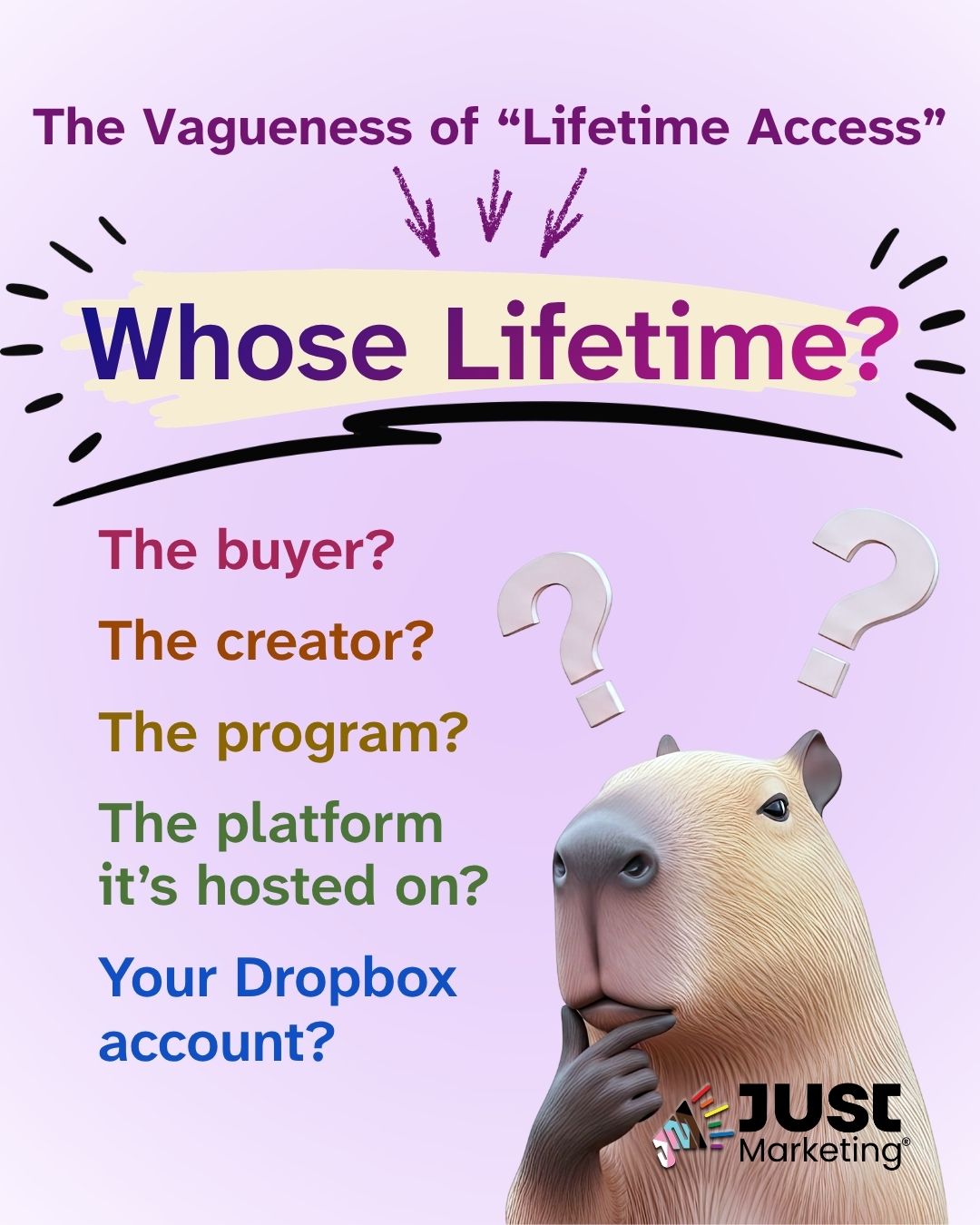
Whose lifetime are we talking about here?
The buyer’s? The business’s? The platform’s? The dog’s?! 🐶
The gist: Lifetime access is a promise that buyers can use a course or digital product indefinitely after a single purchase. It can be ethical when you define exactly what “lifetime” means, such as a guaranteed minimum access window and advance notice before any changes, so buyers know what to expect.
It’s a feel-good phrase that shows up everywhere – from digital courses to memberships to downloadables. And while the promise of forever might make sales easier in the short term, it can raise some sticky questions when we zoom out.
- Is offering lifetime access actually ethical?
- When does it genuinely support your audience – and when might it backfire?
- And how do we honestly set limits without leaning into scarcity, shame, or fear?
If you’ve ever offered (or considered offering) lifetime access – or been burned by it as a buyer – this post is for you. Let’s unpack the nuance, get clear on what’s helpful and what’s harmful, and explore how to communicate access in a way that’s rooted in trust, not tactics.
Because ethical marketing doesn’t have to be confusing – it just has to be human.
Table of Contents
What Does “Lifetime Access” Really Mean?
Let’s be real: “lifetime access” sounds solid, but it’s often as clear as mud.
In theory, it promises ongoing, unlimited access to a product, service, or community. But when you dig a little deeper, you realize… nobody’s defining whose lifetime we’re talking about.
- Is it the lifetime of the buyer?
- The creator?
- The program?
- The platform it’s hosted on?
- The lifespan of your Dropbox account or your Kajabi subscription?
And here’s the thing: the internet moves fast. Platforms shut down, business models shift, and sometimes a one-person show just doesn’t have the capacity to support a “forever” promise – especially when forever comes with tech updates, accessibility improvements, and long-term user support.
When sellers don’t define what “lifetime” means, it puts everyone at risk of disappointment or distrust down the line – especially for neurodivergent folks who often take language literally. (“You said lifetime… I believed you!”)
So before we can decide if it’s ethical or helpful, we’ve got to ask:
Is “lifetime access” just a marketing shortcut – or a clear, conscious choice?
Spoiler alert: it can be both – with the right intention and communication.
Let’s dig into the ethics next.
Is “Lifetime Access” Ethical?
Ethical marketing is all about transparency, consent, and respecting your audience’s autonomy. So where does “lifetime access” land on the ethical scale?
Short answer?
It can be ethical – if you’re clear, realistic, and not making promises you can’t keep.
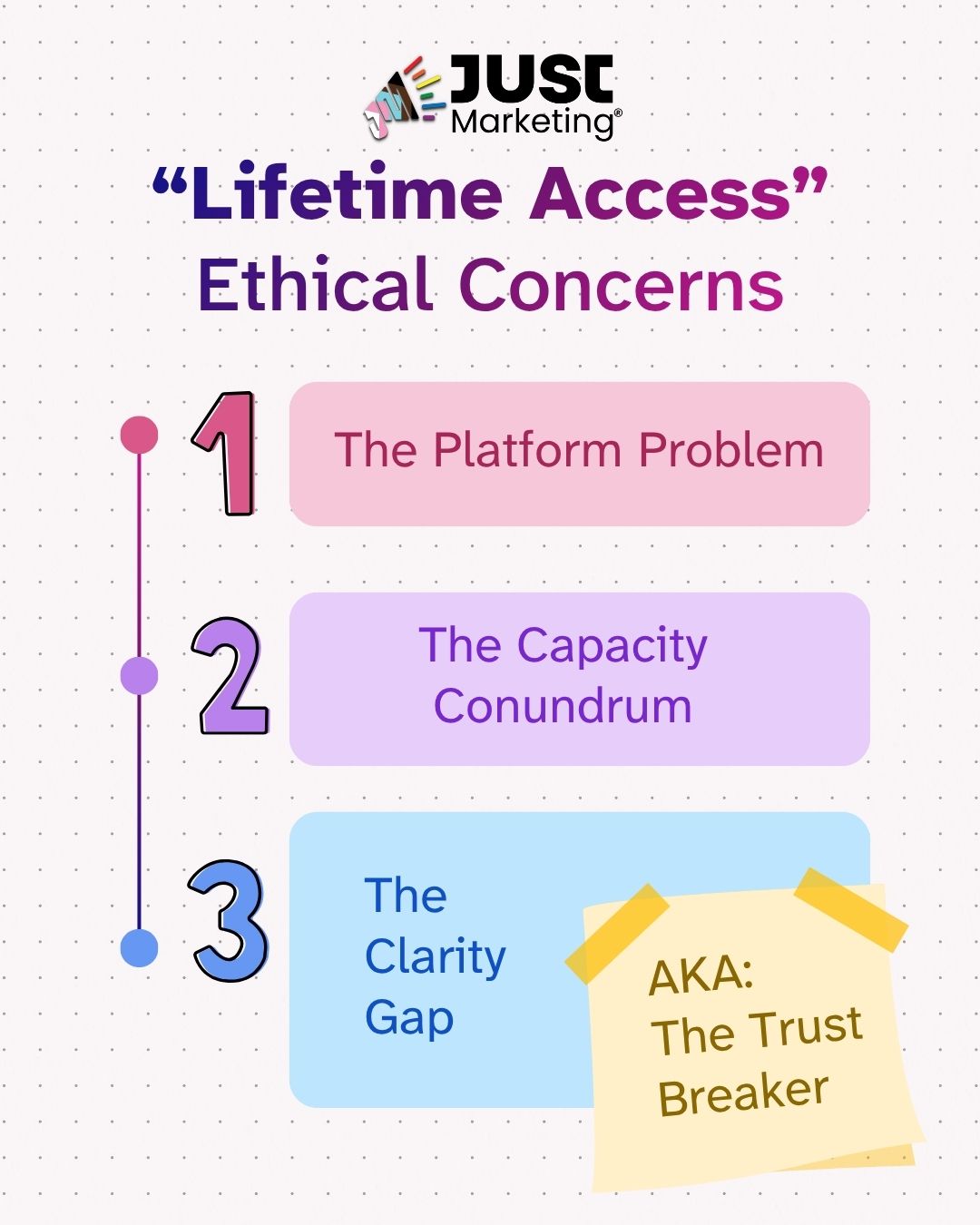
But let’s unpack some of the common ethical pitfalls that crop up with “lifetime” offers:
1. The Platform Problem
You might truly want to offer lifetime access…
…until the software you use shuts down, gets bought out, or jacks up its prices beyond what’s sustainable.
If your course lives on a third-party platform (hi, Teachable/Kajabi/Mighty Networks), you don’t fully control the lifespan of that access – and that’s a risk you need to acknowledge.
Ethical issue? Not the change itself – but failing to prepare people for that possibility.
2. The Capacity Conundrum
Many of us – especially solo creators – grow, pivot, or hit capacity walls. What felt doable when you had 5 students may feel impossible with 500. Offering evergreen support or updates forever can quietly turn into unpaid labor and burnout.
Ethical issue? Offering forever-access support without boundaries is a fast-track to overextension – and potentially failing your people down the road.
3. The Clarity Gap (AKA The Trust Breaker)
This is the big one: lack of clarity.
When you say “lifetime” but mean “until I stop running this program,” that’s a disconnect – and it can lead to disappointment, confusion, or loss of trust… especially among folks who need structure and consistency to feel safe and supported.
Remember: neurodivergent buyers (and many others) may interpret “lifetime” literally. If you don’t mean that, don’t say it.
The Just Marketing® Take
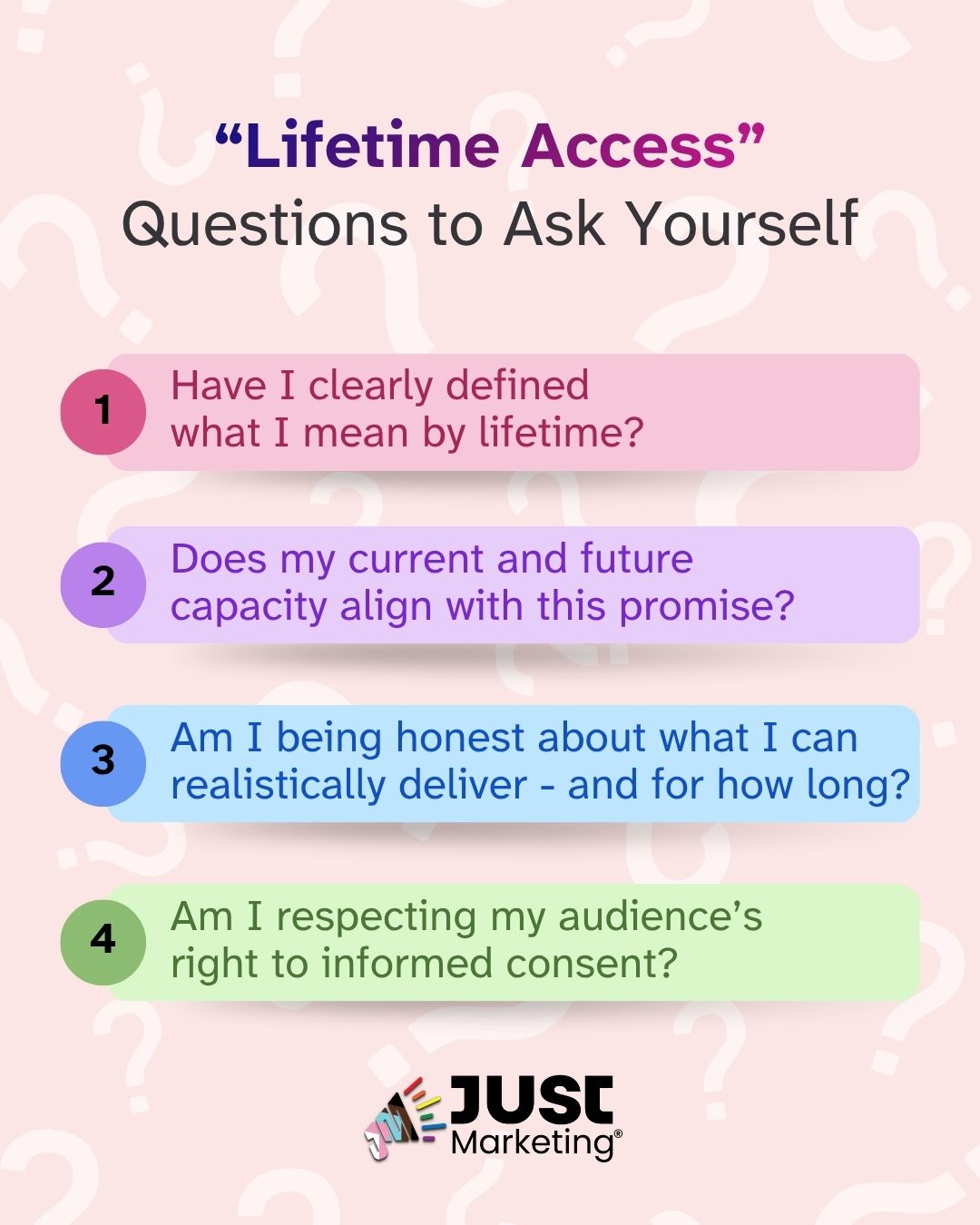
Marketing can be bold and clear without being fear-based or manipulative. So instead of saying “lifetime” to sweeten the deal, ask:
- Have I clearly defined what I mean by lifetime?
- Does my current and future capacity align with this promise?
- Am I being honest about what I can realistically deliver – and for how long?
- Am I respecting my audience’s right to informed consent?
If your answer is “yes,” you’re on the right track.
“Lifetime access” isn’t inherently unethical – but vague or unrealistic promises are. Ethical marketing isn’t about being perfect – it’s about being clear, caring, and courageous enough to tell the whole truth.
When Is Lifetime Access a Good Idea?
Okay, so we’ve established that “lifetime access” can get a little murky. But let’s not throw the whole concept out with the ethical bathwater.
There are times when offering lifetime access makes sense – and can actually support your audience in inclusive, empowering ways.
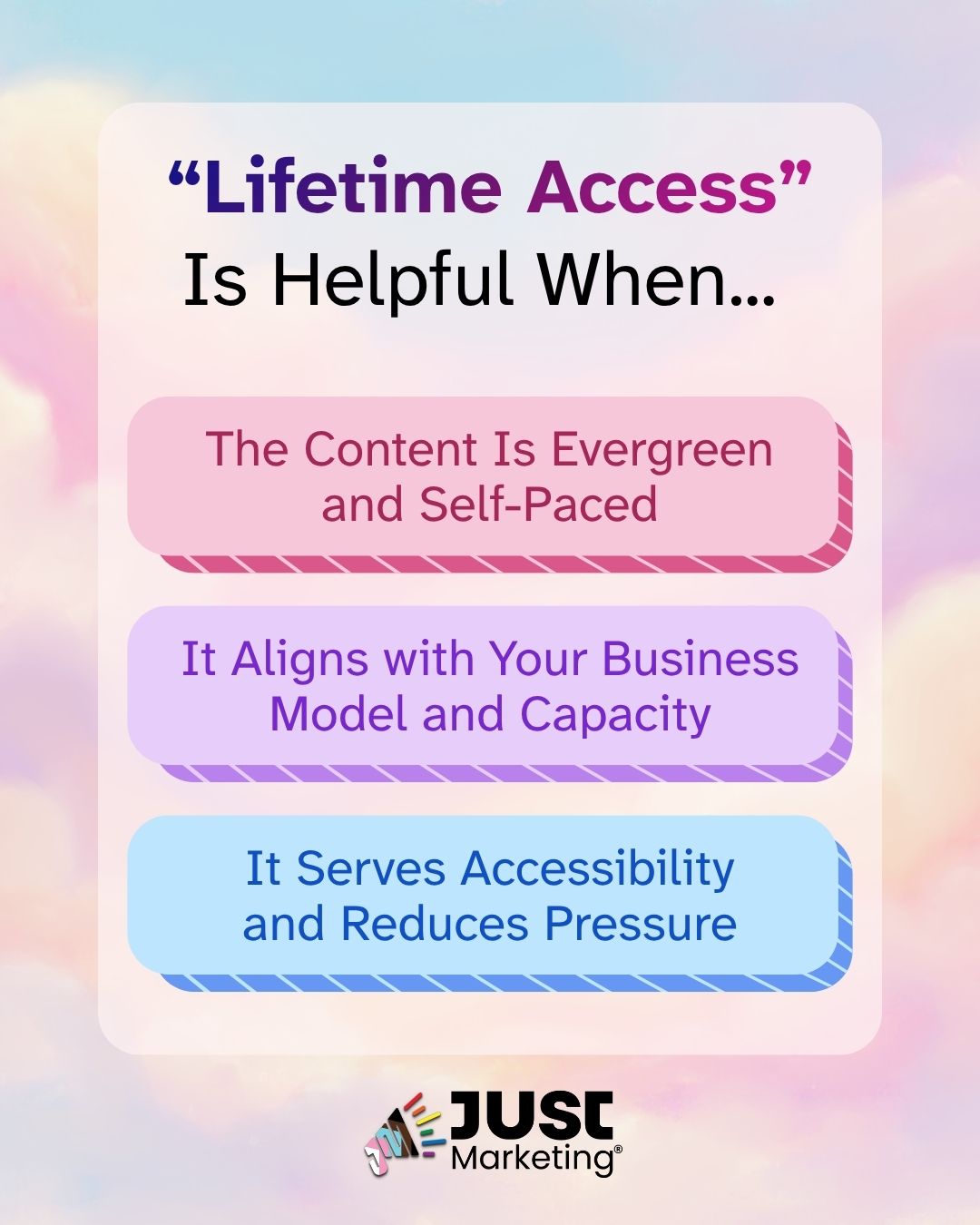
Here’s when it works well (and ethically):
1. When the Content Is Evergreen and Self-Paced
If your offer is made up of pre-recorded videos, worksheets, or guides that don’t require constant updates or live support, then giving someone long-term access could be a win-win.
- Your audience gets the breathing room to learn at their own pace.
- You’re not committing to ongoing energy or support you can’t sustain.
Bonus: This kind of structure is ADHD- and spoonie-friendly (for folks managing limited energy) – letting folks come back to the material when they’re ready and how they learn best.
2. When It Aligns with Your Business Model + Capacity
Let’s say you’ve created a low-ticket offer that you want to set-and-forget. There’s no need to overcomplicate it. If it doesn’t require live maintenance, updates, or community moderation, “lifetime” might genuinely be the simplest solution.
Just remember to define the terms (you knew I’d say that, right?).
A quick line like:
“Lifetime = as long as this program exists and I’m able to host it on this platform”
…goes a long way toward keeping things kind and clear.
3. When It Serves Accessibility + Reduces Pressure
For many neurodivergent or disabled folks, rigid timelines are more stressful than supportive.
Offering long-term access (with clear expectations) can make your program more inclusive, especially for people who:
- Need to pause and restart due to fluctuating energy levels
- Process information non-linearly
- Struggle with traditional launch timelines or content “drip” pacing
Forever Should Still Have Structure
Even if you decide to offer lifetime access, that doesn’t mean it has to be undefined.
You can be generous and boundaried by:
- Offering a generous minimum access window (e.g., “at least 2 years”)
- Committing to advanced notice if/when anything changes
- Providing downloadable versions or backups if your platform shifts
Because “lifetime” should never mean your business is stuck in a time capsule. You get to evolve and honor your people.
How Do I Set Access Limits Without Scarcity Tactics?
Let’s get one thing straight: setting limits doesn’t make you mean.
In fact, boundaries build trust – especially when they’re communicated with clarity and care.
So if you’re moving away from offering “lifetime access,” or never felt aligned with it in the first place, here’s how to create healthy limits without falling into the fear-based marketing trap.
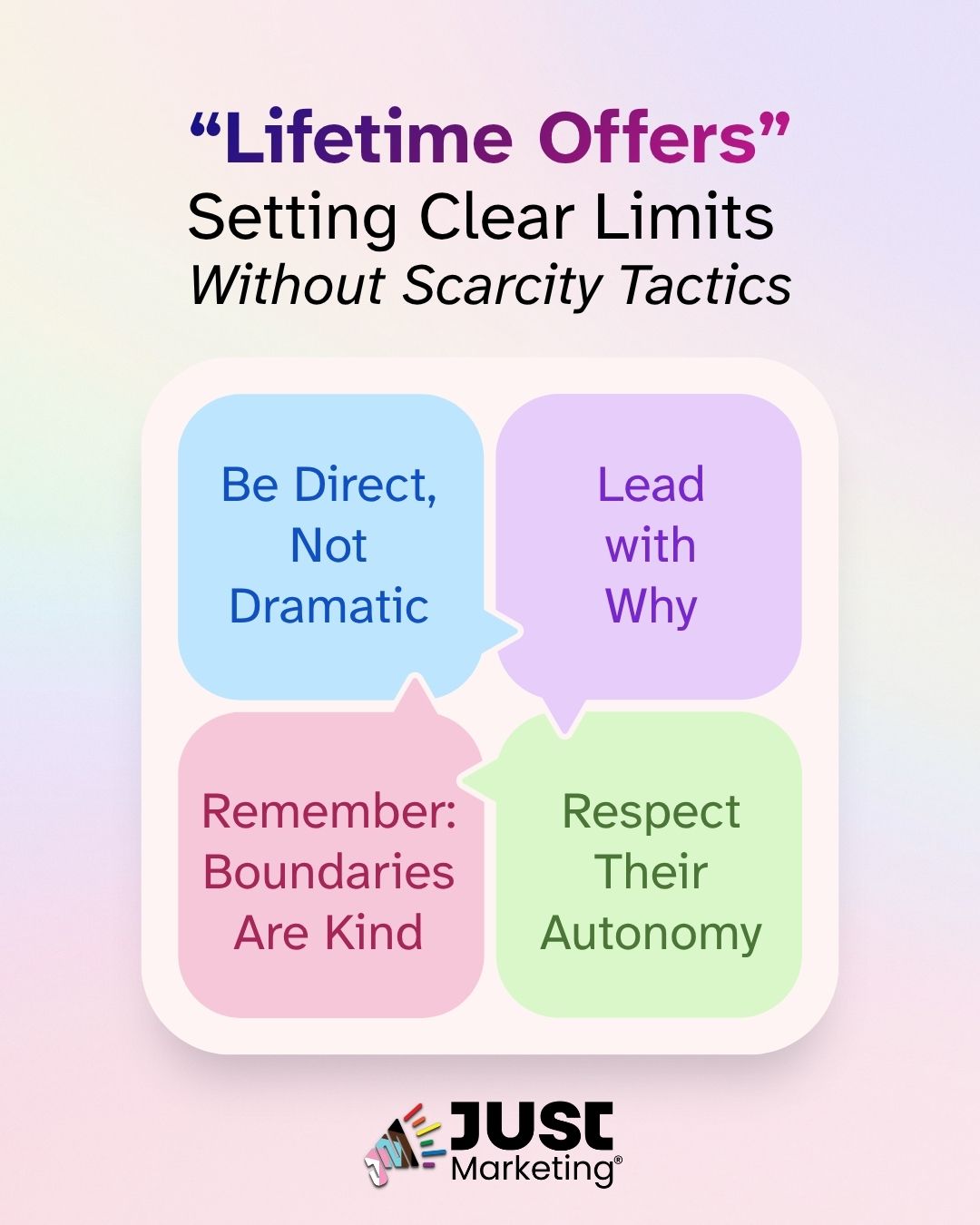
Be Direct, Not Dramatic
Fear-based marketing loves phrases like:
- “Only 3 hours left before it’s gone forever!!!”
- “You’ll never get this chance again!”
- “Miss this and you’ll regret it for LIFE.”
That kind of language triggers urgency and anxiety, especially for neurodivergent folks who might already be dealing with decision fatigue, time blindness, or emotional dysregulation.
Instead, try this:
- “Enrollment closes Friday so I can focus on supporting new students – it’ll reopen next season.”
- “You’ll have access for 12 months, with a reminder before it ends.”
- “Access is through December 2027 – I’ll give a 90-day heads-up if anything changes.”
Lead with Why
Context creates compassion. If you’re setting a limit, explain why – especially if your reasoning supports accessibility, energy sustainability, or program quality.
Try:
- “I’ve capped access at 12 months to help you focus and finish – and to keep updates manageable for my small team.”
- “This offer includes 6 months of community support so I can be fully present without burnout.”
- “Tech shifts fast – I guarantee access for 2 years and give advance notice before retiring programs.”
You're not creating fear – you're creating clarity. And that’s a gift.
Respect Their Autonomy
The opposite of scarcity isn’t endless availability – it’s informed choice.
When you communicate limits clearly and compassionately, you empower your audience to make decisions that align with their needs (not yours).
You might even include:
- A downloadable version they can keep forever
- A reminder system for access expiration
- Options to extend or renew when relevant
This shows your values in action – especially if your community includes folks navigating executive dysfunction or decision paralysis.
Boundaries Are Kind
Want to hear the truth? Most people appreciate boundaries – especially when those boundaries are predictable, consistent, and clearly communicated.
Because fear says: “Buy now or miss out forever.”
But kindness says: “Here’s what to expect – and I’ll walk you through it.”
Let’s normalize that.
What Can I Say Instead of ‘Lifetime Access'?
So you’re ready to ditch the vague “lifetime access” promise – but how do you actually talk about access in a way that feels ethical, supportive, and clear?
Here’s the good news: setting limits doesn’t mean you have to sound like a robot or legal contract. You can still be YOU – just with a little more clarity and care baked in.
Simple, Clear Alternatives to “Lifetime Access”
Instead of saying “lifetime access,” try one of these value-aligned options:
- “Access for at least 2 years, with 90 days’ notice before any changes.”
This builds trust and gives people time to plan. - “You’ll be able to download all materials to keep forever.”
Great for folks who need long-term access but don’t need to stay in a platform. - “Access lasts as long as this program is live – and I’ll always give a heads-up if I need to retire it.”
Transparent, flexible, and fair. - “Because things change, I guarantee access through [date], with clear communication about what comes next.”
Avoids future-you being stuck supporting content that no longer fits your biz.
Ethical Messaging Tips (Especially for Neurodivergent & Disabled Audiences)
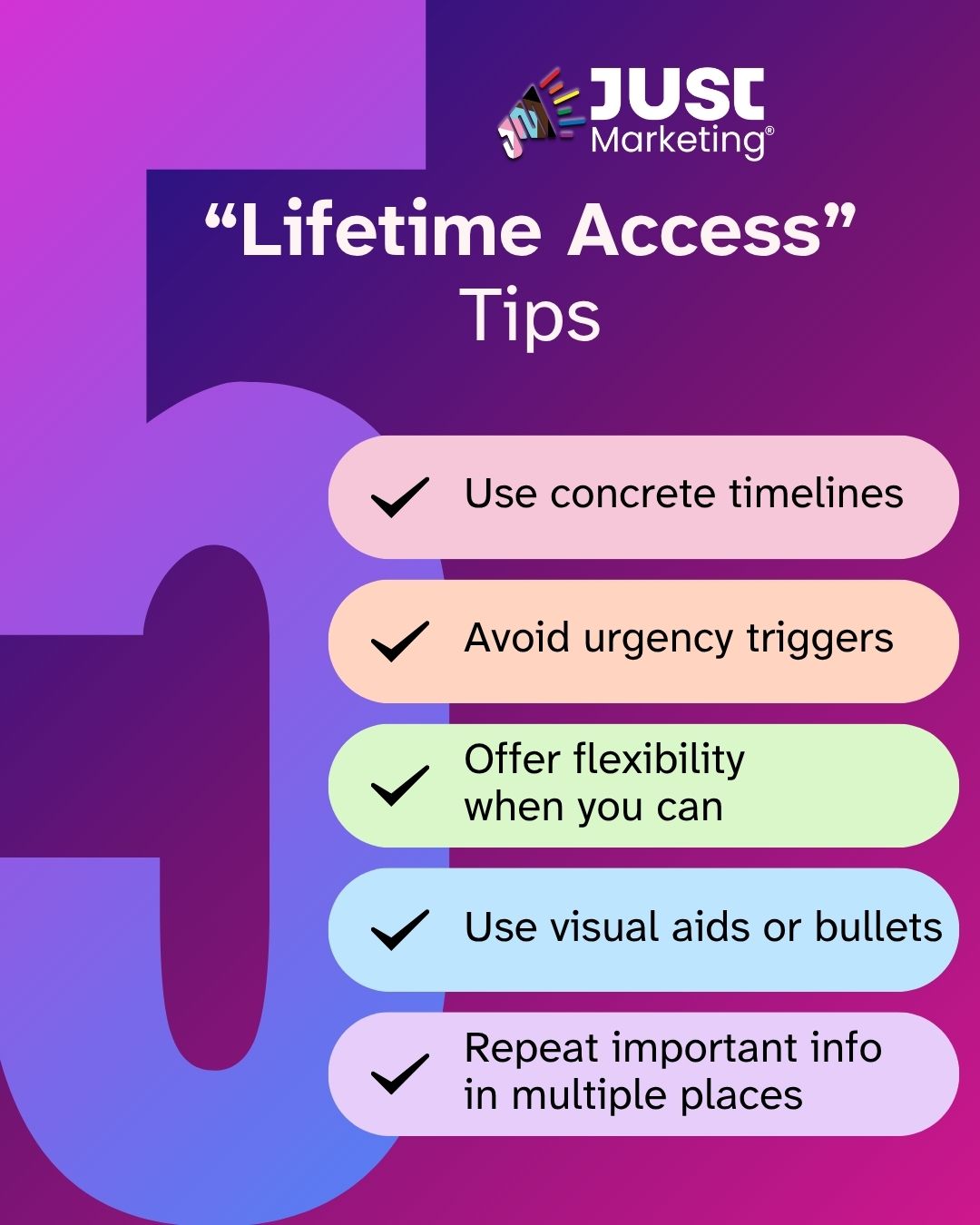
- Use concrete timelines.
Instead of “forever,” give an actual duration – even if it’s generous. - Avoid urgency triggers.
Skip the all-caps countdowns and shame-y language. Use neutral, calm phrases like: “This round closes Friday so I can focus on serving new clients.” - Offer flexibility when you can.
If possible, allow downloadable content, extensions, or accommodations. Mention this proactively! - Use visual aids or bullets.
Break it down in clear formats – like FAQs, comparison charts, or quick-reference graphics. - Repeat important info in multiple places.
Don’t make folks hunt for access details in the fine print. Put it in your offer summary, emails, and onboarding.
Template Language You Can Copy & Customize
Feel free to swipe and adapt any of these:
- Access Details:
You’ll have full access to the course content through December 31, 2026. If anything changes, I’ll give at least 90 days’ notice, plus downloadable versions so you’re never left hanging. - Why There’s a Time Limit:
I believe in keeping things fresh, relevant, and well-supported. That’s why access is set for 18 months – it allows me to maintain quality and make updates without burnout. - What Happens After:
If I ever retire this program, you’ll get plenty of notice and options to download or extend access. No sudden shutdowns here – pinky promise. - Downloadable Option:
Everything you need is available to download so you can revisit it whenever works for you – no log-in required after access ends.
Boundaries Build Trust
“Lifetime access” isn’t inherently bad – but it’s not always honest, helpful, or sustainable.
Being clear about access is a kindness. It respects your audience and your energy. And when you model that kind of transparency you build the kind of trust that no manipulative funnel ever could.
Because ethical marketing isn’t just about what you say.
It’s how you show up.
Let’s Keep the Conversation Going
If this post got your wheels turning (or gave you a tiny sigh of relief), I’d love to stay connected:
Let’s connect on social:
I’m always sharing ethical marketing tips and behind-the-scenes thoughts on LinkedIn and Instagram – come say hi and let me know your take on lifetime access!
Curious about what it’s like to work together?
If you’re looking for a marketing partner who gets your values, energy, and big-picture vision – without the pressure or performative fluff – learn more about working with me here.
Want more ethical marketing inspo in your inbox?
Join my email list for weekly-ish resources on marketing with ADHD, content strategy, and Just Marketing® – all in a way that supports your actual life and values.
FAQs
Lifetime access usually means you can use a course, membership, or digital product for as long as it exists, with no expiration date. Because “lifetime” rarely gets defined, it can refer to the life of the program, the platform, or the business. Clear terms help buyers know exactly what they're getting.
If a creator's platform closes or the program is retired, access can end even when it was sold as “lifetime.” Ethical creators plan for this by offering downloadable materials and giving advance notice before any changes. Checking the terms before you buy helps you understand what's promised.
Many creators choose a defined window, like 12 months or two years, paired with advance notice before access ends. The right length depends on how self-paced the content is and how much support you can sustain. A downloadable option lets students keep the materials long after the window closes.
Try a concrete promise like “Access for at least two years, with 90 days' notice before any changes,” or “You'll be able to download all materials to keep.” Explaining why you've set a limit, like keeping content updated without burnout, builds even more trust. For more on honest timelines, see how to create limited-time offers that don't leave people behind.
Downloadable materials are a generous way to make access last, since students can revisit them even if your platform changes. They also help people who learn at their own pace or prefer working offline. Mentioning the download option upfront makes your offer clearer from the start.
Flexible, self-paced access can be a big help for people who need to pause and return as their energy allows. Clear, concrete terms matter just as much, since many neurodivergent buyers take words like “lifetime” literally. Learn more about removing access barriers from your offers.