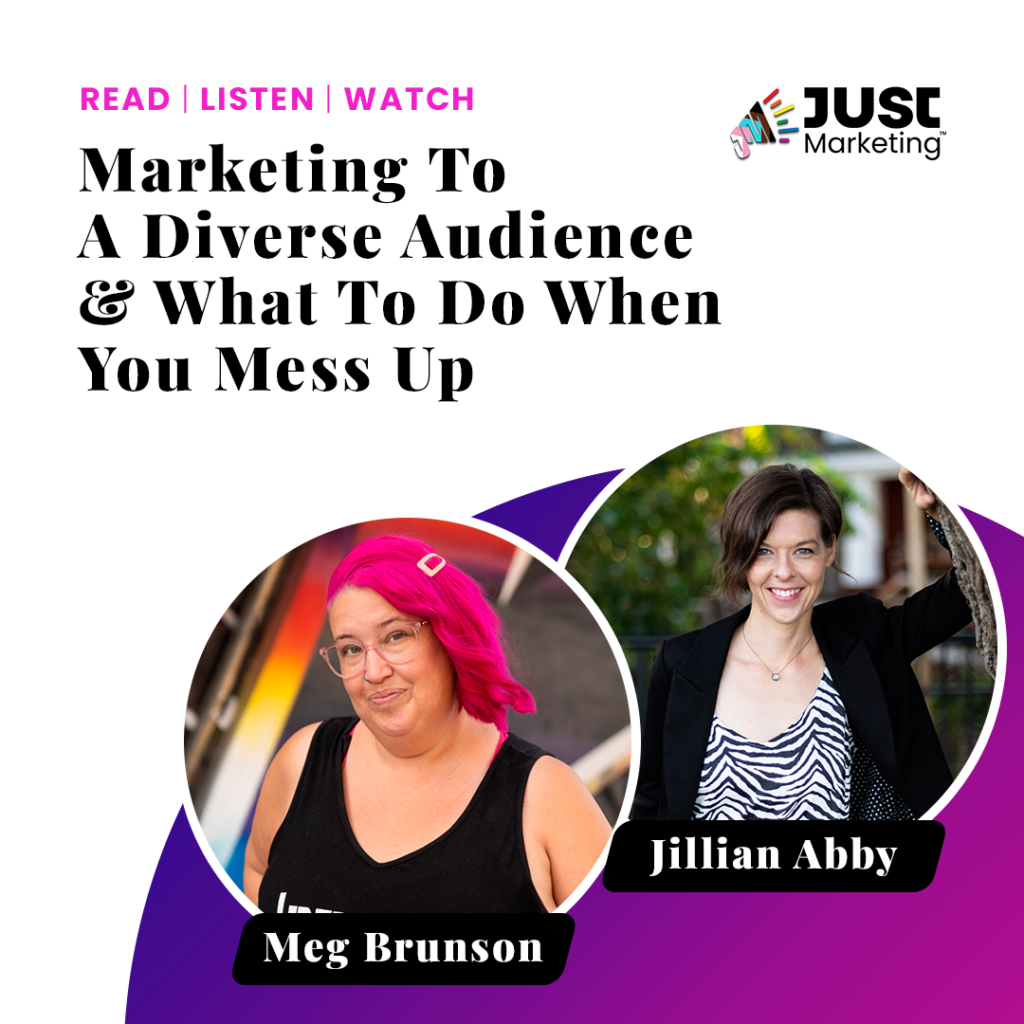
Jillian Abby joins Meg Brunson to discuss inclusive messaging. (recorded in 2022)
Language is always changing and evolving. Many things that were “okay” to say when we were young are now problematic, and there are likely things we're saying now that should be updated. So, how can we be sure that we're being respectful and avoiding stereotypes with our messaging – and what happens when we make a mistake?
(I said “when” because we're all bound to mess up at some point – let's prepare in advance!)
The gist: Inclusive messaging is language and imagery that welcomes people beyond your typical customer, like saying “caregiver” in place of “mom.” In this Just Marketing® episode, copywriter and author Jillian Abby shares how to “zoom out” your wording and what to do after a misstep: respond quickly with a sincere apology and update the content.
How to Make Your Messaging More Inclusive
Jillian encourages looking beyond your ideal client avatar and asking who else might want a seat at your table. These steps help you welcome them:
- Review your current language. Notice how you refer to your customers, especially terms tied to gender, family structure, age, or location.
- “Zoom out” one level. If your copy says “moms,” ask what broader word still fits, like “parents” or “caregivers.” “Son or daughter” can become “child.”
- Check your imagery. People look for themselves in your photos, so feature a wide range of couples, families, body types, ages, and abilities.
- Go beyond a rainbow logo. Updating your logo for Pride Month is a lovely first step. Year-round representation in your images and words shows deeper allyship.
- Consider every part of your audience. Think about sexual orientation, gender identity, ethnicity, family structure, geography, religion, ability, and mental health.
- Schedule with care. Check major religious holidays before booking events, launches, or promotions.
- Retire casual ableist words. Swap phrases like a “crazy” or “insane” sale for words like “wild” or “amazing.”
- Use inclusive language tools. Many writing apps now flag potentially exclusive terms, and sensitivity readers are a great option for bigger projects like books or courses.
- Write inclusive alt text. Describe images without assuming anyone’s gender, and mention race only when it matters to the image’s meaning.
What to Do When You Make a Messaging Mistake
Language evolves quickly, so missteps happen to everyone. How you respond makes all the difference.
- Act quickly. A prompt response keeps a misstep from snowballing in the comments.
- Learn why it landed badly. A little research helps you understand the concern so you can speak to it directly.
- Apologize sincerely. Keep it short and genuine, like “I’m sorry. This wasn’t our intention, and we understand why it was hurtful.”
- Update the content. Jillian prefers editing the post over deleting it, since deleting can look like an attempt to erase the mistake.
- Share what you learned. A follow-up post about the changes you’ve made shows accountability and growth.
- Listen with an open heart. Even if you see things differently, acknowledge that someone felt excluded. Holding space for that builds trust, while doubling down rarely ends well.
Looking for more support? Learn how to use inclusive language in your marketing.
Watch/Listen & Subscribe
Meg Brunson: Hello everybody. I am super excited because today I am here with Jillian Abby. Jill is one of my good business online friends, and so let me introduce you to her formally.
Jillian is a serial entrepreneur with businesses ranging from mobile massage therapy in the Caribbean to craft beer in Florida, and now she's copywriting for businesses worldwide. She is also the author of Perfectly Queer, published by Hay House Publishing in April of 2023, and that's their first LGBTQ plus subject matter book.
Super exciting and creeping up fast. I'm pretty sure I already pre-ordered it, so I cannot wait to get my hands on that book. Jillian's Passion Project is her blog site QueerAbby.com, where she answers honest questions and shares thoughtful perspectives to build bridges of understanding. You can also find Jill podcasting on Life And Love In The Q with co-host Dr. Treisha Peterson. Jill, I'm so excited. I feel like one thing you didn't put in your bio that I'm gonna like just share is that we have another similarity. We're both native to Rochester, New York, and huge Buffalo Bills fans, and this is our year, so yay.
You did say you were a Bills fan, right? Even though you're not a big like watcher.
Jillian Abby: Yes. I'm not a big sports ball fan, but I feel like the Bills are like my children, where I will always be proud of them and support them, but I don't necessarily wanna see everything that they're doing.
So that's the relationship there.
Meg Brunson: I love that. I love that so, so much. So the structure of today's session is you and I are gonna have a little chat and then you are gonna take the mic, and deliver some training for us on inclusive messaging, and then we'll come back for a Q & A.
So that's what people can expect today. And I'd love to talk, a little bit about that process of coming out for you because I feel like that, obviously the topic of your book, the topic of your podcast, the, it was a huge turning point in your life.
Can you talk about that, experience of coming out later in life?
Jillian Abby: Absolutely. So I came out at 38 years old. I am the L in the LGBTQ and. But I think the biggest misconception with it is that especially cuz there are more people who are coming out later in life and so a lot of people assume that it's kind of like a midlife crisis or that somebody got bored or you know, wanted a change and said, Hey, I think I'll try joining this marginalized group.
Really the process for me and why my book is called Perfectly Queer is because so much of my process and why it took so long to be comfortable in my identity was that I'm also a recovering perfectionist and perfectionism and people pleasing was a huge part of my life. And being achievement oriented and tying feelings of love to achievement. And so, I talk a lot in my podcast and in my blog and in the book as well around the biases that we carry. And even though I was raised in a home that I would never have considered to be homophobic in any way, you know, we had gay friends. I realized that there were a lot of biases that I carried internally and things that I had to unlearn.
Not only to love others better, but for my own self-love. So my journey was years and years of not only reeducating myself and then also incorporating therapy into that and some emotional work to integrate my body and memories with my lived experience. And life is just, You know, I can't speak highly enough of living in integrity and allowing people to live the identity that is most truthful to them, because just so many beautiful things can unfold from that.
Meg Brunson: I love that you mentioned how, like you didn't, even though you grew up in an open and accepting home, you still went through some of that difficulty.
Jillian Abby: Absolutely. It was an open and accepting home. But at the same time, you know, one phrase that stands out to me is when in my teenage years, I remember my mom saying to me, “I would never want a gay child, life's just harder for them.” And I understand before anyone picks up a pitch pitchfork and is ready to attack.
I do understand from a parent's perspective wanting to create ease in our own child's life. And I think more interesting than that though, and this is something that I still notice a lot and honestly, something that I was guilty of myself for a while is just assuming heterosexuality for everyone.
Or assuming cisgender for everyone. And really through my own process and now so much through my messaging is just leaving space for people to explore who they are and then when they know who they are or they feel who they are, that they feel comfortable and safe expressing that.
And so that's why I'm so excited about today too, because. It's not only setting up those safe spaces personally, but also within our businesses and how we interact with our customers.
Meg Brunson: I feel like I went through a similar process of like, why do we assume that everybody is straight?
Is hetero, and like you have to come out. If you're not, like, why can't it just be. People love who they love, and we accept that. Like Why does anybody have to come out? Period. Why do we need that? But, and I digress.
Jillian Abby: That's a whole nother, that's a whole nother interview
Meg Brunson: I know. It's like, I don't wanna get too far down that tangent, but it's just like, Oh, it hit me right in the heart, you know? It hit me right in the heart. I feel that So, When it comes. So let's transfer a little bit. You've gone through multiple businesses, right?
And you've done copywriting, which brings you right into the marketing sphere. So in the beginning, you probably had to figure out marketing for, you know, all the different business ventures you did, but you obviously did that because then you were providing marketing support through copywriting. So what is how did that process look and can you talk about what Just Marketing means to you from that lens?
Jillian Abby: Definitely. So I feel like my life is full of serendipity and just these beautiful moments that happened that, that seemed, it was a long and winding road that I didn't quite understand where it was going. And I'm really happy at the place where I've landed right now. But yeah, as you mentioned in my resume, I went from CPA to licensed massage therapist to craft beer bar owner.
I mean, my, my resume has covered a very wide range of things, and for a long time I wish that I could just find my place and my thing and I found that through writing, because I've walked in so many different shoes, had so many different types of lives, I feel like already in my life, living here, living in Bolivia for a while, living in the Dominican Republic for a while.
It's given me adaptability and kind of unique perspective. And so I fell into writing because a kombucha company said that they hired a PR agency and they're like, They don't get me. I'm a hippie in high heels. And the PR company was like, We eat steak, we drink wine. We don't get you, We don't know who you are or who your customers are.
So long story short, they asked if I would try and write a label for their kombucha brand. And I said, I'm not a writer. I've never done this before, but I'm happy to try. I enjoy writing and I said, If it works, pay me. And if it doesn't, no harm none cuz this isn't my gig. And so now that brand is 2 21 BC for any of you kombucha drinkers out there.
And so my words are on their labels in whole foods across the United States and Publix and a lot of other A lot of other grocery stores and restaurants, which is really cool. So they were my first client. And then from there, just kind of naturally and organically the right people, the right businesses found me.
And I really love to help them create very, like, heart centered, soul-centered, honest posts and communications with our people. And so when you ask what Just Marketing is, for me, it is all about integrity and also equity and responsibility in our marketing and doing the best we can until we know better and then doing better. So it's evolving and evolved marketing that's always looking to improve.
Meg Brunson: I love hearing the origin stories, right? That, like you said in that answer, I'm not a writer and it's so funny now to know you and where you are and where you.
Where you are today with this book coming out in a few short months and to think that it all started with a handful of words on the label of a product.
Jillian Abby: Yeah. It's really wild. And I honestly am still trying to.
Sit in and be comfortable in the identity of writer. I do consider myself more of a storyteller just because my degree, I don't have a degree in writing. I still am horrible with comma placement. My grammar is highly questionable as my editors on my book will tell you, they're like, Honey, that's not even a full sentence.
But but I love to tell stories. I love hearing people's stories and I love translating that into a message, so it's been really cool. I'm so, so grateful for the position I'm in. Yes, it is. It's really just connecting the dots for people and I think some of the most powerful marketing out there is when we can take a story or take a moment or take a memory.
And then connect it to our product or our service. But you have to create, if you wanna be memorable, it has to create kind of a visceral response for whoever's viewing it or reading it. So we're always looking to move people in what they're seeing and how they're perceiving a company. And inclusive writing is so much a big piece of that of saying it's seeing the people who feel unseen.
Meg Brunson: Well, I cannot wait any longer. I would love to pass the mic and let you deliver your brilliance on the topic of inclusive messaging. What to say, what to do when you mess up. It's when we mess up, right? We have to get comfortable Yeah. In that discomfort. Like, language is always evolving and so we're gonna mess up.
I'm gonna turn off my mic, turn off my camera and allow you to present, and then when you're done, I'll come back from for some Q & A.
Jillian Abby: Hi, everyone. Thank you again so much for being here today because this work that we're talking about really is so important to business and it just, it speaks so much to your business and the fact that you want to be more inclusive in your marketing or maybe you already are, and I would love to know your tips as well because we all bring a new, unique perspective to this and can grow together. So when it comes to inclusive, Messaging in business when we're marketing, we create an avatar for who our ideal client is, and we may know who the majority of our customers are what age range they're in.
It may be what a certain geography that they live in, a certain family structure. There's a lot of different things that make up our customer avatar. And what I'm going to encourage you to do first and what we do with inclusive messaging is try and look beyond just the basic customer avatar and see who else may wanna see it at the table.
Or who is part of the group that we're not seeing? Those are the people that we're looking to bring in when we're doing our inclusive marketing. As Meg mentioned, our language is ever evolving and particularly at a dizzying pace nowadays. So, My little perfectionist heart struggles with the fact that I can't always get it right in the language and that somebody may feel excluded or somebody may feel hurt and may touch them in a certain way.
And and people are very vocal nowadays about sharing when they're feeling upset or excluded or something didn't hit right. So we will talk about that at the end because I think. That is really, again, a make or break point for companies is how they react to negative comments. The last piece is that I think when it comes to inclusive marketing, sometimes people shy away from it because it does mean changing the language that we use or changing the forms we use in our business. If you're an office space or a medical office it may be doing some revisions there. And some people wonder if the risk of potentially offending people is worth the reward if they just stick to the regular language and marketing that they're doing now, that works.
Is it worth it to expand and be more inclusive, but then also potentially be called out on it? I think companies that make the extra effort to identify those unseen or unrecognized audiences, it establishes your company as one that is progressive and people centric. And I think it shows that you're willing to put in the effort.
To really connect with and know your customers as opposed to going the easiest route with your communications. So again, I'm so glad you're here. As we mentioned before, I'm part of the LGBTQ community, so a lot of my discussion today will be around my perspective and experiences as a queer person.
Which is somewhat of a unique perspective too, because I did go through most of my life with people assuming that I was heterosexual, and so there were a lot of. Benefits and privileges that came with that, where I saw myself in a lot of advertising and marketing, and now I feel more what it's like to be excluded.
So I'll share some stories there as well. But talking about the financial benefit of inclusivity so pink money, Is a term that's used to describe spending by the LGBTQ community, and it accounted for $3.7 trillion in spending power worldwide in 2019. Of the people they surveyed, 90% of pink money purchasers are willing to put money towards businesses that support the LGBTQ community, while anti LGBTQ businesses are often boycotted.
So just in this, the LGBTQ customer base, if that is a, an appropriate base for your product or service, also tends to be a small but very loyal customer base. When American Airlines saw its pink money revenue increase it American Airlines launched a campaign that was actively marketed towards the LGBTQ plus community, and their revenue went from $20 million in 1994.
To $193.5 million in 1999, so five years and $173.5 million difference in spending just for seeing customers that were not being recognized at the time by other airlines. So something to keep in mind with your business. Not only are you being a do-gooder but also there really is it's a business savvy decision to be inclusive.
So what does inclusivity looks like? What I would encourage you to do is to start with your current customer base and really kind of take a critical eye at the marketing that you've done so far and how you refer to your customers. Is your customer base, one that is gender focused, where maybe you're targeting women or you're targeting men.
Does your business target families? Does it target athletes? Does it target Americans or Canadians, or are you worldwide business? Once you start doing that, you'll start seeing the terminology that is specific to the communities that you're working with. And so the next step I encourage you to do is what I call the zoom out.
So like we're becoming a drone we're gonna go a level up. So say your business is geared towards mothers. And so there's a lot of language in your marketing, imagery in your marketing that has images of mothers, mom, mother has used often in your marketing. If we were to zoom out a level, The question I encourage you to ask is, what is a term I could use that would include mother, but also maybe include other caregivers that would, that could be part of your market and could also be buying your product.
And so again, caregiver is another potential term. If we wanna really just zoom up one layer, we could say, parent. So now you're addressing parents instead of just mothers. If, again, if you wanna take it up even another level. Caregiver there, because not everyone fills a parental role, but they may be taking care of a child.
So if it's a, if it's a product for children that a caregiving adult would be interested in buying. And so really that is one, one the first step I would recommend in what you're doing with your marketing. Let's see. Even things like there's a lot of terminology out there about son and daughter, and that's something that we can change to child.
I don't think any, it's not erasing the son or daughter identity, it's just recognizing that there are also children out there who don't fit into that binary. And the word child is more inclusive to anyone that you're, any child that you're selling your product to. The next thing is to look at areas where you can bring bring this type of language into your business.
So obviously we do a whole lot of social media posts. It's not only in the imagery of your social media, but in the write ups you use, in the captions you use and in the captions you could have mom, parent, caregiver just to try and show that you are appealing to different levels and audiences there.
Just one story that I wanted to share from my personal experience is that this year I was engagement ring shopping. And obviously when it comes to engagement rings, the most common purchaser of engagement rings is going to be males. So I did find it interesting when I was looking for a ring for my partner, Jen, that it was a lot harder to find out which companies I felt safer for dealing with.
My biggest fear would be walking into a jeweler or working with a jeweler online. And expressing that I was interested in buying an engagement ring and having my relationship invalidated. So before I even made the decision of what business I wanted to go with, I looked at their websites, I looked at their social media to see what what kind of language they were using and what was out there.
There were a lot of companies who did what I would call first level inclusivity. Related to the LGBTQ and that's that during pride month, they changed their logo to a rainbow color. At least I knew in that case that it was most likely an LGBTQ ally. They were willing to show their allyship, which is great.
That is a great first step. The next thing though, is I would start looking at the images that they were using because I think we try and find ourselves in the imagery, and I know we're seeing that so much now. I won't get into the details of it all, but in TV shows and in movies where more are black, indigenous people of color, different body types, different ages, different abilities are all being represented more in media and we're seeing the reaction that all of those people are having to seeing themselves in that advertising or in that media, it really is so important. So looking at your photography, looking at the images that you're bringing in is really important to inclusivity as well. So I, the next step for me was looking for a company that featured same sex couples in their advertising.
And I did find one . So, At that point, I felt that it was a safer company that I could deal with and also somewhere where I wanted to spend my money. But the reality is that most companies out there were still primarily focused on males as buyers. And unfortunately that's not the only community that's looking at engagement rings.
In fact, there's a lot of women who like to research and pick out their own engagement rings as well. So in that area of business, they so many jewelers stuck very closely to their avatar of men buying engagement rings. And so being able to have the ability to zoom out a layer and say, Hey, you know what, there are other people who get engaged was helpful when I eventually found it.
Okay. Back to business. There's a lot of different categories that we can think about in our inclusivity. So obviously we have talked a little bit about sexual orientation with same sex couples. , and that may be just the couples or in family structures as well. Gender is another one. And making sure that we are including maybe, that we are not just breaking gender into the binary that we're acknowledging our non-binary community, the gender non-conforming community.
I've seen situations where, Groups that are primarily geared towards women but are also safe spaces for non-binary people. They'll put a Women +. And again, at this point, our language is constantly evolving and we are, there are a lot of areas where we're still seeking the best language to use.
That doesn't sound overly clunky, but lets people know that like we are here for you as well. So women + is one way that some businesses and spaces are doing that. You should be aware of different ethnicities that you may be marketing towards, different family structures, different geographies, and making sure that the wording that you're using or slang terms that you're using, especially, a quick Google search, if you do business in another country.
Make sure that slang term or that language works in the other country as well. I've seen a few funny little gaps there. Religions. Religion may not at all be a part of your business or necessarily who you're marketing to. However, I have seen certain events or promotions or things like that are held on very holy days for Jewish people or for Muslim people where they feel excluded from being able to participate in the event or in the conference because it was scheduled on such an important day for them and that awareness wasn't taken into account by the company. Ability is a huge thing right now, and this is one area where I personally am working to be more knowledgeable and make sure that my content is more accessible to the visually impaired, to the hard of hearing. I am fighting hard for an audiobook version of my book right now so that the visually impaired have access to the story in the same way that seeing people do. And then one last category to consider, and this is definitely more.
On the cusp of things. Now we're starting to see a lot more related to this are mental health terms that we include in our writing. And so, Lizzo was a masterclass in this. She released a song recently that had a term in it that the disabled community found offensive. And she very quickly apologized and corrected and still held her customer base because they saw she learned to do better and they saw that and recognized that and appreciated that with her. But I know in a lot of things, you know, it's, people throw out the terms like, whoa, we've got a “crazy” sale going on. Or this is “insane”. Things that were maybe a more regular part of our language.
Just in the past few years and even today, are still heavily used. It is more sensitive if we can move away from those terms and, you know, this is a wild sale going on. I don't know, there's so many other, go grab thesaurus, lots of other words to use. That, but words that we can use to be more sensitive to all communities out there.
There are different apps and websites too. And I I will work with Meg to see if I can get you a list after this, but I believe the newest version of Microsoft Word. I also know Google. This was in the works and I'm not sure if they've launched it yet, but both are looking to have an inclusivity language checker.
And so just like we have the spell check and the thesaurus or you can download Grammarly on your computer to check all your grammar. There are now more inclusivity apps that you can add to your document creation that will highlight certain words that may, or terms or phrases that may be potentially offensive or aren't considered inclusive to populations.
So I would encourage you, depending on your type of communication to seek those apps and then start running your content you're writing through those apps to make sure that the language that you're using is the best terminology you can.
On to missteps. So missteps are bound to happen. And Meg, I forgot to ask you in advance if it was okay to share this story.
So I'm going to water it down a bit more and just say that there's a company that I follow on Instagram that is a toy maker for the adults community. If you understand where I'm going there. I follow the company because they I really liked how they were inclusive of a lot of different body types skin types and different relationship types.
And so I noticed a post that they did recently on Instagram that was certain positions for lesbians. and in the write up of it, it said, Hey, Vagina owners here's something for you. I noticed that there were a lot of comments that were quickly popping up on this post, and when I clicked on it, there were a lot of people saying, Wow, I've never unsubscribed faster.
I've never unfollowed faster. This is transphobic. What was challenging with that post is that the intention of the company was to be inclusive. It was to do a post for a community that doesn't traditionally always get posts where they had their misstep and again this is something that people even were asking on the post itself.
How is this transphobic? I don't understand. But when we're tying certain anatomy to certain relationship types, it does exclude certain people who either don't have that anatomy or don't define themselves by that relationship type. The company could have rebounded from this in a few different ways.
And unfortunately their big misstep is that they decided to stay silent on this one and keep the post up. So they got a lot of traffic on that individual Instagram post. And unfortunately it was a whole lot of people saying, I am not following this anymore. Again, very hard because the company itself, their intention and their goal was not to create anything harmful.
If anything, they were trying to be more inclusive than many other companies in their industry out there. But not having the extra background or education backfired for them, and the reality is, It's almost guaranteed that at some point there is something you will say or do. Heck, there may have been something I have said or done already today that doesn't sit right with somebody.
We are still, we our culture, our community, everything is evolving so fast now, particularly with social media and the internet and that it's almost like our language can't keep up. And I also think there's a lot of generational differences between what certain generations, words that they're okay with and others that aren't.
I know even when it came to naming my book and the fact that I have queer in the title. There are older people in the queer community who remember when that word was used just as a slur, and so it still holds a negative or a hard connotation for them, and then there's other people who have completely reclaimed the term and love it.
I chose the term because I do feel like it was the most inclusive of everyone that I was trying to speak to, but even still, I couldn't make everybody in my audience happy with it. Okay, focus again, Jill. Here's what happens. If you do have a misstep, the first thing you can do and the most important thing to do is to act quickly.
Had this company responded to the original poster who had an issue with that post, they could have squelched a whole lot of negativity with the rest of their post. Instead of staying silent, Before you respond though, I would encourage you to do some quick research to understand why people were offended or hurt by the post so that you can speak directly to it.
And honestly, there is so much out there on Google today. It's very easy to see why. Find out why people might be sensitive to a certain term that you used or again, a certain connection that you made that people didn't feel was appropriate. And then apologize. It doesn't have to be a big write up, but just, I'm sorry, this was not our intention.
We understand that this could be offensive to this community. The second thing to do is to either take down the post or modify the post. My preference is to always modify. Sometimes I feel like when we take down a post, it looks like we're trying to erase something and pretend that we didn't make a mistake at all.
So, again, in Lizzo's case with her song, she used the term that was offensive. She changed the word in the song she rerecorded and re-released. You can do the same with your posts. And I would also recommend too, that maybe you do a follow up post as well, though, acknowledging the misstep and what action you've taken or what you've learned to do better.
The last piece, and this is the most important, and this is so hard sometimes. The double down never wins. I have seen so many companies who feel the need to stand firm in the position that they took, and I understand, I guess there's certain situations where maybe that makes sense, but if somebody is telling you, if somebody in your audience is telling you that what you said offended them or hurt them, listen and try to understand where they're coming from.
Maybe you don't feel it the same way, but they do. And just holding the space and acknowledging that That they didn't feel welcome or they didn't feel included in the messaging. That is still true and that's something you can acknowledge the companies that double down and try and prove why they were right.
It almost never goes well. I don't know if, and I'm sure Meg can speak to this too, there are hardly any successful double down stories. It becomes a very aggressive approach towards your customers, and that's not what we're looking to cultivate. So on that note, I mean, there's, there is so much more we can say, but for the sake of time today we can wrap it there.
I, again, I applaud you for being here and learning more about how to be inclusive in your language, in your marketing, in your forms and letting other people know, and your customers know that you are holding a safe space for them to be who they are is so important. So thank you for that.
Meg Brunson: Oh, Jill, thank you so much. Oh my goodness. I have so many notes written down. Like a page of notes. Oh my gosh, so much good stuff. So I wanna touch on a couple things. It's a very timely discussion.
I'm in the middle of writing my next blog/podcast episode all about ICAs. So I loved how you talked about expanding to include not only who your ideal client is, but who wants a seat at your table. I love that so much, because it's tough, right?
When your ICA is one person how do you make one person inclusive of everybody? So loved that. I loved your, like, levels of inclusivity. First level pride month. Right? So many people fall into that, right? But not many people make it to, to the second level, or, and I'm sure we could have fun with identifying multiple levels in there.
The, that we're all still seeking the best language to use. You talked about Women +, and we've also seen like womxn with an x. Right. W O M X N , we've seen that X sneak in places and there's lots of feelings on that too. Like, you're not gonna, there's not a good answer.
And that's the tough thing about inclusive messaging, right? Is there's almost always somebody who doesn't like what you choose. And so we really just have to do our best to find the best option.
Jillian Abby: Oh it's very challenging.
I still feel like if what you are saying feels good to you, if it is, if it sits right in your soul, in your gut to say that, then you're going to attract the people that you wanna attract. And yes, some people may be put off by it. Not, you know, when you add the X to women, some people don't like that. And so there's always, when we include, sometimes we inadvertently exclude as well.
But really again, it's a, it's about doing what feels best and truest to you and your brand.
Meg Brunson: And I like the plus because I feel like that's something you can say, too. Womxn with an X I don't know how to pronounce that. That's why I say women with an X. Like, I don't know if there's a different pronunciation,
And it just makes it confusing when you're talking. But I've also, I feel like, and I may get it slightly wrong, but the people who are opposed to it are people who feel like it's still Like differentiating them from “real” women, which I'm putting in quotes, right. That women has an E or an A. Right.
And when you put the X in, it's still saying that they're othered in a way. And so that's what I've heard. It's just an interesting, Okay. I don't know, it's just something that I, like I said, I've picked up. But I like the plus. .
Jillian Abby: Yeah. I appreciate you sharing that perspective though too, because again, in my realm when I've seen women with the x, it was more of a feminist statement of we're taking the men we're taking the male aspect out of the word and not so much a trans or non-binary inclusivity exercise. So, again, it's interesting that even just in that word and in that spelling, the meaning for some people can be entirely different in how they're taking it. It
Meg Brunson: It is interesting.
That's why I always wanna have these conversations. It's because you just always are learning new perspectives and new things that you hadn't even thought of. I feel like I do a lot of work to try to be like aware and open to all communities. Right. But when you said ensure that you are not like scheduling stuff on holy days for any religion.
I've never checked that. Like I've hosted virtual events and I've never. Checked that.
So, Jill was talking about using, you know, using the word child instead of son or daughter.
I know for me, I always use the word kiddo. That's how I refer to my kids. I like calling them kiddo, so I feel like you could use fun to you, like how you would talk about people language. And I also wanted to mention, you talked about using that inclusive language when it comes to writing in captions and I am very focused on accessibility. I talk a lot about alt text.
And using the inclusive language is important when we're writing alt text, especially because a lot of us are using stock photos for example on our blog. And we wanna be careful that we're not assuming anybody's gender when we're writing our alt text. So instead of saying, you know, a woman typing on the computer you could just say a person typing on the computer and you only need to mention their race. If race is important for the concept, which typically it's not, right? Like typically it does not matter what color that person is, who's typing on the computer. So you would omit that information again, unless it was contextually important. But that's something I've been working hard to do too, is that instead of saying, “a mom typing, with with her daughter in the background,” it's “a person typing on the computer while a child plays in the background.” So it's just trying to , take away some of the assumptions that we make. And that's all, like, society has baked it into us, right? Society's baked it in and we make those assumptions.
I feel like it's not like you're not to blame for that because society that's what we were raised to believe was normal and Right. But we need to try to deconstruct that and change the way that we are making those assumptions.
Jillian Abby: Absolutely. What we know is a result of our lived experiences.
I can't expect anyone to go into the world and know exactly what it's like for me because they haven't walked in my weird converse shoes in all different countries, , or all different job roles or whatever. So I always try and give space and grace to people as they're figuring out. And I hope that they give the same to me, and I really think that's how we're gonna continue to move forward and have this more inclusive and loving language.
But yeah, These talks are so important too because it's been through reading people's stories. Speaking to people directly in the community is where I don't understand what their life is like. I don't understand all of the obstacles that they're up against. Having those conversations is what educates me best about being a better communicator.
Meg Brunson: When you were talking about mental health terms in the comments right now over on Facebook. So if people are watching this live recording on Facebook, I made a comment a half an hour ago that said, Wow, great stats when you were talking about the pink money and stuff like that.
And originally I wrote “crazy.” And I said no. Delete, change that word. And I'm not perfect. Right? Like, this is one of those things, like, I still say crazy a lot and I'm working really hard to take that to replace that. But it's just that transparency.
Jillian Abby: Absolutely. We're humans we're humans working to be better humans. Right.
Meg Brunson: Exactly. Well, I am also looking forward to that inclusivity language checker that you mentioned. I feel that's gonna be amazing. When I wrote my book, I hired somebody to do a sensitivity read, which is still an option, you know, if you've got like a big piece of work.
My children's book that I wrote, gosh, I think three years ago, the main character is nonbinary . So I wanted to make sure somebody edited it to make sure I wasn't unintentionally offending somebody or doing something wrong, or that I missed a pronoun somewhere.
Because my character changed pronouns throughout the process of writing the book.
Jillian Abby: Even in my own book and writing Perfectly Queer, I'm really grateful to the editors at Hay House again for bringing in their perspective and saying, You know, I'm not sure how this, for you may, that may have hit okay, but for someone else, it's not gonna land in the right way. Let's come up with better words here. So, yeah, it was a great learning experience.
Meg Brunson: Well, I just wanna thank you so much. Like I said, my notes, so many notes. I cannot wait to go back and re digest all of this information, especially because I'm working on that additional , that next piece of content.
I feel like I'm gonna be able to pull some more ideas just from this conversation. Thank you so much for taking time outta your schedule. I know you had a crazy flying night last night and you are still here. You know, bright eyed and bushy tailed. Is that what my mom used to say? So , thank you so much for being here.
Can you share we talked about your podcast, your book. Where can people find you on the internet? Where can they access all of the things?
Jillian Abby: Okay, so the most fun place to find me is on TikTok. My handle is @AskQueerAbby . And within my TikTok bio, you'll also find my link tree that links to my blog site, which is QueerAbby.com.
You can find my book. It's available for presale now on Amazon and Barnes and Noble. Again, it's called Perfectly Queer. And what else? Oh, and the podcast is on Apple and Spotify and it's Life And Love In The Q, just the letter Q. Not related to conspiracy theorists. I actually just got that one recently from someone who was like, Nope, not that Q.
More of like the queue with all the U's and the E's. And we just did the letter Q. It's about the messy in between of life's shifts and identity changes. And so that podcast too is not just for the LGBTQ community. My co-host is actually a Mormon woman and an ally of the LGBTQ. And so I love her perspective.
That she brings the conversations as well.
Meg Brunson: Oh, awesome. Thank you so much, Jill. This has been, you know, I love talking to you, so thank you so much for sharing with me and sharing with my audience. I appreciate you so much.
Jillian Abby: Same. Thank you so much.
About Jillian Abby
Jillian is a serial entrepreneur with businesses ranging from mobile massage therapy in the Caribbean, to craft beer in Florida, and now copywriting for businesses worldwide.
She is also the author of “Perfectly Queer,” a title to be published by Hay House Publishing in April 2023 as their first LGBTQ+ subject matter book.
Jillian's passion project is her blog site, QueerAbby.com, where she answers honest questions, and shares thoughtful perspective to build bridges of understanding.
You can also find Jill podcasting on “Life and Love in the Q” with co-host Dr. Treisha Peterson.
Let’s Keep This Conversation Going
You can build a business rooted in consent, clarity, and connection – and you don’t have to do it alone.
Here are a few ways we can stay connected:
Let’s connect on social: Come say “hi” on LinkedIn or Instagram.
Curious what it’s like to work together? If you’re craving more support with ethical, ADHD-friendly marketing systems that actually feel good – explore how we can co-create something sustainable and aligned.
Join the email list: Want weekly-ish tips on content strategy, Just Marketing®, and marketing with ADHD? Sign up for my emails and get real-talk guidance, delivered with kindness and clarity.
FAQs
Inclusive messaging is marketing language and imagery that welcomes people who may not fit your “typical” customer profile, such as LGBTQ+ customers, non-binary people, or different family structures. It helps more people see themselves in your brand and feel safe doing business with you.
Try what Jillian calls “zooming out.” If your copy says “moms,” ask what broader term still fits, like “parents” or “caregivers.” Swapping “son or daughter” for “child” works the same way. Reviewing your images and forms for assumptions about gender, family, or relationships helps too. Learn how to use inclusive language in your marketing.
Respond quickly. Take a moment to research why the content landed badly, then offer a short, sincere apology. Update the content, and consider a follow-up post sharing what you learned. Listening with an open mind builds far more trust than defending the original message.
Jillian recommends editing the post over deleting it, since removing it entirely can look like you’re trying to erase the mistake. Updating the wording and acknowledging the change shows accountability and a willingness to learn.
Yes. Customers who finally see themselves in your marketing often become especially loyal, and inclusive brands earn trust from allies too. Taking the extra step also positions your business as thoughtful and people-centered.
Describe what’s happening without assuming anyone’s gender or identity, like “a person typing on a laptop while a child plays nearby.” Mention race or other identity details only when they matter to the image’s meaning. That keeps descriptions accurate and avoids reinforcing stereotypes. Learn how to write helpful alt text.


