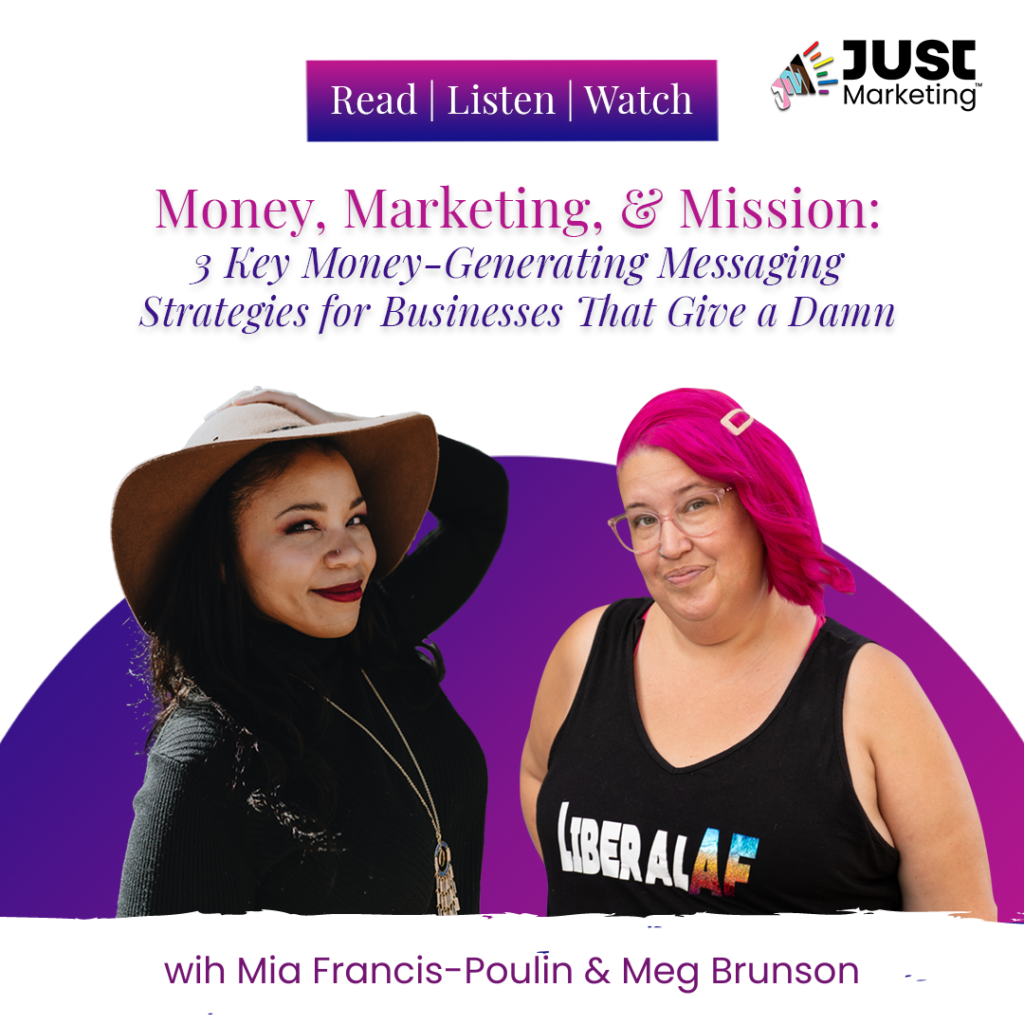
Mia Francis-Poulin joins Meg Brunson to discuss unethical copywriting trends to say adieu to. (Recorded in 2022)
The gist: Ethical copywriting is persuasive writing that respects your audience’s buying decisions and gives them the information they need to choose freely. In this Just Marketing® episode, copywriter Mia Francis-Poulin unpacks five common tactics to rethink, like countdown timers and vanishing bonuses, and shares honest alternatives that still help businesses grow.
Copywriting Tactics to Rethink
Mia encourages business owners to reconsider these common copywriting tactics, each paired with a kinder alternative:
- Countdown timers. A ticking clock can push readers into stress-driven decisions. Mia notes that some people appreciate a clear deadline, so try framing your timer around an upcoming opportunity, like counting down to the moment doors open.
- Vanishing bonuses. Bonuses that disappear for later buyers penalize people who take time to decide. Offer the same bonuses throughout your launch, or bonuses of equal value at each stage.
- 99% discounts. Selling a $1,000 offer for $1 can feel dishonest and lowers the perceived value of your work, especially when the “deal” never actually ends. Modest, genuine incentives build more trust.
- Bonus stacking. The “but wait, there’s more!” approach can create guilt-driven purchases and promise more than you’re able to deliver. Clearly explaining the value of your core offer lets it shine on its own.
- False guarantees. A money-back guarantee that’s hard to claim breaks trust quickly. Offer one only if you’re ready to honor it easily, with clear terms and a simple process.
What to Do Instead
These strategies help you write copy that connects with your audience and respects their decisions:
- Speak to the heart of the matter. Focus on what your readers truly want and what life looks like once they get there, in place of dwelling on their pain.
- Learn your ideal client’s language. Talk with clients in everyday conversation and listen to how they describe their goals. Their words can go straight into your emails, sales pages, and website.
- Document your brand voice. Create a style guide that captures your tone and the key phrases you use for your most important ideas, so every piece of content sounds like you.
- Plan how you go to market. Map out how you’ll share content and launch offers based on your values and your audience, in place of following someone else’s playbook.
Watch/Listen & Subscribe
Meg Brunson
So Words are Mia Francis-Poulin's jam, a conversion copywriter native New Orleanian and parks and rec enthusiast. Mia, along with her team of dedicated copywriters and content strategists, helps online business owners to find the right words to market their products confidently and without the sleaze. She is the CEO and Copywriter in chief of The Copy Haus, the one stop, flat-rate copywriting subscription for businesses that want to market their message authentically, ethically, and profitably. And today we are diving into this topic of unethical copywriting trends that we should say adieu to in 2002. I feel like you really tested me this morning with all of these difficult to pronounce words.
Mia Francis-Poulin
Well, you did great. Thank you, Meg.
Meg Brunson
I always say English is not my strong suit. It may be my first language, but it is not my strong suit. So I'm excited to have you here today and our special guest, Seana, who, if you are watching a video, you might see peeking out of Mia's shirt, her wrap. But thank you so much for being here today. And thank you, Seana, for being cooperative.
Mia Francis-Poulin
Yes, well, thank you for having me, for having us. This is real life here, Seana, my little one. She is three months old, and her favorite place is in my baby wrap on my chest. And so we're rocking with it. This is what business looks like for me right now.
Meg Brunson
I am all about that life. You know that. All right? So the number one reason that you are here is because you are a just marketer that I completely love and respect and want to share with my community. So I want to start by asking you what just marketing means to you.
Mia Francis-Poulin
Okay? I love this question. So for me, just marketing is marketing that respects and honors the purchasing decisions of your consumers, because so often, we're going to dive into this. This is my whole entire ethos of how we should market. And the power of messaging is that used for good, we can make a beautiful world. But so often, business owners are taught tactics that completely disempower the consumer, and we're using it for negative. Right. It reminds me of that quote from Spiderman, “with great power comes great responsibility.” I, as a marketer, as a wielder of words, I feel an immense amount of responsibility to use my skills for good, because we can see what the other side of that looks like. We see it every day in our world, in our society. So for me, just marketing is marketing that empowers your consumers to make educated, thoughtful purchasing decisions.
Meg Brunson
Thank you so much. I love that. Now, I'm going to go out on a limb here on the assumption that you were not always a just marketer. I feel like we're not born that way. Right. Like, we're raised in this world, in this environment that teaches us even, like, on the most subconscious level, teaches us to be deceitful and to lie in order to make money at the expense of others. So what was it? Can you pinpoint what it was that made you realize the way you were doing things isn't the way you should continue to do them?
Mia Francis-Poulin
Yeah. So it was like an instance that happened all at once, but also it was like, years in the making. Right. So I've been a copywriter for over a decade, almost a decade and a half at this point. I've been a copywriter, and I was taught the ways because my background is in English Lit, but also psychology. Right. So that was my minor in undergraduate psychology, and I have a master's degree in communication and media. And so I was taught all the ways to understand the psyche of your consumer, and also how to craft really great messaging, like how to really be an artist at this stuff. Right. Because it's a science and it's an art – marketing, especially copywriting. And I remember I was sitting in on a launch that generated several hundreds of thousands of dollars. And when the question came about, how are we going to actually fulfill, how are we actually going to meet the things that we were promising in this beautifully crafted, beautifully explained sales page and sales process, things fell flat. And so for me, if I'm going to use my skills, I want to make sure that the product, the people, the services on the other side are intending to support that.
Mia Francis-Poulin
Right. And so that was part of it, and then the other part of it and it's actually funny you mentioned this. I saw this video and I almost sent it to you, Meg. I saw this video on Reels, and it was a guy, and he said something along the lines of, at my job, I'm whoever I think I need to be. And he was like, if I'm talking to a Republican, I'm a Republican. If I'm talking to someone who's saying, like, we all need universal health care because this, he's like, let's go and get the CEO of Pfizer and rally them up. Right. I won't say exactly what he said, but essentially what he was saying was he had no loyalty to anything. He was just saying what he needed to say to get by and get what he wanted. And to me, it made me so sad and angry, but it made me sad because there's a lot of people who genuinely they assimilate to their environments, which me as a woman of color, as a black woman, I know about assimilation to survive in predominantly white, predominantly male, predominantly Cis-het spaces. But also the icky side of it that made me mad is that some people, like, they are aware of these constraints and they use their privilege to just continue on the status quo for their own benefit and their own greed, really, to use the phrase from Home, the movie Home, I was sad mad. But that feeling has been present. That awareness of this exact thing that I witnessed today on Reels was also another reason why I decided to really hone in on ethical marketing. So long winded, multi part answer to your question.
Meg Brunson
Oh, I love it. And as you were talking about that Reel, I know you're going to understand and probably appreciate this reference if you didn't already think of it, but all I could think of is Aaron Burr. Right?
Mia Francis-Poulin
Yeah. Stand for nothing. What would you fall for?
Meg Brunson
And we know how that ended.
Mia Francis-Poulin
Yeah.
Meg Brunson
So anyhow, I could talk about Hamilton for days. I know that. Have there been any challenges or any pushback that you've faced since adopting this new approach to marketing?
Mia Francis-Poulin
Oh, totally. Well, I mean, here's the reality. The reality is that the Icky tactics work. They work with quotes around them. They get people to buy, right? And so when we are taught a certain way, it's almost like you're taught how to walk and then you learn how to walk a different way or you learn to skip well, walking works just fine. Why would I skip? Well Skipping could be more efficient or fun or you make it more muscle build. It depends on what it is that you're looking for. Right? I know. Weird analogy but seriously the pushback is from people who don't find that empowering their end user is important to them. Like if the issues of ethics are not important to them, oftentimes they'll push back and they'll say well, I want to just done the way that the other people do it. And I say this all the time, that success does leave clues but some of those clues are red herrings. Like some of those clues are not everything that it seems to be and I think a lot of people end up in trouble in a way to say it.
Mia Francis-Poulin
They end up in trouble where they use these tactics but they haven't figured out how to actually support their people or they haven't figured out how to not oversell a feature of a program because that's what so and so did or they end up really stretched out thin because they've added in 45 bonuses that they have no way to actually support. What we see on face value is not always the reality. But some people, they want the security of the tried and true of what they see works.
Meg Brunson
And then of course, on the flip side, what have been the positive things that have come out of more ethical and just marketing strategies?
Mia Francis-Poulin
So here's the reality. Here's the thing that people are hesitant to accept or maybe not hesitant to accept that they are skeptical of and it is the fact that people who are respected and supported during the buying decision become evangelists and retained customers on the other side. So if you set the expectations and I'm going to talk more in my presentation about the pillars of ethical marketing but if you were setting the expectation that your consumer is going to be respected through the courting phase of your relationship and then once you all get married that that's going to continue on. You're going to have people that stick with you. You're going to have people that tell their friends about you and your marketing ends up being its own self generating machine. And then also the good thing about it is that the people who get it, like the girls who know, know. That trend that's going around. It's like the people who are attracted to this like they are our people and we have a nice little ecosystem going here.
Meg Brunson
Awesome. Well, you've hinted at the presentation a couple of times and I am eager to pass the mic and see all that you've prepared for us. So let's do that now. I'm going to turn off my mic and turn off my camera.
Mia Francis-Poulin
Okay, so I have created this presentation, and I'm really excited to share it because this is really just the genesis. This is everything about my philosophy on copywriting. And so today I'm going to talk about three key money generating messaging strategies for businesses that give a damn, right? And so let's jump into it. Okay, so here's how to know if we're in the right place and really if this is going to jive with you. If not, come back to the end of the Q and A and we'll talk some more with Meg. If you really aren't trying to listen to this, but I think if you've listened to the first ten minutes of this conversation, you know you're in the right place. But essentially what we're going to talk about here is for the people who want to get big results in their businesses, but they also want to be empowered to speak their truth, to be their authentic self, to throw away the misaligned marketing tactics and still make money.
Mia Francis-Poulin
So if you've ever been in a situation, and I know so many business owners have, and I've been in this position where I've been told to follow a specific marketing tactic, and it just feels like I get that knot in the pit of my stomach, I know that you probably experienced the same thing if you felt that. We're going to talk about some specific ways to actually have an empowered experience with your marketing and with your messaging, as you're launching, as you're doing your organic or your paid outreach, but also to actually do things that work, right? So let's jump into this. So effective copywriting, and if you take nothing else away from this, effective copywriting does not have to rely on pain point marketing. So often the rhetoric is lean into the pain points, make them feel the pain of staying in this one place that they're in. And the reality is that there is enough pain out on this planet in 2022 and beyond. I'm sure. Hopefully it changes, but there's enough pain that we don't have to egg people on to feel more pain. Okay? And so what we're going to talk about is what does it mean to drop the sleaze?
Mia Francis-Poulin
And it comes down to ethics. So let's jump into what that actually means. But first, Meg introduced me. I am the owner of The Copy Haus. And the main way that we serve our clients is through our subscription, which is for flat rate copywriting and content writing. And we basically write these ethical words for you that is embodying your authentic self. And we do that through all the magic that we have put together in our secret sauce. So more on that later. So ethical marketing is not just lip service. And I know, one of the things I really respect about Meg and what she's building with Just Marketing is she is really providing a space, an incubator for us to go deeper into how we can be just marketers without relying on or stopping at the surface level ways to show what we stand for. How we can really embody in our marketing what it means to build just businesses and have just marketing. And so for us, these are the three pillars of ethical marketing that we have crafted, is that those pillars rely on respect, consent and education. So the first pillar, respect, that means to honor the buying process.
Mia Francis-Poulin
So often what businesses are taught is that we want to engender people to take that fast action, to not have to think too deeply about it, to lean on their gut and all those things. And there's a place for that and that is a viable way to do business. And there are people who will naturally purchase at that cadence. There are people who are naturally fast purchasers as soon as they know, they know in their gut, right? But there's also other types of buyers. There are buyers who are medium adopters who need to know your successes, and need to know all the specific details of what it is that they're getting in an offer. But then there are people who are late adopters. They want to see that other people have gone through it. They want to see case studies, they want to see all these different things. And so regardless of how quickly they purchase or how slowly they purchase, you want to have respect for each person and each way that they purchase in that buying process. Okay?
Mia Francis-Poulin
The second one is about consent, about being clear about your intentions. So often we are taught that we need to do things like don't mention the pricing of an offer on your sales page or on your website, or to get people on a call so that you can talk to them face to face and then pitch them. Or we're told that if somebody wants to cancel, or opt out of a service, we need to make it as difficult as possible for them to do that by requiring them to hop on calls with your team members. I actually just went through that with the software that I wanted to cancel. And so the thing about it is that you want to be clear about your intentions and get people's consent and buy-in at each stage of this purchasing process. Okay?
Mia Francis-Poulin
And then the third is about education. It's not that you want to cajole or manipulate, which is what a lot of our marketing up to date has been taught to us. It's not that you want to manipulate your people, it's that you want to give them enough information to make an educated purchasing decision. You want to give them the answers to the questions that are those barriers to them purchasing and not to do it in a way that disrespects or it glosses over their concerns. Really. You want to do it in a way that honors their concerns, answers their questions, and leaves the next step up to them.
Mia Francis-Poulin
What it all comes down to is you want to basically be a good human to your people. Okay? You're a human, they're humans. We are humans doing business with humans, human to human, not business to business, not business to consumer, but human to human.
Mia Francis-Poulin
So how does this show up in marketing messaging? Well, let's go ahead and dive into it. So one tactic that we often use are the deadline timer. And so I've been talking about deadline timers for a while. And as I have been growing in the talk that I've been giving around this topic, one thing that came to mind and I appreciated from my quote, neurospicy friends, as they refer to themselves, is that sometimes these deadline timers help them have constraints around when the opportunity to make a decision is up. And I want to respect that. I want to respect that there are people who need to feel that urgency in order to make a purchasing decision. However, here's the opposite side of that. The opposite side of that is that when you have a sales page and you have that tick-tick-tick counting down of the clock, right? What that does physiologically in our bodies is that raises the cortisol levels of your reader, of the person that's in your audience.
Mia Francis-Poulin
And what that cortisol level does is encourages them to move into that fight flight or fleet/freeze mode, right? They're either going to make a decision, they're going to make a decision from a place of a biological imperative, which again works, right? But is it ethical?
Mia Francis-Poulin
So here's the constraint that I've worked around it with honoring that there are some people who need the parameters. They need the container of a timeline of a deadline in order to be reminded to take that action, but also without having the people to be making a decision from a place of heightened energetics, of stress and anxiety. And that is to look at your timers instead of being from an angle that you're going to miss out, but rather we're counting up to an opportunity if you're going to use something like a timer. So instead of saying you are going to miss out on this opportunity if you don't take action in X amount of time. We're about to get into this opportunity. The doors will open. We will start, we will begin. It is giving versus taking away versus attracting when you are using your deadline timer. So that's one way that you could use a deadline timer in an ethical way. It's about how you're positioning that countdown, right?
Mia Francis-Poulin
The other thing is the vanishing bonus. And so this structure of having several bonuses for those fast action purchasers that go away as time goes on, that is a tactic that's been used quite a lot in the past few years. But here's the thing, is that like I mentioned before, there are those people who are going to take action in a what's the word I want to say, they're not going to take action as quickly as other people and we want to again respect that purchasing decision. So instead of penalizing people for acting in the way that they usually act from taking their time to make that purchasing decision, we need to think about other ways that we can incentivize people. So instead of having bonuses that decrease, having bonuses that go away, have bonuses that are consistent if you're going to have bonuses in your offer, bonuses that are consistent throughout that change, right? So we don't want to have things that are less in value. So instead of saying if you take action now, you get this thing that's valued at $5,000, but if you purchase it the day before, the only bonus that you get is worth $25, right? Have a equally weighted amount of bonuses that are different at the different stages. If you wanted to enact something that's like a vanishing bonus.
Mia Francis-Poulin
The 99% discount. So this is the one thing that really gets me, is that you're offering up something that's traditionally $1,000 for a dollar, right? First of all, that makes very little financial sense. Second of all, it devalues your brand because people are thinking, oh, your thing is only valued at a dollar in reality if you're getting it for a dollar. And also it's just simply dishonest, right? And so the thing that I encourage people to do is to think about other ways that you can incentivize and you can position a discount. That's not so drastic, right, because it is not honest. Especially if you have this on Evergreen, right? Like it's always a dollar. It's kind of like the furniture store that's going out of business is always on that going out of business sale. It's dishonest. Right? So think about other ways that you can incentivize people to take action outside of a 99% discount.
Mia Francis-Poulin
The other is bonus stacking. And so this is like the inverse of the vanishing bonus, right, but it's almost like how I had a coach that I really admire. They presented it as shamwowing your business. But wait, there's more. But wait, there's more. But wait, there's more. And what that in turn does is that actually positions your offer from a place of guilt, right? People are making a decision from a place of, oh, they're giving me so much, they're giving me so many things. I have to take them up on this because they're being so incredibly generous with what it is that they're offering me. And the reality is that oftentimes when people stack these bonuses, they're actually incongruent with the value that they're purporting it as, right? They're not actually as valuable as they are saying that they are. And also it's difficult, like I mentioned at the beginning of this presentation, it's difficult for people to deliver on such a high level of bonuses, especially if those bonuses are live or they actually rely on a live person feedback and input. So that's the other thing about the bonus stacking. So the inverse of that would be making sure that in your offer, instead of shamwowing people, but wait there's more, just be very clear and articulate about the container of what it is you're offering in that core offer. How can you articulate the value? How can you articulate the transformation that your people will go through after they've encountered this program that you have that you can share with them?
Mia Francis-Poulin
And this last one, it seems a little bit like, yea duh, but it's the false guarantees, okay? So the thing about the false guarantee is the idea of offering people a way out that you have no intention of honoring or you're going to make extremely difficult to honor, right? So we'll put a guarantee, like 100% money back guarantee, and you'll have the stipulations, which you should have stipulations on things like guarantees. But then what you do is you make it impossible for people to know how to contact you or you make it a multi step process to cancel or you simply never honor the guarantee that you're reporting. And what that just comes down to is if you are leaning on something like a money back guarantee as a way to make it a no brainer, but you want to make sure that you actually are going to put your money where your mouth is on that. So you have to be prepared to actually offer those money back guarantees and be honest with yourself. And if you're not going to offer that, if you're not going to hold up that part of the bargain that you don't have to. Because what a lot of templates or training materials or the experts tell you is that just pop up 100% money back guarantee on your sales page without actually giving you space to think about if that's something that you actually want to offer your people. So that's the other part about the false guarantee.
Mia Francis-Poulin
So let's talk about three things that you should do, can do, may want to do. Okay? So as you're creating your messaging, creating your content around your sales and your marketing, is you want to connect with the heart of the matter? What is it that your readers really want and need? Right? So thinking about what is it that they're really seeking, what does life really look like for them on the other side of resolution for whatever it is that they're dealing with, right? Talk to that rather than focusing on pain. Okay?
Mia Francis-Poulin
Number two is that you want to deeply understand your ideal human's language. You want to understand their wants, their desires, and how they talk about it. And that means that you have to go out and you have to talk to your people, right? You have to talk to your consumers, talk to the people who are in your ideal client avatar and you want to ask them questions in normal conversation and listen to how they talk about these things. They'll give you the language that you need in your emails, in your sales pages, in your website. They'll give you that exact language and you can parrot it back to them.
Mia Francis-Poulin
And then number three is to document your style and craft your plan of action. So one of the things that I find consistently across clients who have maybe been burnt by clients, by copywriters in the past or marketers in the past, is that they feel like the language doesn't sound like them or doesn't sound like their clients, their end users. And the thing that is missing is that they don't have a fleshed out, thought out style guide for their written language. Oftentimes they'll have things like, oh, this is my color palette, or this is the font that I use, which is all great and important, but they haven't thought about and haven't notated how they talk about the things that are the most important, what language they use, what's the style of their tone, the style of their written word.
Mia Francis-Poulin
And it's so important to be able to craft that language and to create a plan of action around your content, around how you go to market, around how you launch your offers, rather than what XYZ expert told you is how you should do it. Okay?
Mia Francis-Poulin
So number one is that you want to really understand and talk to what your people need and want. It goes to transformation. Number two, you want to deeply understand wants, desires, use their language and your people will give you their language. And then three is to create that style guide and create that content action plan.
Meg Brunson
Hey, Mia, thank you so much. That was amazing, knocking over my mic. I always love to hear you speak because you have such a way with words, which of course is what makes you such an incredible copywriter and why I go to you for my copy because I don't have that same way that you have. So thank you so much for bringing so much word magic to us today.
Mia Francis-Poulin
You're so welcome. Thank you so much for having me here to talk about these things again. It's the most important thing for me in business right now is that we have a movement where we're changing how we're treating our people. And it starts with the way the words that we're using to talk to our folks.
Meg Brunson
Yeah. And I think for me, as you were talking through things like the hitting pain points and then of course, having to call to cancel a service, like, as somebody who's like, diagnosed with anxiety, I have like, crazy phone anxiety and I'm fairly confident that's a common thing. And it makes me feel so guilty, right, to have to be like, “Mia, I no longer want to use your product or service.” Like, of course that's not true. But having to say that to somebody, it just makes me feel so guilty. And to think that the reason that I'm being forced to do that, we're being forced to do that is because someone wants to make more money and they are putting that money on the fact that we're not going to do it because we're scared of getting on the phone and things like that. And that's awful.
Mia Francis-Poulin
Yeah. And they are expecting you to feel exactly the way that you just articulated. They're expecting you to when you're faced with having to tell someone face to face, I don't want to use this service, you're going to feel some type of way about it and they can reel you back in. And that's just so highly unethical. I hate it. Plus, besides the fact that I too am diagnosed generalized anxiety disorder, first and foremost, I'm a millennial. I answer the phone for no one. So there's that whole extra level to things as well.
Meg Brunson
Yeah. And I think that my feelings, like you just said, have guided a lot of these decisions because I don't like that I'm never going to make somebody get a phone call with me to cancel, shoot me an email, click the button, you know what I mean? Like, yeah, no phone call with me. I don't want to get on a phone call with you.
Meg Brunson
Anyhow, I also love how, number one, you talked about the science of things like deadline timers. I know I don't like them, but I'm not always like, that's a psychology degree, right, coming through, like, you know about cortisol and things. And it feels so good to hear some of that scientific backing. And I love that you also shared that spin. I don't know if you saw the same post, but I recently saw a post on Facebook about people who actually like deadline timers and it definitely made me go like, what do I do? And so I love that you address that. So thank you very much. Yeah.
Mia Francis-Poulin
And I'm constantly trying to think about what do these things do to a multitude of people. Right. When it occurred to me that, oh, wait, there's actually are people who enjoy, or like, or need deadline timers. And I've been ragging on them for so long, I was like, alright, let's take a step back and reevaluate so therefore we can all grow.
Meg Brunson
And I feel like that answer that comment is such an important thing that we all need to get comfortable with, right, is the willingness to make mistakes, the willingness to examine what our behaviors and actions are as we get more feedback and then to change our thought process. And this is for marketing. This is for everything. That is a core piece of humaning in a way that is kind. So I love that you brought that up.
Mia Francis-Poulin
Just a point to add on to that as just marketers, right? You have to allow yourself to get comfortable with that discomfort of being wrong. That's going to be part and parcel of unlearning biases and challenging the status quo that we all live in, right? And so my mom has a saying, well it's a common saying. But my mom would always tell me, “when you know better, you do better.” And so we have to allow ourselves to do better when we know better, right? So that's my last piece. I'll get off that soap box.
Meg Brunson
And be open to learning that's the only way you're going to know better is you have to be receptive to feedback. And not just, my first gut reaction when I saw that post was like, “no, that's not right.”
Mia Francis-Poulin
Yeah, you're wrong in your feelings. But then it's like, well, wait, hold on.
Meg Brunson
Take a step back. Which is part of the reason one of my philosophy is when it comes to feeling my feelings, is to give it a day. Give it a day. I did not respond to that post. I didn't throw in my two cents. I just gave it a day. And it just so happened that that day was yesterday to today. And now I know better. And I'm not going to throw in my two cents. I'm going to sit back and take it in and learn. I'll get off the soapbox now, too.
Meg Brunson
So one thing, I feel like I have an unfair advantage with this discussion because I work with you over at The Copy Haus, and I know, I know what we're working on. So I'm going to put you on the spot too, because you talked a lot about the style guide. And when I came to you, not only – so I work with you. Like, I help promote The Copy Haus and you help me write my copy. So we have kind of a mutual relationship, if you will. But anyhow, when I started, when I came to you and I had to create my style guide, I had nothing.
Meg Brunson
I had nothing. I didn't know what was supposed to be in there. I went through the steps. I went through the process. You've got some nice little videos. And then I felt like I got clarity on what my writing should focus on, what I should be talking about. It forced me to think about things like how I want my brand to show up in the world, how I want to talk to my audience things like this, anyhow incredible tool. And I know that you're working on something that's going to help make that easier for everybody. Are you cool with sharing a little bit about that, teasing it out to our listeners?
Mia Francis-Poulin
Yes. So what we are working on, and this is actually very exciting because I've been wanting to share to the world about this thing that we've been working on for so long because it's literally been in the works for months. But we're really close to making it happen. So anyway, enough jumble about that. What we're doing is we've taken one our process of being able to create sounds-like-you copy, right? Spot on, conversion focus, copy. That process of getting the information, we've synthesized it into an asynchronous program that allows you to then take that information and create your own style guide. In fact, it creates a style guide for you, right? And so you can then take that style guide and send it to any copywriter or send it to us at the Copy Haus to create those content pieces for you and/or for you to have. Like you just mentioned Meg, have so much more clarity on how you want to show up on the world, what your content pillars are, what your key phrases and key points are, so that you can write more articulately and with more clarity. And so we're creating that program now.
Mia Francis-Poulin
It's going to be 100% free and you'll be able to have that in your marketing arsenal as just as important as any other brand asset that you have about your business. So you'll be the first people, everybody listening will be the first people to know when it drops. But I'm so excited about it because it's the preeminent tool to really craft your compelling messaging across all the platforms because everyone needs a style guide. So it's exciting.
Meg Brunson
And there are going to be things in there, questions that you were like people actually worry… I didn't realize this was a thing. I'll use an example like semi colons. I didn't realize there was controversy.
Mia Francis-Poulin
There's much controversy.
Meg Brunson
This is also going to be, that's going to be a resource. As somebody who runs Facebook Ads for clients, most of my clients don't have anything like that and I kind of have to start from scratch. So this is going to be a great tool to share with really anybody who's working on your business from a VA, a social media manager, a copywriter, the list goes on and on. Anybody who is creating content or interacting with content for your business.
Mia Francis-Poulin
Yeah.
Meg Brunson
Like I said, I'm on the inside. So I'll be sure as soon as that's live and bug free, we'll bring it out into the world. And where can our listeners connect with you? On the web,
Mia Francis-Poulin
All of the channels, we are @TheCopyHaus. And you can visit our site over at www.TheCopyHaus.com.
Meg Brunson
Awesome. I will put all the links in the show notes, of course, and I want to thank you for being here today. I love any excuse to connect with you and to see Seana. Thank you so much. And again, thank you to Seana for being so cooperative.
Mia Francis-Poulin
She's a rock star. I appreciate it. So thanks so much for having me. Meg.
About Mia Francis-Poulin
Words are Mia Francis-Poulin's jam. A conversion copywriter, native New Orleanian, and Parks and Rec enthusiast, Mia (along with her team of dedicated copywriters and content strategists) helps online business owners to find the right words to market their products confidently — and without the sleaze. She's the CEO and Copywriter-in-Chief of The Copy Haus® — the one-stop, flat-rate copywriting subscription for businesses that want to market their message authentically, ethically, and profitably.
Let’s Keep This Conversation Going
You can build a business rooted in consent, clarity, and connection – and you don’t have to do it alone.
Here are a few ways we can stay connected:
Let’s connect on social: Come say “hi” on LinkedIn or Instagram.
Curious what it’s like to work together? If you’re craving more support with ethical, ADHD-friendly marketing systems that actually feel good – explore how we can co-create something sustainable and aligned.
Join the email list: Want weekly-ish tips on content strategy, Just Marketing®, and marketing with ADHD? Sign up for my emails and get real-talk guidance, delivered with kindness and clarity.
FAQs
Ethical copywriting is persuasive writing that honors how and when people choose to buy. It gives readers clear, honest information about your offer and leaves the decision in their hands. People who feel respected during the buying process often become loyal clients who refer others.
Countdown timers can create stress that pushes people into rushed decisions. Mia also notes that some people, including many neurodivergent folks, appreciate a clear deadline. A kinder approach is framing a timer around an upcoming opportunity, like doors opening, in place of a looming loss. Learn how to write calls to action that feel honest and inviting.
A vanishing bonus is an extra offered only to fast buyers that disappears as time passes. It penalizes people who take time to make thoughtful decisions. Offering the same bonuses throughout your launch, or bonuses of equal value at each stage, respects every type of buyer. Learn why one-time offers can leave out the people you want to serve.
Bonus stacking is the “but wait, there’s more!” approach of piling extras onto an offer. It can nudge people to buy out of guilt, often overstates the bonuses’ value, and can be hard to deliver well. Clearly explaining the value of your core offer builds more trust.
Offer one only if you’re ready to honor it easily. Clear terms and a simple refund process show integrity, while a guarantee that’s hard to claim erodes trust quickly. It’s perfectly fine to skip a guarantee if it doesn’t fit your business.
Focus on what life looks like for your clients after they reach their goal. Talk with your clients and listen to the words they use to describe their wants, then reflect that language in your copy. A written brand voice style guide helps keep your messaging consistent and true to you. Learn how to create promotional content that feels good to share.