You know the drill: You sign up for a free resource that actually looks helpful, and before you even finish reading it, your inbox is ambushed by a hard-hitting funnel that ramps up the pressure with every single email.
Limited-time offer!
Only 3 spots left!
Are you even serious about your goals?
Ugh. Make it stop.
For ethical entrepreneurs – especially those of us who are neurodivergent, values-driven, or just allergic to manipulation – that kind of “welcome” feels more like a red flag than a relationship builder.
The gist: An email welcome sequence is a short series of automated emails, usually four or five, that new subscribers receive after joining your list. Ethical sequences deliver what you promised and set clear expectations, saving any invitation to work together until trust is built. Each email has one job, which makes the sequence easy to write in focused sessions.
You don’t have to play that game. You can write email welcome sequences that feel good to send and receive. Ones that reflect your values, build genuine trust, and help your people feel seen – without ever faking urgency or using guilt to get clicks.
Table of Contents
Why Do Welcome Sequences Matter?
If your inbox trauma has made you side-eye all automated emails, I get it. The pressure-y funnels, the overpromises, the “personalized” messages that are clearly copy-pasted… it’s no wonder a lot of mission-driven business owners want to skip email marketing altogether.
But before you write it off, let’s reframe the welcome sequence.
Because when it’s done with care and consent, a welcome sequence isn’t just a sales tool – it’s a relationship starter.
It’s your chance to say:
- “Hey, I’m so glad you’re here.”
- “Here’s what I’m about – and what I’m not.”
- “This is a safe, supportive space for folks who share these values.”
Especially if you're neurodivergent or overwhelmed…
A thoughtful welcome sequence is your built-in system for consistent communication – one that doesn’t rely on you being “on” all the time. It creates structure without rigidity, and connection without pressure.
Think of it as your on-demand intro – no energy-draining small talk required.
When done right, it:
- builds trust without faking urgency,
- gives your new subscribers clarity about what to expect,
- delivers value while centering consent and inclusion, and
- sets the tone for a healthy, values-aligned relationship.
So no – you don’t need to manipulate people into buying. You just need to show up, be real, and give folks a reason to stick around.
And that’s what your welcome sequence is for.
What Should You Avoid in a Welcome Sequence?
Most of us have learned what not to do in email marketing by living through some pretty cringe-worthy funnels.
You know the ones…
- Fake urgency: “This offer disappears at midnight!” (…but it’s magically still there when you click tomorrow).
- Guilt trips: “If you don’t invest now, are you even serious about your dreams?”
- Consent confusion: You signed up for a checklist and suddenly you’re getting daily sales pitches.
- Over-automation: Five emails in five days with zero room to breathe – and zero personality.
These tactics aren’t just annoying – they’re manipulative. And if you’re someone who values honesty, accessibility, and actual human connection, they feel completely misaligned.
Here's the problem:
Those traditional tactics prioritize conversion rates over consent, pressure over trust, and urgency over understanding.
And yeah… they might “work” in the short term. But long term? They burn bridges, erode brand integrity, and leave your dream clients feeling like just another number on your list.
Here's the fix:
Ethical welcome sequences are all about informed choice, transparent intentions, and respect for your reader’s autonomy.
When in doubt, ask yourself:
- “Would I say this to a friend?”
- “Would I want my inbox to look like this?”
- “Does this reflect how I want to show up in the world?”
If the answer’s no, it’s time to try something better – something built on Just Marketing® principles that honor your audience’s agency and your own integrity.
The Just Marketing® Approach to Welcome Sequences
Welcome sequences are often treated like sneaky sales traps – but they can be so much more than that.
At their best, they’re invitations.
To connect, explore, and feel seen.
Just Marketing® flips the script on the traditional funnel by centering consent, clarity, and community – not coercion. When you bring those values into your welcome emails, you create a space where your people feel safe and respected from day one.
Here’s how that looks in practice:
Transparency
Be upfront about:
- What kind of emails they’ll receive
- How often you’ll show up in their inbox
- Whether you’ll ever pitch them – and how often
Let your audience opt in with full information, so there are no surprises (just support).
Autonomy
Give your subscribers choices:
- Let them choose topics they’re most interested in
- Remind them they can unsubscribe any time (and that it’s not personal)
- Don’t force a “journey” they didn’t ask for – invite them to co-create it with you
This approach builds trust because it respects their agency, not just your agenda.
Accessibility
Write with clarity and inclusion in mind:
- Use plain language and short paragraphs
- Avoid jargon or overly polished “corporate speak”
- Include image descriptions and alt text
- Make sure your email platform is screen-reader friendly
Accessible marketing is ethical marketing – period.
Inclusion
Your welcome sequence is a chance to affirm your values:
- Use inclusive greetings (“Hey friend” instead of “Hey guys”)
- Share who you are and who you’re here for
- Acknowledge your lens and uplift diverse perspectives
- Avoid assumptions about your audience’s identity, capacity, or goals
When your emails reflect the lived experiences of your community, they become more than marketing – they become a mirror.
What Should a Welcome Sequence Include?
Built to connect, not convert (unless it's the right fit).
Think of your welcome sequence like a mini-conversation spread out over a few days – no pressure, just presence. The goal isn’t to sell – it’s to help folks feel seen, supported, and informed about how you show up and how (or if!) they might want to go deeper with you.
Here’s a simple and flexible structure you can adapt to your style, audience, and offers:
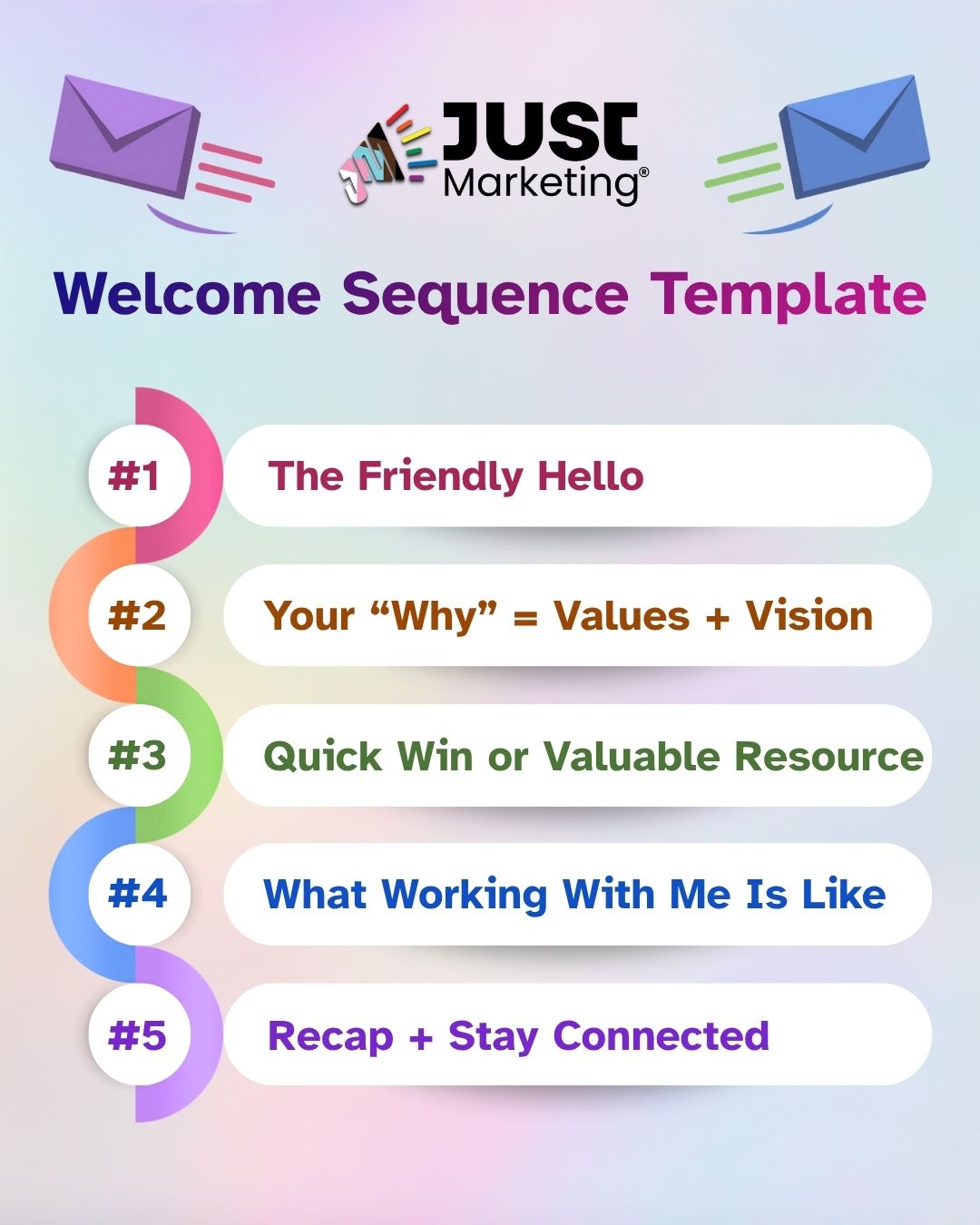
Email 1: The Friendly Hello
Subject line idea: “You’re in – let’s make this easy (and kind)”
- Thank them for signing up – warmly, not robotically
- Deliver the opt-in freebie (if applicable), with clear instructions
- Let them know what to expect: frequency, tone, what kinds of emails they'll get
- Reaffirm your shared values or mission – why your space is different
- Invite them to connect:
“P.S. If you’re on Instagram or LinkedIn, I’d love to say hi over there too!”
Email 2: Your “Why” – Values + Vision
Subject line idea: “Why I do this work (+ who I really do it for)”
- Brief personal story or turning point that grounds your mission
- Share the deeper “why” behind your work
- Frame it with accessibility and inclusion: this space is built with your reader in mind
- Invite them to reply with their story or what brought them to you
“I read every reply – and I love learning more about the amazing humans in this community.”
Email 3: A Quick Win or Valuable Resource
Subject line idea: “This might make your day easier…”
- Offer a useful tip, blog post, checklist, video, or tool – something they can use now
- No pitch. No hidden agenda. Just value.
- Reinforce the vibe: “No pressure. No FOMO. Just thoughtful support.”
- Invite them to explore more (your blog, podcast, etc.) if they want to
Email 4: What Working With Me Looks Like
Subject line idea: “Wondering how I help folks like you?”
- Gentle pivot into sharing your offers or services
- Position it as an invitation, not a pitch
- Use accessible language and focus on outcomes that matter to your audience
- Link to your “Work With Me” page or discovery call scheduler
- Optionally, include a short testimonial or success story – bonus points for making it relatable
Email 5 (Optional): Recap + Stay Connected
Subject line idea: “Before we wrap up… a quick recap 💬”
- Summarize what they’ve received in the sequence
- Reaffirm your commitment to ethical, inclusive marketing
- Share again how to stay connected (socials, blog, services)
- Normalize unsubscribing:
“I want this space to feel good for you. If it’s not the right fit, no hard feelings.”
This sequence sets the stage for a trusting, long-term relationship – the kind where your readers feel invited, not pursued. And it gives you an ADHD-friendly system that supports consistency without overwhelm.
How Do You Write Welcome Emails That Sound Human?
You’ve got your structure – now let’s talk vibes.
Because even the most ethically-structured welcome sequence can fall flat (or feel off) if the tone doesn’t match your values or your voice.
Tone is how your emails feel to the reader – and it’s where a lot of mainstream marketing veers into manipulation. You don’t need to fake urgency, use performative vulnerability, or write like a copy-and-paste bro marketer.
You just need to sound like a real, kind, thoughtful human. (Which, good news: you are.)
Here’s how to keep it authentic, inclusive, and aligned:
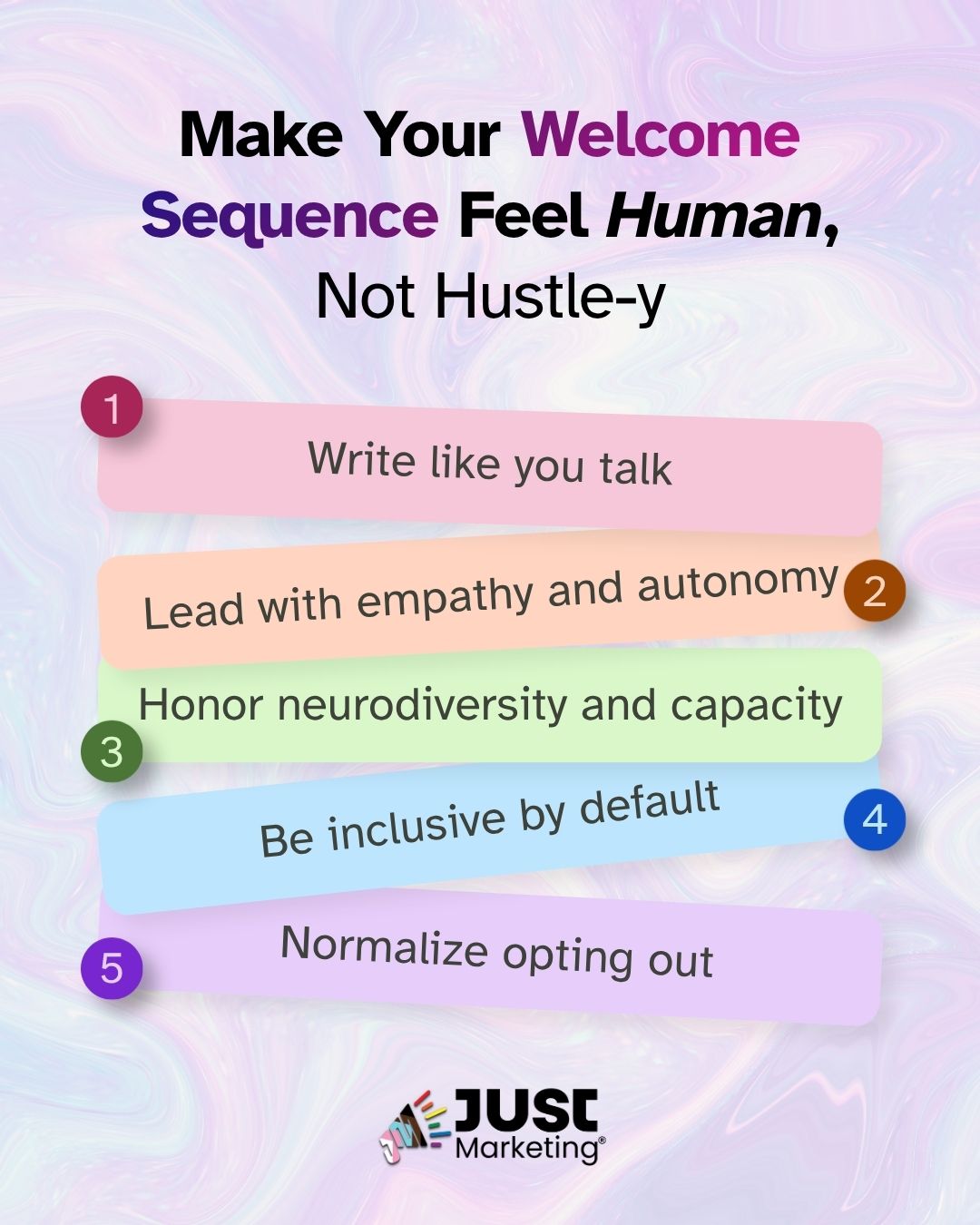
1. Write like you talk – not like a webinar script
- Use contractions, emojis (if they’re your thing), and everyday language
- Keep it casual, but clear: aim for connection over perfection
- If you wouldn’t say it out loud to a peer or client, don’t write it
Instead of: “You’ll gain massive clarity and skyrocket your success!”
Try: “I hope this helps bring a little more clarity and ease into your day.”
2. Lead with empathy and autonomy
- Normalize different experiences and neurotypes
- Avoid absolutes or “shoulds” – they can feel judgmental or rigid
- Center choice and consent in your invitations
Instead of: “This is the only system you need to succeed!”
Try: “This is a tool that’s worked for me and my clients – feel free to take what fits and leave the rest.”
3. Honor neurodiversity and capacity
- Use short paragraphs and clear headers to reduce cognitive load
- Keep emails scannable – bullet points, bold text, spacing
- Avoid overwhelming call-to-actions (one per email is usually enough)
Try: “Here’s the one next step I recommend if you’re feeling curious.”
or
“No pressure to take action – this might just be something to tuck away for later.”
4. Be inclusive by default
- Use non-gendered greetings (“Hey friend” or “Hey there”)
- Avoid assuming family structure, ability, income, or lived experience
- Share your own lens and welcome others in
Instead of: “As busy moms, we all know…”
Try: “If you’re juggling a lot right now (same), I see you.”
5. Normalize opting out + self-regulation
- Give your audience permission to unsubscribe and stay connected on their terms
- Reinforce that your emails are here to support, not pressure
Try: “If this ever stops being helpful, you can unsubscribe anytime – no hard feelings, ever.”
The right tone builds trust faster than any automation ever could. So let your voice be the bridge. Be kind, be clear, be you.
Your audience doesn’t need to be “converted” – they need to be cared for. Welcome sequences built with consent, clarity, and kindness do exactly that.
Now go build yours – your future clients (and your inbox) will thank you.
Let’s Keep the Conversation Going
I’d love to stay connected – in whatever way feels best for you. Here are a few gentle invitations:
Let’s be social (on your terms): You’ll find me sharing real-talk marketing tips, behind-the-scenes moments, and the occasional meme on Instagram and LinkedIn. Come say hi – I’d love to meet you.
Curious what it’s like to work with me? Whether you’re looking for clarity, consistency, or content that actually feels like you, I offer marketing support that centers justice, accessibility, and your unique strengths. Learn more about how we can work together.
Not on my email list yet? This is exactly the kind of content I send out weekly – thoughtful, neurodivergent-friendly, and rooted in Just Marketing® principles. Sign up for my emails.
FAQs
Send the first email right away so people get what they signed up for, then space the rest one to three days apart. That rhythm keeps you fresh in their mind without crowding their inbox. If you're unsure, give subscribers more breathing room.
A gentle invitation is welcome once you've shared real value, usually around the fourth email. Frame it as an option, with clear details and no deadline pressure, so readers can say yes when the timing is right. Here's how welcome emails fit into consent-based funnels.
Deliver whatever you promised at sign-up, like the freebie, with clear instructions. Then share what kinds of emails to expect and how often, plus a warm hello that sets the tone. Keeping it short helps new subscribers feel welcomed without feeling overwhelmed.
Short and scannable works best, often a few brief paragraphs or a handful of bullet points. Stick to one main call to action per email so readers always know the next step. Shorter emails are also easier to write in quick, focused sessions.
A welcome sequence gives new subscribers context your regular newsletter can't, like who you are and what to expect. It also lets you share your best existing content with people who just found you. Once the sequence ends, subscribers flow naturally into your newsletter.
Write in plain language with short paragraphs, and use real text in place of image-only designs so screen readers can access everything. Add alt text to any images and use descriptive link text, like “download the checklist.” Here are alt text tips and templates.