Think about the last time you rolled a suitcase off a sidewalk or pushed a stroller across the street. Chances are, you used a curb cut without giving it a second thought. That little ramp holds one of the most useful lessons in marketing.
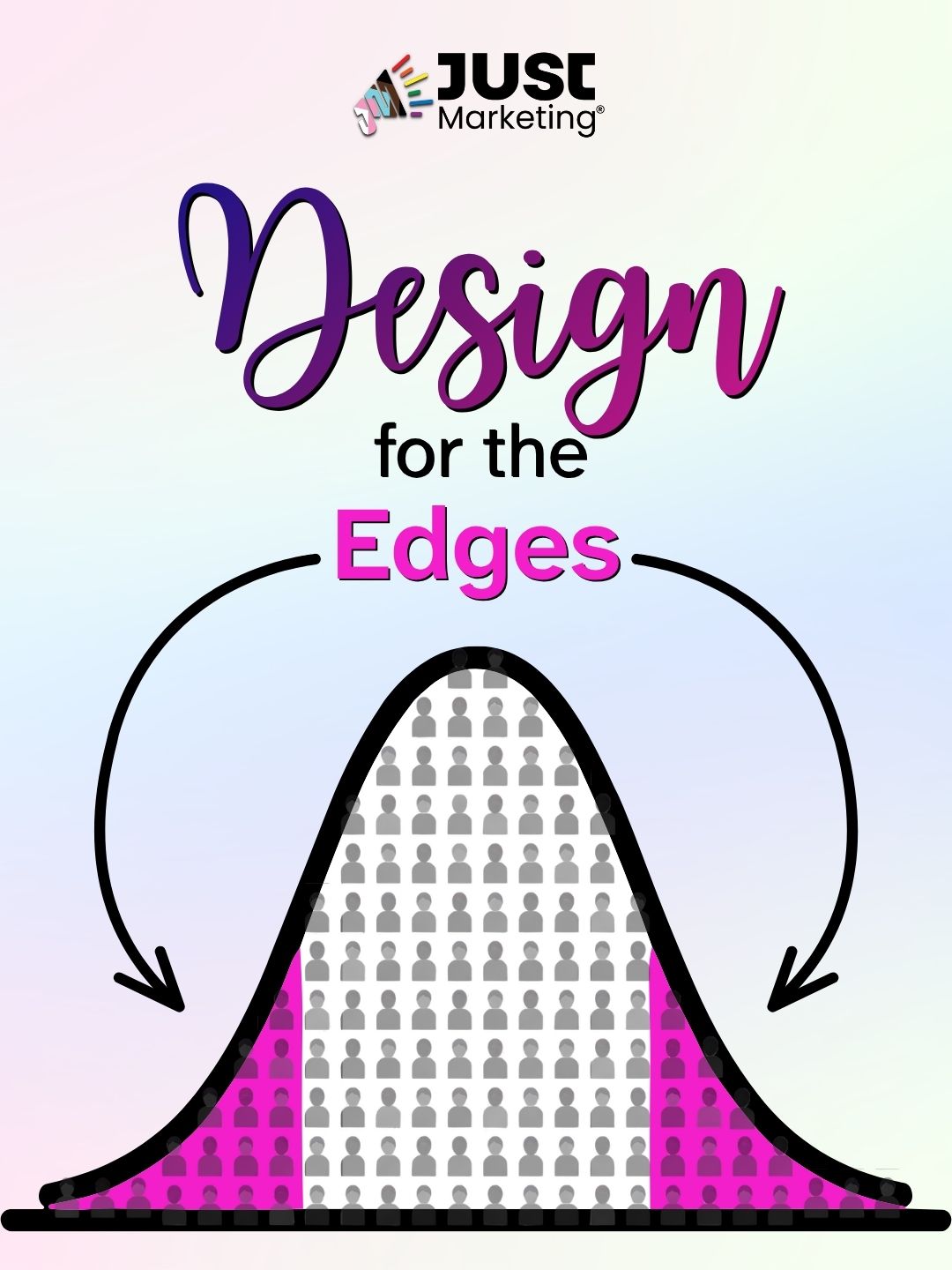
The gist: Designing for the edges means building your marketing around the people most often overlooked, like disabled and neurodivergent folks, so your content works better for everyone. Captions and plain language both started as access needs, and today they make marketing clearer for every audience.
This idea sits at the heart of the accessibility pillar of Just Marketing®. Let's dig into where it comes from and how to put it to work.
The Curb Cut Story
In the early 1970s, disability activist Michael Pachovas and a few friends rolled up to a curb in Berkeley, California, and poured cement into a rough ramp. It was an act of protest and a practical fix at the same time. Getting around the city in a wheelchair meant hunting for driveways and loading docks just to cross the street.
Pushed by disabled activists, Berkeley installed its first official curb cut on Telegraph Avenue in 1972. Many more followed across the country, and the Americans with Disabilities Act, signed on July 26, 1990, made curb cuts a requirement.
Then something wonderful happened. Parents with strollers started heading straight for the curb cuts, and so did travelers dragging luggage. One study at a Florida shopping mall found that nine out of ten pedestrians with nothing to push or carry still went out of their way to use them.
PolicyLink CEO Angela Glover Blackwell named this the curb-cut effect: when something is designed for people who have been left out, it ends up benefiting everyone (Stanford Social Innovation Review).
What Designing for the Edges Means in Marketing
Most marketing is built for an imagined “average” customer: someone who can see every image, hear every video, scroll quickly, and process information at a glance. That person is mostly a myth. Real audiences are full of people whose needs sit at the edges of that picture.
Designing for the edges flips the starting point. You begin with the people most likely to be left out, then build outward. When your marketing works for someone using a screen reader, it also works for someone skimming on a cracked phone screen.
In Just Marketing®, access needs come from five places, and each one is an edge worth designing for:
- Permanent disabilities, like blindness or dyslexia
- Temporary disabilities, like a broken arm or a concussion
- Situational challenges, like bright sunlight or a noisy airport
- Sensitivities, like migraines triggered by flashing graphics
- Personal preferences, like captions on by default or dark mode
The edges include identity, too. People from marginalized communities are often left out of marketing imagery and language entirely. Designing for the edges means making sure they see themselves reflected with care, which is where inclusive marketing comes in.
Marketing Curb Cuts: Small Changes That Help Everyone
Your marketing is full of opportunities for its own curb cuts. Each practice below started with a specific access need and ended up making content better for a much wider audience.
| Practice | Designed for | Also helps |
| Captions | Deaf and hard of hearing viewers | Anyone scrolling with the sound off |
| Transcripts | Deaf and hard of hearing folks | People who prefer reading, plus search engines indexing your content |
| Alt text | Blind and low-vision screen reader users | People on slow internet when images don't load |
| Plain language | People with cognitive disabilities | Busy skimmers and folks reading in a second language |
| CamelCase hashtags | Screen reader users | Every reader trying to decode #susanalbumparty |
| Descriptive link text | Screen reader users navigating by links | Skimmers scanning a page for the next step |
| High color contrast | Low-vision and colorblind readers | Anyone reading a phone outside in bright sun |
| One clear call to action | Neurodivergent folks prone to decision fatigue | Every visitor deciding what to do next |
Notice a pattern? Nearly every accessibility practice also improves clarity, and clarity is good marketing.
How to Design Your Marketing for the Edges
You can start applying this on your very next post. Here's a simple process.
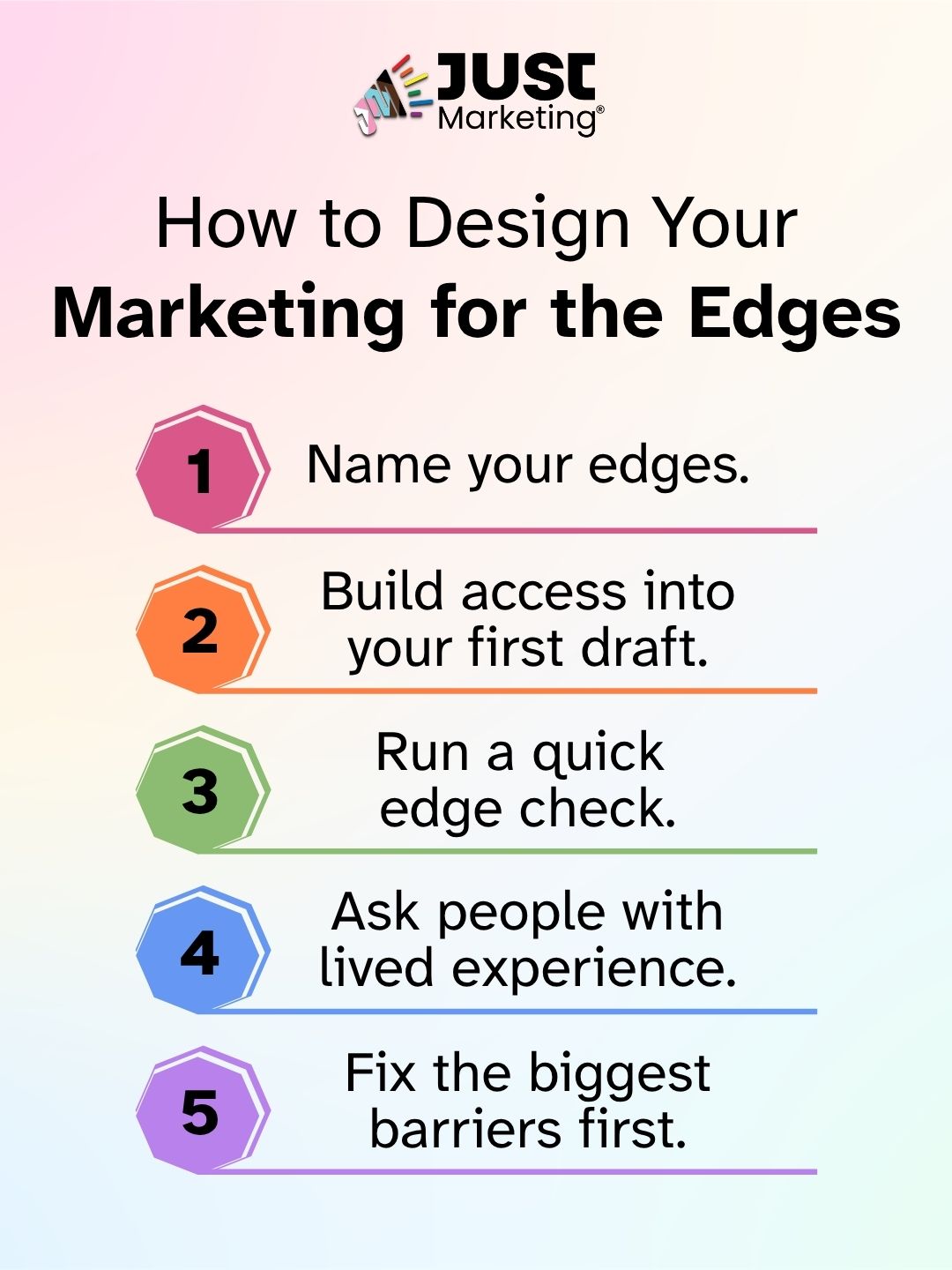
- Name your edges. Look at a piece of content and ask, “Who might struggle to use this?” The five sources of access needs above make great prompts. Add identity, too: who might not see themselves reflected here?
- Build access into your first draft. Write alt text while you design the graphic and caption videos before you schedule them. Access is much easier to include from the start than to retrofit later.
- Run a quick edge check. Before you publish, try a few fast tests:
- Watch your video with the sound off.
- Zoom your web page to 200% and see if anything breaks.
- Switch your phone to grayscale to check whether color is carrying meaning on its own.
- Tab through your website with only a keyboard.
- Ask people with lived experience. Invite feedback from disabled and neurodivergent folks in your audience, and pay people for anything beyond a quick reply. They'll catch what checklists miss.
- Fix the biggest barriers first. You don't have to overhaul everything at once. Start with whatever blocks the most people, then keep improving one piece at a time.
For a deeper look at each type of access need, check out the Accessible Marketing section of my Just Marketing® guide.
Your Next Step
Pick one piece of content you're publishing this week and run the edge check on it. Even one fix, like adding captions or rewriting a vague “click here,” builds a curb cut for your audience.
I'm curious: what's a “curb cut” you've noticed in everyday life or online that made things easier for you? Share it on LinkedIn.
Want help making your marketing more accessible? Explore how we can build an ethical, ADHD-friendly marketing system together, or join my email list for weekly-ish tips delivered with kindness and clarity.
FAQs
Designing for the edges means building your marketing around the people most often overlooked, like disabled and neurodivergent folks, so your content works better for everyone. It's a core idea within Just Marketing®.
The curb-cut effect describes how changes made for people who've been left out end up benefiting everyone. Curb cuts were fought for by wheelchair users and are now used daily by parents with strollers and travelers with luggage. Captions are a classic marketing example.
They're closely related. Universal design aims for products everyone can use, and designing for the edges is a practical way to get there by starting with the people most likely to be excluded.
Often, yes. Transcripts give search engines more text to index, and clear headings make your content easier for both readers and search engines to understand. Learn more about heading tags.
Start with captions on your videos and alt text on your images. Both are free and help a wide range of people right away. Try these alt text best practices.


