Meg Brunson

  • Let’s GoHome
  • #AllTheThingsAbout Me
  • Read | Listen | WatchContent Library
  • Join TheMembership
  • Let’s WorkTogether

Just Marketing for Small Businesses with Limited Resources

Modern marketing is problematic AF. It’s inaccessible to millions of people and is often exploitative, reinforcing systems of oppression rather than challenging them. While some progress has been made in recent years, there’s still a long way to go in building marketing strategies that truly embody justice, equity, diversity, and inclusion (JEDI) principles.

But here’s the good news: marketing doesn’t have to be this way. Instead of perpetuating harm, your marketing can actively contribute to creating a more just and equitable world. By adopting a justice-centered approach, businesses can foster genuine connections with diverse audiences while amplifying their impact and driving meaningful change.

In this blog, we’ll explore actionable strategies to help your business build a Just Marketing strategy – one that centers accessibility, inclusion, and cultural competence. You’ll discover how small businesses, even with limited resources, can lead the charge by challenging racism, ableism, and other oppressive systems through intentional, justice-focused marketing efforts.

What you’ll learn:

  • How to create campaigns that are accessible and inclusive, ensuring your marketing speaks to a broad and diverse audience.
  • Practical ways to incorporate justice-centered principles into your content and brand identity.
  • Simple steps for small businesses to integrate inclusive marketing practices without breaking the bank.

Marketing isn’t just a tool to grow your brand – it’s an opportunity to do better, make a difference, and show that kindness is cool. Let’s start building a Just Marketing strategy together.


The Problem with Traditional Marketing

A pink and purple gradient background. "Problems with Traditional Marketing" in bold text. A purple text box lists: "Limited representation, Bias-shaped strategy, Visual and auditory inaccessibility, Complex language, Cultural insensitivity, Persistent gatekeeping." To the right, an illustration of a person with pink hair sitting with a laptop and surrounded by icons representing marketing problems. Just Marketing for Small Businesses.

Marketing shapes the way we see the world. It tells stories about who matters, what’s valuable, and who belongs. When those stories exclude or harm marginalized communities, they reinforce systemic inequities that are already baked into society.

A justice-centered approach to marketing goes beyond simply avoiding harm – it actively seeks to create a more equitable and inclusive world. It’s about crafting campaigns that resonate with diverse audiences, fostering authentic connections, and ensuring that everyone, regardless of their identity or ability, feels seen and valued.

From a business perspective, justice matters because today’s consumers care about values. People want to support brands that align with their beliefs and demonstrate a genuine commitment to equity and inclusion. Justice-centered marketing isn’t just the ethical choice; it’s also a smart business strategy that builds trust and loyalty.

Inequities in Marketing

Traditional marketing often centers the experiences and identities of dominant groups, perpetuating systems of oppression like racism, sexism, and ableism.

Consider how:

  • Representation is limited: Marginalized communities are often stereotyped, tokenized, or completely excluded from campaigns.
  • Bias shapes strategy: Marketing decisions are frequently based on outdated assumptions or data that fail to capture the diversity of lived experiences.
  • Gatekeeping persists: The voices of creators from underrepresented groups are often sidelined, limiting diverse perspectives in content creation.

These inequities don’t just harm individuals – they weaken brands by alienating potential audiences and missing opportunities to connect with broader communities.

Inaccessibility in Marketing

Marketing is riddled with barriers that exclude individuals with disabilities and others from fully engaging with content. Examples include:

  • Visual and auditory inaccessibility: Images without alt text, videos without captions, and websites with poor navigation exclude people with disabilities.
  • Complex or jargon-filled language: Content that’s hard to read or understand can alienate neurodivergent individuals or those with limited literacy skills.
  • Cultural insensitivity: Campaigns that fail to consider different cultural norms or contexts can feel exclusionary or offensive.

When marketing is inaccessible, it doesn’t just fail to reach some people – it sends a message that those individuals aren’t valued.

Justice-centered marketing is a chance to do better. By addressing inequities and prioritizing accessibility, businesses can create campaigns that don’t just perform well but also leave a lasting, positive impact. 


The Role of Small Businesses in Just Marketing

Small businesses are uniquely positioned to lead the charge in Just Marketing. While larger corporations may have more resources, small businesses have advantages like agility, close community ties, and the ability to innovate quickly. These strengths create opportunities to prioritize justice and inclusion in ways that can set a powerful example for the entire business world.

"Even the smallest business can Implement a Just Marketing® Strategy." The words "Just Marketing®" are highlighted in a pink and purple gradient. Key steps are listed with icons: “1) Start Small, Think Big. 2) Focus on Everyday Practices. 3) Collaborate for Greater Impact. 4) Share Your Commitment. 5) Leverage Free Tools and Resources.” A purple target with a gold coin and a thumbs-up icon.

Agility and Flexibility

One of the greatest advantages small businesses have is their ability to adapt quickly. Unlike large companies that may face layers of bureaucracy and lengthy decision-making processes, small businesses can pivot and implement inclusive marketing strategies with ease.

This flexibility allows small business owners to test new ideas, experiment with inclusive practices on a smaller scale, and refine their strategies based on direct feedback from their audience. Whether it’s updating a website for accessibility or integrating diverse voices into marketing campaigns, small businesses can lead the way with their adaptability.

Close Community Connections

Small businesses are often deeply embedded in their communities, giving them firsthand knowledge of the unique needs, identities, and values of the people they serve. This proximity enables small businesses to create marketing efforts that feel authentic and culturally competent.

For example, a small business owner might notice the lack of representation for a specific cultural group within their community. By addressing this gap through inclusive marketing – such as featuring diverse imagery, languages, or celebrations – they not only build stronger connections but also demonstrate their commitment to equity and inclusion.

The Power of Personalization

With smaller customer bases, small businesses have the opportunity to build deeper, more personal relationships with their audiences. Inclusive marketing can be tailored to resonate with specific community values, identities, and needs.

This level of personalization not only strengthens trust but also fosters a sense of belonging. Customers are more likely to support businesses that acknowledge and celebrate their unique perspectives, creating long-term loyalty and advocacy.

Leading by Example

Small businesses have the ability to set a precedent for inclusion within their industries. By embracing justice-centered marketing, they can challenge the norms set by larger companies and inspire others to follow suit.

Success stories from small businesses that prioritize inclusion can have a ripple effect, showing other businesses that they, too, can make a meaningful impact. Whether it’s through social media, community partnerships, or simply sharing their journey, small businesses can lead the way in redefining what ethical and inclusive marketing looks like.

Doing More with Less

One of the biggest misconceptions about inclusive marketing is that it requires a large budget. In reality, small businesses can take meaningful steps toward accessibility and inclusion without breaking the bank.

Here are a few practical tips:

  • Leverage Free or Low-Cost Tools: Use accessibility checkers for your website, explore free libraries of diverse stock images, and add captions to your videos with tools like YouTube Studio or Otter.ai.
  • Collaborate with Local Organizations: Partner with community groups or creators from marginalized communities to co-create authentic content and campaigns.
  • Focus on Small, Consistent Changes: Start with simple but impactful updates, like using inclusive language, adding alt text to images, or incorporating a wider range of voices in your content.

These small steps can add up, making a big impact over time and showing that inclusive marketing is achievable for businesses of any size.

Small businesses may not have the deep pockets of large corporations, but they have something just as valuable: the ability to make real, meaningful connections with their communities. By embracing justice-centered marketing practices, small businesses can lead by example, demonstrating that inclusion is not just an option – it’s a responsibility.

No matter the size of your business, you have the power to drive change, foster equity, and make a difference. Start where you are, with what you have, and take the first step toward building a marketing strategy that truly reflects the diverse world we live in.


What is Just Marketing?

Just Marketing includes ethical marketing, inclusive marketing, and accessible marketing.

At its core, Just Marketing is about centering justice, equity, diversity, and inclusion (JEDI) in every aspect of a marketing strategy.

This approach challenges the traditional, one-size-fits-all methods that have long excluded marginalized communities. Instead, Just Marketing prioritizes ethics, inclusion, and accessibility. It’s about creating campaigns that resonate with diverse audiences and empower them, rather than exploiting their identities or experiences for profit.

The goal of Just Marketing isn’t just to grow your business but to do so in a way that actively contributes to a more just and equitable society.

Core DEI Values

At the heart of a Just Marketing strategy are the values of diversity, equity, and inclusion:

  • Diversity: Recognizing and embracing the wide range of identities, abilities, cultures, and perspectives that make up your audience.
  • Equity: Ensuring that your marketing practices and content provide fair access and representation for all, particularly those from historically marginalized communities.
  • Inclusion: Actively creating spaces where all individuals feel welcomed, valued, and seen in your marketing efforts.

Incorporating these values means going beyond tokenism. It’s about building systems and strategies that genuinely reflect and support the communities you serve. This includes:

  • Actively seeking out underrepresented voices in your content and campaigns.
  • Designing your messaging to be inclusive of diverse cultural contexts, identities, and experiences.
  • Regularly auditing your marketing materials to identify and address gaps in representation and accessibility.

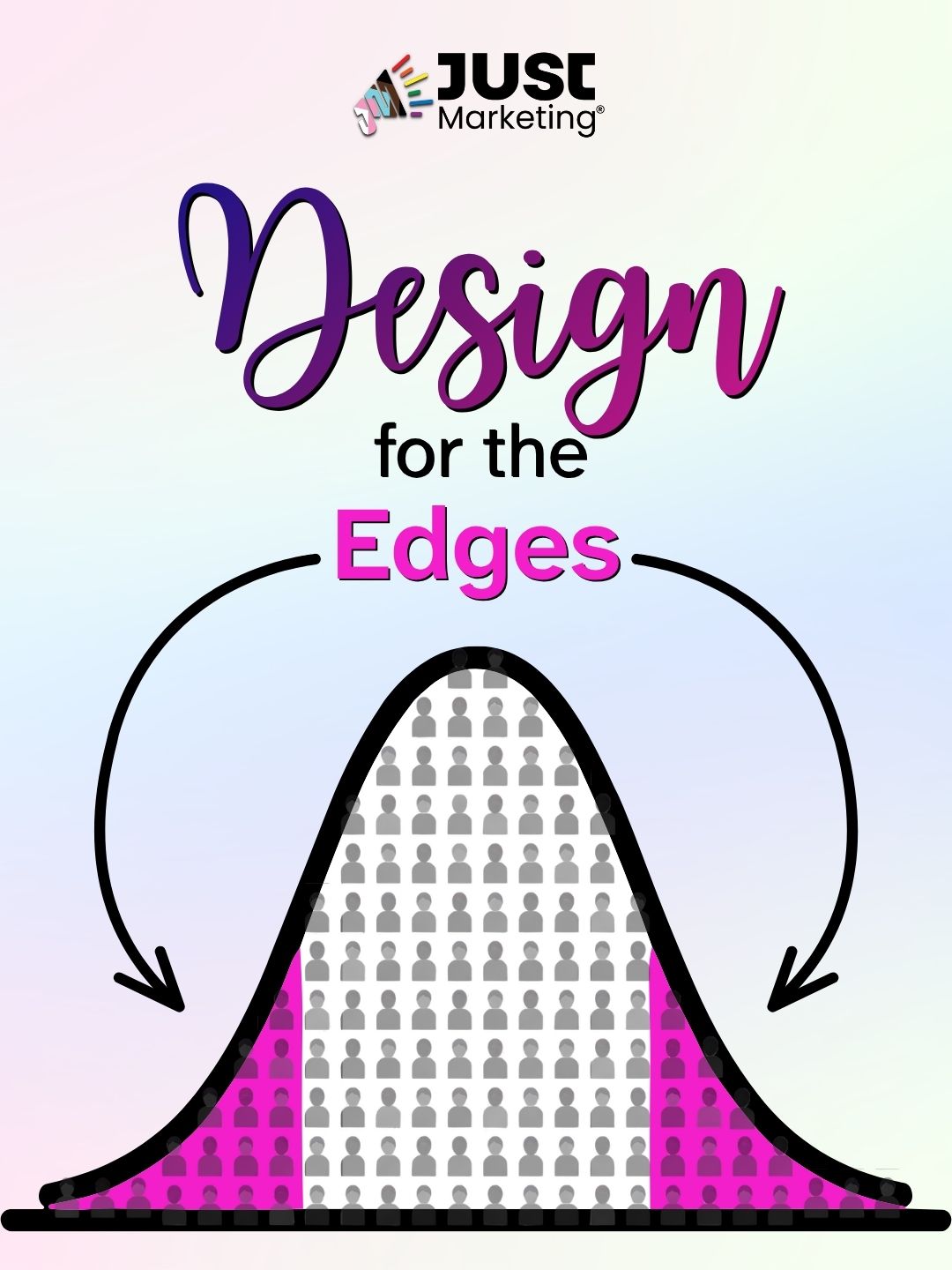
“Design for the Edges” Philosophy

"Design Your Marketing For The Edges" Below, three rounded rectangles highlight key principles in white text: "Accessibility First" with a magnifying glass and star icon. "Representative Storytelling" with an illustration of a diverse group of people. "Intentional Testing" with an image of a person standing next to a checklist.

One of the guiding principles of Just Marketing is the “design for the edges” philosophy. This concept encourages businesses to prioritize the needs of individuals who are often excluded or overlooked in traditional marketing.

Rather than treating inclusion as an afterthought or “add-on,” this approach makes it the foundation of your strategy. By designing your campaigns to meet the needs of people with diverse abilities, identities, and experiences, you create marketing that works better for everyone.

Here’s how to apply this philosophy:

  • Accessibility First: Design your content with accessibility in mind from the start. Use plain language, add alt text to images, and ensure your website meets ADA compliance standards.
  • Representative Storytelling: Create campaigns that reflect a wide range of voices and experiences, ensuring that no group feels erased or misrepresented.
  • Intentional Testing: Before launching campaigns, test them with diverse focus groups to identify potential blind spots or unintended exclusions.

By prioritizing inclusion from the beginning, you build a stronger, more impactful marketing strategy – one that doesn’t just meet your audience where they are but ensures they feel like they truly belong.

Building the foundations of a Just Marketing strategy requires intentionality, and the payoff is worth it: deeper audience connections, greater trust, and a brand identity rooted in justice and equity.


Practical Strategies for Just Marketing

Creating a Just Marketing strategy is about moving from intention to action. This section explores practical steps your business can take to ensure your marketing is both inclusive and accessible, enabling you to authentically connect with diverse audiences.

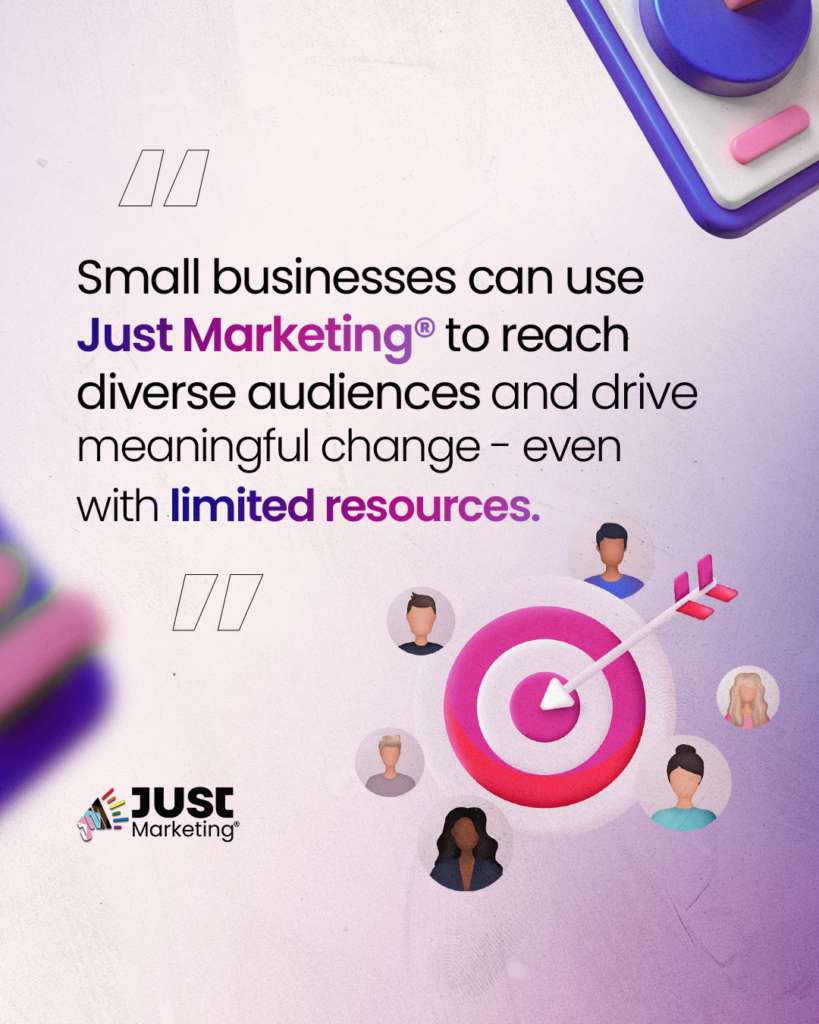
"Small businesses can use Just Marketing® to reach diverse audiences and drive meaningful change – even with limited resources." A 3D illustration shows a pink and white target with an arrow in the bullseye, surrounded by six diverse avatar-style profile icons. The "JUST Marketing®" logo appears in the bottom left.

Bridging Cultural and Identity Differences

Cultural competence is a cornerstone of inclusive marketing. By understanding and respecting different cultural contexts and identities, you can create campaigns that truly resonate with your audience.

Tips for Bridging Differences:

  • Do Your Research: Learn about the cultural nuances, values, and traditions of the communities you’re trying to reach. Avoid stereotyping or making assumptions.
  • Involve Diverse Voices: Collaborate with team members, creators, or consultants from underrepresented backgrounds to co-create campaigns.

Examples of Inclusive Practices:

  • Highlight diverse celebrations, events, or milestones in your campaigns (e.g., Lunar New Year, Pride Month, or International Day of Persons with Disabilities). Check out my free collection of Diverse & Inclusive Holidays!
  • Use images and videos that showcase people from various cultural and identity backgrounds in authentic, non-stereotypical ways.

Making Marketing Accessible

Accessibility ensures that everyone, regardless of ability, can fully engage with your content. Small, intentional changes can make a big difference.

Key Accessibility Practices:

  • Alt Text for Images: Provide descriptive alt text that conveys the essential information in images for people using screen readers.
  • Captions and Transcripts: Include captions for all videos and provide transcripts for podcasts or audio content.
  • Plain Language: Write in a clear, straightforward way to ensure your content is easy to understand for everyone, including people with cognitive disabilities or those who speak English as a second language.
  • Mobile-Friendly Design: Optimize your website and emails for mobile devices to ensure usability across all platforms and devices.

Red Flags to Avoid:

  • Graphics with text that’s too small to read or poorly contrasted colors that make reading difficult.
  • Overly complex navigation on websites that creates barriers for users with disabilities.
  • Flashing elements or autoplay videos that can trigger sensory sensitivities.

Fostering Authentic Connections

Just Marketing isn’t just about avoiding harm – it’s about creating authentic, meaningful connections with your audience.

How to Foster Connection:

  • Center Storytelling: Share stories that highlight diverse perspectives and experiences. Authentic storytelling helps your audience see themselves reflected in your brand.
  • Engage in Dialogue: Use social media to engage with your audience, listen to their feedback, and involve them in the conversation.
  • Avoid Performative Gestures: Steer clear of surface-level actions (e.g., posting about DEI during one month and ignoring it the rest of the year). Show your commitment through consistent and meaningful actions.

By taking these practical steps, your business can break down barriers, connect authentically, and ensure your marketing reflects the diverse, beautiful world we live in.


Practical Steps for Small Businesses to Implement Just Marketing

Small businesses often operate with limited resources, but that doesn’t mean they can’t make a big impact when it comes to inclusive marketing. With intentionality and creativity, even the smallest business can integrate justice-centered practices into its strategy. Here’s how to get started.

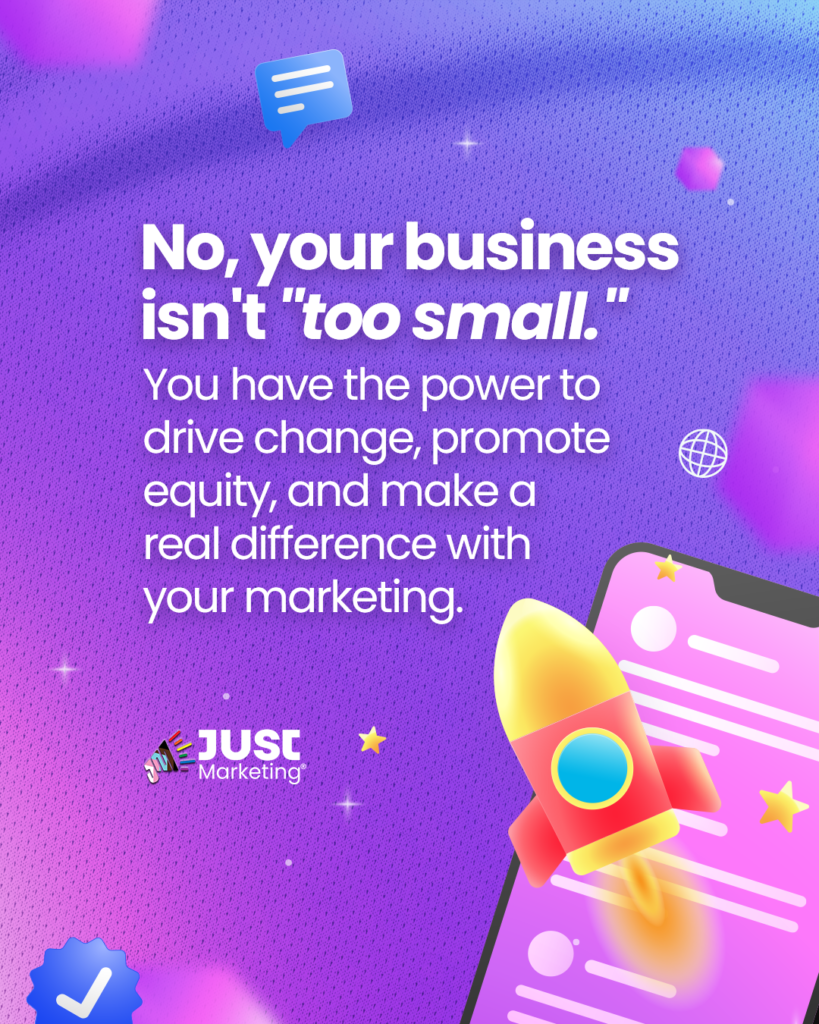
"No, your business isn't too small. You have the power to drive change, promote equity, and make a real difference with your marketing." A stylized illustration of a smartphone with a glowing red and yellow rocket taking off from the screen is in the lower right. Surrounding the text are floating icons, including a blue speech bubble, a globe, and small stars.

Start Small, Think Big

You don’t have to overhaul your entire marketing strategy overnight. Focus on incremental changes that add up over time.

  • Audit Your Current Marketing: Look at your website, social media, and other content through an inclusion and accessibility lens. Identify areas where improvements can be made.
  • Set Priorities: Pick one or two areas to focus on initially, such as adding captions to videos or diversifying imagery.
  • Celebrate Progress: Acknowledge and share your efforts with your audience to show your commitment to growth and learning.

Leverage Low-Cost Tools and Resources

Creating inclusive and accessible marketing doesn’t have to be expensive. Many tools and resources are free or budget-friendly.

  • Accessibility Checkers: Tools like WAVE can help you identify accessibility issues on your website, and tools like the Color Contrast Checker can help ensure your using adequate color contrast in your designs.
  • Diverse Stock Image Libraries: Resources like Nappy, Disability:In, and Disabled and Here offer inclusive stock imagery.
  • Language Assistance: Grammarly, or Hemingway can help ensure your content is clear and inclusive.

These tools allow you to make meaningful changes without stretching your budget.

Focus on Everyday Practices

Consistency is key. Build inclusive marketing practices into your day-to-day operations to ensure they’re a regular part of your business.

  • Use Inclusive Language: Avoid jargon or terms that could alienate your audience. Aim for language that is welcoming and accessible to everyone.
  • Add Accessibility Features: Make adding alt text to images and captions to videos a routine part of your content creation process.
  • Amplify Marginalized Voices: Feature diverse creators, partners, or community members in your campaigns.

Every small effort contributes to building a more inclusive and justice-centered brand.

Collaborate for Greater Impact

Partnerships can help amplify your impact while building authentic connections.

  • Partner Locally: Work with local organizations or community leaders to understand the needs of underrepresented groups in your area.
  • Hire Diverse Creators: Collaborate with freelance writers, designers, or influencers from underrepresented backgrounds to ensure your campaigns reflect diverse perspectives.
  • Learn from Experts: Bring in consultants who specialize in DEI or accessible marketing to help guide your efforts.

Collaborations allow you to share resources and expertise, creating a win-win for everyone involved.

Tell Your Audience About Your Commitment

Transparency is vital. Share your inclusive marketing journey with your audience to build trust and accountability.

  • Show Your Work: Highlight the steps you’re taking to improve accessibility and inclusion.
  • Admit Imperfections: Be honest about areas where you’re still learning or growing.
  • Invite Feedback: Create opportunities for your audience to share their thoughts and experiences, helping you identify gaps and improve further.

By being open about your efforts, you demonstrate your genuine commitment to making a difference.

Inclusive marketing is a journey, not a destination, and every step matters. Small businesses have the unique advantage of being able to implement meaningful changes quickly and authentically. By starting small, leveraging available resources, and staying consistent, your business can create marketing that not only connects with diverse audiences but also drives meaningful change in your community and beyond.


Next Steps

Marketing isn’t just a tool for promoting your products or services – it’s a powerful way to shape the world we want to live in. By embracing justice-centered marketing, you can foster authentic connections, ensure accessibility for all, and challenge systems of oppression.

Whether you’re auditing your existing content, incorporating accessibility features, or amplifying underrepresented voices, every step you take brings us closer to a more equitable and inclusive world. Small businesses, in particular, have the power to lead by example, showing that meaningful change doesn’t require massive budgets – just a commitment to doing better.

If you’re ready to take actionable steps, I’ve got two resources to help you get started:

  • Diverse and Inclusive Holidays Collection: A comprehensive guide to celebrating holidays and events that honor diverse cultures, identities, and experiences.
  • Just Marketing Checklist: A practical tool to help you evaluate and improve your marketing strategy with justice, equity, diversity, and inclusion in mind.

Let’s make marketing more inclusive, accessible, and impactful – together. Check out these resources and take the first step toward building your Just Marketing strategy today!

Just Marketing Content Marketing Membership. Mockup shows elements of the membership in different digital divices including Weekly Social Content, Content Expansion, And 6 bonuses!

Categories: All Categories, Just Marketing®

Tags: Accessible Marketing, Blogging Strategy, Core Content, Email Marketing, Ethical Marketing, Inclusive Marketing, Increase Brand Awareness, Increase Engagement, Marketing Clarity, Marketing Confidence, Values-Aligned Promotions

Prev
Next

About Meg Brunson

Online marketing authority and former Facebook employee Meg Brunson combines their mission to build a more accessible and inclusive world, with their expertise in the digital marketing space.

Meg is on a mission to disrupt the status quo of marketing so that financial success is the byproduct of a genuine commitment to justice, rather than an end goal in itself.

Through Meg’s signature approach, Just Marketing®, businesses are implementing ethical, inclusive, and accessible marketing campaigns that make a positive impact on society and their bottom line, creating a virtuous cycle where profitability and responsible practices reinforce each other.

Meg is a professional speaker, children’s book author, host of the Just Marketing® podcasts, CMO of BetterCEO.app and CEO of Just Marketing®.

Follow me on Instagram @theMegBrunson
Manageable - not stressful. That's the vibe we're Manageable - not stressful.

That's the vibe we're going for over here - and Michelle said it better than I ever could.

Marketing can feel this way. Let me show you…

Comment, DM, or learn more at YourMarketingPerson.co 

ID: A testimonial from Michelle T. reads: 'Meg brings together creativity, strategy, organization, and follow-through in a way that makes marketing feel manageable instead of stressful. I recommend her to any business looking for a skilled, values-aligned marketing partner.' Michelle is smiling in the background. YourMarketingPerson.co

#JustMarketing #EquityForAll #a11y #EquityCenteredBusiness #DiversityInMarketing #SocialJustice #RacialJustice #BeTheChange #DismantleWhiteSupremacy #DiversityEquityInclusion #EthicalMarketing #InclusiveMarketing #AccessibleMarketing #MarketingAccessibility #SocialMediaMarketer #EthicalBusiness #MarketingCoach #CommunityOverCompetition #MarketingWithPurpose #MarketingWithImpact #DEI #DEIMarketing #SocialMediaForAll #ContentCreation #ContentMarketing #ContentMarketingMembership #WeeklySocialContent  #MarketingWithADHD #adhdBusiness #adhdBusinessOwner
Here are five ways to shift your marketing toward Here are five ways to shift your marketing toward messaging that's genuinely empowering, trust-building, and consent-based:

1. Affirm Without Inflating
There's a big difference between "You're a total rockstar who was BORN for this transformation!" and "If you've been looking for support that aligns with your values, this might be it." One tells people who they are. The other meets them where they actually are.

2. Center Autonomy and Consent
Instead of telling your audience they're ready, invite them to decide for themselves. "You know yourself best. If this feels like a fit, I'd love to support you."

3. Empower Without Pressure
Encouragement that says "your work matters whether you buy from me or not" builds genuine trust. 

4. Honor Neurodiversity + Emotional Safety
Not everyone responds well to high-emotion, high-intensity language - choose calm and clear over hype and overwhelm. 

5. Let the Value Speak for Itself
Share real benefits. Tell honest stories. Trust that the right-fit clients will recognize themselves in your words -  not because you told them they were "destined" for it, but because they genuinely felt seen and respected.

These suggestions are not just "nicer" marketing. They're smarter marketing. They build the kind of relationships that lead to referrals, retention, and a reputation you're actually proud of.

And isn't that the whole point?

I share more at: MegBrunson.com/love-bombing

Which of these five shifts feels most relevant to where you are right now?

ID: 'Instead of Love Bombing,' five numbered alternatives are listed: 1) 'Affirm Without Inflating,' 2) 'Center Autonomy and Consent,' 3) 'Empower Without Pressure,' 4) 'Honor Neurodiversity and Emotional Safety,' and 5) 'Let the Value Speak for Itself.' Watercolor hearts in shades of pink and red.

#JustMarketing #EquityForAll #EquityCenteredBusiness #EthicalMarketing #OnlineBusinessMarketing #EthicalBusiness #MarketingWithADHD #ContentMarketing #ContentMarketingMembership #WeeklySocialContent #a11y #ContentStrategy #InclusiveMarketing #AccessibleMarketing #ContentCreation
Struggling to establish your authority and credibi Struggling to establish your authority and credibility online?
An inconsistent online presence might be the culprit.

Symptoms include:
– Sporadic posting
– Unclear branding
– Disjointed messaging

These issues can significantly impact your authority and credibility, leading to missed opportunities for networking, collaboration, and growth.

You’re not broken.
Your systems just weren’t built for you.

You need a system - designed to support neurodivergent brains and values-led business owners - that meets you where you’re at.

Including:
 – A flexible monthly content calendar
 – Ethical, inclusive, customizable prompts
 – Built-in ways to repurpose content so you’re not starting from scratch

Learn more: ContentMarketingMembership.com

ID: A paper that looks like a doctor's prescription pad. Diagnosis is inconsistency. The prescription is for the Content Marketing Membership. Background is light pink with dark pink crosses, a medical theme.

 #JustMarketing #EquityForAll #a11y #EquityCenteredBusiness #DiversityInMarketing #SocialJustice #RacialJustice #BeTheChange #DismantleWhiteSupremacy #DiversityEquityInclusion #EthicalMarketing #InclusiveMarkeitng #AccessibleMarketing #MarketingAccessibility #SocialMediaMarketer #EthicalBusiness #MarketingCoach #CommunityOverCompetition #MarketingWithPurpose #MarketingWithImpact #DEI #DEIMarketing #SocialMediaForAll #ContentCreation #ContentMarketing #ContentMarketingMembership #WeeklySocialContent  #MarketingWithADHD #adhdBusiness #adhdBusinessOwner
Love bombing in marketing isn't just "a little cri Love bombing in marketing isn't just "a little cringe" - it's actually harmful.

A lot of this language gets passed down through traditional sales training as "high-vibe" or "empowering." But when we look closer? The impact tells a different story.

1. Flooding someone with praise to trigger a buying decision isn't connection, it's coercion. Even when the words sound kind, if the goal is to override someone's boundaries and get them to say yes before they're ready? That's manipulation. Full stop.

2. For people who've experienced emotionally manipulative or abusive relationships, love bombing in marketing doesn't just feel uncomfortable, it can be genuinely triggering. It mirrors the same dynamics they've already had to survive.

3. When someone realizes all that validation was just a setup for a pitch, the trust evaporates. And trust is the entire foundation of sustainable, values-aligned client relationships.

Short-term conversions built on manipulation don't grow businesses. They burn bridges.

This isn't about shame - it's about awareness and the willingness to do better.

Your audience doesn't need to be love-bombed into trusting you. 

When your marketing is honest, clear, and genuinely respectful, the right-fit people will find you… and they'll stay.

Read the blog - MegBrunson.com/love-bombing - It covers all of this plus what to do instead of love bombing in your copy.

Which of these three impacts surprised you most?

ID: 'Love Bombing is problematic.' Three broken heart emojis mark the reasons: 'Emotionally Manipulative,' 'Not Trauma-Informed,' and 'Undermines Trust.' The Just Marketing logo appears at the bottom on a light gray background bordered by shiny purple fabric hearts.

#JustMarketing #EquityForAll #MarketingWithHeart #EquityCenteredBusiness #DiversityEquityInclusion #EthicalMarketing #OnlineBusinessMarketing #EthicalBusiness #OnlineMarketingTips #DEI #MarketingWithADHD #ContentMarketing #ContentMarketingMembership #WeeklySocialContent #a11y #InclusiveMarketing #AccessibleMarketing #SocialMediaForAll #ContentCreation
Love bombing is designed to trigger an emotional r Love bombing is designed to trigger an emotional response. 

It floods your nervous system with validation, and then attaches those feelings to a buying decision. So by the time you're reaching for your wallet, it doesn't feel like pressure… it feels like clarity.
But it's not clarity. 

It's a manufactured moment of emotional intensity.

And for folks who've navigated burnout, rejection sensitivity, or trauma… emotionally manipulative marketing doesn't just feel bad - it can cause real harm by mirroring dynamics they've already had to fight their way out of.

Just Marketing® exists because I believe marketing can be better. 

More actually-kind… not performatively kind.

You deserve marketing that respects your autonomy enough to let you decide if something is a fit -  without being emotionally maneuvered into it.

Read more on the topic: MegBrunson.com/love-bombing

What's your gut reaction to love bombing in marketing? 
I'd love to hear your thoughts in the comments.

ID: 'Love Bombing isn't about seeing someone's potential, it's about using praise to pressure them into action.' The Just Marketing logo appears below the text, displayed inside a white decorative lace doily frame on a pink background patterned with hand-drawn hearts.

#JustMarketing #EquityForAll #MarketingWithHeart #MarketingWithIntegrity #EquityCenteredBusiness #SocialJustice #AlignedBusiness #BeTheChange #DismantleWhiteSupremacy #DiversityEquityInclusion #EthicalMarketing #OnlineBusinessMarketing #EthicalBusiness #OnlineMarketingTips #DEI #ValuesMatter #MarketingWithADHD #adhdBusiness #adhdBusinessOwner #ContentMarketing #ContentMarketingMembership #WeeklySocialContent #a11y #ContentStrategy #InclusiveMarketing #AccessibleMarketing #DEIMarketing #SocialMediaForAll #ContentCreation
Love bombing in marketing isn't always obvious. Love bombing in marketing isn't always obvious. 

It doesn't always look like a pushy sales bro screaming "LIMITED TIME OFFER.” 

Sometimes it shows up softly - wrapped in spiritual language, coated in empowerment rhetoric, or disguised as a coach who really believes in you.

Here's what to watch for:
– Language that tells you who you are rather than inviting you to reflect 
– Compliments that seem designed to make you feel obligated to say yes 
– Praise that shows up right before (or during) a pitch

The goal of ethical, Just Marketing® isn't to strip the warmth out of your messaging. It's to make sure the warmth is real - rooted in genuine care, not conversion tactics.

Your audience can feel the difference. And the ones you actually want to work with? They're looking for someone they can trust - not someone who makes them feel temporarily amazing and then asks for their credit card.

Real connection doesn't need to manufacture emotional dependency. It builds naturally, over time, through honesty and respect. 

Want to understand love bombing in marketing more deeply - including why it's especially problematic for neurodiverse and trauma-impacted communities? 

Read about it: MegBrunson.com/love-bombing

And then come back here and tell me: has any of this show up in marketing you've encountered recently?

ID: 'Love Bombing' is defined through three overlapping hearts labeled 'excessive praise,' 'inflated compliments,' and 'positive attention,' followed by the phrase '...used to create emotional dependency or fast-track trust.' The Just Marketing logo appears at the bottom on a white background scattered with pink hearts.

#JustMarketing #EquityForAll #MarketingWithHeart #MarketingWithIntegrity #EquityCenteredBusiness #DiversityEquityInclusion #EthicalMarketing #OnlineBusinessMarketing #EthicalBusiness #OnlineMarketingTips #DEI #ValuesMatter #MarketingWithADHD #ContentMarketing #ContentMarketingMembership #WeeklySocialContent #a11y #ContentStrategy #InclusiveMarketing #AccessibleMarketing #DEIMarketing #SocialMediaForAll #ContentCreation
You may have heard of “love bombing” in the contex You may have heard of “love bombing” in the context of toxic relationships, but it shows up in marketing too.

Love bombing in marketing is when brands flood you with over-the-top praise, inflated compliments, and feel-good validation... all designed to fast-track your trust and nudge you toward a "yes" before you're actually ready.

It sounds like:
– "You're clearly meant for more - don't waste your potential by saying no."
– "I only work with soul-aligned visionaries, and I just KNOW that's you."
– "You're so ready for the next level. Why wait?"

A lot of marketers aren't doing this on purpose. It gets taught as "high-vibe connection" in traditional sales spaces. But good intentions don't cancel out harmful impact.

And for neurodiverse folks, people navigating burnout, or anyone with a history of emotionally manipulative relationships… This kind of language can be genuinely triggering, not just uncomfortable.

Your audience deserves to feel seen and respected -  not love-bombed into a buying decision.

Read more: MegBrunson.com/love-bombing 

And I want to hear from you: Have you ever noticed love bombing in marketing… either in someone else's content or (no judgment!) in your own?

ID: 'Love Bombing: Over-the-Top Praise Isn't as Kind as It Seems.' A cartoon pink bomb with a red heart and a sparkling lit fuse sits in front of a glowing white heart outline on a pastel pink and purple gradient background with sparkles.

#JustMarketing #EquityForAll #MarketingWithHeart #MarketingWithIntegrity #EquityCenteredBusiness #SocialJustice #AlignedBusiness #BeTheChange #DismantleWhiteSupremacy #DiversityEquityInclusion #EthicalMarketing #OnlineBusinessMarketing #EthicalBusiness #OnlineMarketingTips #DEI #ValuesMatter #MarketingWithADHD #adhdBusiness #adhdBusinessOwner #ContentMarketing #ContentMarketingMembership #WeeklySocialContent #a11y #ContentStrategy #InclusiveMarketing #AccessibleMarketing #DEIMarketing #SocialMediaForAll #ContentCreation
When we talk about the EIEIO Marketing Framework - When we talk about the EIEIO Marketing Framework - a lot of people think Engage and Interact sound like the same thing, but they're not - and understanding the difference can really change how you approach your time on social media.

* Engaging your ideal audience is about showing up for the people you want to serve (your ideal clients).

* Interacting with relevant accounts is about showing up alongside the people who influence, serve, or exist in the same ecosystem as your ideal clients.

When building your interaction list, consider:
-- Complementary service providers who serve the same audience
-- Thought leaders or educators your ideal clients follow and trust
-- Organizations or communities your ideal clients are part of
-- Potential collaborators, podcast hosts, or referral partners
-- Accounts that are already creating content your ideal clients love

When you interact consistently with these accounts - a few things start to happen:
-- Their audience sees your name. Repeatedly. In a positive context.
-- The account owner notices you. Relationships form. Collaborations become possible.
-- You become part of a larger ecosystem, rather than a lone voice posting into the void.

The more genuinely you support others in your ecosystem, the more you become a recognized, trusted presence in the spaces your ideal clients already inhabit. That’s visibility through community. And when we lift each other up, everyone benefits.

Your Challenge This Week:
Identify 3-5 accounts in your ecosystem that you're not currently interacting with regularly. Follow them, and engage with their content authentically. The relationships you build through consistent interaction often turn into collaborations, referrals, and friendships you didn't see coming. Show up with no agenda and see what grows!

Comment or DM:
Has "Interact" been on your radar, or is this a missing piece for you?

ID: Meg is smiling with long pink hair wearing a black tank top with pink lettering reading 'Angry Liberal Feminist Killjoy.' Their arm is covered in colorful tattoos. They accessorize with rainbow bracelets. Trees and urban buildings are visible behind them.
Credentials aren't the villain. I want to be real Credentials aren't the villain.

I want to be really clear about that because this conversation can feel uncomfortable, especially if you've worked hard for your experience, your certifications, and your results.

You should share those things. Your audience deserves to know you know your stuff.

But there's a difference between building genuine credibility and performing authority in a way that manipulates, excludes, or overwhelms the people you're trying to serve.

So let's make it practical. Here's the swap:

1. Instead of leading with extreme, cherry-picked success stories... Try sharing client transformations with honest context -  who it worked for, how, and why.

2. Instead of inflated claims designed to impress... Try transparency about your actual journey, including the learning edges.

3. Instead of hype-heavy messaging that creates urgency and pressure... Try relatable stories that help your audience see themselves in your work.

These aren't just "nicer" ways to market. They're more effective -  because they build the kind of trust that actually converts, without leaving people feeling manipulated or excluded after the fact.

Read more: MegBrunson.com/authority-bias

Which of these three swaps feels most relevant to where you are right now in your marketing?

ID: 'Authority is not the problem... it's how we use it that deserves our attention.' Three pairs of thumbs-down and thumbs-up labels contrast approaches: 'extreme examples of success v. client transformations with context,' 'inflated claims v. transparency about your journey,' and 'hype-heavy messaging v. relatable stories.'

#JustMarketing #EquityForAll #EquityCenteredBusiness #SocialJustice #AlignedBusiness #DiversityEquityInclusion #EthicalMarketing #OnlineBusinessMarketing #EthicalBusiness #OnlineMarketingTips #DEI #MarketingWithADHD #adhdBusiness #adhdBusinessOwner #ContentMarketing #ContentMarketingMembership #WeeklySocialContent #a11y #ContentStrategy #InclusiveMarketing #AccessibleMarketing #SocialMediaForAll #ContentCreation
Growth doesn't have to come at the cost of your me Growth doesn't have to come at the cost of your mental health or your bandwidth. 

The right marketing support should help you expand your capacity, not drain it.

If you're ready for results that feel good and work well, I'd love to connect. 

Comment, DM, or learn more at YourMarketingPerson.co

ID: A testimonial from Michelle T. reads: 'Bringing Meg on was one of the best decisions I made... I doubled my group class offerings and increased demand for 1:1 sessions, while feeling less overwhelmed by marketing.' Michelle is smiling and kneeling outdoors with three dogs beside her. YourMarketingPerson.co

 #JustMarketing #EquityForAll #a11y #EquityCenteredBusiness #DiversityInMarketing #SocialJustice #RacialJustice #BeTheChange #DismantleWhiteSupremacy #DiversityEquityInclusion #EthicalMarketing #InclusiveMarketing #AccessibleMarketing #MarketingAccessibility #SocialMediaMarketer #EthicalBusiness #MarketingCoach #CommunityOverCompetition #MarketingWithPurpose #MarketingWithImpact #DEI #DEIMarketing #SocialMediaForAll #ContentCreation #ContentMarketing #ContentMarketingMembership #WeeklySocialContent  #MarketingWithADHD #adhdBusiness #adhdBusinessOwner
Name-dropping. Revenue flexing. Credential overloa Name-dropping.
Revenue flexing.
Credential overloading.

We've been taught this is what authority looks like… But a lot of it is just authority bias - a psychological shortcut that nudges people to trust you before you've actually earned it.

And when those signals are inflated or inaccessible? 

It's not just manipulative. It quietly tells entire communities of entrepreneurs that their expertise doesn't count.

Prestigious degrees, elite networks, and revenue milestones aren't equally accessible to everyone. 

Neurodivergent entrepreneurs, BIPOC business owners, disabled creatives -  many hold deep, hard-earned expertise that simply doesn't look flashy on a bio. 

When we only recognize authority in one narrow, traditional form, we're quietly telling everyone else their experience doesn't count.

It does. 

I’m unpacking how authority bias shows up in marketing -  and what the Just Marketing® alternative looks like on the blog…

Check it out and let me know what resonates: MegBrunson.com/authority-bias

Which of these four tactics bothers you the most when you see it in someone's marketing?

ID: 'Authority Bias: A psychological shortcut that makes people more likely to believe or buy from someone who seems like an expert.' Four items follow: 'Name-dropping big brands,' 'Overloading bios with degrees, certifications, or awards,' 'Highlighting revenue milestones,' and 'Sharing cherry-picked client wins.' The Just Marketing logo appears on a pink to purple gradient background.

#JustMarketing #EquityForAll #MarketingWithHeart #MarketingWithIntegrity #EquityCenteredBusiness #SocialJustice #AlignedBusiness #BeTheChange #DismantleWhiteSupremacy #DiversityEquityInclusion #EthicalMarketing #OnlineBusinessMarketing #EthicalBusiness #OnlineMarketingTips #DEI #ValuesMatter #MarketingWithADHD #adhdBusiness #adhdBusinessOwner #ContentMarketing #ContentMarketingMembership #WeeklySocialContent #a11y #ContentStrategy #InclusiveMarketing #AccessibleMarketing #DEIMarketing #SocialMediaForAll #ContentCreation
If you’re building a business while also unlearnin If you’re building a business while also unlearning perfectionism, healing from burnout, or navigating a neurodivergent brain - this is your reminder:

~ Rest is not failure.
~ Pausing is not quitting.
~ You are still making progress, even when you slow down.

Just Marketing® isn’t about pushing through at all costs.

It’s about creating systems that work with your energy, your values, and your capacity.

So if you’re tired today, rest. 
The work will still be here. 
And so will your impact.

ID: Text over an image of a rumpled bed with pillows, tinted with a pink and purple gradient. The text reads: ‘she believed she could, but she was tired, so she rested. ...and you know what? the world went on and it was okay. she will try again tomorrow.'

 #JustMarketing #EquityForAll #a11y #EquityCenteredBusiness #DiversityInMarketing #SocialJustice #RacialJustice #BeTheChange #DismantleWhiteSupremacy #DiversityEquityInclusion #EthicalMarketing #InclusiveMarkeitng #AccessibleMarketing #MarketingAccessibility #SocialMediaMarketer #EthicalBusiness #MarketingCoach #CommunityOverCompetition #MarketingWithPurpose #MarketingWithImpact #DEI #DEIMarketing #SocialMediaForAll #ContentCreation #ContentMarketing #ContentMarketingMembership #WeeklySocialContent  #MarketingWithADHD #adhdBusiness #adhdBusinessOwner
Follow on Instagram


Links

CMM Log In
Mission, Vision, & Values

DEI Statement
Leadership Philosophy
Community Agreements
Press & Media


Beliefs

Black lives matter.
Love is love.
Abortion is healthcare.
No human is illegal.
Free Palestine.
I also Believe…

Circular badge has the name "Meg" in the middle and is surrounded by: "CEO, author, speaker, marketer, leader, & advocate"

Let’s Connect

  • facebook-official
  • instagram
  • bluesky
  • linkedin
  • youtube-play
  • email
Copyright © 2026|All Rights Reserved|Meg Brunson, LLC| Privacy & Terms