Meg Brunson

  • Let’s GoHome
  • #AllTheThingsAbout Me
  • Read | Listen | WatchContent Library
  • Join TheMembership
  • Let’s WorkTogether

Are You Gatekeeping Your Generosity? Rethinking “Forced Freebies” in Your Funnel

You’ve seen it a hundred times  –  maybe you’ve even done it yourself (no judgment, we’ve all been there):

“Want this freebie? Just drop your email below and it’s all yours…”

This strategy is everywhere in online business. It’s framed as a win-win: your audience gets a “free” resource, and you grow your email list. But here’s the truth that often gets glossed over: when we require personal information in exchange for something we call “free,” it’s not actually free  –  it’s a transaction.

Now, before you panic and start deleting your opt-in forms, take a deep breath. This isn’t about shame. It’s about reclaiming our marketing practices so they reflect the values we actually believe in  –  like transparency, consent, accessibility, and equity.

In this post, we’re unpacking the problems with “forced freebies”  –  and exploring how to share your knowledge in ways that build trust, reduce friction, and respect your audience’s autonomy. Whether you’re a coach, a creator, or a consultant trying to grow your list without feeling salesy, this one’s for you.

Let’s rethink what it means to give freely  –  and why sometimes, the most powerful funnel starts with generosity.
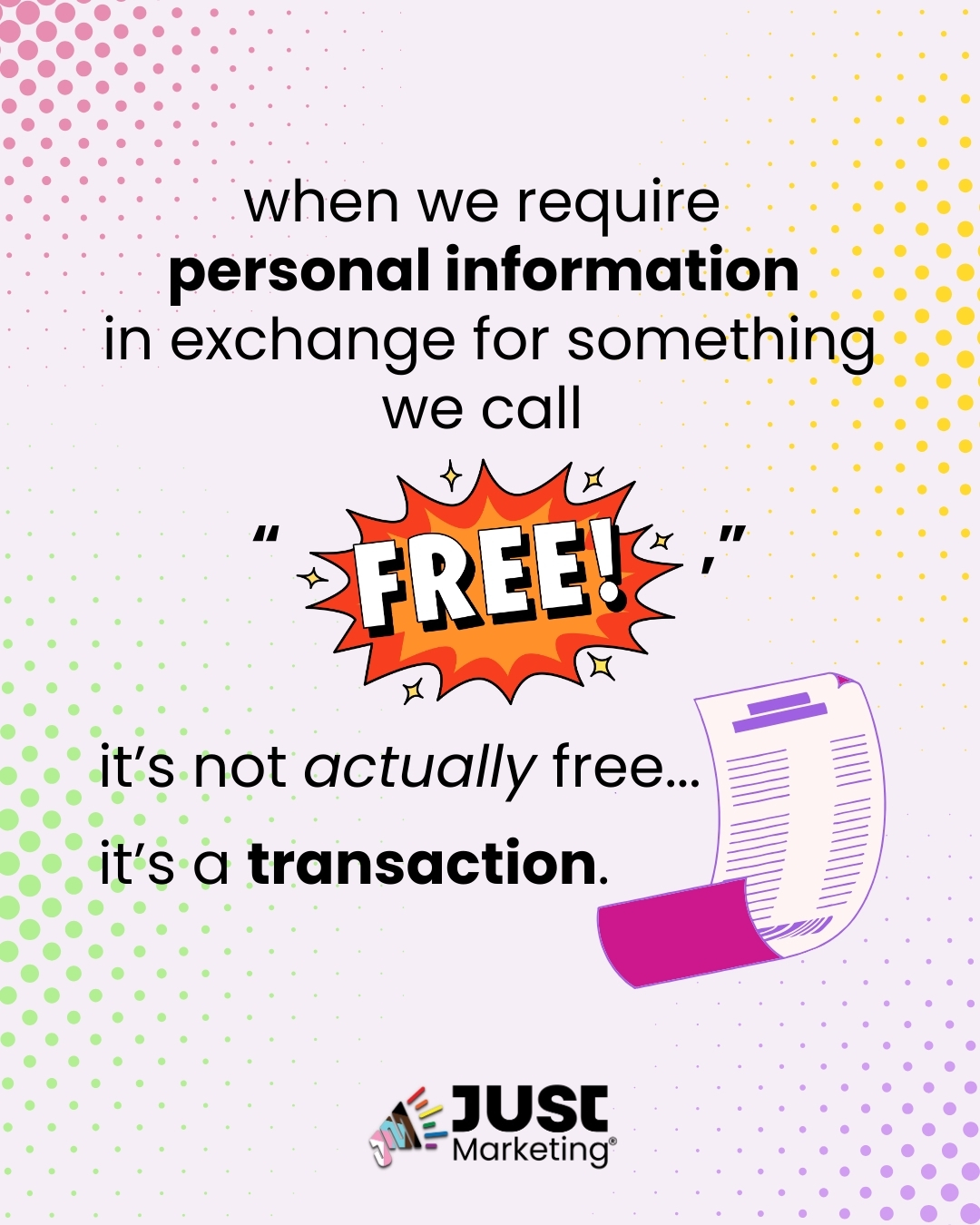
Text: 'When we require personal information in exchange for something we call ‘free!’, it’s not actually free… it’s a transaction.' The word 'free!' is styled in a comic-book explosion, and a receipt appears beside the text. The Just Marketing® logo is at the bottom.

What Are Forced Freebies?

Let’s break it down: “Forced freebies” are free resources  –  like guides, templates, or video trainings  –  that require someone to hand over their email address in order to access them.

They’re usually positioned as lead magnets:

“Get my free checklist  –  just enter your email below!”
“Access this exclusive resource when you subscribe!”

The logic behind this strategy makes sense. You’re offering value in exchange for a spot in someone’s inbox. And to be clear: there’s nothing inherently wrong with wanting to grow your email list. Email marketing can be a powerful, ethical way to build relationships, share your work, and support your business goals.

The issue isn’t offering a free resource  –  it’s when that “free” thing comes with strings attached, especially when those strings aren’t necessary.

For example:

  • A short checklist that could easily live on your blog without a gate.
  • A simple tutorial that would be just as impactful embedded in a post or shared on YouTube.

When we create friction between our audience and the help they’re seeking  –  especially when it’s something we want them to have  –  we risk undermining the very trust we’re trying to build.

Let’s be real: Sometimes the gate doesn’t protect value  –  it just protects your stats.

And that’s worth questioning.
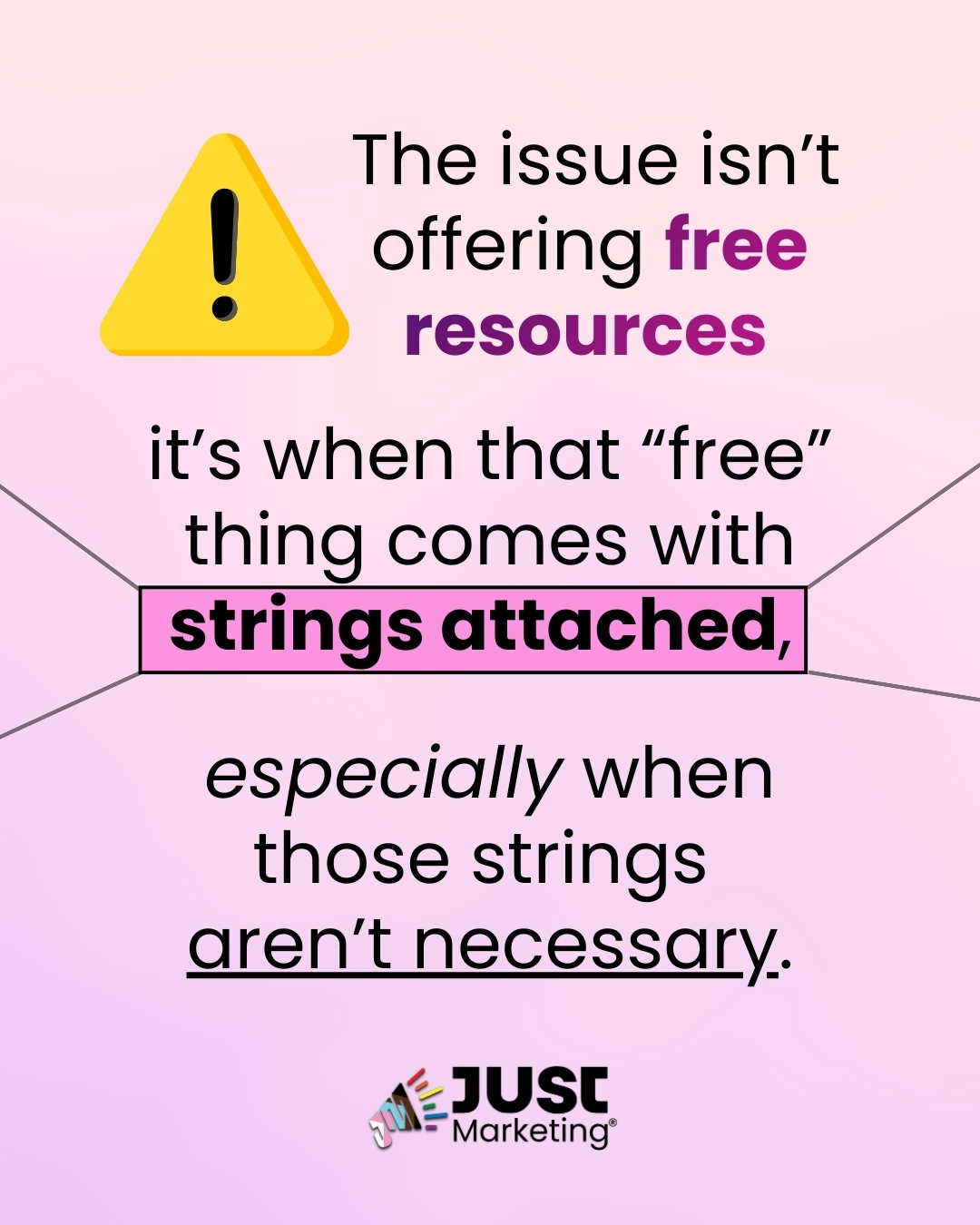
Text: 'The issue isn’t offering free resources - it’s when that “free” thing comes with strings attached, especially when those strings aren’t necessary.' Key phrases like 'free resources', 'strings attached', and 'aren’t necessary' are highlighted in purple or bold. Yellow warning symbol at the top. The Just Marketing® logo appears at the bottom.

Why Forced Freebies Can Be Harmful

Here’s the thing: Forced freebies aren’t evil. Most of us started using them because that’s what the “experts” told us to do. But when we pause to consider how they actually impact our audience  –  especially those who are neurodivergent, disabled, or simply tired of manipulative marketing  –  the cracks start to show.

Let’s unpack a few reasons why this tactic can do more harm than good…
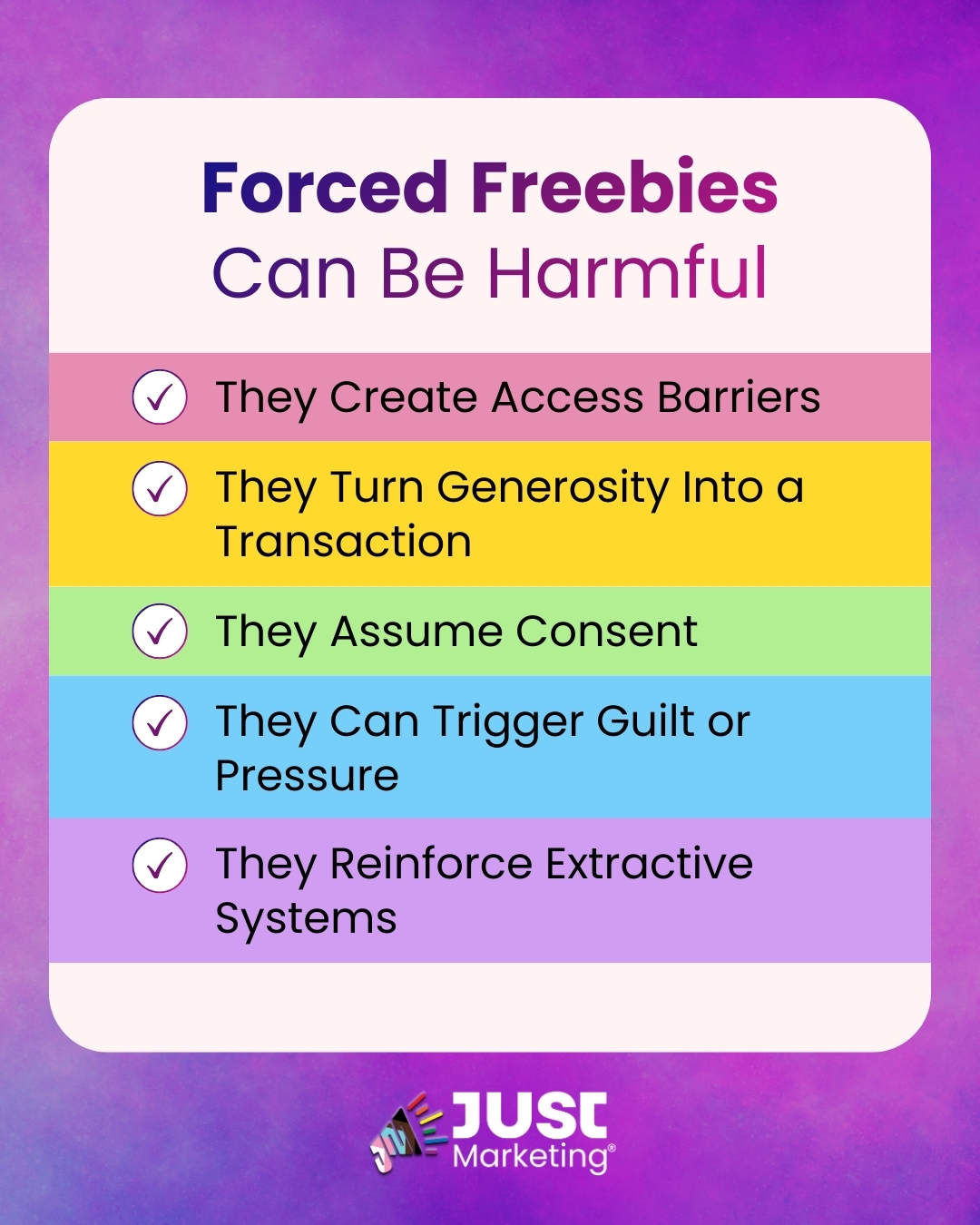
Infographic titled 'Forced Freebies Can Be Harmful' with a checklist of five points: They Create Access Barriers, They Turn Generosity Into a Transaction, They Assume Consent, They Can Trigger Guilt or Pressure, and They Reinforce Extractive Systems'. Each point is color-coded in a horizontal band. The Just Marketing® logo appears at the bottom against a purple gradient background.

1. They Create Access Barriers

When a resource that could be freely shared is locked behind an email form, it immediately limits who can benefit. Some folks don’t have the bandwidth to fill out forms. Others may be cautious about sharing personal info because of privacy concerns, overwhelm, or past negative experiences with spammy marketing.

In short: what was meant to help becomes another hoop to jump through.

2. They Turn Generosity Into a Transaction

When your “free” gift comes with a hidden cost (like inbox access), it sends the message that you’re not really giving  –  you’re trading.

That tiny shift in energy can erode trust, especially for audiences who value authenticity and autonomy.

3. They Assume Consent

Automatically adding someone to a nurture sequence or newsletter after they grab a resource might feel like standard practice, but it assumes consent that hasn’t actually been given. Ethical marketing honors choice  –  it says, “You’re invited to stay connected, not obligated.”

4. They Can Trigger Guilt or Pressure

Some “freebie” funnels lean on urgency or shame  –  like “Don’t miss out!” or “You’re leaving value on the table!”  –  which can feel manipulative, especially for folks with rejection sensitivity or decision fatigue.

5. They Reinforce Extractive Systems

At a bigger-picture level, gatekeeping information reinforces the idea that value must always be monetized or measured  –  instead of shared as part of a more equitable, community-centered economy of knowledge.

Forced freebies might grow your list, but they can also shrink your audience’s trust  –  and that’s a trade no ethical entrepreneur wants to make.

Ethical Alternatives to Forced Freebies

You don’t have to choose between sharing value and growing your business. The real magic happens when you align your marketing with your mission  –  and create systems that honor your audience’s autonomy and your goals.
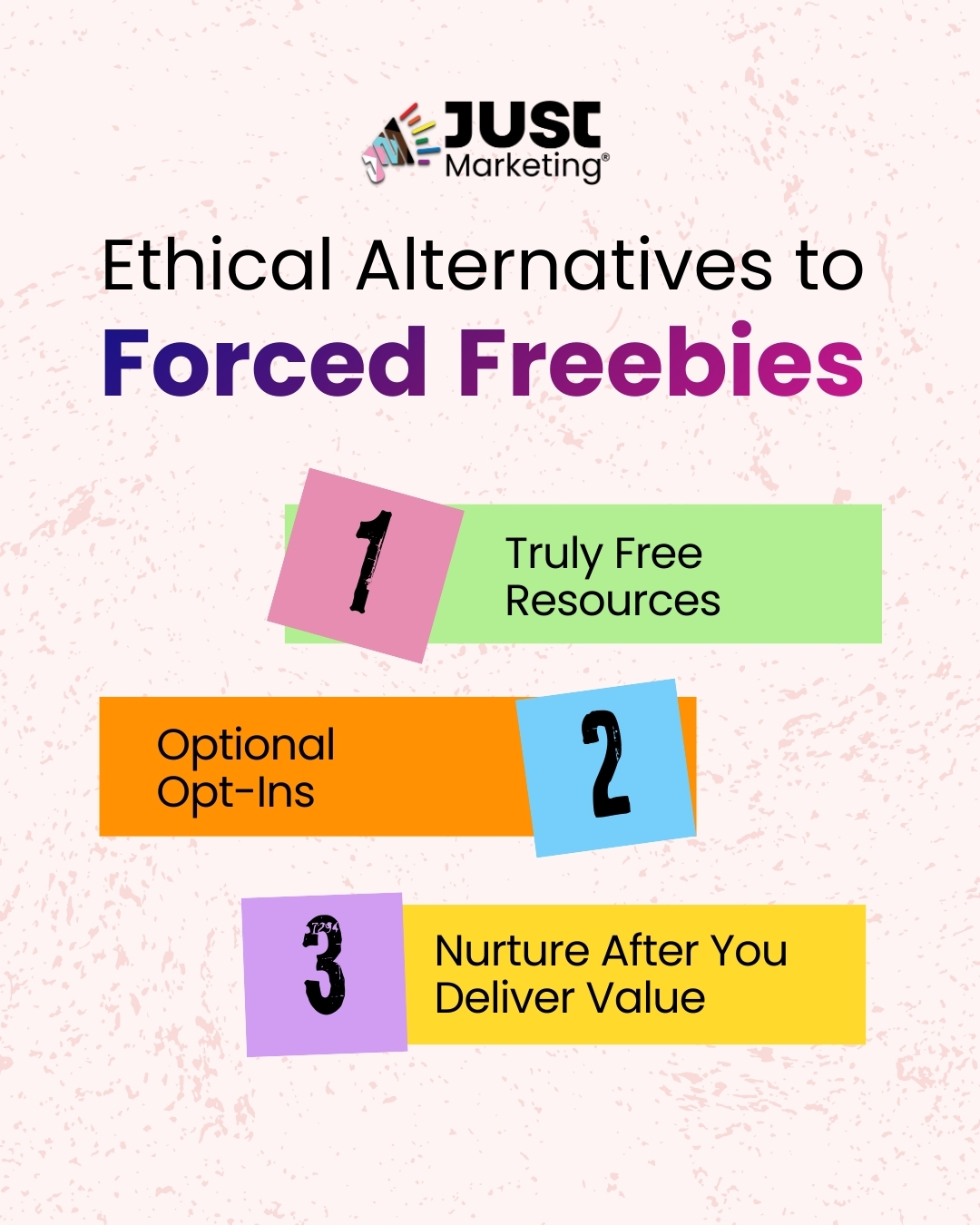
Infographic titled 'Ethical Alternatives to Forced Freebies' with three suggestions: Truly Free Resources (in green), Optional Opt-Ins (in orange), and Nurture After You Deliver Value (in yellow). Each point is accompanied by a colorful number on a separate block. The Just Marketing® logo appears at the top.

Here are three ethical reframes to consider when it comes to offering free resources:

Option 1: Truly Free Resources

This one’s simple but powerful: Just… give the thing away.
No forms. No hoops. Just value, openly shared.

You can:

  • Host the PDF or checklist as a direct download on your blog
  • Embed your video tutorial right into a post  –  no opt-in required
  • Share the content directly on social media (carousel, caption, or link)

Why it works: You immediately build trust by doing what you said you would do  –  helping your audience, no strings attached. And ironically? That kind of transparency often leads to more engagement, not less.

Option 2: Optional Opt-Ins

Instead of making your freebie the “bait,” try shifting the offer:

“Want this resource? Here it is  –  and if you’d like more like this, join my list!”

You’re still inviting folks to stay connected, but you’re not withholding the value unless they agree. You might even offer two versions:

  • A public, instant-access version
  • A “bonus” version with added features delivered via email (only if they want it)

Why it works: It centers consent and gives your audience options. And when people choose to stay in your world, it’s because they want to  –  not because they had to.

Option 3: Nurture After You Deliver Value

Another gentle shift: Let folks access the freebie, then invite them into your email community after they’ve received the resource.

You can add a soft CTA like:

“Was this helpful? Join my list for more tools like this  –  no fluff, no spam, just real support.”

Why it works: You’ve already proven your value. Now your invitation to connect feels like a gift, not a pitch.

These approaches might not give you the same instant list growth as a traditional opt-in funnel  –  but they’ll help you build something even better: a community built on trust, transparency, and aligned values.

And that’s the kind of funnel that actually works long-term.

When Gating Might Make Sense

Not all gated content is unethical. There are situations where asking for an email address is reasonable  –  even respectful  –  especially when it’s done with transparency and consent.
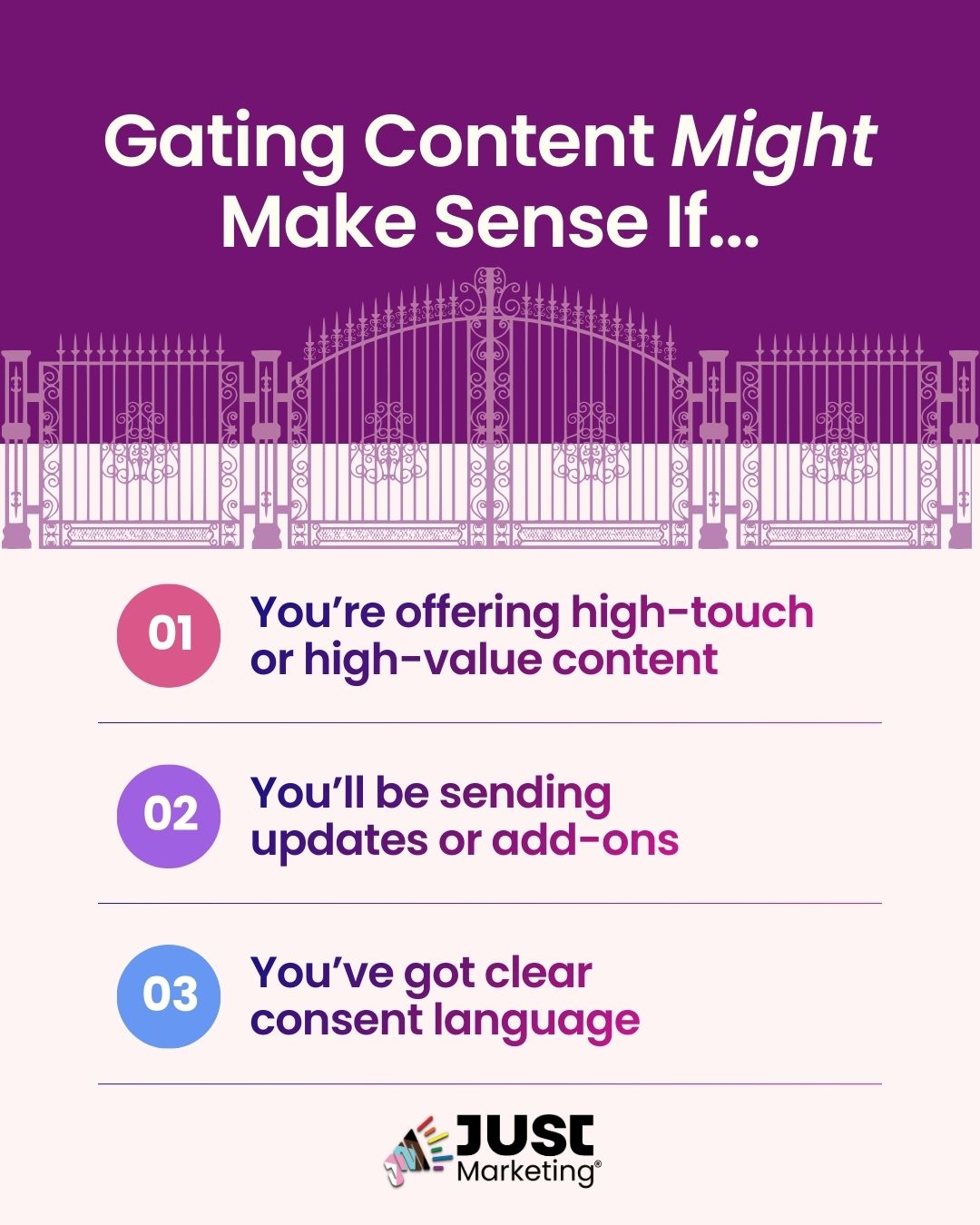
Infographic titled 'Gating Content Might Make Sense If…' with a purple background and an illustrated gate. It lists three conditions where gating may be appropriate: You’re offering high-touch or high-value content, You’ll be sending updates or add-ons, and You’ve got clear consent language. The Just Marketing® logo appears at the bottom.

Here’s when it might make sense to ask for that opt-in:

You’re Offering High-Touch or High-Value Content

If you’ve created something that took significant time, energy, or investment  –  like a multi-module mini course, an in-depth workbook, or a private training  –  it’s fair to request contact info in exchange.

Just be clear about what people are signing up for, and why.

Avoid vague promises like “Get this amazing thing FREE!” and instead say:

“Sign up to receive this 10-page workbook and get occasional emails with resources that support your growth  –  unsubscribe anytime.”

You’ll Be Sending Updates or Add-Ons

If your resource is something you plan to improve or expand (like a living document or evolving template), it makes sense to gate it so folks can receive updates directly.

Ethical twist: Make this the reason for the opt-in, not a hidden surprise.

You’ve Got Clear Consent Language

This is where a lot of traditional funnels go sideways. People grab the freebie… and suddenly find themselves in a 27-email nurture sequence they didn’t know was coming.

Instead, try:

“By signing up, you’ll also receive my weekly newsletter. No spam, just real talk. Unsubscribe anytime.”

Consent = clarity + choice. Always.

A Quick Gut-Check Before Gating

Ask yourself:

  • Could this be shared openly instead?
  • Am I being clear and honest about what they’re opting into?
  • Is there a real reason this needs to be gated  –  or is it just habit?
  • Would I feel comfortable signing up for this myself?

If the answer to any of those feels squishy, it might be time to rethink the funnel.
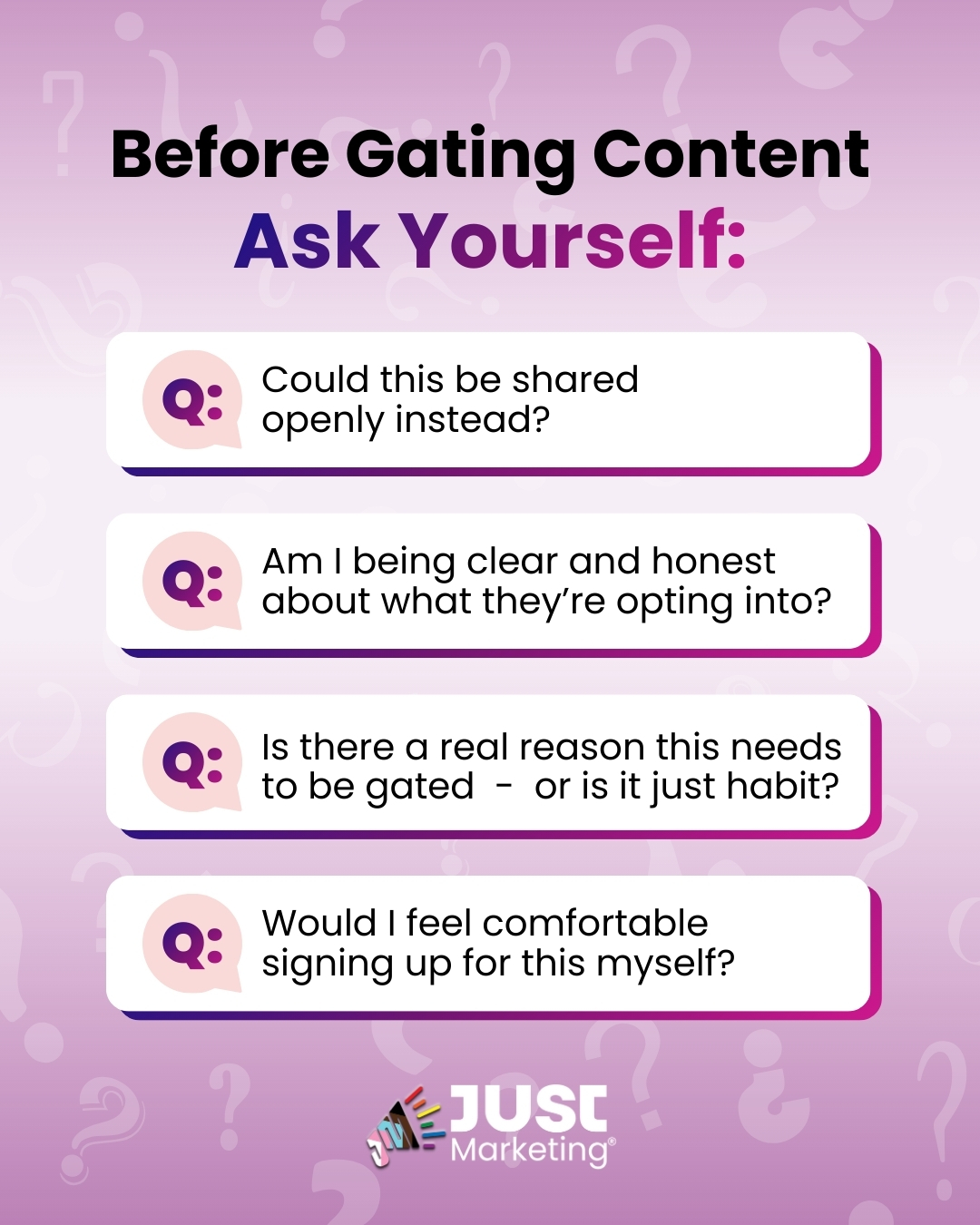
Infographic titled 'Before Gating Content Ask Yourself: Could this be shared openly instead? Am I being clear and honest about what they’re opting into? Is there a real reason this needs to be gated - or is it just habit? Would I feel comfortable signing up for this myself?’ A purple gradient background with question marks. Just Marketing® logo at the bottom.

Let’s Rethink List-Building Together

The truth is, your marketing doesn’t have to rely on tactics that make people feel tricked, trapped, or guilted into connection.

You’re allowed to build a business rooted in consent, curiosity, and community.

You’re allowed to trust that the right people will stick around  –  not because they were funneled into your list, but because they want to be there.

So here’s your invitation: Before creating your next freebie or opt-in form, ask yourself:

  • What experience do I want my audience to have when they find this?
  • How can I make this feel good for them  –  and for me?
  • Where can I loosen the grip and lead with trust instead of tactics?

Because you don’t need to gatekeep your generosity to grow. And in a world full of pop-ups, pressure, and passive-aggressive follow-ups… being radically open might just be your most powerful strategy.
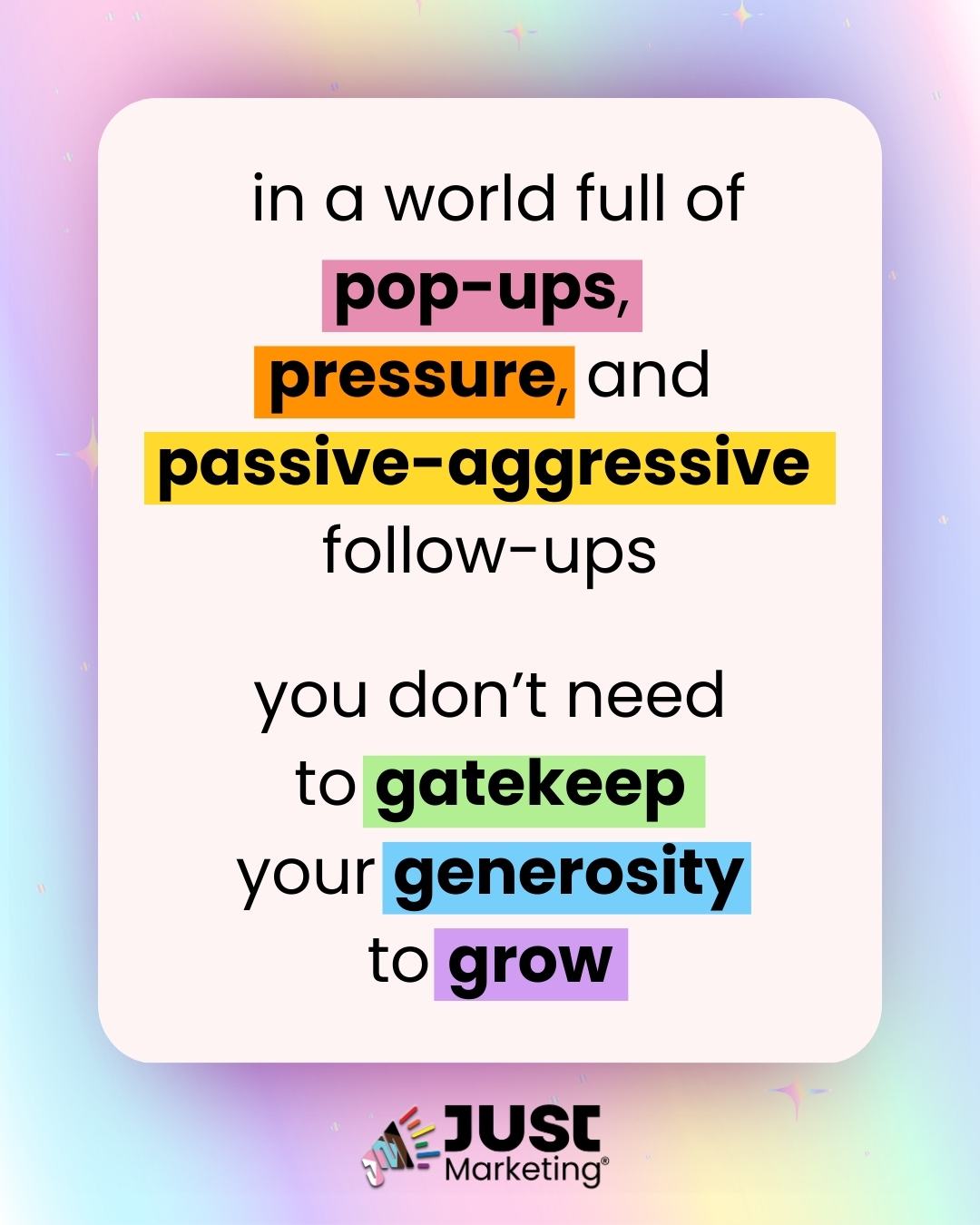
A soft rainbow gradient background and the text: 'In a world full of pop-ups, pressure, and passive-aggressive follow-ups, you don’t need to gatekeep your generosity to grow.' Key phrases are highlighted in bold text with colored backgrounds. The Just Marketing® logo appears at the bottom.

Let’s Keep the Conversation Going

Have you ever clicked on a “free” resource only to hit a wall that says, “But first… your email, please”?

Maybe it made you pause. Maybe it made you bounce. Or maybe you gave in  –  and immediately got flooded with emails you didn’t really ask for.

Or maybe you’ve created freebies yourself and thought, “This is what I’m supposed to do… right?”

But deep down, you wondered: Is this actually building trust  –  or just collecting contacts?

I’d love to hear your take… What freebie experiences have felt generous and supportive to you  –  and which ones felt like a trap?

Let’s connect on LinkedIn or Instagram and talk about what it really looks like to share resources in a way that honors your audience’s autonomy and reflects your values.Because generosity-based, consent-forward marketing isn’t just possible  –   it’s powerful.
And it starts with conversations like this.

Categories: All Categories, Just Marketing®

Tags: Accessible Marketing, Blogging Strategy, Core Content, Ethical Marketing, Increase Brand Awareness, Lead Generation, Promotional Content, Values-Aligned Promotions

Prev
Next

About Meg Brunson

Online marketing authority and former Facebook employee Meg Brunson combines their mission to build a more accessible and inclusive world, with their expertise in the digital marketing space.

Meg is on a mission to disrupt the status quo of marketing so that financial success is the byproduct of a genuine commitment to justice, rather than an end goal in itself.

Through Meg’s signature approach, Just Marketing®, businesses are implementing ethical, inclusive, and accessible marketing campaigns that make a positive impact on society and their bottom line, creating a virtuous cycle where profitability and responsible practices reinforce each other.

Meg is a professional speaker, children’s book author, host of the Just Marketing® podcasts, CMO of BetterCEO.app and CEO of Just Marketing®.

Follow me on Instagram @theMegBrunson
Five small shifts change how "lifetime access" lan Five small shifts change how "lifetime access" language actually lands with your audience.

1. Concrete timelines beat vague forever-language every time… a real end date, even a generous one, gives people something to actually plan around.

2. Skipping countdown-clock urgency, including the all-caps "gone forever" scare tactics, keeps the message calm instead of anxiety-inducing, especially for anyone already managing decision fatigue or a dysregulated nervous system.

3. Flexibility helps too. A downloadable version, an extension option, or an accommodation when someone needs one shows your policy in practice, not just on paper.

4. Presentation matters just as much as the message itself. A quick FAQ, a comparison chart, or a simple graphic (hi, this post) makes access terms easy to actually find, and…

5. Repeating that information across your offer page, emails, and onboarding means nobody has to go hunting through fine print to know what they signed up for.

This is communication that respects how people actually process information, especially neurodivergent and disabled folks who benefit most from clarity over cleverness.

Read the blog for the complete list plus copy-and-paste templates: MegBrunson.com/lifetime-access

Which of these five do you already do well in your marketing?

One small change is a great place to start if the answer is none yet.

ID: 'Just Marketing Lifetime Access Tips' sit over a large purple number five on a purple-to-magenta gradient background. Five tips: 'Use concrete timelines, Avoid urgency triggers, Offer flexibility when you can, Use visual aids or bullets, and Repeat important info in multiple places.'

#JustMarketing #EquityForAll #MarketingWithHeart #MarketingWithIntegrity #EquityCenteredBusiness #SocialJustice #AlignedBusiness #EthicalMarketing #OnlineBusinessMarketing #EthicalBusiness #OnlineMarketingTips #MarketingWithADHD #ContentMarketing #ContentMarketingMembership #WeeklySocialContent #a11y #ContentStrategy #InclusiveMarketing #AccessibleMarketing #DEIMarketing #SocialMediaForAll #ContentCreation
Moving away from "lifetime access" doesn't mean yo Moving away from "lifetime access" doesn't mean your offer suddenly sounds complicated. 

It just means naming your actual access window out loud.

Instead of promising forever, try something specific: "You'll have access for 12 months, with a reminder before it ends," or "Access runs through December 2026, and I'll give you 90 days' notice if anything changes." 

That kind of clarity respects your business's real capacity while still giving buyers something solid to plan around.

Explaining the reason behind an access window turns a limit into information instead of a loss. 

A line like "I've capped this at two years so I can keep the content updated and manageable for my small team" tells people exactly what they're getting and why.

A defined timeline is simply kinder than an undefined one. 

Buyers get to make an informed choice about what they're purchasing, plan for what happens after access ends, and trust the terms won't shift without warning.

Read the blog for templates you can copy straight into your next offer: MegBrunson.com/lifetime-access

If you've replaced "lifetime" with a real access window, what language did you land on? 
Share it below.

ID: The heading reads 'Lifetime Offers, Setting Clear Limits Without Scarcity Tactics' over a soft rainbow gradient background. Four speech-bubble boxes arranged in a grid read 'Be Direct, Not Dramatic' in blue, 'Lead with Why' in purple, 'Remember, Boundaries Are Kind' in pink, and 'Respect Their Autonomy' in green. The Just Marketing logo is at the bottom.

 #JustMarketing #EquityForAll #MarketingWithHeart #MarketingWithIntegrity #EquityCenteredBusiness #SocialJustice #AlignedBusiness #BeTheChange #DismantleWhiteSupremacy #DiversityEquityInclusion #EthicalMarketing #OnlineBusinessMarketing #EthicalBusiness #OnlineMarketingTips #DEI #ValuesMatter #MarketingWithADHD #adhdBusiness #adhdBusinessOwner #ContentMarketing #ContentMarketingMembership #WeeklySocialContent #a11y #ContentStrategy #InclusiveMarketing #AccessibleMarketing #DEIMarketing #SocialMediaForAll #ContentCreation
How often should you actually post on social media How often should you actually post on social media?

The advice out there is loud and contradictory: post daily, hit three posts a day, batch a month of content in one sitting, stay consistent or the algorithm forgets you exist.

Here's what's true: platforms do reward consistency, but a pace that burns you out isn't a sustainable strategy - it's a countdown to an abandoned account.

One post a week for a year gives you 52 touchpoints with your audience and a content library that reflects who you are. 

Three posts a day for two weeks followed by two months of silence gives your audience a pattern they can't rely on.

A realistic starting point: two posts a week, rotating through educational, credibility, engagement, and promotional content. That rhythm builds a balanced mix without becoming a second job.

Give any new rhythm 60-90 days before evaluating it. Growth on social is slow and nonlinear, and momentum favors whoever stayed consistent long enough to build it.

What posting frequency has actually felt realistic for you? 

Curious whether people tend to overcommit or underestimate themselves... let me know in the comments.

ID: I'm standing in front of a crowd of people at a Pride festival. I have long pink hair pulled to one side and an undercut. I'm wearing rainbow glasses and a  pink T-shirt reading 'Erase Transphobia'. I'm smiling and resting one hand on my hip, displaying rainbow bracelets and a colorful tattoo on my forearm.

 #JustMarketing #EquityForAll #a11y #EquityCenteredBusiness #DiversityInMarketing #SocialJustice #RacialJustice #BeTheChange #DismantleWhiteSupremacy #DiversityEquityInclusion #EthicalMarketing #InclusiveMarketing #AccessibleMarketing #MarketingAccessibility #SocialMediaMarketer #EthicalBusiness #MarketingCoach #CommunityOverCompetition #MarketingWithPurpose #MarketingWithImpact #DEI #DEIMarketing #SocialMediaForAll #ContentCreation #ContentMarketing #ContentMarketingMembership #WeeklySocialContent  #MarketingWithADHD #adhdBusiness #adhdBusinessOwner
"Lifetime access" isn't automatically a red flag. "Lifetime access" isn't automatically a red flag. 

Plenty of offers use it well, and the ones that work tend to share a few things in common.

1. Some are built entirely from evergreen material - pre-recorded videos, worksheets, guides - content that doesn't need live support or constant updates to stay valuable. That structure lets people move through it on their own timeline, which happens to be wonderfully ADHD- and spoonie-friendly.

2. Others simply fit the business behind them. A low-ticket, set-it-and-forget-it product that doesn't require ongoing moderation can support a lifetime promise without quietly burning out the person running it.

3. And for a lot of people, flexible access is simply kinder than a countdown timer. Long-term access gives room to pause, restart, and return whenever life allows, which matters for anyone managing fluctuating energy or a non-linear way of processing information.

A generous access window, a promise of advance notice before anything changes, and a downloadable backup plan keep "lifetime" both flexible and genuinely dependable.

Read the full post on the blog for the exact language we'd recommend if your offer fits this bill: MegBrunson.com/lifetime-access

Does your offer check any of these boxes? 

ID: The heading reads 'Lifetime Access, Is Helpful When...' over a soft, cloudy pastel background. Three rounded boxes list conditions: 'The Content Is Evergreen and Self-Paced' in pink, 'It Aligns with Your Business Model and Capacity' in purple, and 'It Serves Accessibility and Reduces Pressure' in blue. The Just Marketing logo is below.

 #JustMarketing #EquityForAll #MarketingWithHeart #MarketingWithIntegrity #EquityCenteredBusiness #SocialJustice #AlignedBusiness #BeTheChange #DismantleWhiteSupremacy #DiversityEquityInclusion #EthicalMarketing #OnlineBusinessMarketing #EthicalBusiness #OnlineMarketingTips #DEI #ValuesMatter #MarketingWithADHD #adhdBusiness #adhdBusinessOwner #ContentMarketing #ContentMarketingMembership #WeeklySocialContent #a11y #ContentStrategy #InclusiveMarketing #AccessibleMarketing #DEIMarketing #SocialMediaForAll #ContentCreation
Before adding "lifetime access" to your next offer Before adding "lifetime access" to your next offer, run it through four honest questions.

1. Ask yourself whether you've actually spelled out what "lifetime" means in this specific offer, rather than leaving it as a feel-good phrase doing all the heavy lifting. 

2. Consider whether what you can realistically sustain today, and years from now, lines up with what you're promising.

3. Get honest about what you can actually deliver and for how long.

4. And check whether your audience has enough real information to make an informed choice about what they're buying.

Answering yes across the board is a great sign you're already doing this ethically. 

Pausing on any one of them points to exactly where your offer could use more clarity before it goes live.

Save this post and run your own offers through it before your next launch.

Read the blog for more: MegBrunson.com/lifetime-access

Which question was hardest for you to answer honestly? 
I’m curious which one trips people up most.

ID: 'Lifetime Access, Questions to Ask Yourself' Four boxes list reflection questions: '1, Have I clearly defined what I mean by lifetime? 2, Does my current and future capacity align with this promise? 3, Am I being honest about what I can realistically deliver, and for how long? and 4, Am I respecting my audience's right to informed consent?' The Just Marketing logo is at the bottom.

 #JustMarketing #EquityForAll #MarketingWithHeart #MarketingWithIntegrity #EquityCenteredBusiness #SocialJustice #AlignedBusiness #BeTheChange #DismantleWhiteSupremacy #DiversityEquityInclusion #EthicalMarketing #OnlineBusinessMarketing #EthicalBusiness #OnlineMarketingTips #DEI #ValuesMatter #MarketingWithADHD #adhdBusiness #adhdBusinessOwner #ContentMarketing #ContentMarketingMembership #WeeklySocialContent #a11y #ContentStrategy #InclusiveMarketing #AccessibleMarketing #DEIMarketing #SocialMediaForAll #ContentCreation
I don’t take feedback like this lightly - because I don’t take feedback like this lightly - because I know how many entrepreneurs have been burned by rigid content formulas, bloated templates, or support that disappears once you pay.

The Content Marketing Membership is built differently:
~ Real strategy that adapts to your energy
~ Designed for neurodivergent brains
~ Made to support your voice - not replace it
~ And grounded in community care, not hustle culture

So when a member says I’ve gone above and beyond?
That’s the goal. Always.

If you’re ready for content support that actually feels supportive...
Visit ContentMarketingMembership.com or DM me!

ID: A red heart-shaped hot air balloon floats over a scenic landscape with trees and houses. The balloon has the words ‘Client Love’ on it. Overlaid text reads: ‘You’ve Really Gone Above & Beyond With This One.’ At the bottom is the website: ContentMarketingMembership.com. The image has a purple and pink gradient overlay.

 #JustMarketing #EquityForAll #a11y #EquityCenteredBusiness #DiversityInMarketing #SocialJustice #RacialJustice #BeTheChange #DismantleWhiteSupremacy #DiversityEquityInclusion #EthicalMarketing #InclusiveMarkeitng #AccessibleMarketing #MarketingAccessibility #SocialMediaMarketer #EthicalBusiness #MarketingCoach #CommunityOverCompetition #MarketingWithPurpose #MarketingWithImpact #DEI #DEIMarketing #SocialMediaForAll #ContentCreation #ContentMarketing #ContentMarketingMembership #WeeklySocialContent  #MarketingWithADHD #adhdBusiness #adhdBusinessOwner
Ever notice how many businesses run on someone els Ever notice how many businesses run on someone else's software? 

That's one of the first cracks in a "lifetime access" promise - platforms shut down, get bought out, or raise prices past what's sustainable, and a seller doesn't fully control that timeline no matter how confident the sales page sounds.

Then there's capacity. 

What felt manageable with five students can feel impossible with five hundred. A promise to support something "forever" can quietly turn into unpaid labor and burnout for the person running the show.

The pitfall that actually breaks trust, though: saying "lifetime" when what you really mean is "until I stop running this program." 

That gap between the word and the reality is where people feel misled, especially anyone who takes "forever" literally instead of as a marketing flourish.

Lifetime access can absolutely work… when a seller's capacity and a platform's reality can actually back up the promise being made.

Read the blog for how to spot these gaps in your own offers before they become a problem: MegBrunson.com/lifetime-access

Which one feels most relevant to your business right now: the platform risk, the capacity limit, or the clarity gap? 

ID: Heading reads, 'Lifetime Access Ethical Concerns.' A numbered timeline lists three colored boxes: '1, The Platform Problem' in pink, '2, The Capacity Conundrum' in purple, and '3, The Clarity Gap' in blue, with a yellow sticky note overlapping the third box reading 'AKA, The Trust Breaker.'

 #JustMarketing #EquityForAll #MarketingWithHeart #MarketingWithIntegrity #EquityCenteredBusiness #SocialJustice #AlignedBusiness #BeTheChange #DismantleWhiteSupremacy #DiversityEquityInclusion #EthicalMarketing #OnlineBusinessMarketing #EthicalBusiness #OnlineMarketingTips #DEI #ValuesMatter #MarketingWithADHD #adhdBusiness #adhdBusinessOwner #ContentMarketing #ContentMarketingMembership #WeeklySocialContent #a11y #ContentStrategy #InclusiveMarketing #AccessibleMarketing #DEIMarketing #SocialMediaForAll #ContentCreation
I want you to know something about me and my work: I want you to know something about me and my work:

I am on a mission to disrupt the status quo of marketing so that financial success is the byproduct of a genuine commitment to justice, rather than an end goal in itself.

Through Just Marketing®, equity-centered entrepreneurs and small businesses will implement ethical, inclusive, and accessible marketing campaigns that make a positive impact on society and their bottom line, creating a virtuous cycle where profitability and responsible practices reinforce each other.

I envision a world where Just Marketing® is *just* marketing.

A world where marketing is no longer synonymous with exploitation and manipulation.

Instead, every person is seen, respected, and celebrated through the buying process.

A world where ethical entrepreneurs and small businesses (not billionaires) set the standard for success, earn abundantly for their work, and align their impact toward advancing equity for all intersectional identities.

If this mission speaks to you…
Pull up a seat.
You belong here.

ID: Top section labeled 'Mission': ‘I am on a mission to disrupt the status quo of marketing so that financial success is the byproduct of a genuine commitment to justice, rather than an end goal in itself.’ Bottom section labeled ‘Vision’: ‘I envision a world where Just Marketing® is just marketing.’ Meg is smiling and standing among the cherry blossoms.

 #JustMarketing #EquityForAll #a11y #EquityCenteredBusiness #DiversityInMarketing #SocialJustice #RacialJustice #BeTheChange #DismantleWhiteSupremacy #DiversityEquityInclusion #EthicalMarketing #InclusiveMarkeitng #AccessibleMarketing #MarketingAccessibility #SocialMediaMarketer #EthicalBusiness #MarketingCoach #CommunityOverCompetition #MarketingWithPurpose #MarketingWithImpact #DEI #DEIMarketing #SocialMediaForAll #ContentCreation #ContentMarketing #ContentMarketingMembership #WeeklySocialContent  #MarketingWithADHD #adhdBusiness #adhdBusinessOwner
"Lifetime access" sounds simple until you start as "Lifetime access" sounds simple until you start asking who it's actually about… 

Nobody's timeline matches up, and most sellers never clarify which one they mean. 

That leaves buyers filling in their own definition of "forever," which rarely holds up once a platform changes hands or a business shifts direction. 

This gap hits especially hard for anyone who takes language at face value - you said lifetime, so that's what you expected.

Read the blog post for the exact questions worth asking before you use this phrase in your own marketing: MegBrunson.com/lifetime-access

Question for you: when you hear "lifetime access," whose lifetime do you assume it means? 

ID: Heading reads, 'The Vagueness of Lifetime Access,' with arrows pointing down to bold text asking 'Who's Lifetime?' Below, five colored questions read 'The buyer? The creator? The program? The platform it's hosted on? and Your Dropbox account?' A pensive, realistic capybara with question marks above its head sits beside the Just Marketing logo.

 #JustMarketing #EquityForAll #MarketingWithHeart #MarketingWithIntegrity #EquityCenteredBusiness #SocialJustice #AlignedBusiness #BeTheChange #DismantleWhiteSupremacy #DiversityEquityInclusion #EthicalMarketing #OnlineBusinessMarketing #EthicalBusiness #OnlineMarketingTips #DEI #ValuesMatter #MarketingWithADHD #adhdBusiness #adhdBusinessOwner #ContentMarketing #ContentMarketingMembership #WeeklySocialContent #a11y #ContentStrategy #InclusiveMarketing #AccessibleMarketing #DEIMarketing #SocialMediaForAll #ContentCreation
What should you actually post today? Most people What should you actually post today?

Most people assume their content struggles come from running out of ideas. Usually the real issue is different: no filter for sorting the ideas already sitting in your notes app.

Without a framework, every post turns into a dozen small decisions - topic, angle, tone, goal - all at once. That decision fatigue is what makes content creation exhausting, not a shortage of things to say.

A simple content mix solves this. Instead of asking "what should I post today?", ask "what type of content comes next in my rotation?" The blank page suddenly has a shape.

Try rotating through four content types:

1. Educational: teach something your ideal client needs to know. Builds trust and positions you as worth following.

2. Credibility: testimonials, case studies, results, stories that show your expertise in action.

3. Engagement: questions, polls, behind-the-scenes moments that spark conversation and help people feel like they know you.

4. Promotional: your offers and services. Letting people know how you can help is part of showing up for them.

Cycle through the four, and the blinking cursor stops being a problem. You've got a rotation and a plan... showing up is the only job left. 💕

Which of these four feels most natural to you? 
And what's the one you tend to dodge?

ID: I'm smiling with pink hair in an undercut style, pink glitter glasses, and purple lipstick, standing in front of a glass block and mesh window. I wear a pink t-shirt printed repeatedly with 'Abortion is healthcare' and have colorful tattoos on one forearm.

 #JustMarketing #EquityForAll #a11y #EquityCenteredBusiness #DiversityInMarketing #SocialJustice #BeTheChange #DiversityEquityInclusion #EthicalMarketing #InclusiveMarketing #AccessibleMarketing #MarketingAccessibility #SocialMediaMarketer #EthicalBusiness #MarketingCoach #CommunityOverCompetition #MarketingWithPurpose #MarketingWithImpact #DEI #DEIMarketing #SocialMediaForAll #ContentCreation #ContentMarketing #ContentMarketingMembership #WeeklySocialContent  #MarketingWithADHD
"Lifetime access"... One payment, and a promise th "Lifetime access"... One payment, and a promise that's supposed to last forever. 

It's the kind of phrase marketers love because it removes hesitation instantly, wrapping a purchase in the comfort of forever.

But a promise this big is worth examining. 

Is offering "lifetime access" actually ethical, or is it a feel-good shortcut that sounds better than it holds up?

Short answer: it depends entirely on what happens after someone hits "buy." 

A seller can call something "lifetime" and still build real trust, as long as the promise is specific enough to actually keep.

Just Marketing® is proven in the follow-through - the phrasing is just the opening line.

Read the full breakdown, including where this phrase tends to go sideways and what we'd recommend instead: MegBrunson.com/lifetime-access 

Have you ever offered (or bought) “lifetime access?” 
What was your experience actually like.

ID: 'Is Lifetime Access Ethical?' appears in bold purple and pink text, with 'Lifetime Access' stamped inside a purple badge beneath an open padlock icon. A faded, repeating 'Sale' pattern fills the light lavender background throughout the graphic.

 #JustMarketing #EquityForAll #MarketingWithHeart #MarketingWithIntegrity #EquityCenteredBusiness #SocialJustice #AlignedBusiness #BeTheChange #DismantleWhiteSupremacy #DiversityEquityInclusion #EthicalMarketing #OnlineBusinessMarketing #EthicalBusiness #OnlineMarketingTips #DEI #ValuesMatter #MarketingWithADHD #adhdBusiness #adhdBusinessOwner #ContentMarketing #ContentMarketingMembership #WeeklySocialContent #a11y #ContentStrategy #InclusiveMarketing #AccessibleMarketing #DEIMarketing #SocialMediaForAll #ContentCreation
You don't have to wait to start making your market You don't have to wait to start making your marketing more accessible.
You can start this week.

Here are six low-lift, high-impact shifts worth putting on your radar:

1. Simplify your language
Write the way you actually talk. If someone has to re-read a sentence twice to understand what you're offering, that's friction.

2. Add alt text and captions
To every image and every video. This one is genuinely non-negotiable, and it takes less time than you think, especially once it becomes a habit.

3. Use legible fonts and strong contrast
High contrast isn't just accessible; it's effective.

4. Reduce decision fatigue
If someone lands on your offers page and immediately feels overwhelmed by choices, they're likely to close the tab rather than figure it out. Simplify, and make it easy to say yes.

5. Offer flexible payment options
Sliding scale pricing, payment plans, and community-funded scholarships aren't just generous - they're strategic. They open your work to people who are deeply values-aligned but navigating real financial constraints.

6. Give people time
Countdown timers and "only 3 spots left!" language create urgency… but they also create stress, especially for folks with time blindness or anxiety. The right people will make empowered decisions when they're ready.

These are all small, intentional choices that add up to a meaningfully more accessible business over time.

Pick one, and make that shift this week.

The blog goes deeper on the biggest offer-level accessibility barriers and how to address them in a way that supports both your audience and your sustainability: MegBrunson.com/marketing-accessibility

Which of these six feels most doable for you right now?

ID: 'Quick Wins for More Accessible Marketing' appears in bold purple. Six rectangles with checkmarks, list tips: 'Simplify your language, Add alt text and captions, Use legible fonts and strong contrast, Reduce decision fatigue, Offer flexible payment options, and Give people time.'
Follow on Instagram


Links

CMM Log In
Mission, Vision, & Values

DEI Statement
Leadership Philosophy
Community Agreements
Press & Media


Beliefs

Black lives matter.
Love is love.
Abortion is healthcare.
No human is illegal.
Free Palestine.
I also Believe…

Circular badge has the name "Meg" in the middle and is surrounded by: "CEO, author, speaker, marketer, leader, & advocate"

Let’s Connect

  • facebook-official
  • instagram
  • bluesky
  • linkedin
  • youtube-play
  • email
Copyright © 2026|All Rights Reserved|Meg Brunson, LLC| Privacy & Terms