Meg Brunson

  • Let’s GoHome
  • #AllTheThingsAbout Me
  • Read | Listen | WatchContent Library
  • Join TheMembership
  • Let’s WorkTogether

Empower Your Audience with Educational Content

That Builds Trust and Provides Value

What if your content could solve problems for your audience, position you as the go-to expert in your niche, and make their lives easier today?

Here’s the truth: educational content is one of the most powerful tools in your content marketing toolbox. It teaches, inspires, and supports your audience while simultaneously building trust and credibility. When done right, it’s not about overwhelming your audience with too much information or making them reliant on your expertise—it’s about empowering them to solve their own challenges and take meaningful action.

By the end of this post, you’ll understand how to create, plan, and analyze educational content that aligns with your values and connects authentically with your audience. Get ready to transform your content strategy and make a lasting impact.

What Is Educational Content?

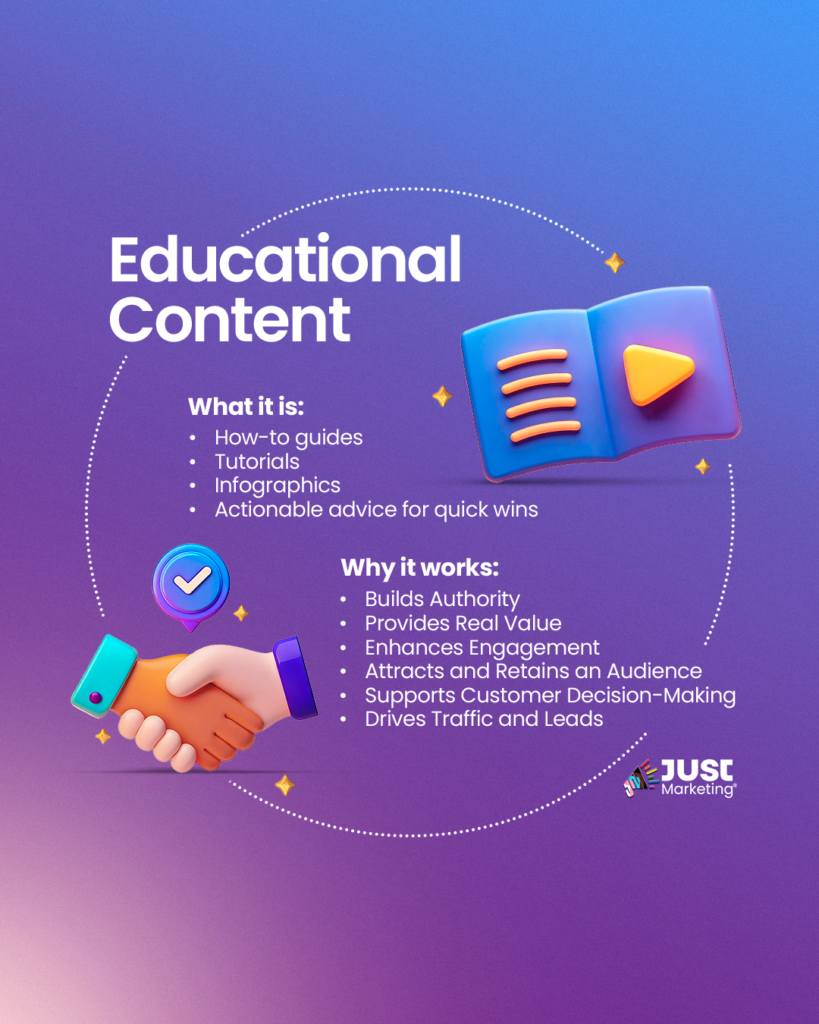
"Educational Content" with two sections underneath: "What it is" (listing how-to guides, tutorials, infographics, and actionable advice) and "Why it works" (highlighting benefits like building authority, enhancing engagement, attracting an audience, and driving traffic). Visual elements include a 3D illustration of a handshake with a checkmark and an open book with a play button.

Educational content is all about teaching or informing your audience in a way that helps them solve a problem, learn something new, or make an informed decision. At its core, educational content empowers your audience by providing real value—and when you consistently deliver this value, you establish yourself as a trusted authority in your niche.

This type of content can take many forms, such as:

  • How-to guides or tutorials: Step-by-step instructions to tackle a challenge.
  • Infographics: Visually engaging summaries of complex ideas.
  • Webinars or workshops: Interactive sessions to deep-dive into key topics.
  • Social media tips and carousels: Bite-sized, actionable advice for quick wins.

Why does educational content work so well?

  1. It Builds Authority: Sharing your expertise demonstrates that you know your stuff, positioning you as the go-to person in your field.

  2. It Provides Real Value: When your audience feels supported and empowered, they’re more likely to trust and engage with your brand.

  3. It Enhances Engagement: Content that teaches and inspires sparks conversations, shares, and saves.

  4. It Attracts and Retains an Audience: By solving problems and addressing questions, you’ll naturally draw in the right people—and keep them coming back.

  5. It Supports Customer Decision-Making: Helping your audience understand their options makes them more confident in choosing your products or services.

  6. It Drives Traffic and Leads: Educational content often leads readers to explore your website, download resources, or join your email list, turning curiosity into connection.

From an ethical perspective, educational content isn’t about creating dependency or overwhelming your audience with jargon. Instead, it’s a tool to empower them. Think of it as planting seeds: when you help your audience grow their knowledge, they’re more likely to trust and invest in you when they’re ready for additional support.

Whether you’re sharing how-to tips, diving into industry trends, or answering common questions, educational content has the potential to be a game-changer in your content marketing strategy. It’s not just about teaching; it’s about inspiring and connecting authentically.

How to Plan Educational Content

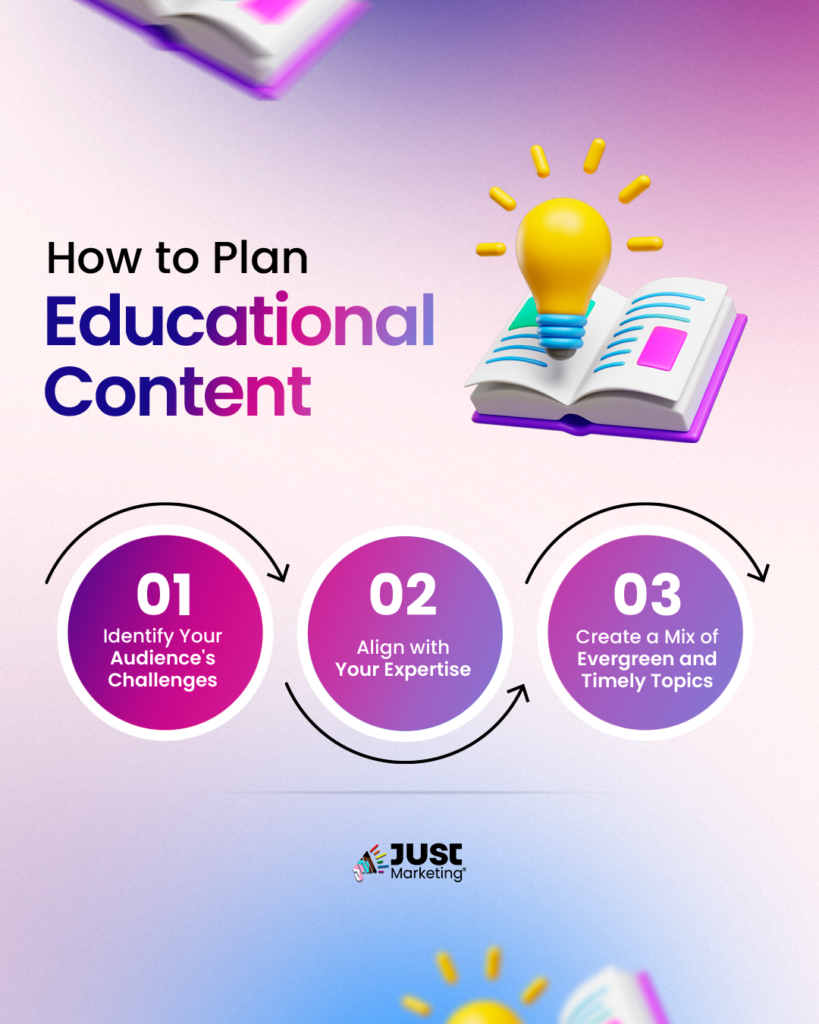
"How to Plan Educational Content." A 3D illustration of an open book with a glowing lightbulb is positioned at the top. Below, three circular steps with gradient backgrounds outline the planning process: 01 - Identify Your Audience’s Challenges, 02 - Align with Your Expertise, and 03 - Create a Mix of Evergreen and Timely Topics. Arrows connect the steps in a flowchart style.

Creating impactful educational content starts with a solid plan. By understanding your audience’s needs, aligning with your expertise, and strategically choosing topics, you can produce content that resonates, empowers, and drives meaningful engagement.

Step 1: Identify Your Audience’s Challenges (aka Pain Points)

The first step in planning educational content is understanding the challenges your audience faces. What keeps them up at night? What questions do they ask repeatedly? These are the areas where your content can provide real value.

  • How to discover their challenges:
    • Conduct audience research through surveys or polls.
    • Keep a running list of FAQs from your clients.
    • Pay attention to comments or DMs on social media.
  • Examples:
    • Challenge: Struggling clients lack clarity on goal-setting.
      Content Idea: The 5-Step Goal-Setting Framework Every Coach Needs to Share with Clients.

    • Challenge: Businesses struggle with client retention.
      Content Idea: How to Create a Client Onboarding Process That Builds Loyalty from Day One.

    • Challenge: Clients aren’t seeing the value in regular communication.
      Content Idea: The Weekly Check-In Template That Keeps Projects on Track and Clients Happy.

When you solve a problem your audience cares about, your content becomes indispensable.

Step 2: Align with Your Expertise

Educational content works best when it leverages your unique strengths and niche expertise. Focus on topics that showcase your skills and reflect the core values of your business.

  • How to Align Your Expertise:
    • List your top skills or areas of knowledge.
    • Cross-reference those skills with your audience’s needs.
  • Example:
    • Business Coach Expertise: Helping small businesses grow sustainably.
      Content Idea: 3 Low-Stress Systems to Streamline Your Business Operations and Reclaim Your Time.

    • DEI Consultant Expertise: Building inclusive workplace cultures.
      Content Idea: The Inclusive Language Guide: 10 Phrases to Strengthen Workplace Communication.

    • Virtual Assistant Expertise: Managing schedules and productivity.
      Content Idea: 5 Productivity Hacks to Help Your Clients Stay Organized and On Time.

By centering your expertise, you’ll attract an audience who aligns with your approach and is eager to learn from you.

Step 3: Create a Mix of Evergreen and Timely Topics

A balanced content strategy includes both evergreen and timely topics. This mix ensures your content remains relevant over time while addressing current trends and events.

  • Evergreen Content: Timeless resources that remain valuable year-round.
    • Examples:
      • How to Use Hashtags for Small Business.
      • How to Structure a Discovery Call That Converts Without Feeling Salesy.
      • How to Audit Your Business Processes for Long-Term Growth.
      • The Client Feedback Framework: How to Use Testimonials to Grow Your Business.
  • Timely Content: Trend-focused resources tied to a moment in time.
    • Examples:
      • 2025 Social Media Best Practices.
      • 2025 Trends Every Life Coach Needs to Know to Attract New Clients.
      • How New Data Privacy Laws Will Impact Your Consulting Contracts in 2025.
      • 3 Ways to Prep Your Business for Black Friday as a Service Provider.

Tip: Aim for a 70/30 mix—70% evergreen and 30% timely—to maximize the longevity of your content while staying up-to-date.

Pulling It All Together

With these three steps—identifying pain points, aligning with your expertise, and balancing evergreen and timely topics—you’ll have a clear roadmap for planning educational content that delivers real value. This process ensures you’re not just throwing content out into the void but creating intentional, impactful resources that your audience will appreciate.

Best Practices for Creating Educational Content
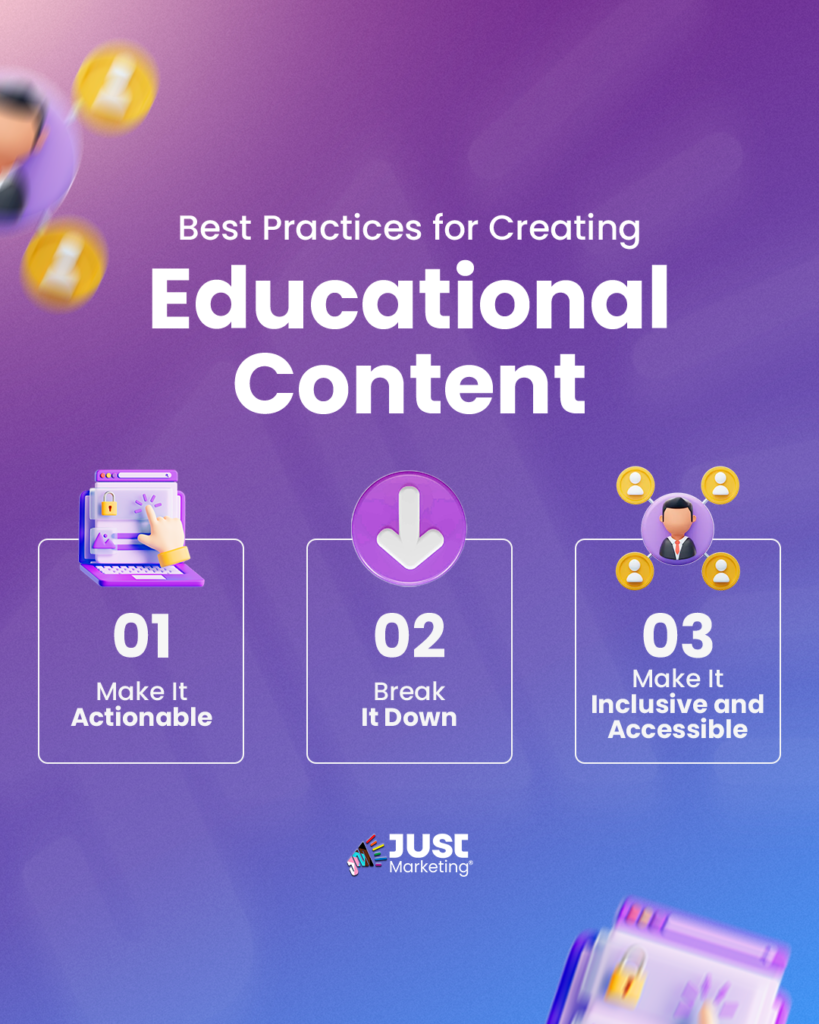
"Best Practices for Creating Educational Content." Below, three rectangular sections each contain an icon and a best practice: 01 - Make It Actionable (a hand pointing at a laptop screen), 02 - Break It Down (a downward arrow), and 03 - Make It Inclusive and Accessible (an icon of a person connecting with other people). The Just Marketing® logo is positioned at the bottom.

Once you’ve planned your educational content, the next step is to create resources that are engaging, actionable, and accessible. Here are some best practices to ensure your content resonates with your audience while reflecting your values.

Tip 1: Make It Actionable

Your audience should walk away from your content feeling empowered to take immediate action. Break down complex ideas into simple, clear steps they can implement right away.

  • How to Apply This:
    • Provide checklists, templates, or step-by-step instructions.
    • Include examples that show how your audience can apply the content to their own situation.
  • Example: If you’re a parenting coach, create a resource like “3 Easy Steps to Decrease Bedtime Battles Tonight.”

Pro Tip: End your content with a “next step” suggestion, such as completing a small task or downloading a related resource.

Tip 2: Break It Down

Dense or overly complicated content can overwhelm your audience. Make your content more digestible by breaking it into smaller, manageable pieces.

  • How to Apply This:
    • Use visuals like infographics or diagrams to simplify concepts.
    • Write in short paragraphs and use bullet points to organize key takeaways.
  • Example: A business coach could turn a blog post like “How to Scale Your Business in 12 Months” into:
    • An infographic summarizing the 12-month roadmap.
    • A carousel post for Instagram with one tip per slide.
    • A webinar diving into each phase.

Pro Tip: Always prioritize clarity over jargon. Your goal is to make your audience feel confident and informed, not overwhelmed.

Tip 3: Make It Inclusive and Accessible

Educational content should serve as many people as possible, regardless of their background, abilities, or language proficiency.

  • How to Apply This:
    • Use plain, inclusive language that avoids jargon or complex terminology.
    • Add accessibility features like captions on videos, alt text for images, and transcripts for audio content.
    • Consider cultural and contextual differences when addressing topics.
  • Example: A DEI consultant might create a guide like “5 Inclusive Team-Building Activities for Remote Teams” and ensure the examples apply to global teams with varying time zones and cultures.

Pro Tip: Test your content for readability using tools like Hemingway App and ensure it meets accessibility standards like WCAG – The Just Marketing Checklist is also a great resource that simplifies the process.

By following these best practices, your educational content will not only deliver value but also reflect your commitment to ethical, inclusive, and accessible marketing. When your audience feels supported and empowered by your content, they’ll naturally see you as a trusted expert—and they’ll keep coming back for more.


How to Repurpose Educational Content
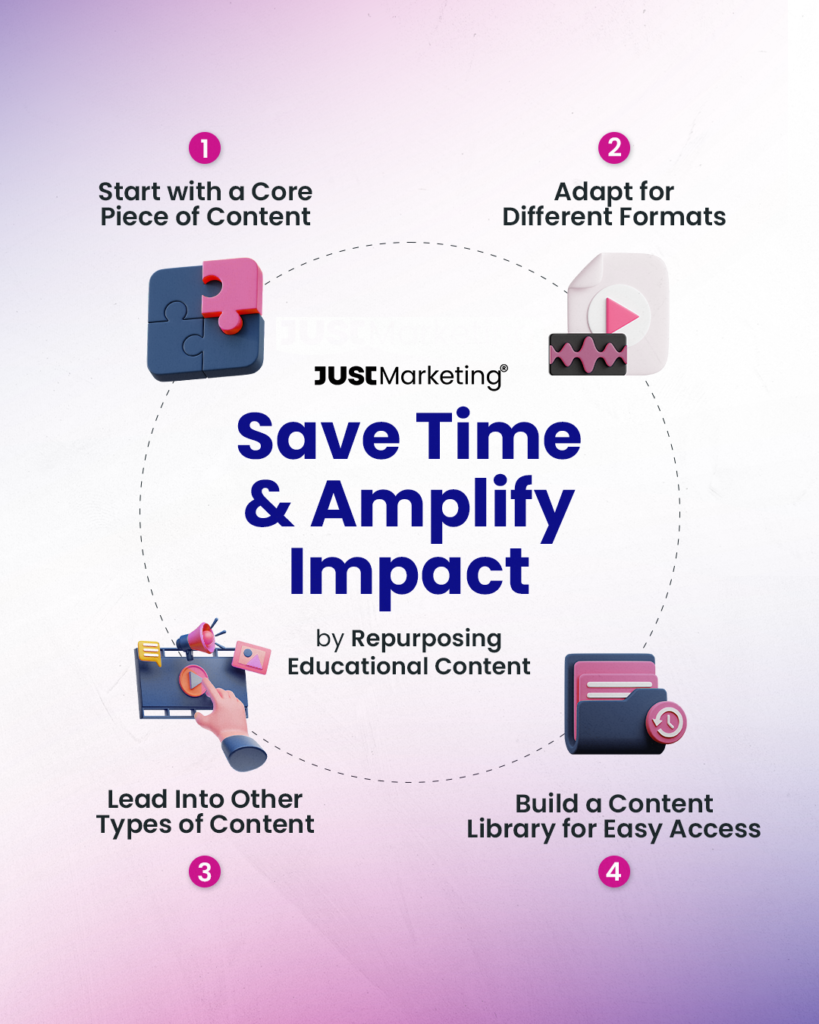
"Save Time & Amplify Impact by Repurposing Educational Content." Four steps with icons: 1 - Start with a Core Piece of Content (puzzle piece icon), 2 - Adapt for Different Formats (play button on a document icon), 3 - Lead Into Other Types of Content (a hand pointing at a computer screen with various content icons), and 4 - Build a Content Library for Easy Access (a file folder icon).

Creating educational content takes time and effort, so why not maximize its impact? Repurposing allows you to transform one piece of content into multiple formats, reaching new audiences and extending its lifespan. Here’s how to do it effectively:

Step 1: Start with a Core Piece of Content

Choose a high-value piece of content as your foundation. This could be a blog post, podcast, webinar, or a video. From there, you can break it into smaller pieces or reformat it for different platforms.

  • Example:
    A business coach creates a blog post titled “How to Build a Morning Routine for Success.”
    • Repurpose into:
      • An Instagram carousel with each slide showcasing one step.
      • A YouTube video or Instagram Reel with quick tips from the blog.
      • A LinkedIn article summarizing the blog with a professional tone.
      • An email to your subscribers featuring the main takeaways.

Pro Tip: Always include a call-to-action (CTA) in every format, such as directing readers to download a free resource or join your membership.

Step 2: Adapt for Different Formats

Each platform has unique strengths, so tailor your content to fit. Focus on the audience’s behavior and preferences on that channel.

  • How to Adapt:
    • Visual Formats: Turn how-to guides or tips into Instagram carousels or Pinterest graphics.
    • Interactive Formats: Host a Q&A or webinar on the same topic.
    • Bite-Sized Formats: Break a long article into a series of short social media posts.
  • Example:
    A DEI consultant publishes a guide on “Inclusive Leadership Practices.”
    • Repurpose into:
      • A LinkedIn post highlighting three practices with commentary.
      • A downloadable checklist for your website.
      • A podcast episode discussing how to implement those practices.

Pro Tip: Use Canva templates to streamline creating visual assets for repurposing.

Step 3: Use Educational Content to Lead Into Other Types

Repurposed educational content can serve as the gateway to other content types, such as promotional or engagement-focused pieces.

  • How to Transition:
    • Link educational content to a related free resource or product offer.
    • Use a blog post to drive email list sign-ups with a compelling lead magnet.
    • Turn FAQs into short videos that promote upcoming services or products.
  • Example:
    A virtual assistant shares a YouTube tutorial titled “How to Set Up Your Email Automation.”
    • At the end, include a CTA like: “Want to save time? Download my free email automation checklist!”
    • Later, promote your email automation services in a follow-up email sequence.

Step 4: Build a Content Library for Easy Access

Repurposing isn’t a one-time activity—it’s an ongoing strategy. Keep track of your core content and how you’ve repurposed it so you can refresh and reuse it later.

  • Example:
    Store all your educational content in a tool like Trello or Airtable, categorizing it by topic and format. This makes it easy to revisit and repurpose as your audience grows or your business evolves.

Pro Tip: Schedule periodic audits of your content library to identify pieces that can be updated or reused.

Repurposing educational content not only saves you time but also amplifies your reach. By sharing your message across multiple formats and platforms, you’re ensuring it reaches the right people at the right time—without constantly reinventing the wheel.


Measuring Success

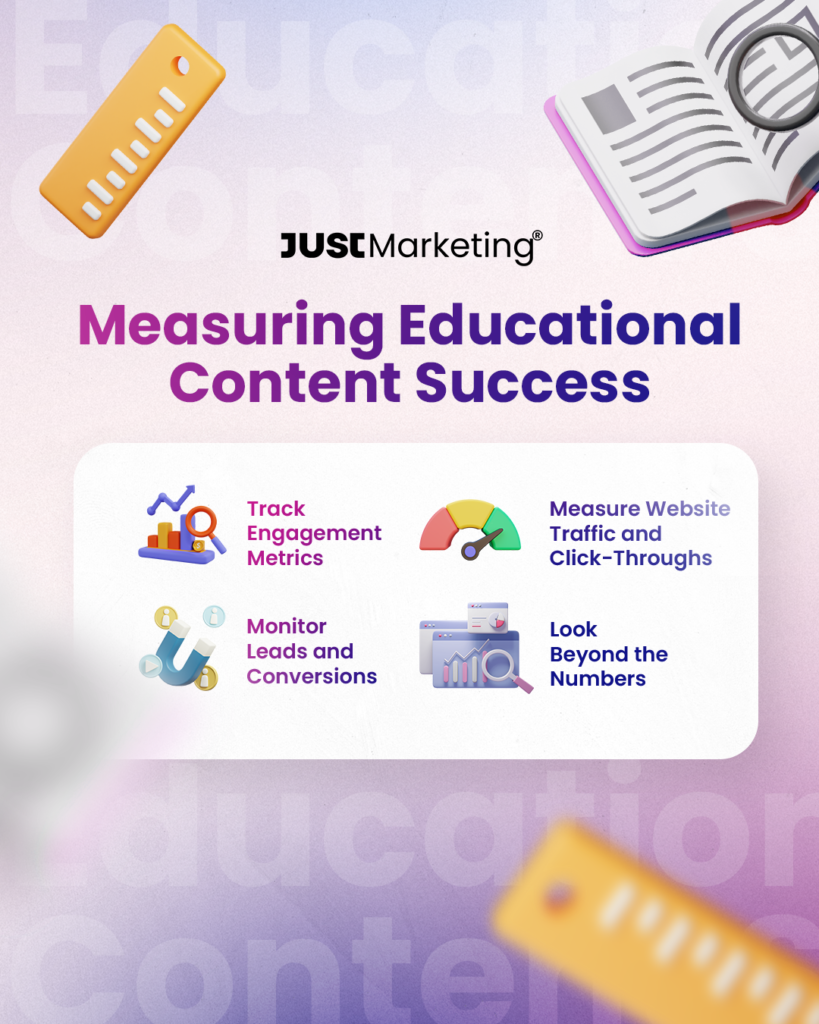
"Measuring Educational Content Success." Four key measurement strategies are visually represented with icons: 1 - Track Engagement Metrics (chart with magnifying glass), 2 - Measure Website Traffic and Click-Throughs (speedometer), 3 - Monitor Leads and Conversions (magnet attracting people), and 4 - Look Beyond the Numbers (computer screen with analytics).

Creating educational content is only half the equation—you also need to evaluate how it’s performing. Tracking the right metrics will help you understand what resonates with your audience, refine your strategy, and maximize your impact. Here’s how to measure the success of your educational content:

Step 1: Track Engagement Metrics

Engagement is a key indicator of how well your content connects with your audience. High engagement means your audience finds value in what you’re sharing.

  • What to Look For:
    • Likes, comments, and shares on social media posts.
    • Saves or pins (e.g., on Instagram or Pinterest).
    • Direct messages or responses from your audience.

Pro Tip: Pay attention to qualitative feedback, such as comments or DMs, which can offer deeper insights than numbers alone.

Step 2: Measure Website Traffic and Click-Throughs

Educational content often directs your audience to your website or specific resources. Monitoring these metrics shows how effectively your content drives action.

  • What to Look For:
    • Website visits from content links.
    • Click-through rates (CTRs) on CTAs.
    • Time spent on the page (a higher duration means your content is engaging).

Pro Tip: Use tools like UTM codes to track where your traffic is coming from and refine your promotional strategy accordingly.

Step 3: Monitor Leads and Conversions

One of the main goals of educational content is to build trust and guide your audience toward taking the next step—whether that’s signing up for a resource, joining your email list, or purchasing a service.

  • What to Look For:
    • Number of downloads or sign-ups for free resources.
    • Growth in email subscribers or leads generated.
    • Conversion rates on offers linked to educational content.

Pro Tip: Pair your educational content with a strategic CTA to make it easy for your audience to take action.

Step 4: Look Beyond the Numbers

Metrics are important, but success isn’t just about data. Educational content builds relationships, trust, and goodwill over time. Sometimes, the most valuable feedback comes from personal interactions or long-term audience engagement.

  • How to Measure Qualitative Success:
    • Do you receive messages like, “Your post helped me solve this problem,” or, “I love how much I learn from your content”?
    • Are clients or leads mentioning your content during consultations or calls?
    • Are you building a community of engaged followers who resonate with your values?

Pro Tip: Keep a file of positive feedback or testimonials—it’s a great way to remind yourself of the impact you’re making, even if growth feels slow.

By measuring both quantitative and qualitative success, you’ll have a holistic view of how your educational content performs. Use these insights to double down on what works, refine what doesn’t, and continue creating content that empowers and inspires your audience.

Next Steps
A vibrant pink-to-purple gradient background features the Just Marketing® logo at the top. Inside a white text box: “Educational content is one of the most powerful tools in your content marketing toolbox. It’s about empowering your audience to take action, solve problems, and see you as a trusted partner in their journey." A large orange light bulb, and a 3D thumbs-up icon.

Educational content is a game-changer for entrepreneurs who want to serve their audience, build trust, and establish authority. It’s not just about sharing what you know—it’s about empowering your audience to take action, solve problems, and see you as a trusted partner in their journey.

By creating content that is actionable, inclusive, and tailored to your audience’s needs, you can make a meaningful impact while growing your business. Remember: educational content doesn’t have to be overwhelming or complicated. Start small, focus on quality over quantity, and always prioritize value.

Choose one topic your audience struggles with and create a piece of educational content this week. Whether it’s a quick Instagram post with tips or a detailed blog, you’ll be taking a step toward building deeper connections with your audience.

If you’re looking for guidance and inspiration, join my Content Marketing Membership! With weekly prompts, resources, and a supportive community, you’ll have everything you need to show up consistently and confidently.

Check out the other blog posts in this series:

  • What to Post on Social Media
  • Showcase Credibility Content Without Feeling Like You’re Bragging
  • Spark Meaningful Interactions and Relationships with Engaging Content
  • Increase Your Income with Promotional Content That Doesn’t Feel Salesy
  • Connect With Your Audience Authentically Through Holiday Content

Categories: All Categories, Content Marketing

Tags: Accessible Marketing, Content Repurposing, Core Content, Ethical Marketing, Inclusive Marketing, Increase Brand Awareness, Marketing Clarity, Marketing Productivity, Simplified Marketing Systems, Social Media Strategy

Prev
Next

About Meg Brunson

Online marketing authority and former Facebook employee Meg Brunson combines their mission to build a more accessible and inclusive world, with their expertise in the digital marketing space.

Meg is on a mission to disrupt the status quo of marketing so that financial success is the byproduct of a genuine commitment to justice, rather than an end goal in itself.

Through Meg’s signature approach, Just Marketing®, businesses are implementing ethical, inclusive, and accessible marketing campaigns that make a positive impact on society and their bottom line, creating a virtuous cycle where profitability and responsible practices reinforce each other.

Meg is a professional speaker, children’s book author, host of the Just Marketing® podcasts, CMO of BetterCEO.app and CEO of Just Marketing®.

Follow me on Instagram @theMegBrunson
If your marketing feels gross, confusing, or out o If your marketing feels gross, confusing, or out of alignment...
This is your permission slip to rebuild.

Because marketing can feel good.
It can reflect your values.
It can be clear, kind, and wildly effective… all at once.

You don’t need hacks or hustle.
You need a framework that puts people first.

Enter: Just Marketing.

A justice-centered approach with 3 core pillars:

1. Ethical: Honest. Responsible. Respectful. Fair. 
No shame. 
No bait-and-switch. 
No pressure-packed manipulation.

2. Inclusive: Diverse. Culturally responsive. Trauma-informed.
Real representation, not tokenism. Real care, not clichés.

3. Accessible: Designed for every body and brain.
Visual, auditory, motor, and cognitive access aren’t afterthoughts… they’re essentials.

Together, these three pillars form the foundation of marketing that doesn’t just perform… it transforms.

Want to see how this works in practice - and how to bring it into your biz, step by step?
Read the blog: MegBrunson.com/just-marketing

And let’s chat in the comments:
Which of these 3 pillars are you already focusing on… and which one needs more love?

ID: 3 Pillars of Just Marketing: Ethical, Inclusive, and Accessible. Ethical (pink, justice scale) = Transparent, Responsible, Respectful, Fair. Inclusive (blue, pride heart) = Embraces Diversity, Checks Biases, Culturally Responsive, Trauma-Informed. Accessible (purple, accessibility icon) = Visual, Auditory, Motor, Cognition.

#JustMarketing #EquityForAll #a11y #EquityCenteredBusiness #DiversityInMarketing #SocialJustice #RacialJustice #BeTheChange #DismantleWhiteSupremacy #DiversityEquityInclusion #EthicalMarketing #InclusiveMarketing #AccessibleMarketing #MarketingAccessibility #SocialMediaMarketer #EthicalBusiness #MarketingCoach #CommunityOverCompetition #MarketingWithPurpose #MarketingWithImpact #DEI #DEIMarketing #SocialMediaForAll #ContentCreation #ContentMarketing #ContentMarketingMembership #WeeklySocialContent  #MarketingWithADHD #adhdBusiness #adhdBusinessOwner
Holidays have a way of bringing out the best in us Holidays have a way of bringing out the best in us. Whether it’s lighting candles, exchanging gifts, or gathering around a table with loved ones, they remind us of the universal values we share - hope, light, reflection, and togetherness.

In December especially, holidays like Hanukkah, Kwanzaa, Christmas, and Yule have different origins, but they echo similar themes of connection and renewal.

When we acknowledge and honor holidays outside our own traditions, we not only foster empathy - we deepen our sense of belonging to a global community.

Recognizing diverse holidays is about creating a ripple effect of understanding and connection that includes:

1. Stronger community ties: Celebrating inclusively builds trust and loyalty among diverse audiences who feel seen and respected.

2. Deeper cultural understanding: Learning about and honoring different holidays broadens perspectives and combats stereotypes.

3. Global belonging: Inclusive celebrations remind us that, despite our differences, we’re all connected by shared values.

This season, learn about holidays outside your own traditions, and foster conversations that bring people closer.

Looking for ways to create inclusive holiday campaigns year-round?
The Inclusive Holiday Content Guide was made for you…
Get it here: CelebrateOnSocial.com

ID: Four quadrants depicting different holiday traditions. A lit menorah with challah bread and candles. A decorated Christmas tree with presents. A Yule wreath with a lit candle and crystals. A Kinara with red, black, and green candles, and a unity cup. Text: 'happy holidays,' and the Just Marketing logo.

#2026 #Holidays #DaysOfTheYear #JustMarketing #HappyYule #JoyousKwanzaa #HappyHanukkah #EquityCenteredBusiness #SocialJustice #RacialJustice #DismantleWhiteSupremacy #HappyHolidays #EthicalMarketing #OnlineBusinessMarketing #EthicalBusiness #OnlineMarketingTips #DEI #MerryChristmas #MarketingWithADHD #adhdBusiness #adhdBusinessOwner #ContentMarketing #ContentMarketingMembership #WeeklySocialContent #a11y #InclusiveMarketing #AccessibleMarketing #DEIMarketing #SocialMediaForAll #ContentCreation
We’re reclaiming marketing. Not as a sales machin We’re reclaiming marketing.

Not as a sales machine. 
Not as a manipulative funnel.
But as a force for justice.

– Ethical: rooted in honesty, responsibility, and respect.
– Inclusive: built to reflect and resonate with diverse identities.
– Accessible: designed for all bodies, brains, and bandwidths.

This isn’t fluff.
It’s foundational.

Because when your marketing reflects your values…
1. You build trust that translates to sustainable income.
2. You contribute to real social impact.
3. You help raise the standards of your entire industry.

And you don’t need a huge team or fancy tools to do this.
Just a willingness to start small and stay aligned.

Curious what Just Marketing actually looks like in action?
Read the post: MegBrunson.com/just-marketing

And let me know... What’s one word you would add to this definition?

ID: A dictionary entry for 'Just Marketing,' labeled as a noun with phonetic pronunciation. It defines the term as reflecting a commitment to justice through marketing that is ethical, inclusive, and accessible. Each term includes a brief explanation in parentheses. Related benefits: increased income, positive social impact, and elevated industry standards.

 #JustMarketing #EquityForAll #a11y #EquityCenteredBusiness #DiversityInMarketing #SocialJustice #RacialJustice #BeTheChange #DismantleWhiteSupremacy #DiversityEquityInclusion #EthicalMarketing #InclusiveMarketing #AccessibleMarketing #MarketingAccessibility #SocialMediaMarketer #EthicalBusiness #MarketingCoach #CommunityOverCompetition #MarketingWithPurpose #MarketingWithImpact #DEI #DEIMarketing #SocialMediaForAll #ContentCreation #ContentMarketing #ContentMarketingMembership #WeeklySocialContent  #MarketingWithADHD #adhdBusiness #adhdBusinessOwner
Give your content calendar a glow-up with 470+ inc Give your content calendar a glow-up with 470+ inclusive holidays!

(No, you should not post them all - and strategy is included!)

The Inclusive Holiday Content Bundle is your new favorite way to show up without burning out.

Because let’s be real: Posting about random “National Cashew Day” isn’t cutting it anymore. You want to show up in a way that reflects your values and resonates with your people.

– 470+ inclusive holidays from diverse cultures and communities
– At least one done-for-you graphic per holiday
– Customizable Canva templates for on-brand brilliance
– Alt-text. Because accessibility isn’t optional.
– Red flags to watch for (so you don’t unintentionally mess up)
– Cultural context that makes each post meaningful, not performative
– Plus: marketing tips + prompts for every single holiday

Get the system that helps you post with purpose at CelebrateOnSocial.com

All sparkle.
No stress.

ID: Large pink and purple glitter-filled text reads '470+' above the words 'Inclusive Holidays' and the website CelebrateOnSocial.com  The background is black with sparkling confetti-like dots in purple, pink, and blue along the top and bottom edges.

 #2026 #Holidays #DaysOfTheYear #JustMarketing #EquityForAll #BossMom #MomBoss #EquityCenteredBusiness #SocialJustice #RacialJustice #DismantleWhiteSupremacy #DiversityEquityInclusion #EthicalMarketing #OnlineBusinessMarketing #EthicalBusiness #OnlineMarketingTips #DEI #ValuesMatter #MarketingWithADHD #adhdBusiness #adhdBusinessOwner #ContentMarketing #ContentMarketingMembership #WeeklySocialContent #a11y #InclusiveMarketing #AccessibleMarketing #DEIMarketing #SocialMediaForAll #ContentCreation
When you’re rooted in justice, you know: – Ethics When you’re rooted in justice, you know:
– Ethics doesn’t make your marketing less effective 
– Inclusion doesn’t dilute your impact
– Accessibility doesn’t take away from your profit

Prioritizing people over profits isn’t bad for business - in the long run, it’s actually more profitable than chasing quick wins

You don’t lose anything by supporting others.
In fact... you gain community, trust, and long-term sustainability.

This is the beauty of running a values-based business:

We don’t hoard the pie.
We bake more.
We share it.
And we all eat.
💕

ID: A background of whole and sliced pumpkin pies topped with whipped cream on a pink background. Overlaid bold text reads: ‘Equal Rights For Others Does Not Mean Less Rights For You… It’s Not Pie.’ The text is in magenta and purple with a decorative border.

 #JustMarketing #EquityForAll #a11y #EquityCenteredBusiness #DiversityInMarketing #SocialJustice #RacialJustice #BeTheChange #DismantleWhiteSupremacy #DiversityEquityInclusion #EthicalMarketing #InclusiveMarkeitng #AccessibleMarketing #MarketingAccessibility #SocialMediaMarketer #EthicalBusiness #MarketingCoach #CommunityOverCompetition #MarketingWithPurpose #MarketingWithImpact #DEI #DEIMarketing #SocialMediaForAll #ContentCreation #ContentMarketing #ContentMarketingMembership #WeeklySocialContent  #MarketingWithADHD #adhdBusiness #adhdBusinessOwner
This quote? It’s the heartbeat of Just Marketing®. This quote? It’s the heartbeat of Just Marketing®.

If you’ve used scarcity tactics…
If your past offers weren’t accessible…
If you’ve centered dominant identities in your visuals or messaging without realizing it…

You’re not a bad marketer.
You’re not “doing it wrong.”

You were doing what you were taught — by courses, by coaches, by a system built to prioritize profit over people.

But now you know better.
And that is powerful.

Because now, you get to make different choices.
You get to show up with more intention.
You get to build a business that reflects your values, not just your goals.

Justice-centered marketing isn’t about perfection.
It’s about awareness, curiosity, and action — one decision at a time.

Ready to shift how you show up in your marketing?
Start here: MegBrunson.com/just-marketing

And if you’re feeling bold:
What’s one marketing habit you’ve outgrown — and why?

ID: A large, stylized quotation mark in dark purple with a lighter purple shadow. Inside the mark is white text that reads, 'Do the best you can until you know better. Then, when you know better, do better.' At the bottom right, the quote is attributed to Maya Angelou in bold purple gradient text.

 #JustMarketing #EquityForAll #a11y #EquityCenteredBusiness #DiversityInMarketing #SocialJustice #RacialJustice #BeTheChange #DismantleWhiteSupremacy #DiversityEquityInclusion #EthicalMarketing #InclusiveMarketing #AccessibleMarketing #MarketingAccessibility #SocialMediaMarketer #EthicalBusiness #MarketingCoach #CommunityOverCompetition #MarketingWithPurpose #MarketingWithImpact #DEI #DEIMarketing #SocialMediaForAll #ContentCreation #ContentMarketing #ContentMarketingMembership #WeeklySocialContent  #MarketingWithADHD #adhdBusiness #adhdBusinessOwner
It’s not just annoying popups or clickbait emails. It’s not just annoying popups or clickbait emails.
It’s the way so many campaigns still rely on manipulation.
On pressure. 
On shame.

And it’s the way they erase or exclude entire communities, whether by design or by ignorance.

Think about it…

~ How many ads center white, cis, non-disabled, neurotypical folks as the default?
~ How many sales pages flood your senses but provide zero accessibility?
~ How many launches use scarcity as a weapon, not a strategy?

Marketing isn’t neutral.

It either challenges injustice… or quietly reinforces it.

And too often, it does the latter… in flashy fonts and limited-time offers.

But we don’t have to do it that way.
There is a better path - one rooted in consent, care, and community.

Want to understand where marketing goes wrong, and how to do it differently?

Read more: MegBrunson.com/just-marketing

Do you remember a time when a brand’s marketing made you feel unwelcome or unseen?

ID: 'Modern Marketing Has a Justice Problem' in a bold gradient font transitioning from purple to pink. A large yellow warning sign with an exclamation point appears at the top left. Diagonal yellow and black caution tape stretches across the top and bottom.

 #JustMarketing #EquityForAll #a11y #EquityCenteredBusiness #DiversityInMarketing #SocialJustice #RacialJustice #BeTheChange #DismantleWhiteSupremacy #DiversityEquityInclusion #EthicalMarketing #InclusiveMarketing #AccessibleMarketing #MarketingAccessibility #SocialMediaMarketer #EthicalBusiness #MarketingCoach #CommunityOverCompetition #MarketingWithPurpose #MarketingWithImpact #DEI #DEIMarketing #SocialMediaForAll #ContentCreation #ContentMarketing #ContentMarketingMembership #WeeklySocialContent  #MarketingWithADHD #adhdBusiness #adhdBusinessOwner
When most people hear “marketing,” they don’t thin When most people hear “marketing,” they don’t think of justice.

They think of popups. 
Spammy emails. 
Countdown timers that never actually expire.
They think of being sold to, not spoken with.

But here’s the truth:
Marketing is a tool.

And like any tool — a hammer, a paintbrush, a wrench — how it’s used depends on who’s holding it and what they care about.

When we use marketing to center people over profit,
When we prioritize access over aesthetics,
When we lead with ethics, inclusion, and care...
Marketing becomes something radically different.

It becomes a vehicle for trust.
A method of community-building.
A way to challenge norms and invite more folks in.

This isn’t about being perfect. It’s about being intentional.
And even small businesses - even solopreneurs juggling a million things - can make shifts that matter.

Ready to reframe marketing as a force for justice?
Read the blog: MegBrunson.com/just-marketing 

Then tell me:
If you could reinvent marketing from scratch, what would you eliminate in your version?

ID: ‘Marketing Can Be A Tool For Justice.' in large script and bold fonts, with 'Marketing' and 'Justice' in a gradient of purple to pink. Surrounding the text are various illustrated hand tools, including a paintbrush, hammer, saw, ruler, screwdriver, wrench, and safety helmet. 

#SocialMediaMarketing #JustMarketing #EthicalMarketing #InclusiveMarketing #AccessibleMarketing
Your social media is a reflection of your values - Your social media is a reflection of your values - whether you’re posting with intention or just winging it between client calls.

If you've ever hesitated to post about cultural holidays because you didn't want to say the wrong thing…

If you've ever wanted to celebrate with your community but didn’t know how to do it respectfully…

You are exactly who I created this for.

The Inclusive Holiday Content Bundle gives you more than content.
It gives you confidence.

– 470+ holidays across cultures, identities, and movements
– Done-for-you graphics + editable Canva templates
– Holiday descriptions rooted in cultural context
– Red flags to avoid (because intention doesn’t erase impact)
– Strategic tips and prompts that tie into your marketing ethically
– Alt-text for every image, because access matters

Whether you’re a coach, creative, consultant, or community-builder, this bundle makes it easy to post with purpose.

You don’t have to post for every holiday.
But when you do - it should feel good.

Let your content reflect the world you’re helping build.
Explore the bundle now at CelebrateOnSocial.com 

ID: Text reads 'Inclusive Holiday Content Bundle'. Below is an illustration of a large, diverse group of people representing different ages, ethnicities, abilities, and styles. A calendar graphic appears next to text stating 'Canva templates, done-for-you graphics, and strategic guidance for 470+ inclusive holidays.' At the bottom is a pink button with the URL, CelebrateOnSocial.com

 #2026 #Holidays #DaysOfTheYear #JustMarketing #EquityForAll #BossMom #MomBoss #EquityCenteredBusiness #SocialJustice #RacialJustice #DismantleWhiteSupremacy #DiversityEquityInclusion #EthicalMarketing #OnlineBusinessMarketing #EthicalBusiness #OnlineMarketingTips #DEI #ValuesMatter #MarketingWithADHD #adhdBusiness #adhdBusinessOwner #ContentMarketing #ContentMarketingMembership #WeeklySocialContent #a11y #InclusiveMarketing #AccessibleMarketing #DEIMarketing #SocialMediaForAll #ContentCreation
The harm traditional marketing can do goes deeper The harm traditional marketing can do goes deeper than annoying tactics.

It’s in who gets left out.
Who isn’t considered.
And who’s made to feel like marketing “just isn’t for them.”

That’s why I created Just Marketing® – a justice-centered alternative to business-as-usual.

It’s about building with intention, not pressure.

About connection over conversion.

And it’s about using our platforms not just to sell… but to serve, include, and uplift.

Because when marketing centers ethics, inclusion, and accessibility, we don’t just grow our reach.

We grow trust.
We build community.
We drive change.

And yes, this is 100% possible for small business owners, solo creators, and folks navigating neurodivergence or limited capacity.

You don’t need a massive team to market in a way that feels good.

You just need a values-aligned strategy that centers people, not pressure.

Curious what that looks like in practice?
Read the full blog: MegBrunson.com/just-marketing 

What’s one marketing tactic you wish we’d leave behind for good?

ID: Just Marketing: A Justice-Centered Alternative To Traditional Marketing. Colorful interlocking gears display icons related to media and communication, such as a microphone, heart, email, globe, and video. Centered is a larger gear with the initials JM shaped like a megaphone in ‘progress pride’ rainbow colors.

 #JustMarketing #EquityForAll #a11y #EquityCenteredBusiness #DiversityInMarketing #SocialJustice #RacialJustice #BeTheChange #DismantleWhiteSupremacy #DiversityEquityInclusion #EthicalMarketing #InclusiveMarketing #AccessibleMarketing #MarketingAccessibility #SocialMediaMarketer #EthicalBusiness #MarketingCoach #CommunityOverCompetition #MarketingWithPurpose #MarketingWithImpact #DEI #DEIMarketing #SocialMediaForAll #ContentCreation #ContentMarketing #ContentMarketingMembership #WeeklySocialContent  #MarketingWithADHD #adhdBusiness #adhdBusinessOwner
If your “content calendar” is a chaotic Google Doc If your “content calendar” is a chaotic Google Doc, a half-used planner, or a bunch of screenshots you keep meaning to organize... this one’s for you!

Staying consistent on social media can feel impossible - especially when you’re trying to do it ethically, inclusively, and with purpose.

The Inclusive Holiday Content Bundle is your go-to system for showing up on social with confidence and conscience.

Inside, you’ll get:
– 470+ holidays that celebrate diverse identities, cultures, and communities
– Done-for-you graphics you can post instantly
– Customizable Canva templates that match your brand
– Cultural context for each holiday, so you understand what you’re posting about
– Alt-text, red flags to avoid, and marketing tips to keep it inclusive
– And content prompts for every single holiday

No more Googling, “What holiday is it today?”
Just meaningful content that reflects your values and keeps you consistent.

This isn’t just a calendar.
It’s a plug-and-play system for purpose-driven marketing that builds community, not just visibility.

Ready to make 2026 the year you show up with intention and impact?

Head to CelebrateOnSocial.com to explore the bundle and start planning your most aligned year yet.

ID: Gold balloon numbers spell out '2026' above the text 'Diverse and Inclusive Holidays to celebrate on social media!' in purple and pink fonts. Below is a blue button with the website CelebrateOnSocial.com Purple and pink confetti dots are scattered across a light background.

#2026 #Holidays #DaysOfTheYear #JustMarketing #EquityForAll #BossMom #MomBoss #EquityCenteredBusiness #SocialJustice #RacialJustice #DismantleWhiteSupremacy #DiversityEquityInclusion #EthicalMarketing #OnlineBusinessMarketing #EthicalBusiness #OnlineMarketingTips #DEI #ValuesMatter #MarketingWithADHD #adhdBusiness #adhdBusinessOwner #ContentMarketing #ContentMarketingMembership #WeeklySocialContent #a11y #InclusiveMarketing #AccessibleMarketing #DEIMarketing #SocialMediaForAll #ContentCreation
There are a few easy-to-make mistakes that can mak There are a few easy-to-make mistakes that can make your alt text less effective or confusing to screen reader users. 

Here are 6 of the most common pitfalls I see (and how to avoid them):

1. Starting with “Image of…” - Screen readers already say it’s an image. No need to repeat that.
Instead: Jump into what matters - “A woman giving a keynote about inclusive marketing.”

2. Keyword stuffing for SEO - Google and humans can both tell when you're writing for robots.
Instead: Prioritize clarity, include keywords only when they naturally fit.

3. Over-describing visual details - Not every color or brushstroke needs to be named.
Instead: Focus on what the image adds to the content. What does someone need to know?

4. Repeating surrounding text - If the quote is already in the caption, don’t duplicate it in the alt text.
Instead: Add context that complements the post.

5. Leaving out context and purpose - Alt text isn’t just what, it’s why.
Instead: Share the message behind the image, not just the visual elements.

6. Letting platforms auto-generate it - sorry (not sorry), but “May be an image of text” isn’t cutting it.
Instead: Take a few seconds to write it yourself. You know your message better than any algorithm.

If you care about accessibility, inclusion, and connection - you’re already ahead of the game. Now let’s make your visuals match your values.

Read more: MegBrunson.com/alt-text 

Which mistake surprised you most? 
Or have you caught yourself doing one of these before? 

ID: Common Alt Text Mistakes to Avoid include: Writing ‘Image of…’ or ‘Picture of…’, Keyword stuffing for SEO, Over-describing visual details, Repeating text that’s already written elsewhere, Forgetting context and purpose, and Letting your platform auto-generate it.

#JustMarketing #EquityForAll #EquityCenteredBusiness #SocialJustice #EthicalMarketing #OnlineBusinessMarketing #EthicalBusiness #OnlineMarketingTips #DEI #MarketingWithADHD #ContentMarketing #ContentMarketingMembership #WeeklySocialContent #a11y #InclusiveMarketing #AccessibleMarketing #SocialMediaForAll #ContentCreation
Follow on Instagram


Links

CMM Log In
Mission, Vision, & Values

DEI Statement
Leadership Philosophy
Community Agreements
Press & Media
Pitch Yourself


Beliefs

Black lives matter.
Love is love.
Abortion is healthcare.
No human is illegal.
Free Palestine.
I also Believe…

Circular badge has the name "Meg" in the middle and is surrounded by: "CEO, author, speaker, marketer, leader, & advocate"

Let’s Connect

  • facebook-official
  • instagram
  • bluesky
  • linkedin
  • youtube-play
  • email
Copyright © 2025|All Rights Reserved|Meg Brunson, LLC| Privacy & Terms