Meg Brunson

  • Let’s GoHome
  • #AllTheThingsAbout Me
  • Read | Listen | WatchContent Library
  • Join TheMembership
  • Let’s WorkTogether

Paywalling Community: When Connection Becomes a Commodity

Community is one of the most powerful parts of ethical business. It’s where trust is built, ideas are exchanged, and people feel like they belong – especially in online spaces that can often feel isolating or transactional.

But here’s the hard truth: in many digital business models, paywalling community has become the norm.

The gist: Paywalling community means making connection, like group chats or peer support spaces, available only to paying clients. Offering at least one free, welcoming touchpoint and being transparent about what's paid helps more people find belonging, especially those facing financial or other barriers.

Part of the Marketing Accessibility series.

Maybe you’ve seen it – or done it yourself. Group chats, Slack spaces, Voxer threads, mastermind calls… all offered only to paying clients, framed as “exclusive bonuses” or “added value.” It’s not inherently manipulative, but it is worth questioning.

Because when we put connection behind a paywall, we risk sending the message that belonging must be earned.

In this post, we’re unpacking how paywalling community can unintentionally create barriers – especially for neurodivergent, disabled, or marginalized entrepreneurs – and what more inclusive, accessible alternatives can look like. This isn’t about calling anyone out. It’s about calling ourselves into new possibilities for building connection that’s rooted in care – not conversions.

Let’s explore how we can make community a practice, not a product.

What Does Paywalling Community Look Like?

Paywalling community means making connection, like group chats or peer support spaces, available only to paying clients.

Paywalling community doesn’t always look like a giant “members only” sign. In fact, it’s often framed as a benefit – a bonus Facebook group, Slack channel, or Voxer chat that comes with your course, program, or membership. It's sold as added value, something that sweetens the deal.
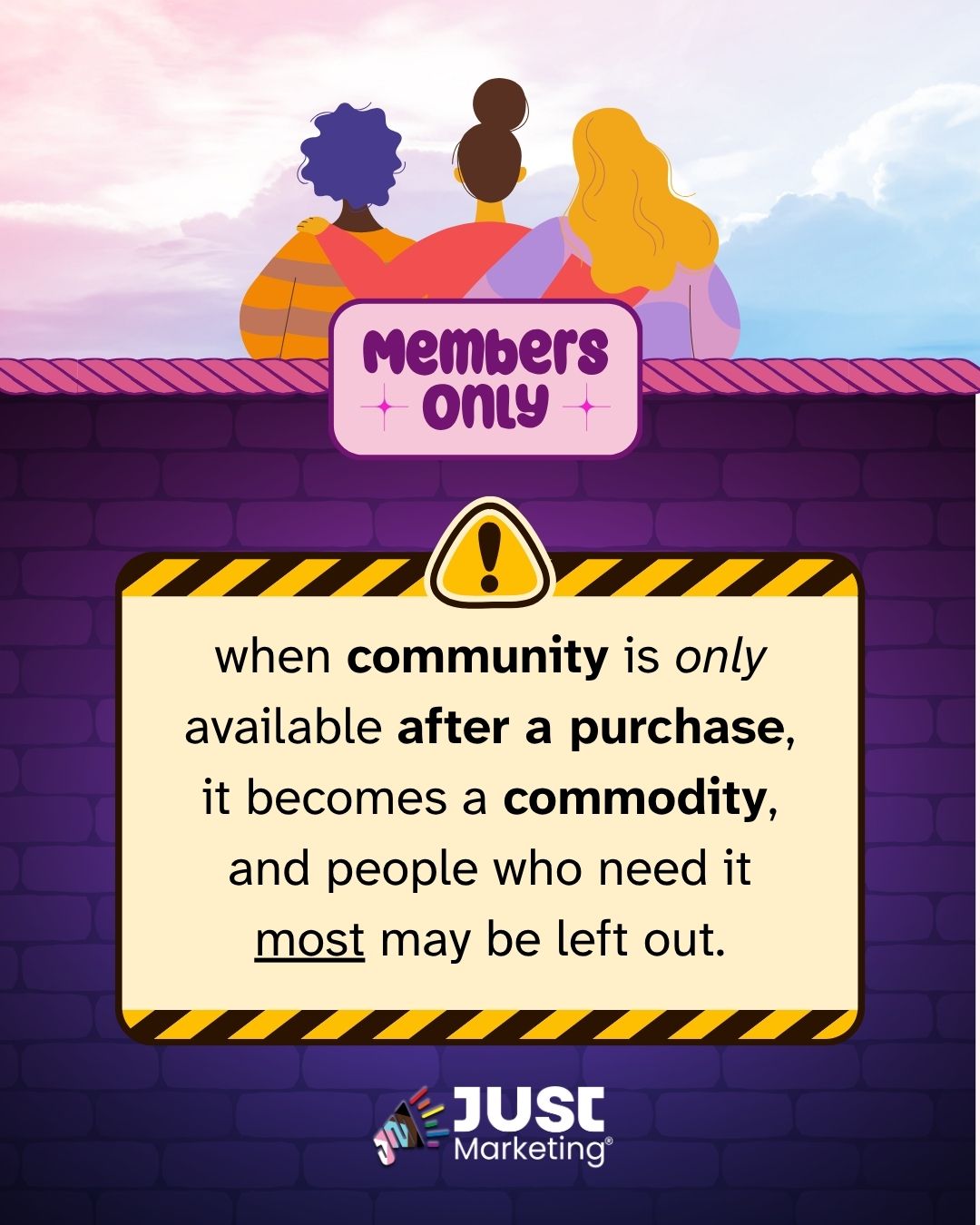
Three diverse figures with arms around each other stand behind a 'Members Only' sign. A yellow caution-striped box with a warning triangle reads: 'when community is only available after a purchase, it becomes a commodity, and people who need it most may be left out.' The Just Marketing logo is at the bottom.

And in some ways, it is valuable. People crave connection, support, and belonging – and offering community access can absolutely enhance your services.

But when community is only available after a purchase, it becomes a commodity. It turns connection into something you have to buy into – rather than something that’s available by design.

Let’s break it down. Paywalling community might look like:

  • A “private client-only” group that houses all your peer support and shared resources
  • Framing connection and access to others as a limited-time bonus
  • Messaging that suggests your community is exclusive, elite, or only for those who can “invest”
  • Using FOMO language to imply that you’re missing out unless you pay to join

While these strategies are common – and often taught as “best practices” – they can unintentionally reinforce systems of exclusion, especially for folks who can’t afford to buy in right now, but still deeply need connection and support.

When access to community is conditional, people who need it most may be left out.

The intention might be to protect your energy or create a container for your clients. That’s totally valid. But there are ways to do that without locking belonging behind a price tag – and we’ll dig into those in the next section.

Who Gets Left Out When We Paywall Community?

Paywalling community doesn’t just shape who’s inside your space – it directly impacts who’s left out.
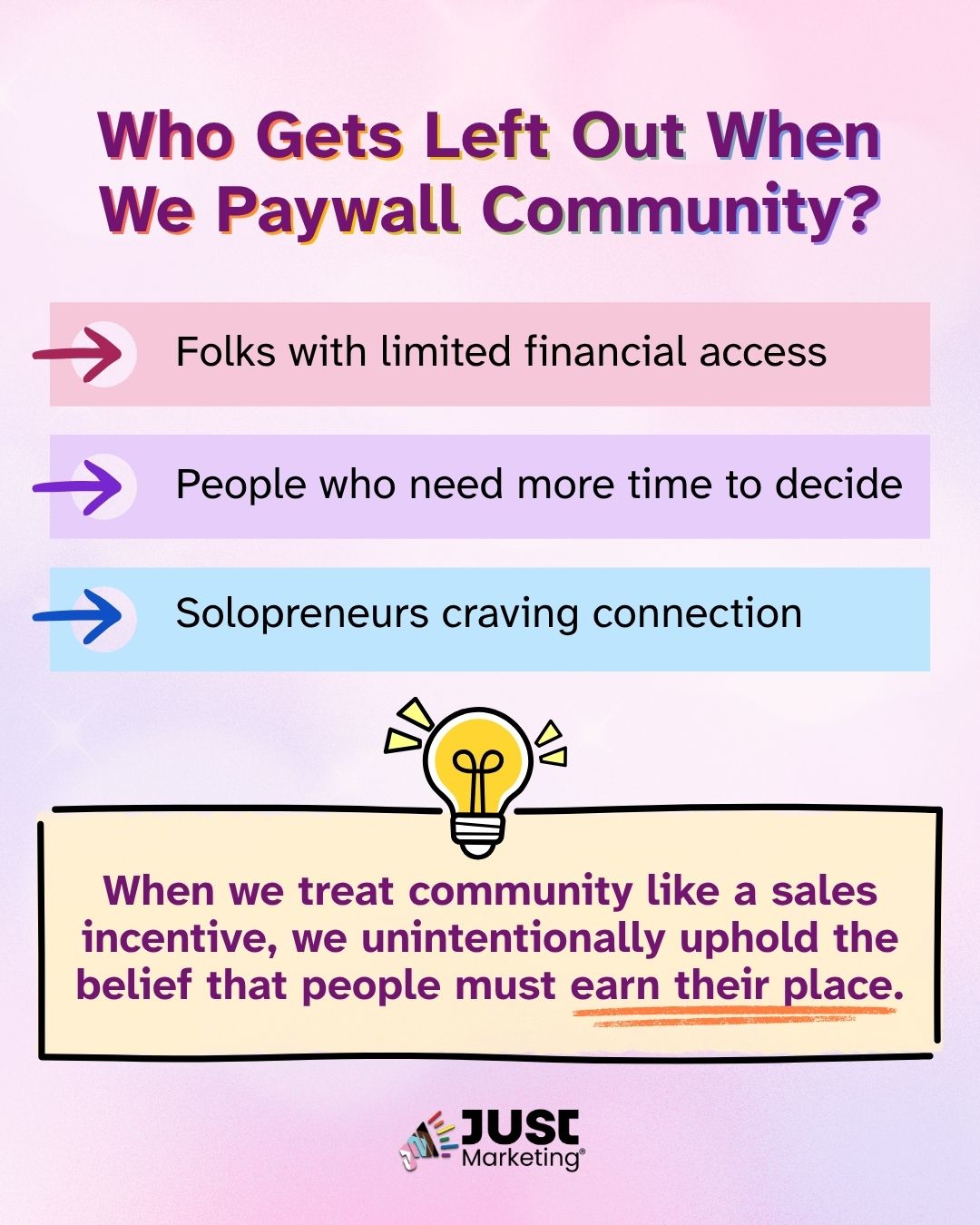
'Who Gets Left Out When We Paywall Community?' in bold. Three color-coded banners: 'Folks with limited financial access,' 'People who need more time to decide,' and 'Solopreneurs craving connection.' A light bulb illustration. 'When we treat community like a sales incentive, we unintentionally uphold the belief that people must earn their place.' Just Marketing logo at the bottom.

When community is something people have to buy into, those who are already facing systemic barriers – financial, cognitive, emotional – often get excluded. Not because they’re not aligned or interested, but because the door was never open without a transaction.

Here’s who often gets left out:

Folks with limited financial access

Neurodivergent entrepreneurs, disabled creators, and folks from historically excluded communities are more likely to face economic challenges. When the only way to access support is through payment, many are shut out before they even get started.

People who need more time to decide

Some of your most aligned future clients might need time to build trust, understand the offer, or regulate nervous system responses before making a purchase. If community is locked away behind a deadline or “fast action” bonus, they may never feel welcome enough to join.

Solopreneurs craving connection

Entrepreneurs navigating business alone – especially those who are newer or feel isolated – might be looking for a sense of belonging before they’re ready to invest. When connection only exists behind the scenes, they stay in the margins, not in the room.

And beyond individual exclusion, there’s a bigger pattern: When we treat community like a sales incentive, we unintentionally uphold the belief that people must earn their place.

This mimics harmful systems many of us are actively trying to unlearn: capitalism, gatekeeping, ableism, and the false idea that value is tied to output or income. And while that may not be the intention, the impact is still real.

Accessible community shouldn't be a luxury. It should be a reflection of your values.

How Can I Offer Community Without Burning Out?

You can protect your energy, honor your capacity, and still offer community without locking it behind a paywall. This isn’t about overextending yourself or offering everything for free – it’s about creating access points that reflect your values and invite in more of the right people.
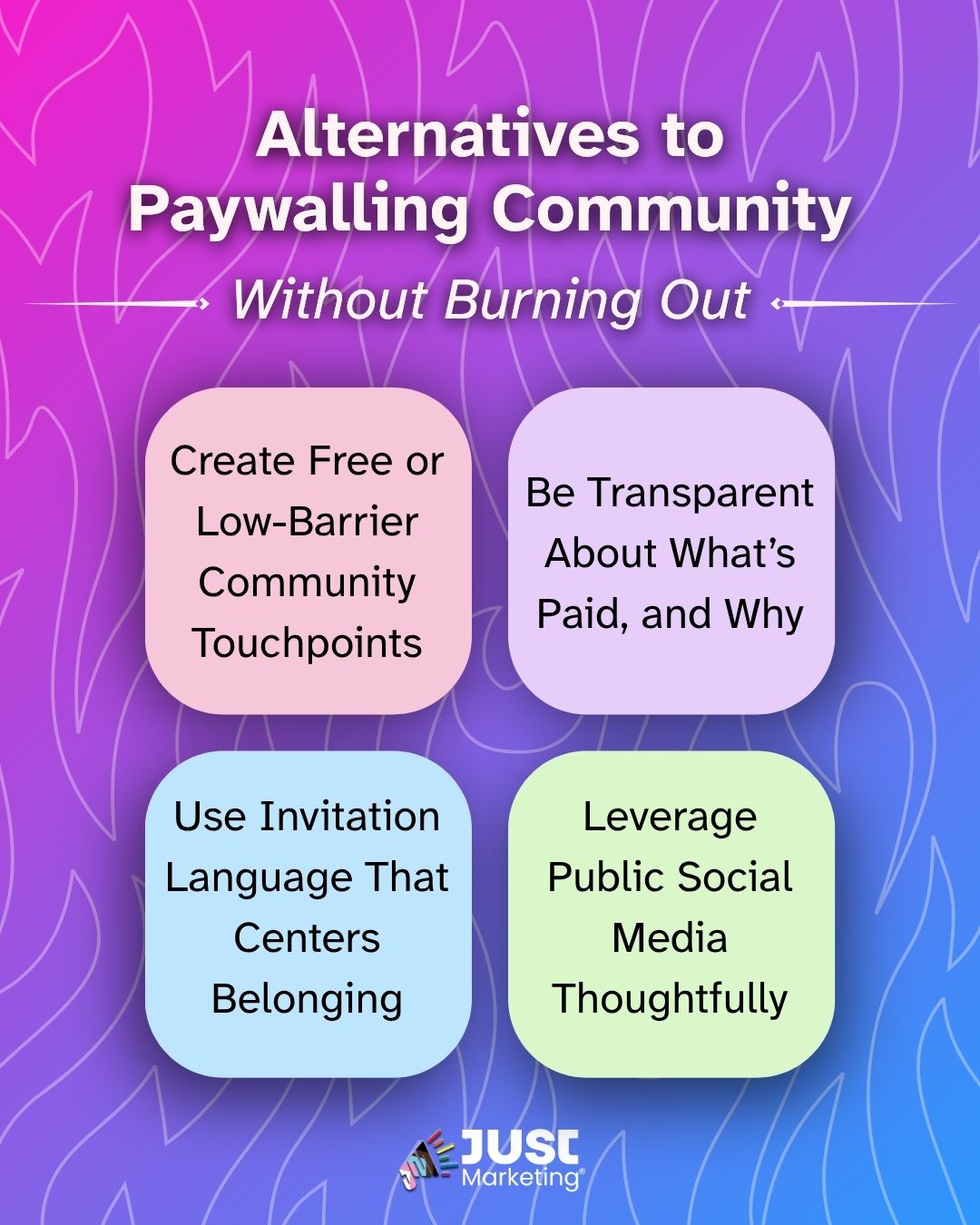
'Alternatives to Paywalling Community Without Burning Out' in bold. Four strategies: 'Create Free or Low-Barrier Community Touchpoints,' 'Be Transparent About What's Paid, and Why,' 'Use Invitation Language That Centers Belonging,' and 'Leverage Public Social Media Thoughtfully.' The Just Marketing logo is at the bottom on a purple-to-pink gradient background with flame outlines.

Here are a few ways to build connection without making people “pay to belong”:

1. Create Free or Low-Barrier Community Touchpoints

Not every space needs to be open access – but could there be one place where people can connect without buying?

Some examples:

  • A free monthly coworking session or community call
  • A lightly-moderated, no-pressure Facebook or Discord group
  • Public-facing comment threads on LinkedIn or Instagram where you intentionally create space for dialogue

Community doesn’t have to be big to be impactful – it just has to feel welcoming.

2. Be Transparent About What’s Paid – and Why

If some parts of your community do live behind a paywall, explain that clearly and compassionately. Frame it as a boundary rooted in your capacity, not a hierarchy of value.

For example:

“To keep my paid clients supported and my own energy protected, I reserve this space for folks inside the program. But you’re always welcome to join my free monthly chats or connect with me on Instagram!”

Transparency builds trust and shows you’re not using access as a carrot – you’re being intentional with your time and care.

3. Use Invitation Language That Centers Belonging

So many sales pages and launch emails lean into exclusivity and urgency:

“Only a few will get in.”

“This is your one shot.”

“You’ll miss out if you wait.”

Try flipping that script.

Use words like:

  • “This space is designed to feel welcoming, not overwhelming.”
  • “You're invited to join when you're ready.”
  • “You already belong here – even if now’s not the right time to buy.”

Belonging isn't a bonus – it’s the baseline.

4. Leverage Public Social Media Thoughtfully

If a full-blown free community feels out of reach right now, that’s okay. You can still foster meaningful connection in small but powerful ways:

  • Ask open-ended questions in your Instagram Stories
  • Host a live session with no pitch, just presence
  • Respond to DMs with warmth and curiosity, not urgency

Remember: You don’t need to be everywhere, everything, or everyone’s community space.

You just need to create pockets of welcome – where people know they’re seen, even if they’re not ready to buy.

Does Offering Free Community Pay Off?

There’s a narrative in online business that says: if you give too much for free, people won’t value it – or they won’t pay you later. 

But when it comes to community, the opposite is often true.

When you lead with generosity, openness, and accessibility, you create something more powerful than a sales funnel: you build trust.

And trust is the foundation of any sustainable, values-aligned business.

Here’s what happens when you stop paywalling community:

  • People feel safe engaging with your brand before they ever spend a dollar.
  • Your work becomes word-of-mouth worthy because people share how seen and supported they feel in your spaces.
  • You build a values-aligned audience that doesn’t just buy because of FOMO – but because they resonate with your mission and feel part of your world already.

This kind of marketing isn’t manipulative. It’s magnetic.

Accessible community creates a ripple effect.

  • A person who felt excluded elsewhere finally finds their place.
  • Those unsure about investing can take their time – and come back when it feels right.
  • Even folks who never become clients may still amplify your work, simply because they believe in what you stand for.
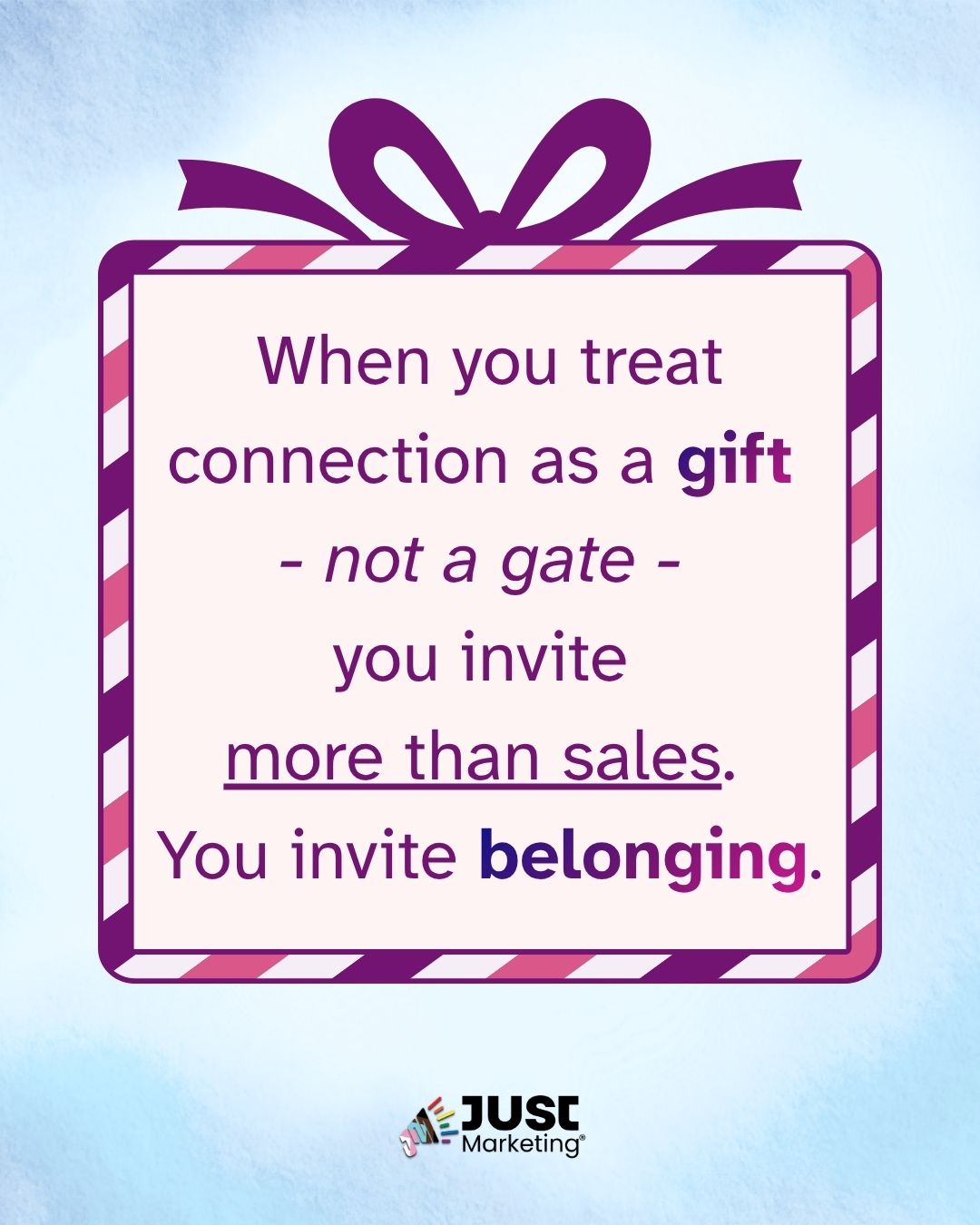
A purple gift box with a bow frames the quote: 'When you treat connection as a gift - not a gate - you invite more than sales. You invite belonging.' The words 'gift' and 'belonging' appear in a bold purple-to-pink gradient, with 'more than sales' underlined for emphasis. The Just Marketing logo is at the bottom on a light blue background.

This is how we shift from extractive business models to ethical ecosystems – where everyone benefits, and no one is left out.

Let’s Rethink Paywalling Community in Ethical Business Models

Paywalling community isn’t always intentional – or inherently harmful. Often, it’s something we do because it’s what we’ve seen work, or what we’ve been taught to do in traditional business spaces.

But when we pause to ask who gets left out, we open the door to more inclusive, values-aligned possibilities.

Because, you don’t need to gatekeep connection to protect your time.
You don’t need to package belonging as a bonus to make your offers valuable.
And you definitely don’t need to follow someone else’s formula to build a thriving, trust-based business.

Your community can be built on access, care, and intention – and still support your capacity and income goals.

Want to Build Connection Without Barriers?

Let’s keep this conversation going… Because community shouldn’t be a commodity – and marketing doesn’t have to leave people out.

  • Join me on LinkedIn or Instagram – I’d love to hear your thoughts on accessible, inclusive community spaces.
  • Ready to create ethical offers that feel good and convert? Learn more about working with me here.

Get more values-aligned marketing ideas in your inbox when you join my email list.

FAQs

Is it okay to charge for a community or membership?

Absolutely! Paid communities can offer deeper support and help sustain your business. The key is being clear about what's included and why it's paid, plus offering at least one free way for people to connect with you and each other.

How can I offer a free community without burning out?

Start small with something that fits your capacity, like a monthly coworking session or an open comment thread on LinkedIn. Set clear boundaries around when you'll show up, and keep moderation light. A small, welcoming space can be just as meaningful as a big one.

Where should I host a free online community?

Choose a platform your audience already uses and finds easy to navigate, such as a Facebook group, a Discord server, or the comments on your social posts. Checking that the space works well with screen readers and on mobile helps everyone participate.

How do I explain why part of my community is paid?

Frame it around your capacity and your clients' needs. For example: “To keep my paid clients supported and my energy protected, I reserve this space for program members. You're always welcome at my free monthly chats.” Honest context builds trust with members and non-members alike.

Does offering free community hurt sales?

Free community often builds the trust that leads to future sales. People who feel welcomed early tend to share your work with others and come back when the timing is right. Many become clients precisely because they already feel at home in your space.

How do I make my community more accessible?

Add captions to live calls, share recordings for anyone who can't attend in real time, and post clear community guidelines so everyone knows what to expect. Offering ways to participate asynchronously helps people with different schedules and energy levels. See our community agreements for an example.


Categories: All Categories, Just Marketing®

Tags: Accessible Marketing, Ethical Marketing, Inclusive Marketing, Increase Engagement, Lead Generation, Promotional Content, Social Media Strategy, Values-Aligned Promotions

Prev
Next

About Meg Brunson

Meg Brunson is a marketing strategist and the creator of Just Marketing®, a justice-centered approach to marketing for impact-driven businesses.

Just Marketing® is ethical, inclusive, and accessible, so your audience feels supported and your business grows sustainably.

Follow me on Instagram @theMegBrunson
Ever bought a “one size fits all” shirt and discov Ever bought a “one size fits all” shirt and discovered it actually fit... one very specific person?

Digital offers can work the same way. A course delivered only as hour-long videos leaves out a lot of learners: Deaf and hard of hearing folks, neurodivergent people who process best in writing, parents squeezing in a lesson during school pickup, and anyone opening your course on a phone with spotty Wi-Fi.

Flexible formats let people choose what fits their needs and their day:

 → Captioned video for watching on mute
 → Audio versions for learning on a walk or in the car
 → Transcripts for skimmers and screen reader users
 → Printable PDFs for anyone who needs a break from screens
 → Mobile-friendly design for learning from anywhere

Good news for your schedule, too. Many of these formats come from content you already have. One recorded lesson can become a transcript and a printable summary with a little editing, which also gives you fresh material to repurpose.

As the bottom of that tag says, one-size-fits-all can work beautifully when it’s accessible to all. 💜

The blog  walks through each format, plus how accessibility builds trust with your audience: MegBrunson.com/accessible-digital-offers

Then tell me below: what’s your go-to format when you’re learning something new? 👇

ID: Accessible Digital Offers. A white clothing tag reads ‘One Size Fits,’ with ‘All’ and ‘Some’ crossed out and ‘Most?’ written below. Text beneath reads, ‘Because One-Size-Fits-All doesn’t work! (unless it’s accessible to all!)’ The design uses a lavender background with a purple-to-magenta headline and a wavy purple ribbon border tied in bows at each corner.

#JustMarketing #EquityForAll #a11y #EquityCenteredBusiness #DiversityInMarketing #SocialJustice #DiversityEquityInclusion #EthicalMarketing #InclusiveMarketing #AccessibleMarketing #MarketingAccessibility #EthicalBusiness #MarketingWithPurpose #MarketingWithImpact #DEI #SocialMediaForAll #ContentCreation #ContentMarketing #ContentMarketingMembership #WeeklySocialContent  #MarketingWithADHD #adhdBusiness #adhdBusinessOwner
Step 5 says to fix the biggest barriers first, the Step 5 says to fix the biggest barriers first, then keep improving one piece at a time… making progress at your own pace.

Accessibility can feel like a mountain when you picture your whole website, your entire back catalog of posts, and every video you’ve ever uploaded all at once. 

(Overwhelmed achievers, I see you.) 

Starting with whatever blocks the most people turns that mountain into a manageable next step.

Some high-impact places to begin:
 → Captions on your most-watched video
 → Alt text for the images on your homepage
 → Stronger color contrast on your email signup button
 → Descriptive link text on your services page

Choose one this week and another next week. Small fixes stack up faster than you’d expect, and each one makes your marketing easier to use for disabled and neurodivergent folks (and clearer for everyone else, too).

The blog post covers all five steps… Read it at: MegBrunson.com/design-for-the-edges 

Then tell me below: which barrier are you tackling first? 👇

ID: Just Marketing logo above the heading ‘How to Design Your Marketing for the Edges.’ Five numbered steps sit in hexagons shaded pink to purple, each with a matching underline: 1, name your edges. 2, build access into your first draft. 3, run a quick edge check. 4, ask people with lived experience. 5, fix the biggest barriers first. Pastel gradient background.

#JustMarketing #EquityForAll #a11y #EquityCenteredBusiness #DiversityInMarketing #SocialJustice #RacialJustice #BeTheChange #DismantleWhiteSupremacy #DiversityEquityInclusion #EthicalMarketing #InclusiveMarketing #AccessibleMarketing #MarketingAccessibility #SocialMediaMarketer #EthicalBusiness #MarketingCoach #CommunityOverCompetition #MarketingWithPurpose #MarketingWithImpact #DEI #DEIMarketing #SocialMediaForAll #ContentCreation #ContentMarketing #ContentMarketingMembership #WeeklySocialContent  #MarketingWithADHD #adhdBusiness #adhdBusinessOwner
If your marketing isn’t hitting your goals, the pr If your marketing isn’t hitting your goals, the problem probably isn’t your graphics.
It’s not your captions.
It’s not that you need more content.

What you need is a strategy.

One that’s tied to your business goals, aligned with your values, and flexible enough to evolve as you grow.

That’s the difference between someone who just posts for you
…and someone who partners with you to actually grow your business.

– Strategy
– Testing
– Tuning
– Real results

And impeccable work, every step of the way.

If you’re ready to stop guessing and start growing, let’s talk: YourMarketingPerson.co 

(or DM me!)

ID: Mia P. holding a coffee cup, ‘I was going through social media manager after social media manager, until Meg came in with a strategic perspective on how our marketing could achieve our goals and KPIs. We crafted a plan and Meg was there every step of the way to test and tweak until we got the results we wanted. Her work is impeccable, her expertise is top notch.’ YourMarketingPerson.co

#JustMarketing #EquityForAll #a11y #EquityCenteredBusiness #DiversityInMarketing #SocialJustice #RacialJustice #BeTheChange #DismantleWhiteSupremacy #DiversityEquityInclusion #EthicalMarketing #InclusiveMarkeitng #AccessibleMarketing #MarketingAccessibility #SocialMediaMarketer #EthicalBusiness #MarketingCoach #CommunityOverCompetition #MarketingWithPurpose #MarketingWithImpact #DEI #DEIMarketing #SocialMediaForAll #ContentCreation #ContentMarketing #ContentMarketingMembership #WeeklySocialContent  #MarketingWithADHD #adhdBusiness #adhdBusinessOwner
November is here, and with it comes a season of re November is here, and with it comes a season of reflection, gratitude, and connection.

Here’s a look at some of the meaningful holidays and observances this month:

Native American Heritage Month (All November) - A time to celebrate the rich histories, cultures, and contributions of Native American communities while recognizing the resilience and strength that continue to define them. Let’s amplify Indigenous voices, learn from their stories, and commit to supporting their movements for justice.

Diwali (November 8) - Known as the Festival of Lights, Diwali celebrates the triumph of light over darkness and good over evil. This vibrant holiday is marked with candles, fireworks, and family gatherings. It’s a beautiful reminder of hope and renewal that resonates far beyond the cultures that celebrate it.

Transgender Day of Remembrance (November 20) - This solemn observance honors the lives of transgender people lost to violence and prejudice. It’s a call to action to protect and uplift trans voices, ensuring that every member of our community is seen, valued, and safe.

Thanksgiving (November 26) - Yes, Thanksgiving is about gathering, feasting, and expressing gratitude - but it’s also a chance to reflect on its history and recognize the complexities of this holiday for Indigenous communities. Pair your gratitude with education and action to make this day truly meaningful.

The Inclusive Holiday Content Bundle is your go-to resource for creating marketing that matters. Packed with observances and ideas, it’ll help you craft content that connects authentically while celebrating the diversity of your audience.

Instant Access: CelebrateOnSocial.com

Which holiday or observance will you be honoring this month?
I’d love to hear how you’re making November meaningful.

ID - A 6-card carousel highlighting 'Diverse & Inclusive Holidays' in November. Promotional graphic encourages planning inclusive holiday content year-round. Text promotes access to Canva templates, graphics, and guidance for over 470 inclusive holidays. CelebrateOnSocial.com appears in a purple bar.
Titles don’t make leaders. Practice does. Here’s Titles don’t make leaders.
Practice does.

Here’s a look at my own Leadership Philosophy:

I make decisions by …

(1) Leveraging my knowledge & experiences, researching new ideas, and listening to feedback from all who are impacted.

(2) Asking questions & considering the most marginalized community members.

(3) Getting creative and considering innovative & unconventional options. 

I believe …

(1) In being transparent about my feelings and actions, including owning up to my mistakes & lessons learned.

(2) In collaboration & empowering each other so that we’ll become stronger as a collective & as individuals.

(3) We should be asking tough questions & calling out inequities, even when it's uncomfortable.

(4) Through small daily actions, we will influence broad long-term outcomes.

My leadership liberates others by …

(1) Providing a space for marketers & business owners to make mistakes, learn, and grow.

(2) Supporting the growth of business revenue & personal profits.

(3) Changing the landscape of marketing so all feel seen, supported, and respected through the buying process.

Marketers are trendsetters with platforms and influence. By leading the charge with the way we ethically represent our brands, we can help spark a more inclusive & accessible future into existence. That’s Just Marketing®.

💕

Whether you’re leading a team, a classroom, or a solo business…
You are a leader.

And you get to define what leadership looks like - on your own terms.

Take a moment: How would you finish these sentences?

I make decisions by...
I believe...
My leadership liberates others by...

Drop yours in the comments or journal it out. There’s no wrong answer - just truth.

Title: ‘Leadership Philosophy’ on a purple and pink gradient. A smartphone frame displays Meg with pink and purple hair sitting outdoors with a laptop covered in stickers. Their shirt reads “People > Profit.” On the right are three speech bubbles: 'I make decisions by…' 'I believe…' and 'My leadership liberates others by…'
At its heart, marketing is about connection. And l At its heart, marketing is about connection. And language sits right at the center of every connection we make with the people we hope to serve.

When we slow down and notice whose voices we center, we can start building brands that reflect the world we want to live in: one where multilingual, multicultural, and neurodiverse communities are welcomed from the very beginning.

If that feels like a big goal, here's the encouraging part. Language justice is an ongoing practice, and you get to begin at your current capacity. A few low-lift places to start:

– Add captions and transcripts to your videos, in more than one language if you can

– Translate one key page, like your homepage, booking page, or lead magnet

– Poll your community about the languages they speak at home and whether multilingual content would help them

– Choose plain, clear language that works well for neurodivergent readers, multilingual audiences, and translation tools

Pick one and let it be enough for now. A single thoughtful change creates more impact than a dozen performative gestures, and each step makes it more likely someone feels seen and respected by your brand.

You can move toward language justice with the skills you have today. Curiosity and a willingness to learn will carry you a long way.

Find more small, sustainable shifts at MegBrunson.com/language-justice 

Which of these shifts feels most doable for you this month? 
Tell me in the comments, and I'll cheer you on!

ID: Large handwritten-style text on a purple-to-magenta gradient reads 'Language is a Justice Issue, and a Relationship Tool,' with the Just Marketing logo centered below.

#JustMarketing #EquityForAll #a11y #EquityCenteredBusiness #DiversityInMarketing #DiversityEquityInclusion #EthicalMarketing #InclusiveMarketing #AccessibleMarketing #MarketingAccessibility #EthicalBusiness #MarketingWithPurpose #MarketingWithImpact #DEI #SocialMediaForAll #ContentCreation #ContentMarketing #ContentMarketingMembership #WeeklySocialContent  #MarketingWithADHD
Google Translate can help you get the gist of some Google Translate can help you get the gist of something… and when your message really matters, you'll want people who live in the languages and cultures you hope to honor.

Hiring a translator or interpreter works best when you approach it as a relationship grounded in shared values and clear communication. Here are four ways to do that ethically:

1. Hire values-aligned professionals
Look for people who understand your audience and your mission. Experience in marketing or your industry is a big plus. Prioritize the person who gets what you're trying to say and knows how to say it in a way that resonates culturally.

2. Pay fairly and credit contributors
Language work is skilled labor. Translators adapt tone, catch cultural missteps, and often keep you from saying something unintentionally harmful. Compensate them accordingly, and give credit when their work shapes your content.

3. Co-create instead of extract
Invite collaboration from the start with questions like:
– Does this phrase translate well?
– Would this example resonate with your community?
That kind of conversation turns a technically correct translation into one that feels emotionally and culturally right.

4. Expand your definition of "language access"
Language justice includes people who communicate nonverbally or process language differently. Consider ASL interpreters for live events and videos, accurate captions and transcripts (auto-captions miss a lot), alt text and image descriptions, and plain language for neurodivergent readers.

Learn more about ethical translation and inclusive messaging: MegBrunson.com/language-justice 

Have you worked with a translator, interpreter, or language consultant? 
Share what made the collaboration great, or tag someone you'd recommend!

ID: Title, 'Working with Translators, Interpreters, and Creators Ethically.' 4 numbered boxes: hire values-aligned professionals, pay fairly and credit contributors, co-create instead of extract, and expand your definition of 'language access.'
According to the U.S. Census Bureau, about 20% of According to the U.S. Census Bureau, about 20% of people in the U.S. speak a language other than English at home. Zoom out to a global audience and that number climbs dramatically.

Still, much of the online business world treats English as the default. When your marketing only shows up in English, your reach shrinks, even when your services are technically open to anyone.

Language shapes how we process information and whether we feel welcomed or shut out. For some people, English is a second or third language. For others, it carries memories of exclusion in schools, healthcare, and other systems that were supposed to serve them. And for many neurodivergent readers, even "simple" English content can feel dense and hard to follow.

When we treat language as a bridge, we open the door to people who've been left outside the "ideal client" box for far too long.

Here's a quick self-check for your own marketing:
– Do I know which languages my audience speaks or prefers?
– Have I tested whether my message stays clear in translation?
– Would someone using a screen reader or translation app understand my offer?
– Is my writing as plain and direct as it could be?

Centering access starts with asking better questions. From there, you can build marketing that meets people where they are, one thoughtful change at a time.

Explore more ways to make your messaging accessible: MegBrunson.com/language-justice

What languages are spoken in your home or in the communities you serve?

ID: Title, 'Language as Access,' an illustrated smiling mouth has speech bubbles reading 'Annyeong' in Korean, 'Hello,' and 'Bonjour.' The Just Marketing logo appears at bottom right, with text below reading 'Not Everyone Speaks (or Thinks in) English.'

#JustMarketing #EquityForAll #EquityCenteredBusiness #DiversityInMarketing #DiversityEquityInclusion #EthicalMarketing #InclusiveMarketing #AccessibleMarketing #MarketingAccessibility #EthicalBusiness #MarketingWithPurpose #MarketingWithImpact #DEI #ContentCreation #ContentMarketing #ContentMarketingMembership #WeeklySocialContent  #MarketingWithADHD
Most online marketing defaults to English and assu Most online marketing defaults to English and assumes everyone shares the same cultural context. 

That default feels efficient, and it also quietly shrinks the room. 

Multilingual folks, immigrant communities, Deaf audiences, and neurodivergent readers often end up outside messages that were supposedly meant for everyone.

Language justice starts with a simple question: who gets left out of our message? 
Then comes the more hopeful follow-up: how do we invite them back in?

Here's a quick example. Say you're a coach who helps clients "get off the hamster wheel." Plenty of U.S. English speakers will nod along. For someone outside that cultural context, or someone reading through a translation app, the phrase might land as pure confusion. 

"Break free from the cycle of burnout" carries the same meaning to far more people.

Words carry culture, humor, tone, and emotion, so a literal translation only gets you partway there. 

Localization and transcreation help your message arrive with the meaning you intended.

Start small. 
Swapping one idiom for clearer language is a real step toward more inclusive marketing, and it makes your content easier for everyone to read.

The blog walks through:
– Why language is an access issue
– How cultural nuance shapes the way your message lands
– How to work with translators and interpreters ethically
– Small, sustainable shifts you can make right away

Read more: MegBrunson.com/language-justice 

What's a phrase or idiom you use often that might not translate well? 
Let's brainstorm clearer alternatives together.

ID: Title, 'Language Justice in Marketing,' an illustrated globe surrounded by speech bubbles greeting in different languages: 'Ni Hao' in Chinese, 'Hola,' 'Hello,' Arabic script, and 'Namaste' in Hindi. Italic text below asks 'How Inclusive is Your Messaging?' against a soft pastel gradient.

#JustMarketing #EquityCenteredBusiness #DiversityInMarketing #DiversityEquityInclusion #EthicalMarketing #InclusiveMarketing #AccessibleMarketing #MarketingAccessibility #MarketingWithPurpose #MarketingWithImpact
You’re the visionary. You shouldn’t have to be the You’re the visionary.
You shouldn’t have to be the marketing department, too.

Erica came to me with two businesses and one goal: grow without burning out, and she got:
– Real results
– Clear strategy
– No extra work dumped on her lap

Just Marketing® is about collaboration that respects your capacity.
Strategy that doesn’t rely on hustle.
Support that feels good.

You don’t need to do it all alone.
You just need a plan (and a partner) that actually works.

Ready to grow your biz without burnout?

Let’s chat!

ID: Testimonial: ‘We’ve used Meg's marketing services for two businesses over a couple years and she did a fantastic job. She's laid back. She listens. And she doesn't add more work to my plate to get the job done. We had great results and would definitely recommend her to a small business looking for growth!’ A small circular photo and text, ‘Erica 'Poindexter' Gunderson recommends Meg Brunson.’

 #JustMarketing #EquityForAll #a11y #EquityCenteredBusiness #DiversityInMarketing #SocialJustice #RacialJustice #BeTheChange #DismantleWhiteSupremacy #DiversityEquityInclusion #EthicalMarketing #InclusiveMarkeitng #AccessibleMarketing #MarketingAccessibility #SocialMediaMarketer #EthicalBusiness #MarketingCoach #CommunityOverCompetition #MarketingWithPurpose #MarketingWithImpact #DEI #DEIMarketing #SocialMediaForAll #ContentCreation #ContentMarketing #ContentMarketingMembership #WeeklySocialContent  #MarketingWithADHD #adhdBusiness #adhdBusinessOwner
Ever rolled a suitcase down a curb cut? You can t Ever rolled a suitcase down a curb cut? 
You can thank disability activists for that!

In the early 1970s, Michael Pachovas and a few friends poured their own cement ramp onto a Berkeley curb. Berkeley installed its first official curb cut in 1972, and before long, parents with strollers and travelers with luggage were heading straight for them too.

PolicyLink CEO Angela Glover Blackwell later named this the curb-cut effect: when you design for people who’ve been left out, everyone benefits.

Marketing follows the same pattern. 

Most content gets built for an imagined “average” person who sees every image, hears every video, and scrolls at top speed. 

That person is mostly a myth. 

When you start with the folks at the edges of the bell curve, like disabled and neurodivergent people, your content gets clearer for your whole audience.

Designing for the edges sits at the heart of the accessibility pillar of Just Marketing®. 

The blog covers eight marketing curb cuts you can start using today: MegBrunson.com/design-for-the-edges 

What’s an accessibility practice you started for one reason that ended up helping way more people than you expected?

ID: Just Marketing logo above the title ‘Design for the Edges,’ with ‘Design’ in purple-to-magenta script and ‘Edges’ in bold magenta. Two curved arrows point from ‘Edges’ down to both tails of a bell curve filled with rows of gray person icons. Icons in the outer edges are shaded magenta, highlighting people at the margins. Pastel gradient background.

#JustMarketing #EquityForAll #a11y #EquityCenteredBusiness #DiversityInMarketing #SocialJustice #RacialJustice #BeTheChange #DismantleWhiteSupremacy #DiversityEquityInclusion #EthicalMarketing #InclusiveMarketing #AccessibleMarketing #MarketingAccessibility #SocialMediaMarketer #EthicalBusiness #MarketingCoach #CommunityOverCompetition #MarketingWithPurpose #MarketingWithImpact #DEI #DEIMarketing #SocialMediaForAll #ContentCreation #ContentMarketing #ContentMarketingMembership #WeeklySocialContent  #MarketingWithADHD #adhdBusiness #adhdBusinessOwner
You fold one load of marketing content… … and some You fold one load of marketing content…
… and somehow 3 more are waiting in your inbox.

Blog post.
Instagram carousel.
Email newsletter.

…Oh wait. Now the algorithm wants video again?

Tell me why marketing feels like digital laundry.

You finally get “caught up,” and then…
– You launch something new
– The season shifts
– You pivot your offer
– Or let’s be honest… you’re just tired

And suddenly your content pile has become Mt. Overwhelm.

Listen, you’re not doing anything wrong.
Marketing really is never-ending.
But that doesn’t mean you have to do it all yourself.

I work with entrepreneurs who are ready to stop guessing.

Who want structure that still leaves room for creativity.

Who are done with the hustle and want a system that works with their brain and bandwidth.

Whether you need a full strategy, ongoing support, or someone to hand you the calendar so you just show up and press post…
I’ve got you.

Let’s talk → YourMarketingPerson.co 
(or DM me!)

Or if you’re the DIY type: Check out the Content Marketing Membership - it was literally made for this kind of thing: ContentMarketingMembership.com 

ID: A circular graphic with laundry-related icons, including a washing machine, basket, gloves, spray bottle, ironing board, hanger, shirt, iron, clothespin, and wash basin surrounded by soap bubbles. Center text reads: ‘Do you ever feel like… marketing is constant digital laundry?’ The words ‘marketing,’ ‘constant,’ and ‘digital’ are emphasized in different fonts and colors.

 #JustMarketing #EquityForAll #a11y #EquityCenteredBusiness #DiversityInMarketing #SocialJustice #RacialJustice #BeTheChange #DismantleWhiteSupremacy #DiversityEquityInclusion #EthicalMarketing #InclusiveMarketing #AccessibleMarketing #MarketingAccessibility #SocialMediaMarketer #EthicalBusiness #MarketingCoach #CommunityOverCompetition #MarketingWithPurpose #MarketingWithImpact #DEI #DEIMarketing #SocialMediaForAll #ContentCreation #ContentMarketing #ContentMarketingMembership #WeeklySocialContent  #MarketingWithADHD #adhdBusiness #adhdBusinessOwner
Follow on Instagram


Links

CMM Log In
Mission, Vision, & Values

DEI Statement
Leadership Philosophy
Community Agreements
Press & Media


Beliefs

Black lives matter.
Love is love.
Abortion is healthcare.
No human is illegal.
Free Palestine.
I also Believe…

Circular badge has the name "Meg" in the middle and is surrounded by: "CEO, author, speaker, marketer, leader, & advocate"
Copyright © 2026|All Rights Reserved|Meg Brunson, LLC| Privacy & Terms