Meg Brunson

  • Let’s GoHome
  • #AllTheThingsAbout Me
  • Read | Listen | WatchContent Library
  • Join TheMembership
  • Let’s WorkTogether

Rethinking Sales Funnels and Traditional Conversion Tactics: What to Do Instead

We’ve all been there – caught in a whirlwind of pop-ups, countdown timers, and “just one more offer” before you can finally complete your purchase. What was supposed to be a simple “yes” turns into a confusing, high-pressure maze of upsells, FOMO, and guilt.

These are the classic moves of traditional sales funnels – and they’re everywhere in the online business world. Tactics like tripwires, one-time offers, and abandoned cart emails are marketed as smart strategy… but more often than not, they create friction, not flow. Especially for neurodivergent folks, overwhelmed entrepreneurs, or anyone trying to make values-aligned decisions, these funnels can feel less like support and more like manipulation.

This post is your no-shame, no-fluff round-up of five common sales funnel tactics that deserve a second look – because when we know better, we can do better.

If you’re craving a marketing approach that centers consent, accessibility, and actual connection (instead of coercion), you’re in the right place.

Let’s unpack what these tactics are, why they’re so problematic, and what kinder, more ethical alternatives could look like – so you can build marketing systems that feel good for you and your audience.

What’s the Deal With Sales Funnels, Anyway?

Let’s start with a quick gut-check: the phrase “sales funnel” can feel a little… icky, right? It conjures up images of complicated diagrams, high-pressure tactics, and that bro-marketing vibe we’re all trying to unlearn. But at its core, a sales funnel is simply the path someone takes from discovering your work to deciding whether or not to buy from you.

The problem isn’t the funnel itself – it’s how that path is often paved with pressure, urgency, and manipulation.

Traditional funnels are designed to push people toward a sale as quickly as possible. And while that might boost short-term revenue, it often comes at the cost of long-term trust – especially when the process includes surprise pop-ups, shame-based follow-ups, or tactics that prey on impulse rather than informed choice.

Here’s the thing: when we treat people like “leads” to convert instead of humans to connect with, our marketing starts to feel transactional, extractive, and out of alignment with our values.

And for mission-driven, neurodivergent, or equity-minded entrepreneurs? That just doesn’t sit right.

But don’t worry – this isn’t a “funnels are bad” post.
Text: 'Funnels can be part of a Just Marketing® strategy… When they’re built with intention.' The word 'Funnels' is written in a purple gradient with a white outline and the word 'intention' is highlighted by a purple gradient. A soft, pastel swirl background.

This round-up dives into six of the most common (and most problematic) conversion tactics you’ve likely seen – or used – so you can reimagine them in ways that center clarity, care, and choice.

Because a funnel that feels good works better – for everyone.

6 Sales Funnel Tactics That Deserve a Rethink

Honestly, most of these tactics didn’t start out feeling shady. Many of us were taught to use them by mainstream marketing “experts” who prioritized conversion rates over consent. But once you start to look at how they actually impact your audience – especially those who are neurodivergent, disabled, or navigating trauma – it becomes clear: they’re doing more harm than good.

The good news? You don’t have to rely on pressure to make a sale. You can create supportive, accessible funnels that honor your people’s autonomy and build real trust.
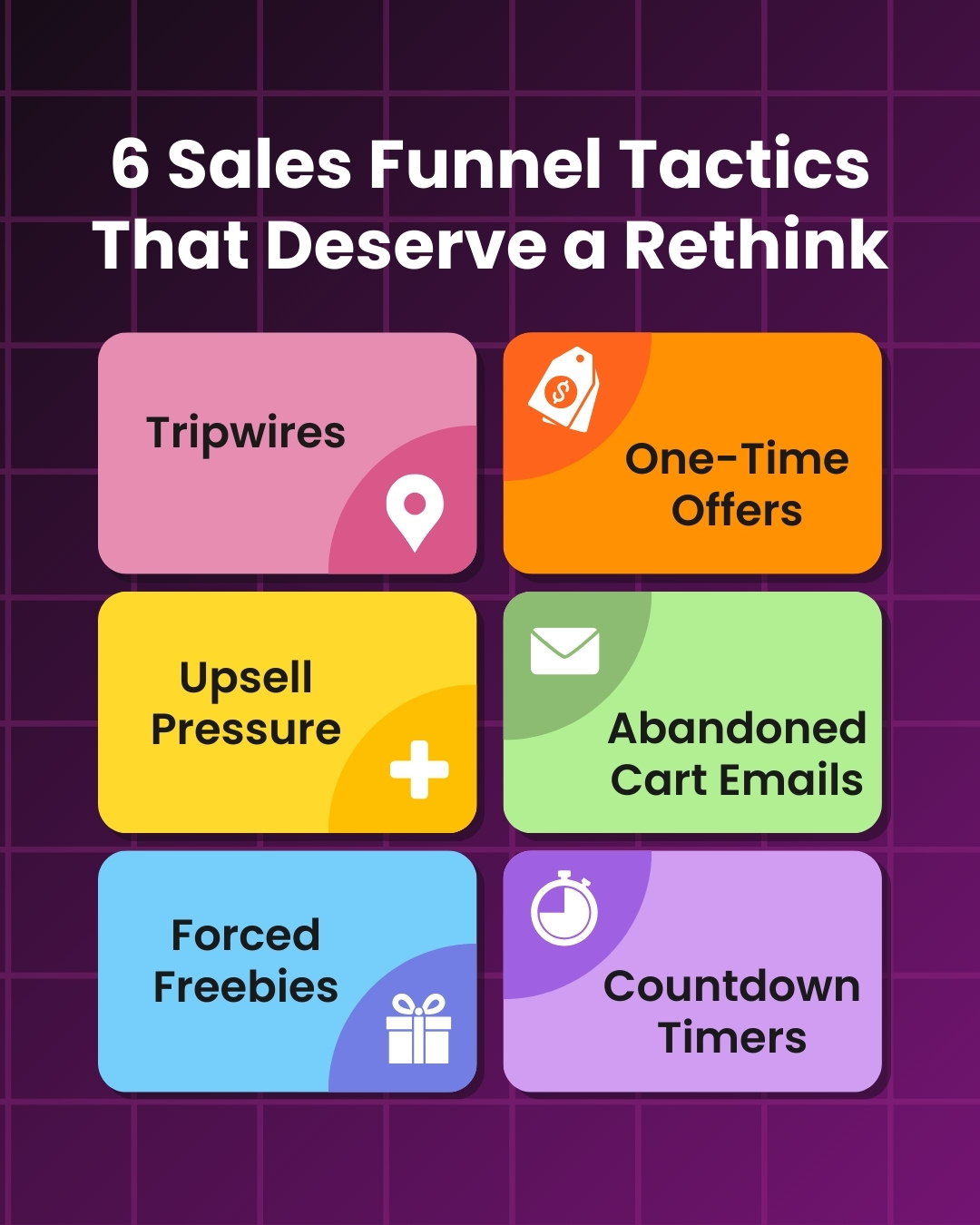
Infographic titled '6 Sales Funnel Tactics That Deserve a Rethink' with a dark grid background. Six colorful boxes list tactics: Tripwires, One-Time Offers, Upsell Pressure, Abandoned Cart Emails, Forced Freebies, and Countdown Timers - each paired with a relevant icon.

Here are six of the most common conversion tactics that could use a compassionate makeover:

1. Tripwires

The tactic: A low-cost offer ($7, $27, etc.) positioned as a “no-brainer,” followed by a surprise upsell sequence the second someone clicks “buy.”

Why it’s harmful: Tripwires can create a bait-and-switch dynamic. They prey on impulse buying and often lead people into a funnel they didn’t fully consent to – especially when followed by pressure-heavy upsells, timers, or aggressive copy. For folks with ADHD or financial sensitivity, this can be overwhelming and even triggering.

A better way: Let your low-cost offer stand alone as a full, valuable experience. Be upfront about what comes next, and use invitational – not manipulative – language.

[Read the full post on Tripwires →]

2. One-Time Offers (OTOs)

The tactic: A post-purchase pop-up that promises an “exclusive” upgrade – available only right now.

Why it’s harmful: OTOs are designed to capitalize on that “already in buying mode” moment. But the pressure to decide immediately – especially under the threat of never seeing the offer again – can create stress, not empowerment. It compromises consent and can lead to buyer’s remorse.

A better way: Offer upgrades through a post-purchase nurture sequence or transparent product path. Give people time and space to decide, and trust that the right buyers will say yes when they’re ready.

[Read the full post on One-Time Offers →]

3. Upsell Pressure

The tactic: A gauntlet of pop-ups, add-ons, and “wait – don’t miss this!” offers that delay checkout and disrupt the buyer’s flow.

Why it’s harmful: This tactic piles on decision fatigue at the worst possible moment. It undermines trust and signals that your original offer wasn’t actually complete or valuable on its own. For neurodivergent folks especially, it can lead to cognitive overload or checkout abandonment.

A better way: If you offer an upgrade, make it simple, optional, and directly aligned with what the person already said yes to. No detours, no guilt trips, no overwhelm.

[Read the full post on Upsell Pressure →]

4. Abandoned Cart Guilt Emails

The tactic: Follow-up emails with subject lines like “You forgot something!” or “Don’t miss out!” aimed at pressuring folks back into the sale.

Why it’s harmful: These messages can come across as patronizing or shame-inducing – especially when someone is already navigating decision fatigue, financial limitations, or a busy, neurodivergent brain.

A better way: Send supportive, curiosity-based check-ins that acknowledge life happens. Offer to answer questions, and always include a clear, shame-free opt-out.

[Read the full post on Guilt-Based Abandoned Cart Emails →]

5. Forced Freebies

The tactic: Requiring an email address to access something labeled as “free.”

Why it’s harmful: When your “free” resource comes with strings attached, it’s no longer free – it’s a transaction. This creates access barriers, undermines trust, and assumes consent that wasn’t clearly given.

A better way: Share genuinely free content whenever possible. If you do gate something, explain why and give people an honest choice about opting into further communication.

[Read the full post on Forced Freebies →]

6. Countdown Timers

The tactic: A ticking clock placed on sales pages, checkouts, or pop-ups to create urgency and nudge buyers into acting fast.

Why it’s harmful: Countdown timers often create manufactured urgency – especially when there’s no legitimate reason for the deadline. This kind of pressure can trigger anxiety, especially for folks with executive dysfunction, time blindness, or trauma related to scarcity and urgency. It also creates a false sense of scarcity that chips away at trust.

A better way: If there is a real deadline (like a live start date or capacity limit), communicate it transparently and with context. If not? Skip the timer. Trust is more powerful than panic.

[Read the full post on Countdown Timers →]

Why These Tactics Feel So Gross (Even If They “Work”)

These funnel tactics do “work” – if your only goal is to squeeze a few extra dollars out of every sale. That’s why they’re so common in the online business world. They prey on urgency, impulse, and decision fatigue to drive conversions fast.

But just because something works on paper doesn’t mean it works in practice – especially if it leaves your audience feeling manipulated, overwhelmed, or regretful.

If you’ve ever clicked “buy” and immediately thought “ugh, that didn’t feel good,” you already know the truth: These tactics might boost short-term revenue, but they damage long-term relationships.
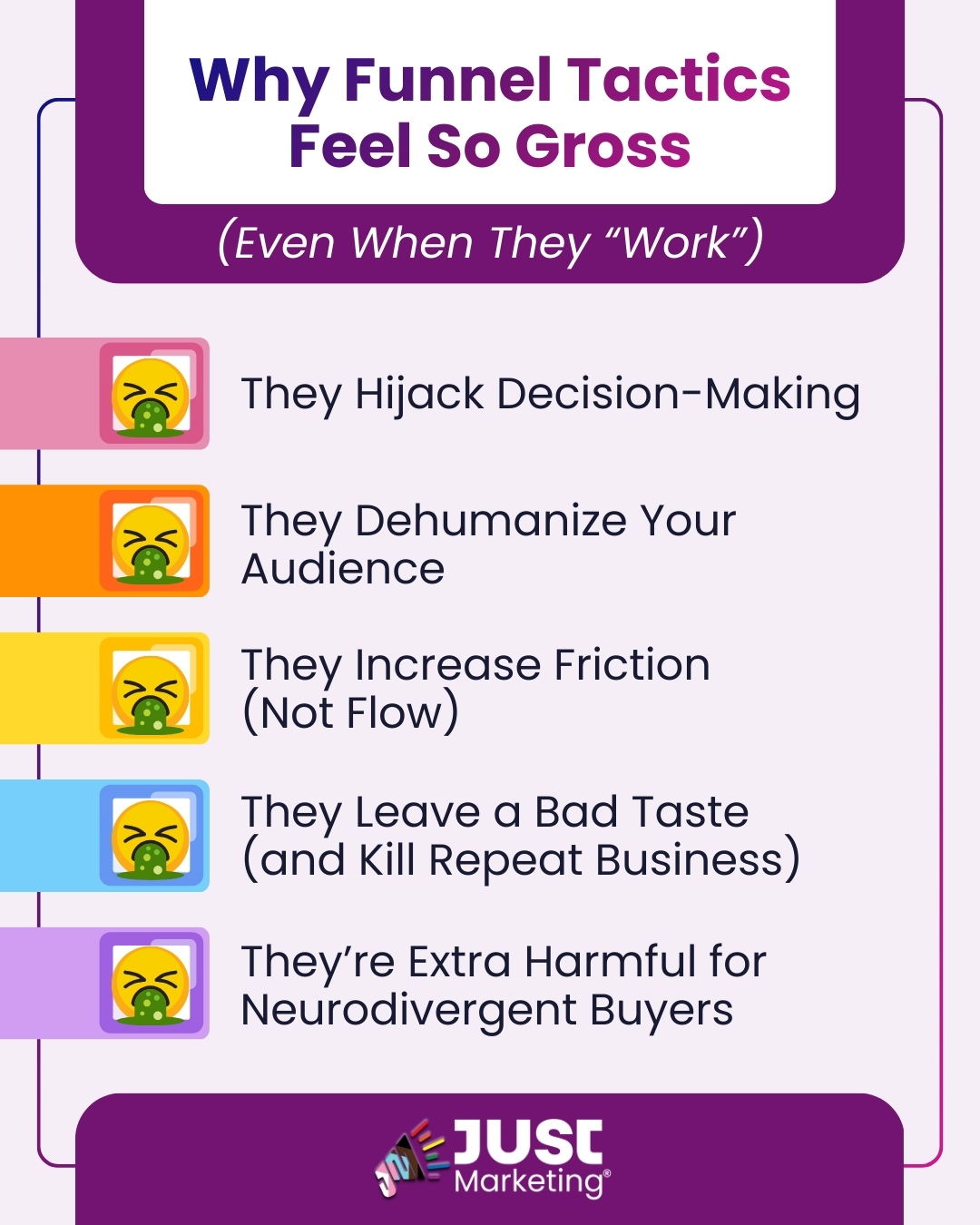
Why Funnel Tactics Feel So Gross - Even When They ‘Work.’ Five points, each marked by a nauseated face emoji: They Hijack Decision-Making, They Dehumanize Your Audience, They Increase Friction (Not Flow), They Leave a Bad Taste (and Kill Repeat Business), and They’re Extra Harmful for Neurodivergent Buyers. The Just Marketing® logo appears at the bottom.

Let’s break down why they feel so gross (and why that feeling is worth listening to):

1. They Hijack Decision-Making

Countdown timers, surprise OTOs, and guilt-based emails are all designed to push people into quick decisions – without giving them time to think clearly or fully consent. For folks with ADHD, anxiety, or trauma histories, that kind of pressure can cause shutdown, not conversion.

2. They Dehumanize Your Audience

Traditional funnel strategies treat people like “leads” to move through a pipeline – not full humans with agency, emotions, and boundaries. It’s easy to forget that behind every email address is a real person. And when we prioritize profit over people, we chip away at the trust we’re trying to build.

3. They Increase Friction (Not Flow)

Funnels are supposed to make the buying process easier – but these tactics often do the opposite. They interrupt the flow, add emotional and cognitive load, and create decision fatigue. Instead of a smooth yes, your audience gets stuck in a spiral of pop-ups, pressure, and second-guessing.

4. They Leave a Bad Taste (and Kill Repeat Business)

Even if someone does buy under pressure, they’re less likely to come back. That quick win might cost you long-term loyalty. If someone feels tricked, shamed, or rushed, it’s not just a lost sale – it’s a broken relationship. And in values-aligned businesses, relationships are everything.

5. They’re Extra Harmful for Neurodivergent Buyers

If your audience includes folks who are neurodivergent (and let’s be real, they probably do), these tactics can be especially inaccessible. Countdown timers increase anxiety. Stacked upsells create executive dysfunction. Hidden OTOs trigger decision paralysis. It’s not just bad UX – it’s exclusionary.

The bottom line? These tactics compromise consent, increase stress, and erode trust.

Ethical funnels prioritize clarity, autonomy, and accessibility – because your audience deserves better. And so do you.

So… What’s the Alternative?

If you're side-eyeing your sales funnel right now, wondering if it’s a little more pressure-filled than you’d like… you’re not alone.

And you’re not a bad marketer. You’re someone who was handed a playbook that prioritized manipulation over meaning – and now you’re ready to write a new one.

The truth is: you can sell your offers, support your audience, and grow your business without pressure, shame, or urgency tactics.

The key? Build a funnel rooted in care, consent, and clarity – not coercion.
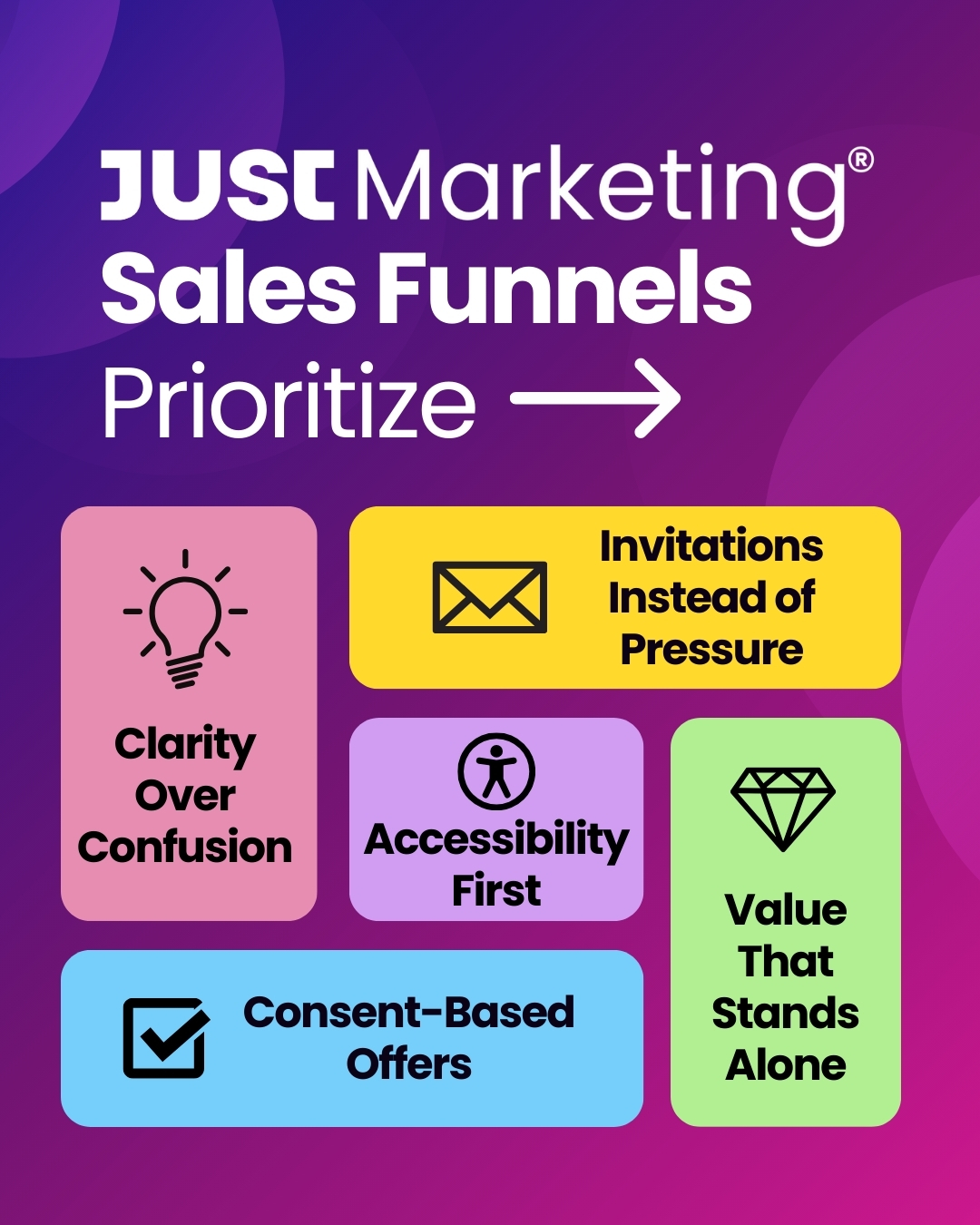
Infographic titled 'Just Marketing® Sales Funnels Prioritize' on a purple gradient background. It highlights five principles with matching icons: Clarity Over Confusion, Invitations Instead of Pressure, Accessibility First, Consent-Based Offers, and Value That Stands Alone.

Let’s look at what ethical sales systems can actually look like in practice:

1. Clarity Over Confusion

Be transparent from the start. Let your people know what’s coming (and what’s not). If you’re offering a follow-up, an upsell, or a nurture sequence, say so before they enter it. Trust grows when there are no surprises.

2. Invitations Instead of Pressure

You don’t need to “convince” people. You need to create space for them to say yes – when and if they’re ready. Use invitational language like:

  • “Want to go deeper?”
  • “If this was helpful, here’s what’s next.”
  • “No rush – this offer will still be here when you are.”

3. Consent-Based Offers

Just because someone grabs your freebie doesn’t mean they’ve consented to a sales sequence. Just because they bought your tripwire doesn’t mean they want a pop-up OTO. Ask for permission, honor their preferences, and make it easy to opt in – or opt out.

4. Accessibility First

Design your funnel with neurodivergent folks in mind. That means:

  • Fewer clicks
  • Minimal cognitive load
  • Clear paths to purchase
  • No “gotchas” or urgency triggers
    This isn’t just ethical – it’s good user experience (and good for conversions).

5. Value That Stands Alone

Whether it's a $7 offer or a “free” resource, let it be enough. Don’t treat it like bait. Build offers that can stand on their own, so that every interaction with your brand builds trust – not dependence.

Ethical funnels aren’t about doing less. They’re about doing it differently – with more intention, more inclusivity, and more respect for the real humans on the other side of the screen.

It’s not just possible – it’s powerful. And yes, it still converts (sometimes even better, because people feel safe to say “yes”).

Let’s Rebuild Funnels That Feel Good

Here’s the truth a lot of marketing “experts” won’t tell you:

  • You don’t have to trick, trap, or pressure people into buying from you.
  • Or, sacrifice your values to be profitable.
  • And you can create a sales experience that supports your people and sustains your business.

And the best part? When your funnel feels good – for you and for your audience – it works better. Because trust is the ultimate conversion strategy.

Let’s reframe what your funnel could be:

  • Not a pushy path, but a supportive journey.
  • Not a game of “gotcha,” but a space for informed, empowered choice.
  • Not a grind for growth, but a system rooted in generosity, accessibility, and real connection.

If you’ve used some of the tactics in this round-up before – no shame. Seriously. Most of us have. You were following advice that’s been recycled for years in online business spaces that rarely center consent, equity, or accessibility.

Now that you know better, you get to do better.

So here’s your permission slip to change your funnel…

  • Delete the countdown timer.
  • Turn that OTO into a kind follow-up email
  • Un-gate that freebie.
  • Rewrite your abandoned cart sequence with empathy.

Because the moment you shift your funnel from “how do I get more sales?” to “how do I build more trust?” – you start creating a business that people actually want to stay connected to.

Marketing That Honors People First

Funnels aren’t the enemy. But the way we’ve been taught to build them? That’s worth a second look.

Because you didn’t start your business to manipulate people into saying “yes.” You started it to help. To serve. To share something meaningful with the world. And that mission deserves a marketing system that reflects your values – not someone else’s sales script.

So if you’ve ever felt gross about your funnel…
If you’ve hesitated to hit “publish” because something didn’t sit right…
Or, if you’ve been quietly wondering, “Is there a better way?”

This is your reminder:

  • Ethical funnels exist.
  • Consent-based marketing works.
  • You don’t have to choose between your integrity and your income.

Let’s build systems that support our people instead of pressuring them.
Create buying journeys that feel good before, during, and after the sale.
And let’s make trust the foundation – not just the byproduct – of how we sell.

Let’s Keep the Conversation Going

What sales tactics have made you cringe?
Which ones are you rethinking – or ready to release altogether?
What would a funnel built with empathy and accessibility look like for your audience?

Let’s talk about it.

Connect with me on LinkedIn or Instagram – I’d love to hear your take.

And if you’re ready to reimagine your funnel in a way that reflects your values and supports your community with care?

Let’s connect. We can build something better – together.

Categories: All Categories, Just Marketing®

Tags: Accessible Marketing, Email Marketing, Ethical Marketing, Inclusive Marketing, Increase Targeted Website Traffic, Lead Generation, Promotional Content, Values-Aligned Promotions

Prev
Next

About Meg Brunson

Online marketing authority and former Facebook employee Meg Brunson combines their mission to build a more accessible and inclusive world, with their expertise in the digital marketing space.

Meg is on a mission to disrupt the status quo of marketing so that financial success is the byproduct of a genuine commitment to justice, rather than an end goal in itself.

Through Meg’s signature approach, Just Marketing®, businesses are implementing ethical, inclusive, and accessible marketing campaigns that make a positive impact on society and their bottom line, creating a virtuous cycle where profitability and responsible practices reinforce each other.

Meg is a professional speaker, children’s book author, host of the Just Marketing® podcasts, CMO of BetterCEO.app and CEO of Just Marketing®.

Follow me on Instagram @theMegBrunson
Love bombing is designed to trigger an emotional r Love bombing is designed to trigger an emotional response. 

It floods your nervous system with validation, and then attaches those feelings to a buying decision. So by the time you're reaching for your wallet, it doesn't feel like pressure… it feels like clarity.
But it's not clarity. 

It's a manufactured moment of emotional intensity.

And for folks who've navigated burnout, rejection sensitivity, or trauma… emotionally manipulative marketing doesn't just feel bad - it can cause real harm by mirroring dynamics they've already had to fight their way out of.

Just Marketing® exists because I believe marketing can be better. 

More actually-kind… not performatively kind.

You deserve marketing that respects your autonomy enough to let you decide if something is a fit -  without being emotionally maneuvered into it.

Read more on the topic: MegBrunson.com/love-bombing

What's your gut reaction to love bombing in marketing? 
I'd love to hear your thoughts in the comments.

ID: 'Love Bombing isn't about seeing someone's potential, it's about using praise to pressure them into action.' The Just Marketing logo appears below the text, displayed inside a white decorative lace doily frame on a pink background patterned with hand-drawn hearts.

#JustMarketing #EquityForAll #MarketingWithHeart #MarketingWithIntegrity #EquityCenteredBusiness #SocialJustice #AlignedBusiness #BeTheChange #DismantleWhiteSupremacy #DiversityEquityInclusion #EthicalMarketing #OnlineBusinessMarketing #EthicalBusiness #OnlineMarketingTips #DEI #ValuesMatter #MarketingWithADHD #adhdBusiness #adhdBusinessOwner #ContentMarketing #ContentMarketingMembership #WeeklySocialContent #a11y #ContentStrategy #InclusiveMarketing #AccessibleMarketing #DEIMarketing #SocialMediaForAll #ContentCreation
Love bombing in marketing isn't always obvious. Love bombing in marketing isn't always obvious. 

It doesn't always look like a pushy sales bro screaming "LIMITED TIME OFFER.” 

Sometimes it shows up softly - wrapped in spiritual language, coated in empowerment rhetoric, or disguised as a coach who really believes in you.

Here's what to watch for:
– Language that tells you who you are rather than inviting you to reflect 
– Compliments that seem designed to make you feel obligated to say yes 
– Praise that shows up right before (or during) a pitch

The goal of ethical, Just Marketing® isn't to strip the warmth out of your messaging. It's to make sure the warmth is real - rooted in genuine care, not conversion tactics.

Your audience can feel the difference. And the ones you actually want to work with? They're looking for someone they can trust - not someone who makes them feel temporarily amazing and then asks for their credit card.

Real connection doesn't need to manufacture emotional dependency. It builds naturally, over time, through honesty and respect. 

Want to understand love bombing in marketing more deeply - including why it's especially problematic for neurodiverse and trauma-impacted communities? 

Read about it: MegBrunson.com/love-bombing

And then come back here and tell me: has any of this show up in marketing you've encountered recently?

ID: 'Love Bombing' is defined through three overlapping hearts labeled 'excessive praise,' 'inflated compliments,' and 'positive attention,' followed by the phrase '...used to create emotional dependency or fast-track trust.' The Just Marketing logo appears at the bottom on a white background scattered with pink hearts.

#JustMarketing #EquityForAll #MarketingWithHeart #MarketingWithIntegrity #EquityCenteredBusiness #DiversityEquityInclusion #EthicalMarketing #OnlineBusinessMarketing #EthicalBusiness #OnlineMarketingTips #DEI #ValuesMatter #MarketingWithADHD #ContentMarketing #ContentMarketingMembership #WeeklySocialContent #a11y #ContentStrategy #InclusiveMarketing #AccessibleMarketing #DEIMarketing #SocialMediaForAll #ContentCreation
You may have heard of “love bombing” in the contex You may have heard of “love bombing” in the context of toxic relationships, but it shows up in marketing too.

Love bombing in marketing is when brands flood you with over-the-top praise, inflated compliments, and feel-good validation... all designed to fast-track your trust and nudge you toward a "yes" before you're actually ready.

It sounds like:
– "You're clearly meant for more - don't waste your potential by saying no."
– "I only work with soul-aligned visionaries, and I just KNOW that's you."
– "You're so ready for the next level. Why wait?"

A lot of marketers aren't doing this on purpose. It gets taught as "high-vibe connection" in traditional sales spaces. But good intentions don't cancel out harmful impact.

And for neurodiverse folks, people navigating burnout, or anyone with a history of emotionally manipulative relationships… This kind of language can be genuinely triggering, not just uncomfortable.

Your audience deserves to feel seen and respected -  not love-bombed into a buying decision.

Read more: MegBrunson.com/love-bombing 

And I want to hear from you: Have you ever noticed love bombing in marketing… either in someone else's content or (no judgment!) in your own?

ID: 'Love Bombing: Over-the-Top Praise Isn't as Kind as It Seems.' A cartoon pink bomb with a red heart and a sparkling lit fuse sits in front of a glowing white heart outline on a pastel pink and purple gradient background with sparkles.

#JustMarketing #EquityForAll #MarketingWithHeart #MarketingWithIntegrity #EquityCenteredBusiness #SocialJustice #AlignedBusiness #BeTheChange #DismantleWhiteSupremacy #DiversityEquityInclusion #EthicalMarketing #OnlineBusinessMarketing #EthicalBusiness #OnlineMarketingTips #DEI #ValuesMatter #MarketingWithADHD #adhdBusiness #adhdBusinessOwner #ContentMarketing #ContentMarketingMembership #WeeklySocialContent #a11y #ContentStrategy #InclusiveMarketing #AccessibleMarketing #DEIMarketing #SocialMediaForAll #ContentCreation
When we talk about the EIEIO Marketing Framework - When we talk about the EIEIO Marketing Framework - a lot of people think Engage and Interact sound like the same thing, but they're not - and understanding the difference can really change how you approach your time on social media.

* Engaging your ideal audience is about showing up for the people you want to serve (your ideal clients).

* Interacting with relevant accounts is about showing up alongside the people who influence, serve, or exist in the same ecosystem as your ideal clients.

When building your interaction list, consider:
-- Complementary service providers who serve the same audience
-- Thought leaders or educators your ideal clients follow and trust
-- Organizations or communities your ideal clients are part of
-- Potential collaborators, podcast hosts, or referral partners
-- Accounts that are already creating content your ideal clients love

When you interact consistently with these accounts - a few things start to happen:
-- Their audience sees your name. Repeatedly. In a positive context.
-- The account owner notices you. Relationships form. Collaborations become possible.
-- You become part of a larger ecosystem, rather than a lone voice posting into the void.

The more genuinely you support others in your ecosystem, the more you become a recognized, trusted presence in the spaces your ideal clients already inhabit. That’s visibility through community. And when we lift each other up, everyone benefits.

Your Challenge This Week:
Identify 3-5 accounts in your ecosystem that you're not currently interacting with regularly. Follow them, and engage with their content authentically. The relationships you build through consistent interaction often turn into collaborations, referrals, and friendships you didn't see coming. Show up with no agenda and see what grows!

Comment or DM:
Has "Interact" been on your radar, or is this a missing piece for you?

ID: Meg is smiling with long pink hair wearing a black tank top with pink lettering reading 'Angry Liberal Feminist Killjoy.' Their arm is covered in colorful tattoos. They accessorize with rainbow bracelets. Trees and urban buildings are visible behind them.
Credentials aren't the villain. I want to be real Credentials aren't the villain.

I want to be really clear about that because this conversation can feel uncomfortable, especially if you've worked hard for your experience, your certifications, and your results.

You should share those things. Your audience deserves to know you know your stuff.

But there's a difference between building genuine credibility and performing authority in a way that manipulates, excludes, or overwhelms the people you're trying to serve.

So let's make it practical. Here's the swap:

1. Instead of leading with extreme, cherry-picked success stories... Try sharing client transformations with honest context -  who it worked for, how, and why.

2. Instead of inflated claims designed to impress... Try transparency about your actual journey, including the learning edges.

3. Instead of hype-heavy messaging that creates urgency and pressure... Try relatable stories that help your audience see themselves in your work.

These aren't just "nicer" ways to market. They're more effective -  because they build the kind of trust that actually converts, without leaving people feeling manipulated or excluded after the fact.

Read more: MegBrunson.com/authority-bias

Which of these three swaps feels most relevant to where you are right now in your marketing?

ID: 'Authority is not the problem... it's how we use it that deserves our attention.' Three pairs of thumbs-down and thumbs-up labels contrast approaches: 'extreme examples of success v. client transformations with context,' 'inflated claims v. transparency about your journey,' and 'hype-heavy messaging v. relatable stories.'

#JustMarketing #EquityForAll #EquityCenteredBusiness #SocialJustice #AlignedBusiness #DiversityEquityInclusion #EthicalMarketing #OnlineBusinessMarketing #EthicalBusiness #OnlineMarketingTips #DEI #MarketingWithADHD #adhdBusiness #adhdBusinessOwner #ContentMarketing #ContentMarketingMembership #WeeklySocialContent #a11y #ContentStrategy #InclusiveMarketing #AccessibleMarketing #SocialMediaForAll #ContentCreation
Growth doesn't have to come at the cost of your me Growth doesn't have to come at the cost of your mental health or your bandwidth. 

The right marketing support should help you expand your capacity, not drain it.

If you're ready for results that feel good and work well, I'd love to connect. 

Comment, DM, or learn more at YourMarketingPerson.co

ID: A testimonial from Michelle T. reads: 'Bringing Meg on was one of the best decisions I made... I doubled my group class offerings and increased demand for 1:1 sessions, while feeling less overwhelmed by marketing.' Michelle is smiling and kneeling outdoors with three dogs beside her. YourMarketingPerson.co

 #JustMarketing #EquityForAll #a11y #EquityCenteredBusiness #DiversityInMarketing #SocialJustice #RacialJustice #BeTheChange #DismantleWhiteSupremacy #DiversityEquityInclusion #EthicalMarketing #InclusiveMarketing #AccessibleMarketing #MarketingAccessibility #SocialMediaMarketer #EthicalBusiness #MarketingCoach #CommunityOverCompetition #MarketingWithPurpose #MarketingWithImpact #DEI #DEIMarketing #SocialMediaForAll #ContentCreation #ContentMarketing #ContentMarketingMembership #WeeklySocialContent  #MarketingWithADHD #adhdBusiness #adhdBusinessOwner
Name-dropping. Revenue flexing. Credential overloa Name-dropping.
Revenue flexing.
Credential overloading.

We've been taught this is what authority looks like… But a lot of it is just authority bias - a psychological shortcut that nudges people to trust you before you've actually earned it.

And when those signals are inflated or inaccessible? 

It's not just manipulative. It quietly tells entire communities of entrepreneurs that their expertise doesn't count.

Prestigious degrees, elite networks, and revenue milestones aren't equally accessible to everyone. 

Neurodivergent entrepreneurs, BIPOC business owners, disabled creatives -  many hold deep, hard-earned expertise that simply doesn't look flashy on a bio. 

When we only recognize authority in one narrow, traditional form, we're quietly telling everyone else their experience doesn't count.

It does. 

I’m unpacking how authority bias shows up in marketing -  and what the Just Marketing® alternative looks like on the blog…

Check it out and let me know what resonates: MegBrunson.com/authority-bias

Which of these four tactics bothers you the most when you see it in someone's marketing?

ID: 'Authority Bias: A psychological shortcut that makes people more likely to believe or buy from someone who seems like an expert.' Four items follow: 'Name-dropping big brands,' 'Overloading bios with degrees, certifications, or awards,' 'Highlighting revenue milestones,' and 'Sharing cherry-picked client wins.' The Just Marketing logo appears on a pink to purple gradient background.

#JustMarketing #EquityForAll #MarketingWithHeart #MarketingWithIntegrity #EquityCenteredBusiness #SocialJustice #AlignedBusiness #BeTheChange #DismantleWhiteSupremacy #DiversityEquityInclusion #EthicalMarketing #OnlineBusinessMarketing #EthicalBusiness #OnlineMarketingTips #DEI #ValuesMatter #MarketingWithADHD #adhdBusiness #adhdBusinessOwner #ContentMarketing #ContentMarketingMembership #WeeklySocialContent #a11y #ContentStrategy #InclusiveMarketing #AccessibleMarketing #DEIMarketing #SocialMediaForAll #ContentCreation
If you’re building a business while also unlearnin If you’re building a business while also unlearning perfectionism, healing from burnout, or navigating a neurodivergent brain - this is your reminder:

~ Rest is not failure.
~ Pausing is not quitting.
~ You are still making progress, even when you slow down.

Just Marketing® isn’t about pushing through at all costs.

It’s about creating systems that work with your energy, your values, and your capacity.

So if you’re tired today, rest. 
The work will still be here. 
And so will your impact.

ID: Text over an image of a rumpled bed with pillows, tinted with a pink and purple gradient. The text reads: ‘she believed she could, but she was tired, so she rested. ...and you know what? the world went on and it was okay. she will try again tomorrow.'

 #JustMarketing #EquityForAll #a11y #EquityCenteredBusiness #DiversityInMarketing #SocialJustice #RacialJustice #BeTheChange #DismantleWhiteSupremacy #DiversityEquityInclusion #EthicalMarketing #InclusiveMarkeitng #AccessibleMarketing #MarketingAccessibility #SocialMediaMarketer #EthicalBusiness #MarketingCoach #CommunityOverCompetition #MarketingWithPurpose #MarketingWithImpact #DEI #DEIMarketing #SocialMediaForAll #ContentCreation #ContentMarketing #ContentMarketingMembership #WeeklySocialContent  #MarketingWithADHD #adhdBusiness #adhdBusinessOwner
Let's talk about the flex. "Harvard-trained." "6- Let's talk about the flex.

"Harvard-trained."
"6-figure coach."
"#1 expert in [XYZ]."

We've all seen it. Heck, some of us have written it - because that's what we were told authority looks like.

But there's a fine line between establishing credibility and exploiting a psychological shortcut to manufacture trust.

That shortcut is called authority bias - and it's one of the most common (and sneaky) tactics in conventional marketing.

Authority bias is our brain's tendency to believe or buy from someone who seems like an expert. And when marketers weaponize that tendency with inflated credentials, cherry-picked wins, or strategically vague name-drops, it stops being influence and starts being manipulation.

When authority is only modeled one way (polished, credentialed, neurotypical, certain), a whole lot of people start to wonder if they even belong in the room.

They do.
You do.

So what does the Just Marketing® alternative look like?
– It means leading with trust over ego. 
– Showing your work instead of shouting your accolades. 
– Being transparent about your journey, your limitations, and the actual humans behind the results you're sharing.

Real authority doesn't need smoke and mirrors. It's built on connection, clarity, and mutual respect.

Read more about what authority bias looks like in practice, why it can be harmful, and how to build genuine credibility without the hype: MegBrunson.com/authority-bias 

And tell me, have you ever felt pressure to puff up your bio or drop a humblebrag just to feel "legit"? 

I know I have!

ID: 'Authority Bias: Establishing Credibility? Or, Manipulating Trust?' Two purple award ribbons are shown side by side -  one with a green checkmark and one with a pink question mark -  on a soft purple gradient background with a rounded purple border.

#JustMarketing #EquityForAll #EquityCenteredBusiness #DiversityEquityInclusion #EthicalMarketing #EthicalBusiness #OnlineMarketingTips #DEI #MarketingWithADHD #ContentMarketingMembership #WeeklySocialContent #a11y #ContentStrategy #InclusiveMarketing #AccessibleMarketing
Most of us have been conditioned to think of engag Most of us have been conditioned to think of engagement as something that happens to our content. Likes, comments, shares - the numbers that tell us whether our post "worked."

But engagement isn't a metric… It's a practice.

Mission-driven entrepreneurs are often really good at creating content, and not as intentional about what happens after we hit post. We move on to the next thing. We're already thinking about next week's email or tomorrow's caption.

But every time someone takes the time to interact with your content or reach out to you directly, they're raising their hand. They're saying "I see you. I'm interested. I'm paying attention."

How you respond - or whether you respond at all - sends a message right back.

From a Just Marketing perspective, engaging your ideal audience is about treating every interaction as a relationship, not a transaction. The person who left a comment today might not be ready to hire you for six months. But if you showed up consistently, warmly, and genuinely in the meantime… You'll be the first person they think of when they are ready.

In practice, engaging your ideal audience looks like:
-- Replying to every comment with something more than an emoji 
-- Responding to DMs promptly and personally
-- Acknowledging shares, tags, and mentions with genuine gratitude
-- Creating content that ends with a question you actually want the answer to
-- Circling back to people you've had great conversations with, just to stay connected

Your challenge this week: 
Audit your last few posts. Did you reply to every comment? Did any DMs go unanswered? Start there - catch up on what's already waiting for you… and next time someone comments on one of your posts, don't just heart it. Reply with something real. Ask a question. Make them feel seen.

Comment or DM:
What does engagement feel like in your business right now - something you're on top of, or something that tends to slip through the cracks?

ID: Meg is smiling, wearing a blue t-shirt, 'My Vibe Isn't For Everyone, And That's The Point.' 

#JustMarketing #EthicalMarketing #InclusiveMarketing #AccessibleMarketing
Swapping exclusivity pressure for something better Swapping exclusivity pressure for something better doesn't mean being vague... It means being intentional... This is the part people get nervous about.

"But if I don't use that language… won't I attract the wrong clients?"

Totally valid concern.
And also - no. You won't.

What exclusivity pressure actually filters for is people who respond to shame-based urgency. And if that's not the transformation you're selling… that's probably not who you want in your corner anyway.

You can be crystal clear about who your offer is for, set real expectations, and attract deeply aligned clients - without making anyone feel like they have to audition.

It comes down to four simple shifts:

1. Shift from exclusion to alignment.
Describe who your offer is designed for, not who isn't allowed in.

2. Be transparent, not judgmental.
Set honest expectations about time, energy, and pace without implying there's only one "right" way to show up.

3. Create filters without shame.
Think values-aligned checkpoints, not velvet ropes. FAQs, quizzes, and "who this is for" sections can do this beautifully.

4. Make inclusive language swaps.
Small word changes create big shifts in who feels safe enough to say yes.

None of this is about being all things to all people. It's about being the right thing to the right people - without leaving a trail of harm on the way there.

The blog has a before/after copy breakdown you can actually use. Check it out: MegBrunson.com/exclusivity-pressure

Which of these four shifts feels most doable for you right now?
Which are you still wrestling with?

ID: 'Exclusivity Pressure' with a strikethrough, followed by 'Swap Pressure for Permission.' Four arrow-shaped banners: 1) 'Shift from Exclusion to Alignment', 2) 'Be Transparent, Not Judgmental', 3) 'Create Filters Without Shame', and 4) 'Make Inclusive Language Swaps'.

#JustMarketing #EquityForAll #EquityCenteredBusiness #EthicalMarketing #EthicalBusiness #DEI #MarketingWithADHD  #ContentMarketing #ContentMarketingMembership #WeeklySocialContent #a11y #InclusiveMarketing #AccessibleMarketing
The weight of doing it all alone? We don't do that The weight of doing it all alone?
We don't do that here.

Kim came in juggling her marketing AND her operations, and left feeling like she finally had a real partner in her corner.

That's the goal. 
Every. Single. Time.

If you're tired of carrying your marketing solo, let's talk… in the comments, DMs, or at YourMarketingPerson.co 

ID: A testimonial from Kim F. reads: 'Meg has been an absolute game-changer for my marketing and operations... like a weight has been lifted from my shoulders... Her expertise is incredible and I trust her implicitly. I couldn't ask for a better partner in this work!' Kim is smiling in the background. YourMarketingPerson.co

#JustMarketing #EquityForAll #a11y #EquityCenteredBusiness #DiversityInMarketing #SocialJustice #RacialJustice #BeTheChange #DismantleWhiteSupremacy #DiversityEquityInclusion #EthicalMarketing #InclusiveMarketing #AccessibleMarketing #MarketingAccessibility #SocialMediaMarketer #EthicalBusiness #MarketingCoach #CommunityOverCompetition #MarketingWithPurpose #MarketingWithImpact #DEI #DEIMarketing #SocialMediaForAll #ContentCreation #ContentMarketing #ContentMarketingMembership #WeeklySocialContent  #MarketingWithADHD #adhdBusiness #adhdBusinessOwner
Follow on Instagram


Links

CMM Log In
Mission, Vision, & Values

DEI Statement
Leadership Philosophy
Community Agreements
Press & Media


Beliefs

Black lives matter.
Love is love.
Abortion is healthcare.
No human is illegal.
Free Palestine.
I also Believe…

Circular badge has the name "Meg" in the middle and is surrounded by: "CEO, author, speaker, marketer, leader, & advocate"

Let’s Connect

  • facebook-official
  • instagram
  • bluesky
  • linkedin
  • youtube-play
  • email
Copyright © 2026|All Rights Reserved|Meg Brunson, LLC| Privacy & Terms