Meg Brunson

  • Let’s GoHome
  • #AllTheThingsAbout Me
  • Read | Listen | WatchContent Library
  • Join TheMembership
  • Let’s WorkTogether

Tracking Your Marketing Data – Without Overwhelm – and Adjusting Strategies as Needed

Does the thought of tracking your marketing efforts send you into a spreadsheet spiral? For many mission-driven entrepreneurs, the idea of analyzing metrics feels overwhelming – especially when you’re juggling everything else on your plate. But here’s the thing: tracking your marketing data doesn’t have to be stressful or time-consuming…and, it can be a game-changer for your business.

When you know what’s working (and what’s not), you can make smarter decisions, save time, and ensure your marketing strategies align with your values and are profitable. It’s not about chasing vanity metrics or perfection – it’s about finding clarity and using that insight to grow your business authentically.

In this post, I’ll show you how to track your marketing data in a way that’s simple, ADHD-friendly, and designed to keep overwhelm at bay. You’ll also learn how to adjust your strategies with confidence, so you’re always moving toward your goals without getting stuck in the weeds.

Illustration of two people sitting at a desk, smiling and working on a laptop, with a coffee mug and a small plant beside them. Surrounding them are icons of charts, graphs, a target, and a megaphone. Text: ‘Tracking Your Marketing Data Without Overwhelm – and Adjusting Strategies as Needed.’ The Just Marketing logo appears at the bottom right on a purple gradient background.

Identifying Key Metrics That Matter (and Ditching the Rest)

When it comes to tracking your marketing success, less is more. Instead of drowning in a sea of stats, focus on a few key metrics that align with your goals. The right data can give you clarity and direction without adding to your overwhelm.
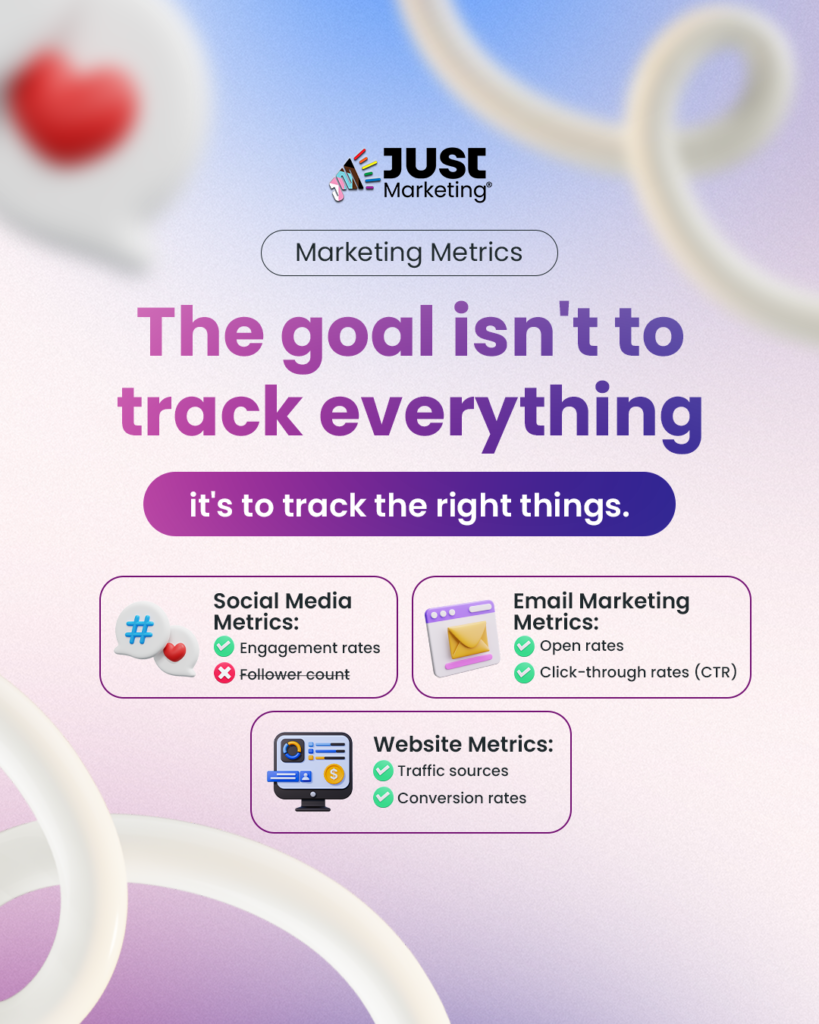
Infographic titled ‘Marketing Metrics.’ Text: ‘The goal isn't to track everything, it's to track the right things.’ Key metrics: Social Media Metrics (engagement rates, not follower count), Email Marketing Metrics (open rates, click-through rates), and Website Metrics (traffic sources, conversion rates). Background features a soft pink and blue gradient with abstract curved shapes.

Focus on the Marketing Data that Matters Most

Here are some examples of high-impact metrics to track, based on common marketing goals:

  • Social Media: Engagement rates (likes, comments, shares, saves) over follower count. Why? Because engagement shows genuine interest and connection, while follower count is often just a vanity metric.
  • Email Marketing: Open rates and click-through rates (CTR). These metrics reveal how effectively your emails are reaching and resonating with your audience.
  • Website: Traffic sources (where your visitors are coming from) and conversion rates (how many people are taking action, like signing up for your email list). This data can help you fine-tune your content and marketing channels.

Simplify Your Marketing Data Dashboard

The goal isn’t to track everything – it’s to track the right things. Ask yourself:

  • What’s the purpose of this channel or campaign?
  • What actions do I want my audience to take?
  • Which data points show me if I’m on track?

For example, if your goal is to grow your email list, tracking social media shares or impressions isn’t as helpful as monitoring how many people actually clicked through to your sign-up page.

Quality Over Quantity

Here’s the big takeaway: It’s better to have 100 engaged followers than 1,000 who scroll past your content. Meaningful engagement – whether it’s a thoughtful comment, a reply to your email, or a referral – is a more valuable indicator of success than sheer numbers.

By narrowing your focus to a few key metrics, you can get actionable insights without feeling buried under data. 


Tools and Systems That Keep Marketing Data Manageable

Tracking your marketing success doesn’t have to involve complicated spreadsheets or hours of analysis. With the right tools and systems, you can gather the insights you need quickly and without overwhelm. Here are some simple, ADHD-friendly ways to keep your marketing data organized and actionable.

Beginner-Friendly Tools to Get You Started

You don’t need fancy software to start tracking effectively. Here are a few user-friendly options that do the heavy lifting for you:

  • Google Analytics: A free tool to track website traffic, sources, and behavior. Use it to see which pages are getting the most attention and where your visitors are coming from.
  • Social Media Analytics: Most platforms (like Instagram, Facebook, and LinkedIn) have built-in insights. Focus on engagement metrics like comments, saves, and shares.
  • Email Marketing Platforms: Tools like Mailchimp, ConvertKit, or FGFunnels offer reports on open rates, click-through rates, and subscriber growth.
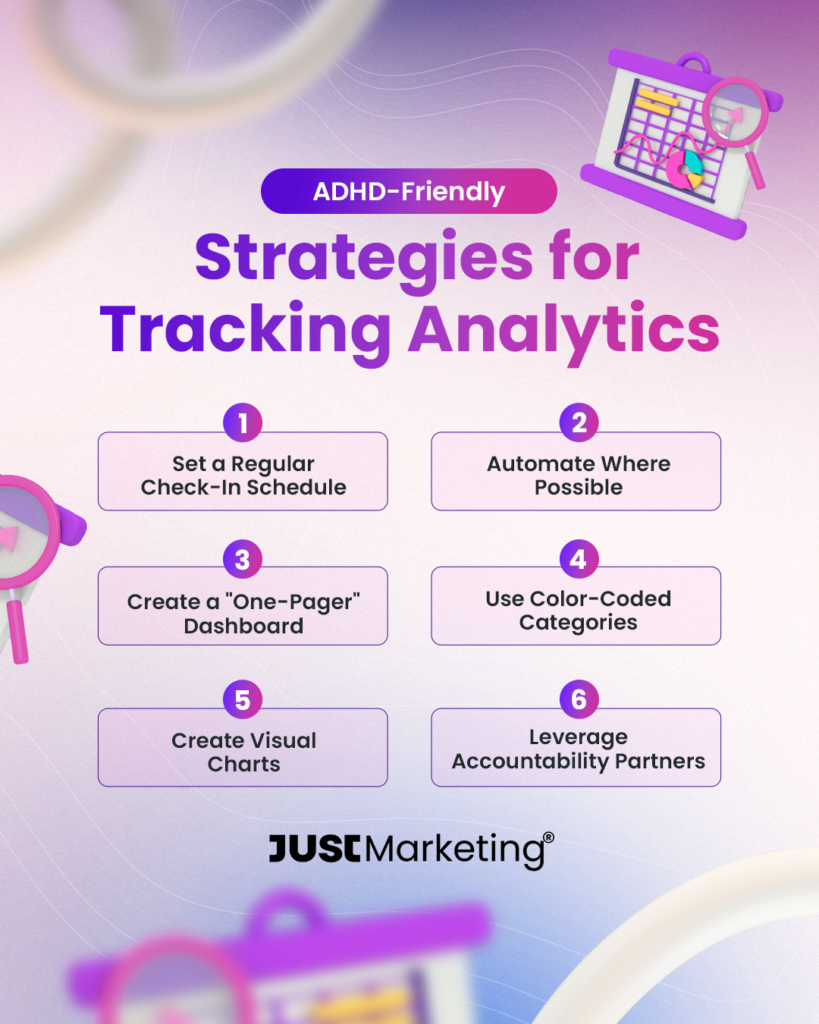
Infographic titled ‘ADHD-Friendly Strategies for Tracking Analytics.’ Six tips are listed: 1) Set a Regular Check-In Schedule, 2) Automate Where Possible, 3) Create a ‘One-Pager’ Dashboard, 4) Use Color-Coded Categories, 5) Create Visual Charts, and 6) Leverage Accountability Partners. Background has a soft pink and purple gradient with magnifying glass and chart illustrations.

Overwhelm-Free Tips for Managing Marketing Data

Tracking doesn’t have to feel like a chore. These ADHD- and overwhelm-friendly strategies can help you stay on top of your numbers:

  • Set a Regular Check-In Schedule: Block 30 minutes once a month to review your key metrics. Keep it consistent and short to avoid overthinking.
  • Automate Where Possible: Many tools let you schedule reports to be sent directly to your inbox. Set it and forget it!
  • Create a “One-Pager” Dashboard: Use a simple spreadsheet or document to record only the most important stats for each month. Seeing everything in one place keeps it manageable and helps you notice trends.

ADHD-Friendly Systems to Stay Consistent

Staying consistent is the key to making tracking work for you. Try these systems:

  • Color-Coded Categories: Use colors to mark priority metrics so you can quickly identify the data that matters most.
  • Visual Charts: Tools like Canva or Excel can help you create simple bar or pie charts to visualize trends at a glance.
  • Accountability Partners: Share your tracking routine with a friend, team member, or coach to keep yourself on track without the added pressure of doing it alone.

By using tools and systems that fit your workflow, you’ll make tracking your marketing success not only easier but also more effective. Once you have the data, it’s time to analyze and adjust your strategies – and we’ll tackle that next.


Analyzing and Adjusting Strategies with a Growth Mindset

Now that you’ve got your marketing data organized, it’s time to use it. The magic of tracking isn’t just in collecting numbers – it’s in using them to make informed adjustments that align with your goals. Let’s break this process down so it feels doable and empowering, not overwhelming.
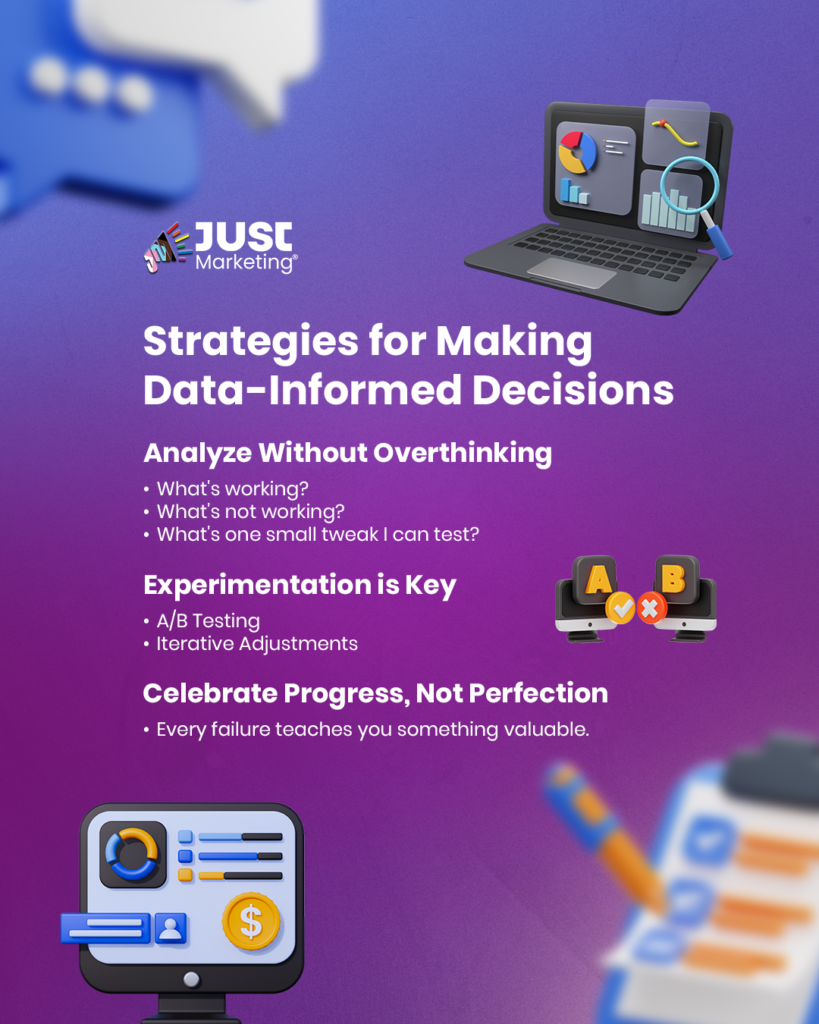
Infographic titled ‘Strategies for Making Data-Informed Decisions.’ Key points: Analyze Without Overthinking (identify what's working, what's not, and test small tweaks), Experimentation is Key (A/B testing, iterative adjustments), and Celebrate Progress, Not Perfection (learn from failures). Background features a purple gradient with laptop, chart, and computer illustrations.

Analyze Marketing Data Without Overthinking

Tracking trends is more important than obsessing over every little spike or dip in your numbers. Ask yourself these questions to spot meaningful patterns:

  • Did certain content (like a blog post or social media reel) perform better than others?
  • Are you seeing steady growth in engagement, even if it’s slow?
  • Are there consistent dips that might signal a need for change?

Look for big-picture insights instead of stressing over the details. For instance, if your Instagram saves are up, it could mean your audience loves the actionable tips you’ve been sharing recently – so create more of that content!

Questions to Guide Your Adjustments

When tweaking your strategy, keep it simple. Use these guiding questions:

  • What’s working? Identify successful content, formats, or channels and consider doubling down on them.
  • What’s not working? If something isn’t resonating, it’s okay to let it go or experiment with a different approach.
  • What’s one small tweak I can test? For example, try posting at a new time, experimenting with a different headline style, or creating a new type of call-to-action (CTA).

Experimentation is Key

Marketing success rarely comes from doing the same thing over and over – it’s about testing and learning.

  • A/B Testing: Compare two variations of a single element (like email subject lines) to see which performs better.
  • Iterative Adjustments: Make small, incremental changes to your strategies instead of a complete overhaul.
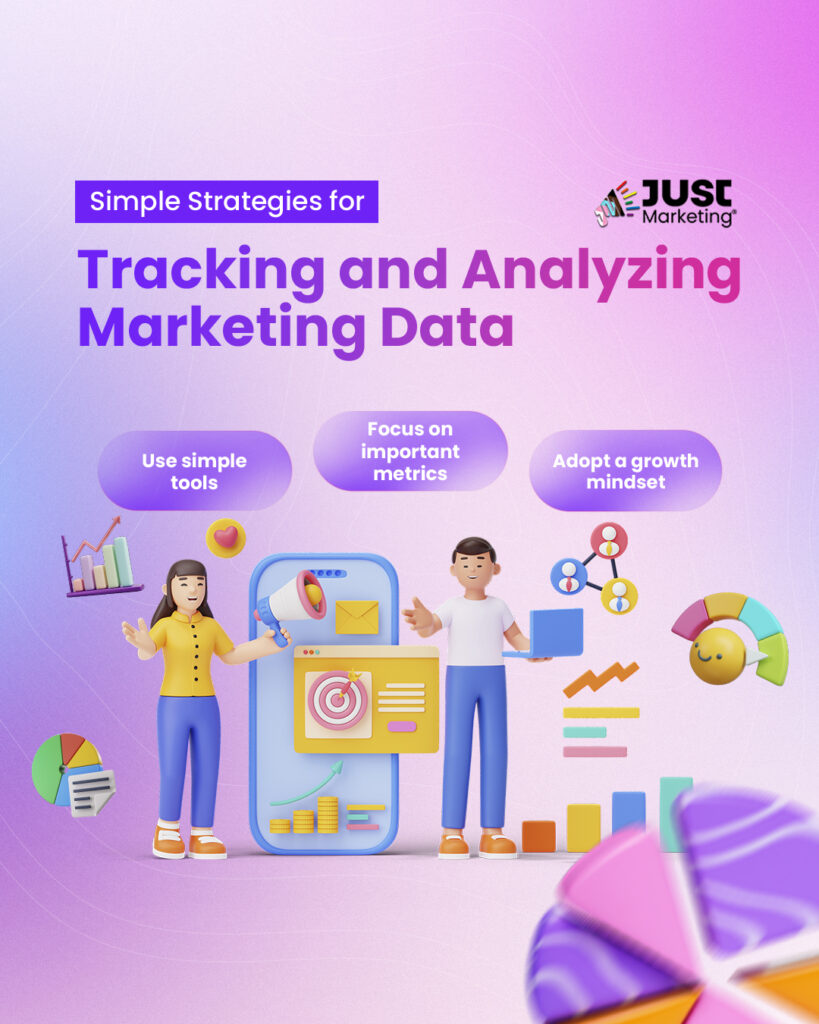
Infographic titled ‘Simple Strategies for Tracking and Analyzing Marketing Data.’ Three tips are highlighted: ‘Use simple tools, Focus on important metrics, and Adopt a growth mindset.’ At the bottom, two illustrated characters stand beside charts, graphs, and a giant smartphone displaying marketing icons. Background features a pink and purple gradient with abstract data visuals.

Give It Time

Allow enough time to gather meaningful data before deciding if a change works. The timeline for testing depends on a few key factors:

  1. Your Audience Size:
    • If your audience is small, you’ll need more time to collect enough data to see a clear pattern. For example, a small email list or niche social media following might require 2-3 months of consistent effort to show trends.
  2. The Type of Strategy You’re Testing:
    • Short-term experiments: Things like testing email subject lines, social media post formats, or posting times can often show results in 2-4 weeks.
    • Longer-term strategies: Larger changes, like introducing a new content pillar or optimizing for SEO, may take 2-3 months or more to reflect in metrics like website traffic or conversions.
  3. Your Goals:
    • If your goal is brand awareness, it might take longer to see significant shifts in reach or impressions.
    • For actions like sign-ups or purchases, trends may emerge more quickly.

Here’s a simple rule of thumb:

  • For smaller changes (like tweaking CTAs or testing headlines), review results after a few weeks.
  • For broader initiatives (like a new email series or blog strategy), give it at least 2-3 months to gather enough data.

Celebrate Progress, Not Perfection

Every experiment, whether it succeeds or fails, teaches you something valuable about your audience. Shift your mindset to view adjustments as opportunities for growth rather than judgments of your skills. Progress, even if it’s small, is worth celebrating.

By adopting a growth mindset and making data-informed adjustments, you’ll keep your marketing strategies fresh, effective, and aligned with your goals.


Staying Consistent Without Burnout

Consistency is key to building a successful marketing strategy, but it can also be one of the biggest challenges – especially if you’re juggling multiple responsibilities or navigating overwhelm. The good news? You don’t have to sacrifice your sanity to show up consistently. Here’s how to create sustainable habits that work for you.

Set Realistic Goals for Tracking and Reviewing Your Marketing Data
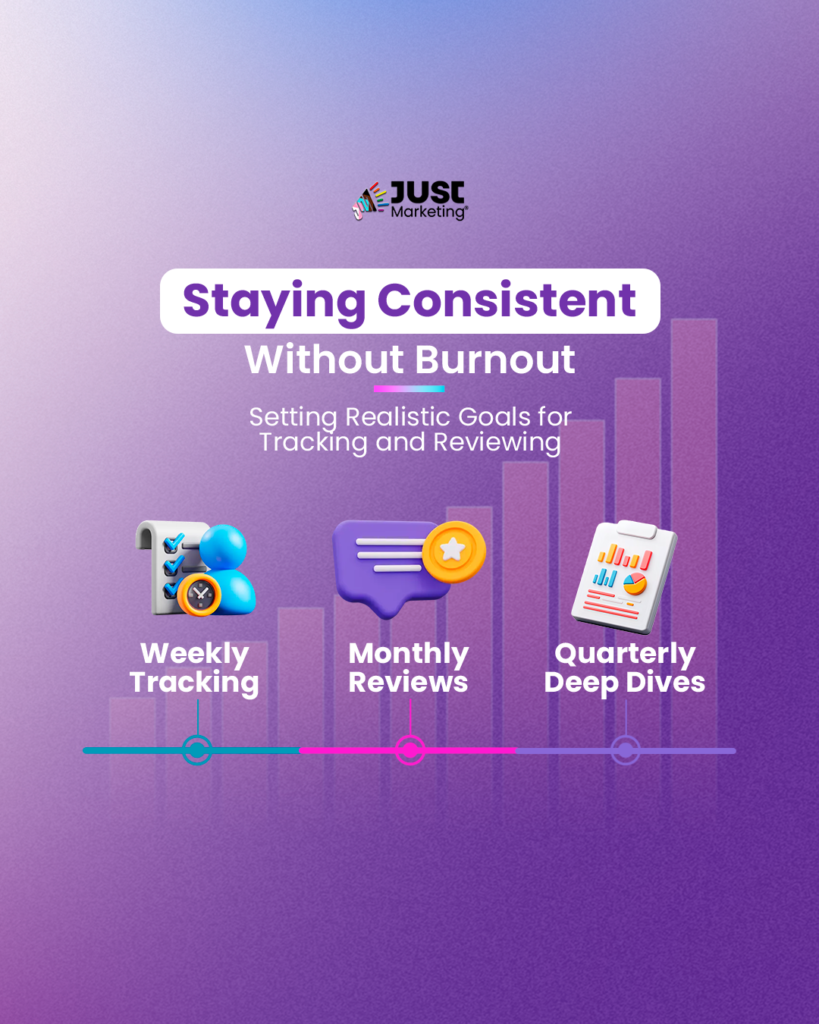
Infographic titled ‘Staying Consistent Without Burnout.’ Subtitle reads ‘Setting Realistic Goals for Tracking and Reviewing.’ Three sections are shown: ‘Weekly Tracking, Monthly Reviews, and Quarterly Deep Dives,’ each with corresponding icons. Background features a purple gradient with a subtle bar chart graphic.

One of the biggest causes of burnout is trying to do too much, too fast. Instead of aiming to track every metric all the time, prioritize what’s manageable.

  • Weekly Tracking: Checking in on metrics weekly ensures you stay on track, but commit to making major assessments or pivots only once a month or quarterly. This prevents premature changes based on short-term fluctuations.
  • Monthly Reviews: For most small businesses, a monthly check-in on key metrics is enough to notice trends and make adjustments.
  • Quarterly Deep Dives: Every 3 months, take a closer look at your overall progress and long-term goals.

By spacing out your tracking and review sessions, you can stay consistent without feeling like you’re constantly crunching numbers.

Automate and Delegate Where Possible

You don’t have to do it all yourself. Leverage tools and resources to make tracking easier:

  • Automation Tools: Schedule reports from tools like Google Analytics, your email platform, or social media insights to be delivered directly to your inbox.
  • Outsourcing: If tracking feels like a major time-suck, consider delegating it to a virtual assistant or marketing specialist who can provide you with a simple summary.

Create a Marketing Data Tracking Routine You Enjoy

Turn your tracking sessions into a habit that feels rewarding:

  • Time-Block It: Set aside 30 minutes on the same day each month to review your marketing data.
  • Add a Reward: Pair your review session with something you enjoy – like your favorite coffee or a celebratory playlist.
  • Keep It Quick: Focus only on your top metrics to avoid falling into a rabbit hole of unnecessary data.

Celebrate Wins, Big and Small

Tracking often highlights areas for improvement, but don’t forget to celebrate what’s going well. Whether it’s a bump in engagement or hitting your first 100 email subscribers, take a moment to recognize your progress. Celebrating wins keeps you motivated and focused on the positive.

Embrace Flexibility
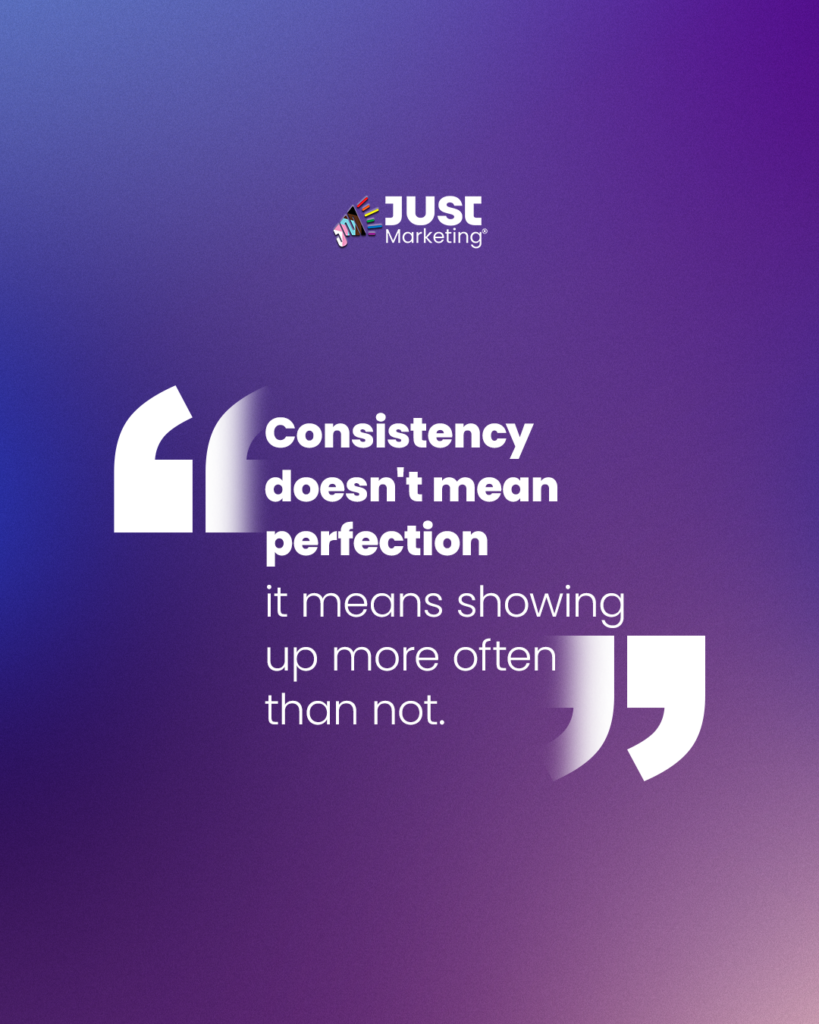
Purple gradient background displaying a large quotation mark design and text: ‘Consistency doesn't mean perfection, it means showing up more often than not.’ The Just Marketing logo appears at the top.

Remember, life happens. If you miss a tracking session or fall behind, don’t stress. Consistency doesn’t mean perfection – it means showing up more often than not. Give yourself permission to adjust your routines as needed.

By creating a sustainable system for tracking and celebrating your progress, you’ll stay consistent and energized, making it easier to keep moving toward your goals.

With these strategies, tracking your marketing success becomes a manageable and even rewarding part of your routine. You’ve got this!


Next Steps

Tracking your marketing data doesn’t have to feel overwhelming or complicated. By focusing on the metrics that matter most, using simple tools and systems, and approaching adjustments with a growth mindset, you can confidently keep your strategies on track.

Remember, progress is the goal – not perfection. It’s okay to experiment, make small tweaks, and learn as you go. Celebrate your wins, big and small, and give yourself grace when things don’t go as planned. The key is staying consistent in a way that works for you, without burning out.

Now it’s your turn: Take a deep breath and pick one simple step to get started. Maybe it’s setting up a dashboard, reviewing last month’s results, or scheduling a time to dive into your metrics. Whatever it is, you’ve got the tools – and the heart – to make it happen.

If you’re ready for more ADHD-friendly and justice-centered marketing advice, sign up for my newsletter or follow me on Facebook, Instagram, LinkedIn, or BlueSky!

I look forward to connecting with you!

Categories: All Categories, Content Marketing, Marketing with ADHD

Tags: Avoiding Burnout, Blogging Strategy, Email Marketing, Increase Brand Awareness, Increase Engagement, Increase Targeted Website Traffic, Lead Generation, Marketing Productivity, Overcome Marketing Overwhelm, Simplified Marketing Systems, Social Media Strategy, Time Management

Prev
Next

About Meg Brunson

Online marketing authority and former Facebook employee Meg Brunson combines their mission to build a more accessible and inclusive world, with their expertise in the digital marketing space.

Meg is on a mission to disrupt the status quo of marketing so that financial success is the byproduct of a genuine commitment to justice, rather than an end goal in itself.

Through Meg’s signature approach, Just Marketing®, businesses are implementing ethical, inclusive, and accessible marketing campaigns that make a positive impact on society and their bottom line, creating a virtuous cycle where profitability and responsible practices reinforce each other.

Meg is a professional speaker, children’s book author, host of the Just Marketing® podcasts, CMO of BetterCEO.app and CEO of Just Marketing®.

Follow me on Instagram @theMegBrunson
Recycling is about sustainability - and that appli Recycling is about sustainability - and that applies to your content, too.

You do not need to start from scratch every time you post.

In fact, you shouldn’t.

Reusing and repurposing content is:
– ADHD-friendly
– More sustainable
– Smarter strategy

That blog post you wrote last month?
– Turn it into a Reel
– Break it into carousels
– Use it to spark a new email

Your ideas are valuable.
Let’s make the most of them.

The Content Marketing Membership is here to help you recycle and repurpose with ease - so your content works harder without you working more.

Learn more: ContentMarketingMembership.com 

ID: Background is pink with the word 'Recycling' repeated in a vertical pattern. The symbol for recycling - three arrows pointing to form a triangle - are in shades of green and you can see the world reflected in them. Text reads, ‘Good for the planet. Good for your content.’

 #JustMarketing #EquityForAll #a11y #EquityCenteredBusiness #DiversityInMarketing #SocialJustice #RacialJustice #BeTheChange #DismantleWhiteSupremacy #DiversityEquityInclusion #EthicalMarketing #InclusiveMarkeitng #AccessibleMarketing #MarketingAccessibility #SocialMediaMarketer #EthicalBusiness #MarketingCoach #CommunityOverCompetition #MarketingWithPurpose #MarketingWithImpact #DEI #DEIMarketing #SocialMediaForAll #ContentCreation #ContentMarketing #ContentMarketingMembership #WeeklySocialContent  #MarketingWithADHD #adhdBusiness #adhdBusinessOwner
Heading tags (H1 through H6) do way more than chan Heading tags (H1 through H6) do way more than change font size.

They build the foundation of your content.

Think of them like stacking blocks - each level (H1, H2, H3…) adds clarity, depth, and organization. 

And that structure matters for everyone who interacts with your content:

– Search engines use them to understand and rank your page
– Screen readers use them to help users navigate without frustration
– Neurodivergent folks use them to scan and focus without overwhelm

Headings are a strategic tool for creating inclusive, ethical, and effective websites.

Whether you’re building your first blog or reworking an existing site, it’s time to use heading tags with intention.

Want the full breakdown of what each tag does, and how to use them right?

Read the blog: MegBrunson.com/heading-tags

Let me know what questions you have about headings!

ID: Text: ‘Heading tags are not just formatting tools. They’re structure tools… for SEO, for Accessibility, for User Experience.’ Three stacked 3D blocks in pink, blue, and purple appear on the left, representing layered structure. A pink-to-purple gradient background. 

 #JustMarketing #EquityForAll #BossMom #MomBoss #EquityCenteredBusiness #SocialJustice #RacialJustice #BeTheChange #DismantleWhiteSupremacy #DiversityEquityInclusion #EthicalMarketing #OnlineBusinessMarketing #EthicalBusiness #OnlineMarketingTips #DEI #ValuesMatter #MarketingWithADHD #adhdBusiness #adhdBusinessOwner #ContentMarketing #ContentMarketingMembership #WeeklySocialContent #a11y #DiversityInMarketing #InclusiveMarketing #AccessibleMarketing #DEIMarketing #SocialMediaForAll #ContentCreation
Every June, my feed floods with rainbow logos and Every June, my feed floods with rainbow logos and brands saying, “Love is love!” Come July? The rainbows vanish.

I know it’s not always intentional... but it does feel performative.

A lot of entrepreneurs want to show up for causes and communities they care about, but don’t always know how to do it thoughtfully.

I’ve seen folks:
~ Acknowledge a cultural or religious holiday with a confusing caption
~ Announce a sale (or event) on a sacred or solemn day
~ Copy what everyone else is doing, hoping it lands

Most of the time, it’s not coming from a bad place.
It’s overwhelm. It’s lack of context. It’s not having the right info at your fingertips.

But I know that’s not your vibe.
You want to be intentional. Inclusive. Thoughtful.
Even if you’re tired. Or busy. Or struggling to be consistent.

That’s exactly why I created the Inclusive Holiday Content Bundle: CelebrateOnSocial.com

If you’re looking for an easy way to plan inclusive, values-aligned content in 2026 (and finish 2025 strong)… check out the Inclusive Holiday Content Bundle:

~ 470+ holidays from a wide range of cultures, communities, and causes.
~ Canva templates and Alt Text for each holiday.
~ Holiday descriptions, marketing tips, content ideas, and red flags to watch out for.

It’s a one-time investment of $40, and you’ll get immediate access to the 2026 Content.

Plus, the 2025 holiday content is still available to finish the year strong.

And you'll get lifetime access!
(for as long as I offer it - I’ve been showing up since 2022, and I’m not going anywhere soon)

Learn More: CelebrateOnSocial.com

And let me know if you have any questions!

ID = I'm smiling at a Pride event. I have long pink hair, 'progressive prided' rainbow glasses, and am wearing a light pink shirt that reads 'Erase Transphobia' inside a cartoon-style eraser graphic. Blurred crowd and tents in background.

#JustMarketing #EquityForAll #a11y #SocialJustice #RacialJustice #DismantleWhiteSupremacy #DiversityEquityInclusion #EthicalMarketing #InclusiveMarketing #AccessibleMarketing #DEI #SocialMediaForAll #ContentMarketingMembership #WeeklySocialContent  #MarketingWithADHD
"How to Use Heading Tags" isn't just a web dev les "How to Use Heading Tags" isn't just a web dev lesson; it's a visibility and accessibility game-changer.

When I built my first website, I thought heading tags (H1, H2, H3…) were just style choices. A shortcut to make things bold, big, and pretty with different fonts.

But spoiler alert: they’re not. 

Heading tags are structure tools, not just formatting tools.
They’re how your content tells a story - to your readers, to search engines like Google, and to assistive tech like screen readers.

Imagine visiting a site with no titles, no subheadings, just… walls of text.
No thanks, right?

When used correctly, heading tags:

– Boost your SEO by showing Google what your page is really about
– Improve accessibility for screen reader users
– Help neurodivergent folks skim and stay focused
– And make your content more clear, readable, and actually enjoyable

If you’ve ever felt unsure about which tag to use (or why you should care), this blog post is for you.
I’m breaking it all down - no coding experience required.

Read the full post: MegBrunson.com/heading-tags 

Want to make your content more intentional without reinventing everything?
Start with your headings. This post shows you how.
MegBrunson.com/heading-tags 

What’s one way you’ve used (or misused) heading tags in the past?

ID: Title: ‘How to Use Heading Tags’ with subtitle ‘For Better SEO, Clarity, and Accessibility.’ The background is a purple watercolor texture. A stylized browser window illustration shows HTML code for heading tags: H1, H2, and H2, each followed by lines representing text layout.

#JustMarketing #EquityForAll #BossMom #MomBoss #EquityCenteredBusiness #SocialJustice #RacialJustice #BeTheChange #DismantleWhiteSupremacy #DiversityEquityInclusion #EthicalMarketing #OnlineBusinessMarketing #EthicalBusiness #OnlineMarketingTips #DEI #ValuesMatter #MarketingWithADHD #adhdBusiness #adhdBusinessOwner #ContentMarketing #ContentMarketingMembership #WeeklySocialContent #a11y #DiversityInMarketing #InclusiveMarketing #AccessibleMarketing #DEIMarketing #SocialMediaForAll #ContentCreation
SEO can feel like a black hole of techy jargon, co SEO can feel like a black hole of techy jargon, conflicting advice, and “must-do” checklists that just leave you overwhelmed.

But here’s what I want you to know (and what this entire blog post is all about):

Keywords aren’t about chasing clicks.
They’re about creating clarity.

– Clarity for search engines.
– Clarity for your ideal clients.
– Clarity for you, so you’re not reinventing the wheel every time you sit down to write.

When you choose the right keyword and place it intentionally, you’re not just “doing SEO.”

You’re building a marketing strategy that supports:
Your energy
Your values
Your business goals
And the humans you’re here to help

And no, it doesn’t need to be perfect. 
It just needs to be intentional.

If you’ve been following this series (or if this is your first post in the mix), the blog is your go-to guide to:
– Choosing a keyword without overthinking
– Placing it where it matters
– Avoiding common traps (like keyword cannibalization + stuffing)
– Building long-term visibility that works while you rest

Ready to make your content more discoverable without selling your soul to the algorithm?

MegBrunson.com/keywords 

ID: Purple gradient background with a 3D computer monitor displaying the word “SEO” under a magnifying glass. Text: ‘Keywords aren't about chasing clicks, They're about creating clarity.’ A bullseye with a dart, a potted plant, and a digital clock reading 12:00 are also visible. Just Marketing logo.

#JustMarketing #EquityForAll #BossMom #MomBoss #EquityCenteredBusiness #SocialJustice #RacialJustice #BeTheChange #DismantleWhiteSupremacy #DiversityEquityInclusion #EthicalMarketing #OnlineBusinessMarketing #EthicalBusiness #OnlineMarketingTips #DEI #ValuesMatter #MarketingWithADHD #adhdBusiness #adhdBusinessOwner #ContentMarketing #ContentMarketingMembership #WeeklySocialContent #a11y #DiversityInMarketing #InclusiveMarketing #AccessibleMarketing #DEIMarketing #SocialMediaForAll #ContentCreation
Been trying to “do SEO right” but still not se Been trying to “do SEO right” but still not seeing results?

Here are 5 common SEO mistakes (and how to avoid them without getting overwhelmed):

Mistake 1: Keyword Stuffing

You cram your keyword everywhere because someone told you to. But now your post sounds like a robot wrote it. (Google and humans both hate that.) Instead, use your keyword naturally and strategically - especially in places like the title, first paragraph, and subheadings.

Mistake 2: Ignoring User Intent

You choose keywords based on search volume instead of what people actually want to find. Ask: Does my content answer the question behind this search?

Mistake 3: Going After High-Competition Keywords

Trying to rank for “marketing” with a brand-new site = burnout. Fast. Start with long-tail keywords like “ethical marketing tips for ADHD entrepreneurs.” Less competition, better results.

Mistake 4: Using the Same Primary Keyword on Multiple Pages

(Keyword cannibalization alert!) Your pages start competing with each other instead of helping. Give each page a unique keyword focus, even if they’re all part of a bigger content theme.

Mistake 5: Not Optimizing Older Content

You hit publish, and then never look back. But your old content might be - one tweak away - from ranking. Schedule regular SEO check-ins to refresh, reoptimize, and keep your content working for you.

Reminder: You’re not behind.
You’re learning, refining, and building something sustainable - and that’s powerful.

I walk you through each of these mistakes (with examples and fixes) inside the full blog post.

Head to MegBrunson.com/keywords to get the scoop.

Have you made any of these 5 mistakes before? 
No shame - just commiseration! 

ID: A partial rocket and cloud illustration. Text: ‘SEO Keyword Mistakes to Avoid: Keyword Stuffing, Ignoring User Intent, Targeting Keywords That Are Way Too Competitive, Using the Same Primary Keyword on Multiple Pages, and Forgetting to Optimize Existing Content.'
Facebook marketing can be messy, confusing, and… Facebook marketing can be messy, confusing, and… a lot.

This testimonial reminds me why I do what I do:
– To make marketing feel manageable.
– To give actionable advice, not cookie-cutter strategies.
– To help you grow without selling your soul (or burning out in the process).

Marketing doesn’t have to feel like a burden.

If you want expert support and a collaborator who makes things fun and human again — let’s connect.

You bring the passion.
I’ll help you build a plan that works!

YourMarketingPerson.co (or DM me!)

ID: Testimonial: ‘Meg is knowledgeable, savvy, and just plain fun to talk to. I loved my time with her. If you're looking for an ad expert to take the reins (or give you the real talk on Facebook), look no further than this powerhouse wonder woman.’ A profile section shows a small circular photo and the name ‘Chris E. Graphic Designer, Branding Strategist, Copywriter, Social Media Specialist.’

 #JustMarketing #EquityForAll #a11y #EquityCenteredBusiness #DiversityInMarketing #SocialJustice #RacialJustice #BeTheChange #DismantleWhiteSupremacy #DiversityEquityInclusion #EthicalMarketing #InclusiveMarkeitng #AccessibleMarketing #MarketingAccessibility #SocialMediaMarketer #EthicalBusiness #MarketingCoach #CommunityOverCompetition #MarketingWithPurpose #MarketingWithImpact #DEI #DEIMarketing #SocialMediaForAll #ContentCreation #ContentMarketing #ContentMarketingMembership #WeeklySocialContent  #MarketingWithADHD #adhdBusiness #adhdBusinessOwner
Feel like you’re late to the SEO party? Like eve Feel like you’re late to the SEO party?
Like everyone else is already showing up in Google, and you’re still trying to figure out how they did it?

Here’s the truth:

The best time to start optimizing for SEO was 12 months ago.
The second-best time?
Right now.

I know it’s tempting to chase only the fast wins - those social posts, DMs, and reels that get quick dopamine hits. (And hey, those can work!)

But if you want your content to keep working even when you take a break, get sick, take a vacation, or just can’t show up consistently - you need a long-term visibility strategy.

That’s where SEO shines.

It's values-aligned, sustainable, and ideal for neurodivergent brains that thrive with systems (not constant output).

And it all starts with one step: learning how to choose and use keywords that actually work for you.

I put together a friendly and comprehensive guide to help you start:
MegBrunson.com/keywords 

What’s stopping you from starting your SEO strategy today? 
I’d love to help clear the fog.

ID: Colorful 3D illustration of a woman riding a rocket through clouds, surrounded by icons like charts, a globe, and a clock. Text: ‘The best time to start optimizing for SEO was 12 months ago; the second-best time is now.’ Bottom text: Learn more: MegBrunson.com/keywords

 #JustMarketing #EquityForAll #BossMom #MomBoss #EquityCenteredBusiness #SocialJustice #RacialJustice #BeTheChange #DismantleWhiteSupremacy #DiversityEquityInclusion #EthicalMarketing #OnlineBusinessMarketing #EthicalBusiness #OnlineMarketingTips #DEI #ValuesMatter #MarketingWithADHD #adhdBusiness #adhdBusinessOwner #ContentMarketing #ContentMarketingMembership #WeeklySocialContent #a11y #DiversityInMarketing #InclusiveMarketing #AccessibleMarketing #DEIMarketing #SocialMediaForAll #ContentCreation
You picked the perfect keyword… now what? You d You picked the perfect keyword… now what?

You don’t need to stuff your keyword into every sentence like it’s a secret password.
(Please don’t. Search engines - and actual humans - hate that.)

Instead, drop your keyword into strategic places where it makes the most impact:

Here’s your non-robotic, non-stressful placement checklist:

– Page or Post Title (H1)
– URL Slug
– Meta Description
– First 100 Words
– Subheadings (H2/H3)
– Image File Names
– Image Alt Text (accessibility first, SEO second!)
– Internal Link Anchor Text

Tip: You don’t need to hit every single one - especially not perfectly.

This is about being intentional, not obsessive. 

There’s room to breathe.

And if you're using WordPress, I highly recommend the free Yoast SEO plugin. It gives you an easy, color-coded checklist and helps you optimize without overdoing it.

Think of this as a way to make your content more searchable and more supportive - because the people Googling your topic need what you’re creating.

Want examples, visuals, and a breakdown of how this looks in action?

It’s all in the full post: MegBrunson.com/keywords 

What’s one part of SEO you’ve always avoided because it felt “too techy”? 
Let’s bust those myths together!

ID: Gradient background with SEO-themed 3D icons. Title: ‘Where to Put Your SEO Keywords’ includes: Page/Post Title (H1), URL Slug, Meta Description, First 100 Words, Subheadings (H2 or H3), Image File Names, Image Alt Text, and Internal Link Anchor Text. Just Marketing logo.

 #JustMarketing #EquityForAll #BossMom #MomBoss #EquityCenteredBusiness #SocialJustice #RacialJustice #BeTheChange #DismantleWhiteSupremacy #DiversityEquityInclusion #EthicalMarketing #OnlineBusinessMarketing #EthicalBusiness #OnlineMarketingTips #DEI #ValuesMatter #MarketingWithADHD #adhdBusiness #adhdBusinessOwner #ContentMarketing #ContentMarketingMembership #WeeklySocialContent #a11y #DiversityInMarketing #InclusiveMarketing #AccessibleMarketing #DEIMarketing #SocialMediaForAll #ContentCreation
You’re creating blog posts. Writing service page You’re creating blog posts.
Writing service pages. 
Pouring your heart into that website copy. 

But somehow…
– Your traffic isn’t growing.
– Your rankings are meh.
– And you're wondering, “What gives?!”

Here’s a sneaky SEO mistake you might be making (without even realizing it):
Keyword Cannibalization.

Sounds dramatic, right?

It basically means:
You’re using the same primary keyword on multiple pages or posts - so instead of boosting each other, your content is fighting for attention in search results. (yikes)

But here’s the good news:
It is 100% fixable.

All you need to do is give each page or post its own keyword focus - like assigning roles on a team. That way, each piece supports your SEO strategy without stepping on another’s toes.

Example:
If your services page targets “content repurposing,”
Then your blog post might focus on “repurposing blog posts for Instagram”
…and another post might cover “content batching and repurposing”

See the difference? Same topic, different angles.
– More visibility.
– Better internal linking.
– SEO wins without sabotage.

I break it all down inside this blog post… plus walk you through how to avoid other common SEO pitfalls like keyword stuffing and chasing competitive keywords that aren’t realistic (yet!).

Give it a read: MegBrunson.com/keywords 

ID: Gradient background with a 3D laptop and magnifying glass icon. Text: ‘Don’t use the same primary keyword across multiple posts. This can lead to keyword cannibalization, where your own pages compete with each other in search results.’ Just Marketing logo.

 #JustMarketing #EquityForAll #BossMom #MomBoss #EquityCenteredBusiness #SocialJustice #RacialJustice #BeTheChange #DismantleWhiteSupremacy #DiversityEquityInclusion #EthicalMarketing #OnlineBusinessMarketing #EthicalBusiness #OnlineMarketingTips #DEI #ValuesMatter #MarketingWithADHD #adhdBusiness #adhdBusinessOwner #ContentMarketing #ContentMarketingMembership #WeeklySocialContent #a11y #DiversityInMarketing #InclusiveMarketing #AccessibleMarketing #DEIMarketing #SocialMediaForAll #ContentCreation
November is here, and with it comes a season of re November is here, and with it comes a season of reflection, gratitude, and connection. 

As the year winds down, this month invites us to honor traditions, build bridges, and find ways to give back. 

Whether it’s through cultural celebrations or acts of kindness, November is a reminder of the beauty in community.

Here’s a look at some of the meaningful holidays and observances that define this month:

Native American Heritage Month (All November) - This month is a time to celebrate the rich histories, cultures, and contributions of Native American communities while recognizing the resilience and strength that continue to define them. Let’s amplify Indigenous voices, learn from their stories, and commit to supporting their movements for justice.

Transgender Day of Remembrance (November 20) - This solemn observance honors the lives of transgender people lost to violence and prejudice. It’s a call to action to protect and uplift trans voices, ensuring that every member of our community is seen, valued, and safe.

Thanksgiving (November 27) - Yes, Thanksgiving is about gathering, feasting, and expressing gratitude - but it’s also a chance to reflect on its history and recognize the complexities of this holiday for Indigenous communities. Pair your gratitude with education and action to make this day truly meaningful.

November is the perfect time to lean into gratitude, reflection, and connection. Share meaningful content that honors Native American Heritage Month, create campaigns around giving back, or encourage your audience to embrace gratitude in their own lives.

My Diverse and Inclusive Holidays guide is your go-to resource for creating marketing that matters. Packed with observances and ideas, it’ll help you craft content that connects authentically while celebrating the diversity of your audience.

Download it here: CelebrateOnSocial.com 

November reminds us that gratitude isn’t just a feeling - it’s a practice. 

Which holiday or observance will you be honoring this month? 
I’d love to hear how you’re making November meaningful.
Did you know that LGBTQIA+ children are 4x more li Did you know that LGBTQIA+ children are 4x more likely to commit suicide than their peers?

Yes, this is the alarming and terrible reality we live in.

A reality where OUR children suffer:

- For something they have NO control over
- For being who they are
- For NOT conforming to mainstream societal standards

And it needs to stop.

Because we fail as humans when we value someone's identity over their BEING!

So…what can we ACTUALLY do to support our children?

Well, for starters, you can learn to respect their pronouns.

Research shows that transgender and nonbinary youth who reported having pronouns respected by all or most people in their lives attempted suicide at HALF THE RATE of those who did not have their pronouns respected.

Something so simple can have such an enormous impact.

And I would also like to share my personal experience here.

When my kid was just 10, they told me they were nonbinary and that they wanted to change their name.

Now, years later, they have explored a variety of names. They have changed their gender identity multiple times. And I'm pretty sure we've used every pronoun to refer to them at one point or another.

Still, I fully expect that the kiddo I know today is not the final version of themself.

And that's okay!

All they need to know is I stand with them, no matter what name they use, what their pronouns are, etc.

And this is what EVERY kid needs... The more SUPPORT a kid has, the less likely they are to take their lives. End of discussion. Hard stop.

P.S. If you want to go the extra mile, you can advocate for more gender inclusivity and representation in everything, from school to sports, fashion to medical care to media. You can also show your support for inclusive brands! Start small and keep learning and expanding!

ID: Screenshot of a tweet by Chase Strangio @ChaseStrangio: ‘I would rather my kid change their sense of their gender 200 times before puberty than die before they could live. Your anxiety over young kids claiming a truth of who they are is about you, not them, not medicine, not some grave threat. Deal with your shit and let others live.’
Follow on Instagram


Links

CMM Log In
Mission, Vision, & Values

DEI Statement
Leadership Philosophy
Community Agreements
Press & Media
Pitch Yourself


Beliefs

Black lives matter.
Love is love.
Abortion is healthcare.
No human is illegal.
Free Palestine.
I also Believe…

Circular badge has the name "Meg" in the middle and is surrounded by: "CEO, author, speaker, marketer, leader, & advocate"

Let’s Connect

  • facebook-official
  • instagram
  • bluesky
  • linkedin
  • youtube-play
  • email
Copyright © 2025|All Rights Reserved|Meg Brunson, LLC| Privacy & Terms