So much of what we’ve been taught about copywriting is rooted in old-school sales psychology: stir the pain, create urgency, push the sale. And hey – it works. But at what cost?
If you’re a mission-driven entrepreneur who cares about equity, accessibility, and consent, chances are you’ve wrestled with this tension. You want your words to connect and convert – but not by poking pain points, hyping false urgency, or preying on insecurity.
The gist: Copywriting frameworks are repeatable structures, like PAS or AIDA, that guide readers from a first impression to a decision. A Just Marketing® approach keeps their helpful structure while swapping pressure-based steps, such as agitating pain or pushing urgency, for empathy and consent-based invitations.
That’s where ethical persuasion comes in.
In this post, we’re rethinking nine of the most popular conversion copywriting frameworks – like PAS, AIDA, and FAB – through a Just Marketing® lens. You’ll see exactly where traditional tactics veer into manipulation (often unintentionally), and how to reframe them in a way that aligns with your values and still gets results.
Spoiler alert: You don’t have to ditch these frameworks entirely. You just have to use them differently – thoughtfully, transparently, and with a whole lot more humanity.
Table of Contents
- Why Do Copywriting Frameworks Need an Ethical Upgrade?
- The 9 Frameworks, Rethought Through a Just Marketing® Lens
- PAS (Problem–Agitate–Solution)
- AIDA (Attention–Interest–Desire–Action)
- FAB (Features–Advantages–Benefits)
- 4P’s (Promise–Picture–Proof–Push)
- Before–After–Bridge
- PASTOR (Problem–Amplify–Story–Transformation–Offer–Response)
- ACCA (Awareness–Comprehension–Conviction–Action)
- Star–Story–Solution
- GRAB (Grab–Relate–Agitate–Bridge)
- What These Reframes Have in Common
- How Do I Choose the Right Copywriting Framework?
- Can Persuasive Copy Be Ethical?
- Let’s Keep This Conversation Going
- FAQs
Why Do Copywriting Frameworks Need an Ethical Upgrade?
Most of the copywriting frameworks we know and love were created in a time when marketing was all about conversion at any cost. The goal? Get attention. Trigger emotion. Close the sale. Rinse, repeat.
And while that might work on paper (or in a funnel), it often relies on strategies that bypass consent, stoke urgency, and prey on fear – especially for folks navigating marginalization, trauma, or neurodivergence.
Let’s be real:
- Shame isn’t a strategy.
- FOMO isn’t consent.
- And urgency shouldn’t override autonomy.
As values-driven business owners, we know that how we sell matters just as much as what we sell. We’re not here to manipulate people into saying yes – we’re here to support them in making empowered, informed decisions that feel good in their body and align with their values.
So no, we don’t have to throw these frameworks in the marketing trash bin. But we do need to slow down, ask better questions, and rewrite the parts that no longer serve our people – or us.
Because when persuasion is rooted in compassion, transparency, and trust? That’s when it really starts to resonate – and convert.
The 9 Frameworks, Rethought Through a Just Marketing® Lens
You don’t need to start from scratch to market ethically – you just need to shift the way you use the tools. Here’s a quick look at nine common copywriting frameworks and how we’ve reimagined them for consent-based, trauma-informed, neurodivergent-friendly marketing.
Framework Traditional Steps Just Marketing® Reframe Best For PAS Problem–Agitate–Solution Understand–Empathize–Empower Ads and email openers AIDA Attention–Interest–Desire–Action IIDA: Invite–Inspire–Decide–Act Landing pages and email funnels FAB Features–Advantages–Benefits FAB with expanded benefits (personal plus community impact) Describing what's in your offer 4Ps Promise–Picture–Proof–Push Possibility–Picture–Proof–Permission Sales pages and launch emails Before–After–Bridge Before–After–Bridge Compassionate Before–After–Bridge* Captions and short stories PASTOR Problem–Amplify–Story–Transformation–Offer–Response Problem–Acknowledge–Story–Transformation–Offer–Reflection* Long-form sales pages ACCA Awareness–Comprehension–Conviction–Action Awareness–Comprehension–Consideration–Action Educational content for complex offers Star–Story–Solution Star–Story–Solution Client-centered Star–Story–Solution* Testimonials and case studies GRAB Grab–Relate–Agitate–Bridge Ground–Relate–Affirm–Bridge Social posts and short-form content
A quick comparison of nine popular copywriting frameworks and their ethical, consent-based alternatives.
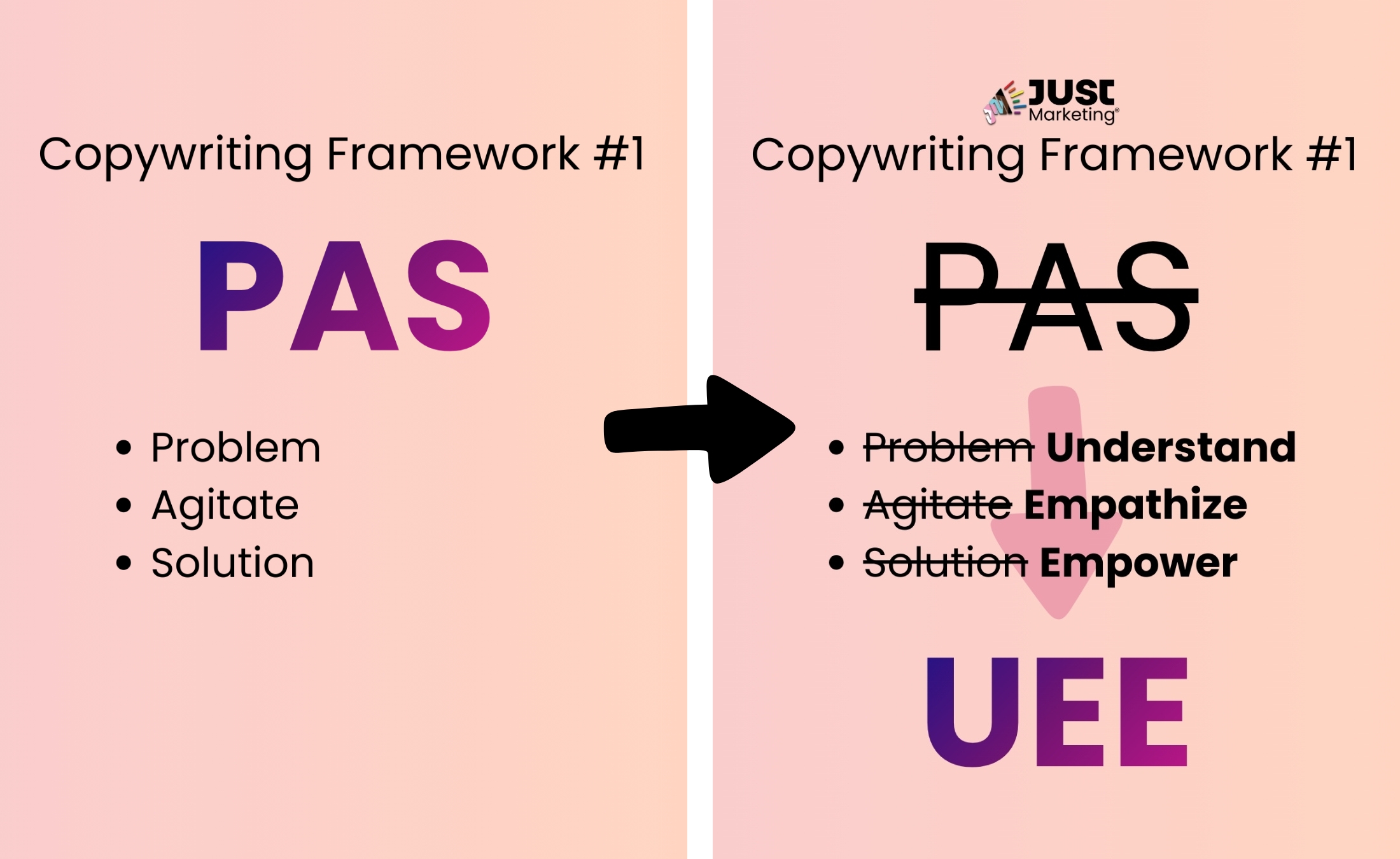
1. PAS (Problem–Agitate–Solution)
A classic. You identify the reader’s pain point, stir the discomfort to make it feel urgent, then offer your solution.
Example:
- Problem: You’re posting on social every day but seeing no engagement.
- Agitate: It’s discouraging to put in all that effort and feel invisible.
- Solution: My content plan helps you post less but get better results.
Why it works: Fast and emotionally compelling
What’s problematic:
- The “Agitate” step often leans on fear, shame, or inadequacy to push action.
- It can exploit insecurity – especially when pain is exaggerated or pathologized (“You’re broken until you buy this”).
- This framework assumes people won’t act unless they’re uncomfortable, which dismisses motivation through curiosity, hope, or empowerment.
Just Marketing® Reframe: Understand – Empathize – Empower
- Reframe agitation as empathy.
- Acknowledge the challenge without amplifying distress.
2. AIDA (Attention–Interest–Desire–Action)
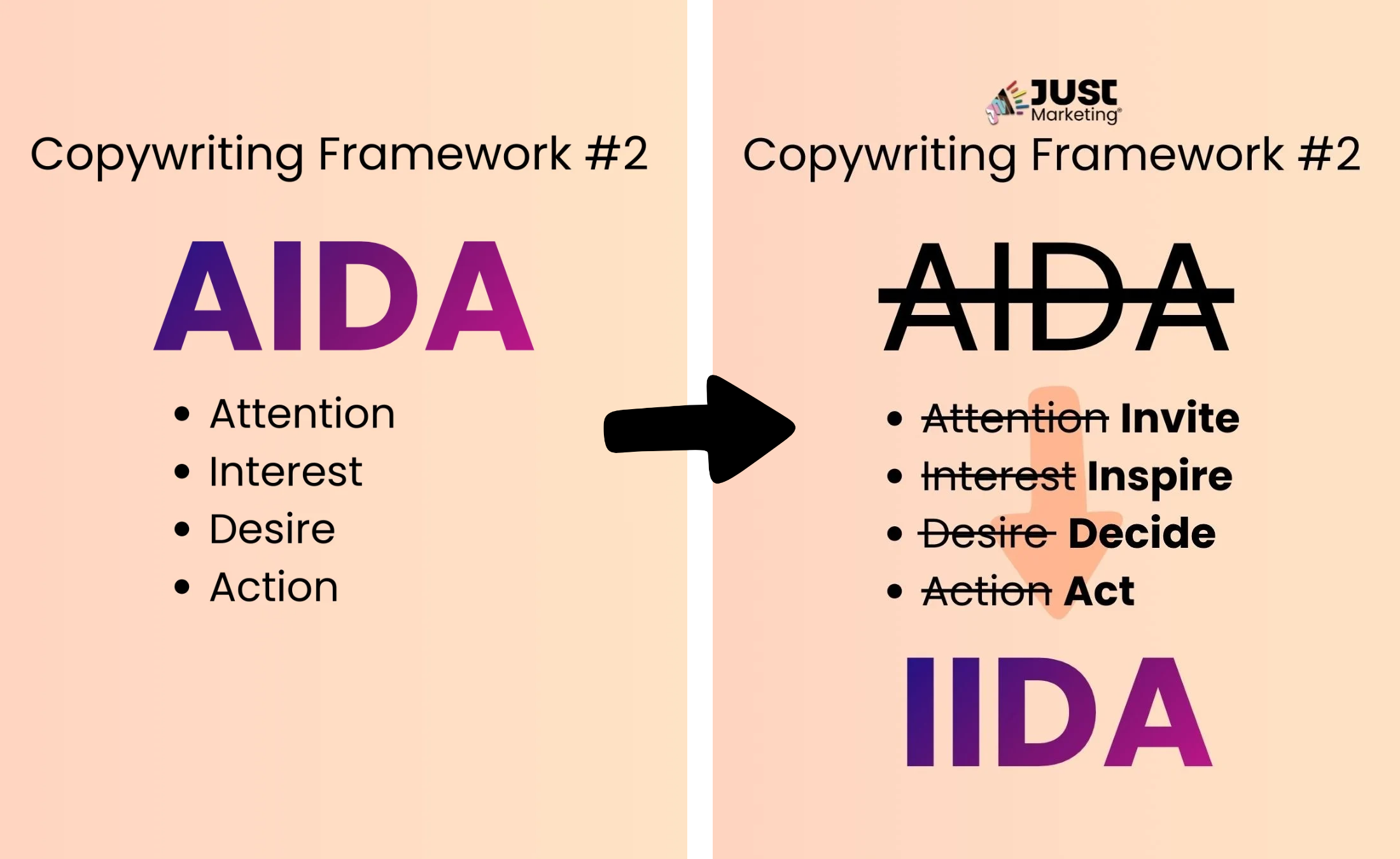
Often used for ads, landing pages, and emails. You grab attention, build interest, spark desire, and drive action.
Example:
- Attention: Struggling to stay consistent with your content?
- Interest: Our proven system helps entrepreneurs plan a month of content in just one hour.
- Desire: Imagine having your posts scheduled and done – so you can finally focus on growing your business.
- Action: Book your content strategy session today – limited spots available!
Why it works: Clear structure to guide the reader
What’s problematic:
- The “Attention” phase can reward shock value or clickbait.
- “Desire” can lean into FOMO or envy – fueling scarcity mindsets rather than genuine alignment.
- The funnel-like structure centers persuasion over consent, prioritizing conversion above autonomy.
Just Marketing® Reframe: Invite – Inspire – Decide – Act
- Use honesty to attract attention, information to inspire interest, and autonomy to support decision-making.
3. FAB (Features–Advantages–Benefits)
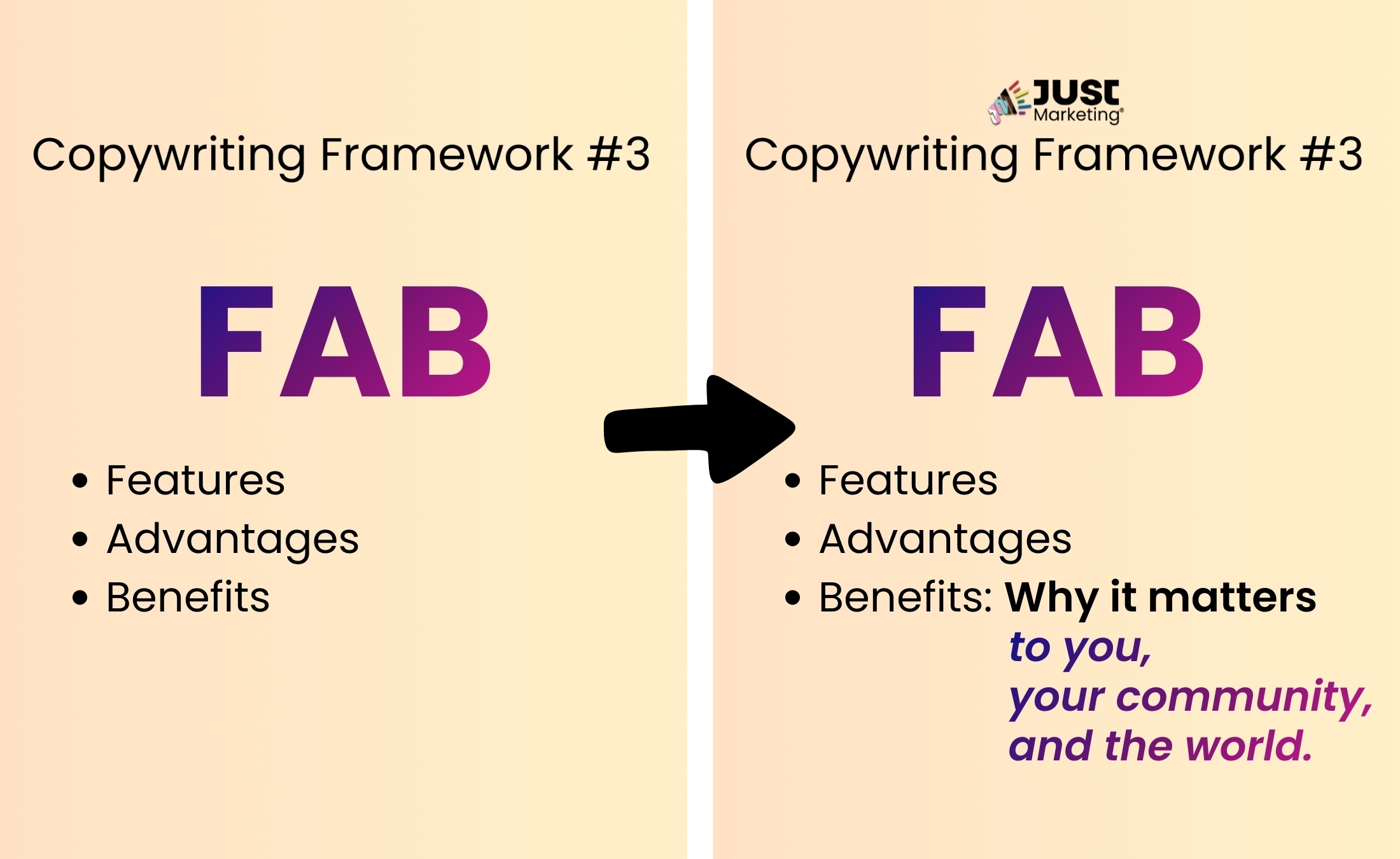
Helps shift from product details to what the customer actually gains.
Example:
- Feature: 6-week coaching program.
- Advantage: You’ll get structured support each week.
- Benefit: You’ll finally follow through without burnout.
Why it works: Helps translate details into real-life relevance
What’s problematic:
- It assumes that every benefit should appeal to personal gain, often ignoring community, justice, or sustainability impact.
- Overemphasis on benefits can edge into overpromising.
- “What’s in it for me?” can become “What can I extract?”
Just Marketing® Reframe: Feature – Advantage – Benefit
- Expand benefits to include collective and ethical impact – how the purchase helps others, not just the buyer.
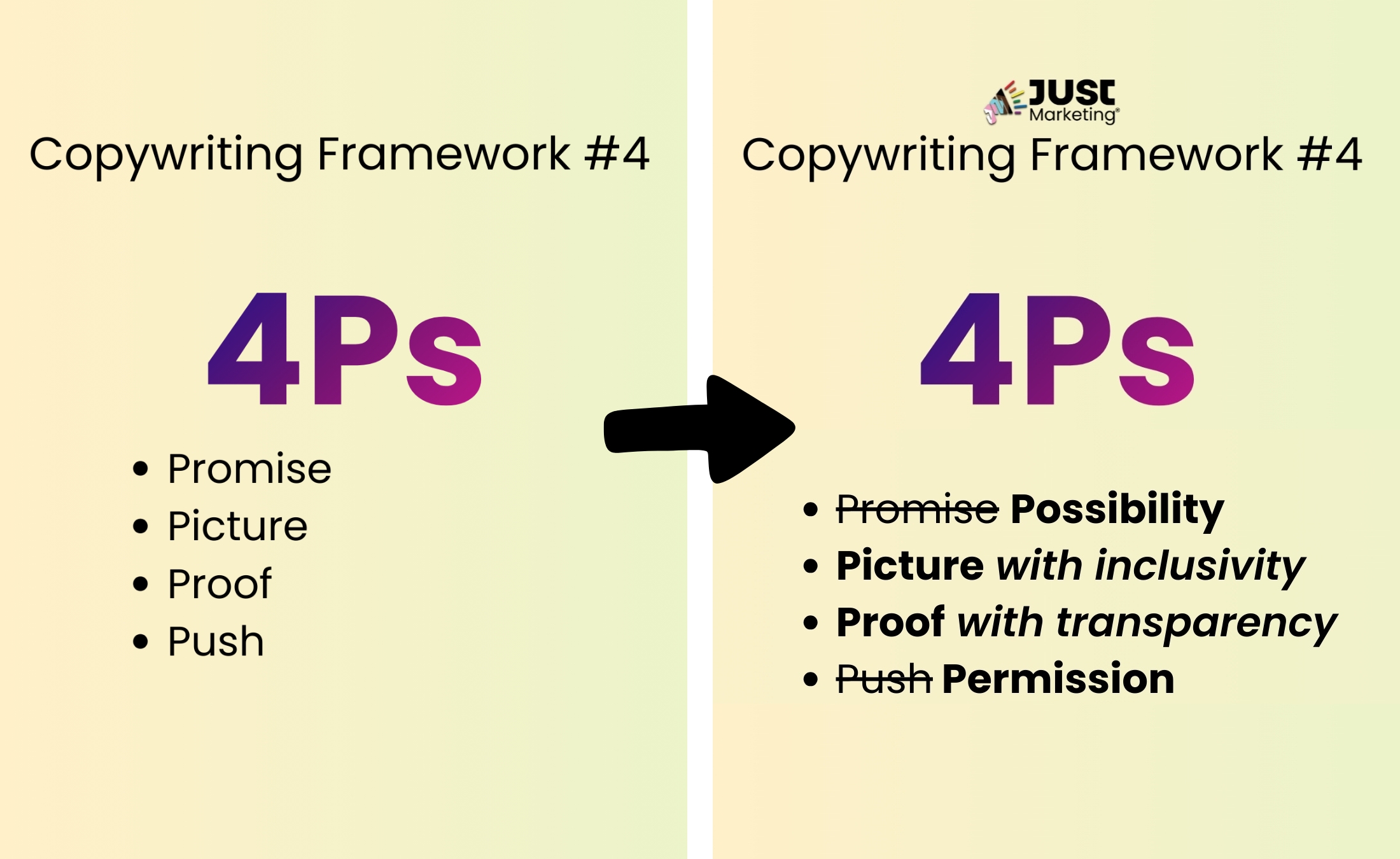
4. 4P’s (Promise–Picture–Proof–Push)
Great for sales pages and email campaigns: Promise the result, paint the vision, prove it works, then nudge to act.
Example:
- Promise: Double your client leads in just 30 days with my proven strategy session.
- Picture: Imagine waking up to a full inbox of inquiries from dream clients who already know they want to work with you.
- Proof: Sarah booked one session and gained three high-ticket clients in a week – without changing her offer or increasing her workload.
- Push: Only 2 spots left. Book your session now before they’re gone!
Why it works: Paints a compelling vision with social proof
What’s problematic:
- The “Promise” can create unrealistic expectations.
- The “Push” step often adds artificial urgency or pressure.
- Testimonials (“Proof”) can be used without context – implying everyone will have the same result.
Just Marketing® Reframe: Possibility – Picture – Proof – Permission
- Instead of pushing, invite the reader to choose what feels right for them.
5. Before–After–Bridge
Show life before using your offer, what “after” looks like, and the bridge (your offer) that gets them there.
Example:
- Before: You’re drowning in to-dos.
- After: You’ve got a clear plan that fits your brain.
- Bridge: My productivity system for ADHD entrepreneurs.
Why it works: Story-driven and emotionally resonant
What’s problematic:
- The “Before” often paints people’s current state as a failure or deficiency.
- This contrast can shame readers into buying rather than empowering them to grow.
- It frames the brand as a savior instead of a partner.
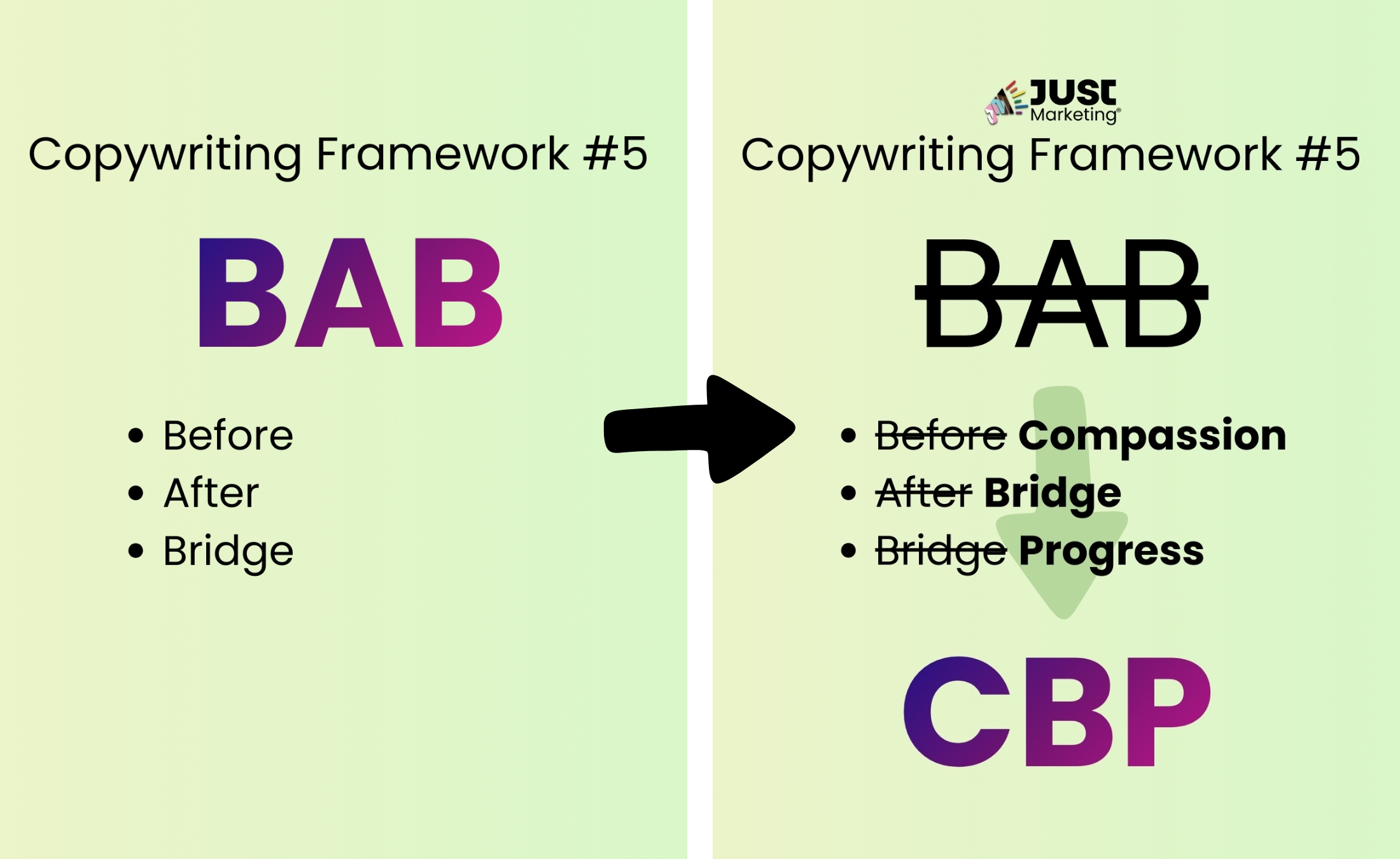
Just Marketing® Reframe:
- Compassion: Tell stories with compassion and center agency.
- Bridge: Show nuanced transformation without judgment.
- Progress: Celebrate the possibility of progress instead of dramatizing pain.
6. PASTOR (Problem–Amplify–Story–Transformation–Offer–Response)
Ray Edwards’ framework. Ideal for storytelling and long-form copy. It expands PAS by weaving emotion and narrative into the pitch.
Example:
- Problem: You’re juggling too many offers and still not making consistent income.
- Amplify: If you keep going like this, you’ll stay stuck in hustle mode, burning out and falling further behind your goals.
- Story: When I started, I had five offers, zero boundaries, and constant anxiety. Once I simplified my services, everything changed.
- Transformation: Now I have a streamlined business, more income, and way more spaciousness in my week.
- Offer: That’s exactly what I teach inside my 1:1 coaching container.
- Response: Spots are limited – apply now before the next round closes!
Why it works: Leans into storytelling and emotion
What’s problematic: The “amplify” step can escalate pain and urgency; metaphor isn’t inclusive
- “Amplify” tends to escalate pain unnecessarily – same issue as PAS.
- “Response” often pressures immediate action (“Buy now,” “Don’t miss out”).
- The religious metaphor of “pastor” can feel exclusionary or manipulative in diverse contexts.
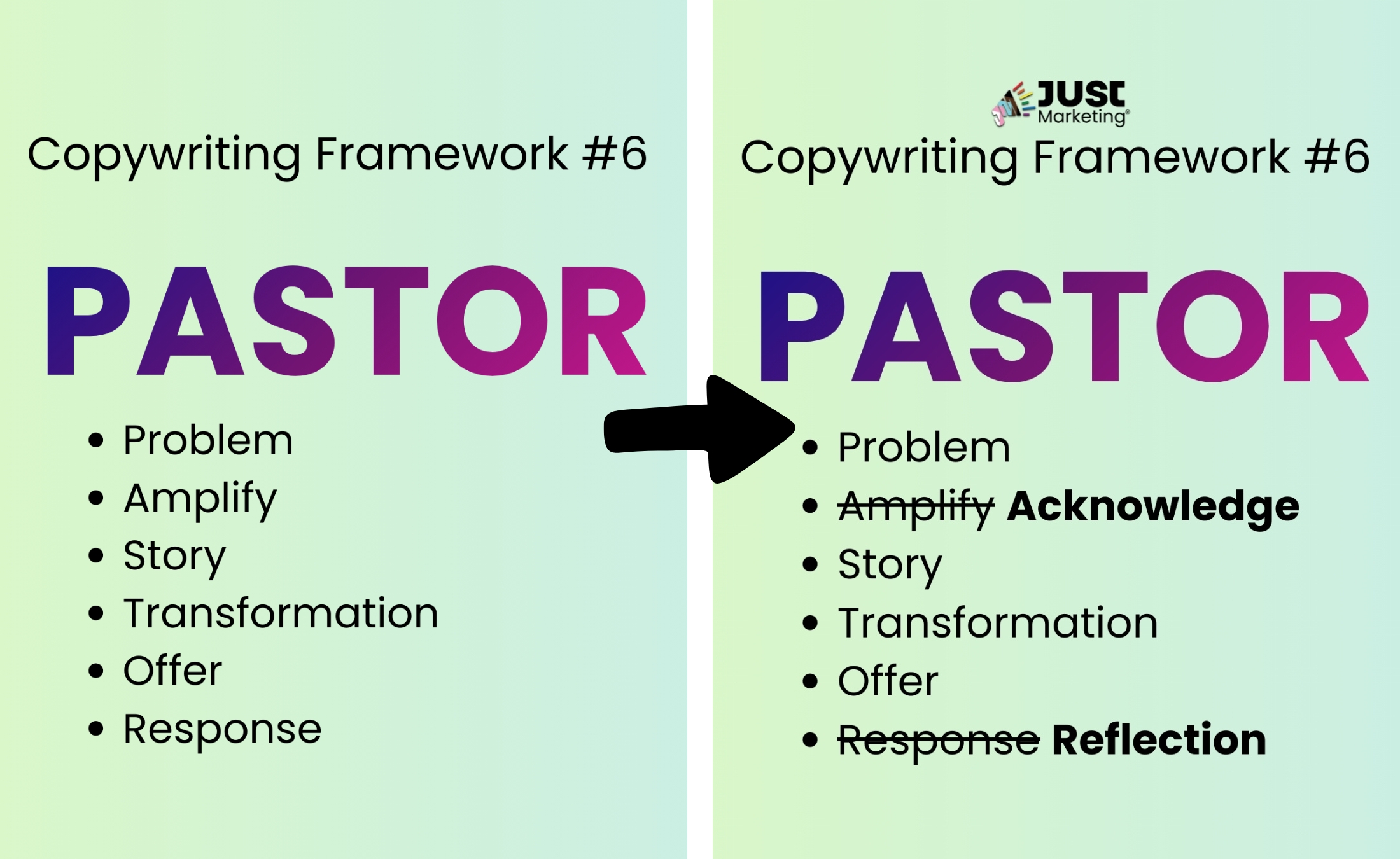
Just Marketing® Reframe: Problem – Acknowledge – Story – Transformation – Offer – Reflection
- Replace amplification with understanding, and pressure with permission.
Read the full PASTOR breakdown
7. ACCA (Awareness–Comprehension–Conviction–Action)
Used in educational or high-trust sales. You build awareness of the issue, explain it clearly, help them believe your solution, then prompt action.
Example:
- Awareness: You feel exhausted, unmotivated, and disconnected from your business. That’s not laziness – it’s burnout.
- Comprehension: Burnout happens when your nervous system is overwhelmed. Without the right support, it only gets worse – and your business suffers.
- Conviction: My proven framework has helped dozens of entrepreneurs bounce back and rebuild their energy. If you want real results, this is the solution.
- Action: Book your spot now – spaces are limited and filling fast!
Why it works: Built for educational, high-trust sales
What’s problematic:
- “Conviction” can drift into indoctrination if it overrides critical thought.
- It may prioritize persuasion over informed choice.
- It assumes one “correct” conclusion – the seller’s.
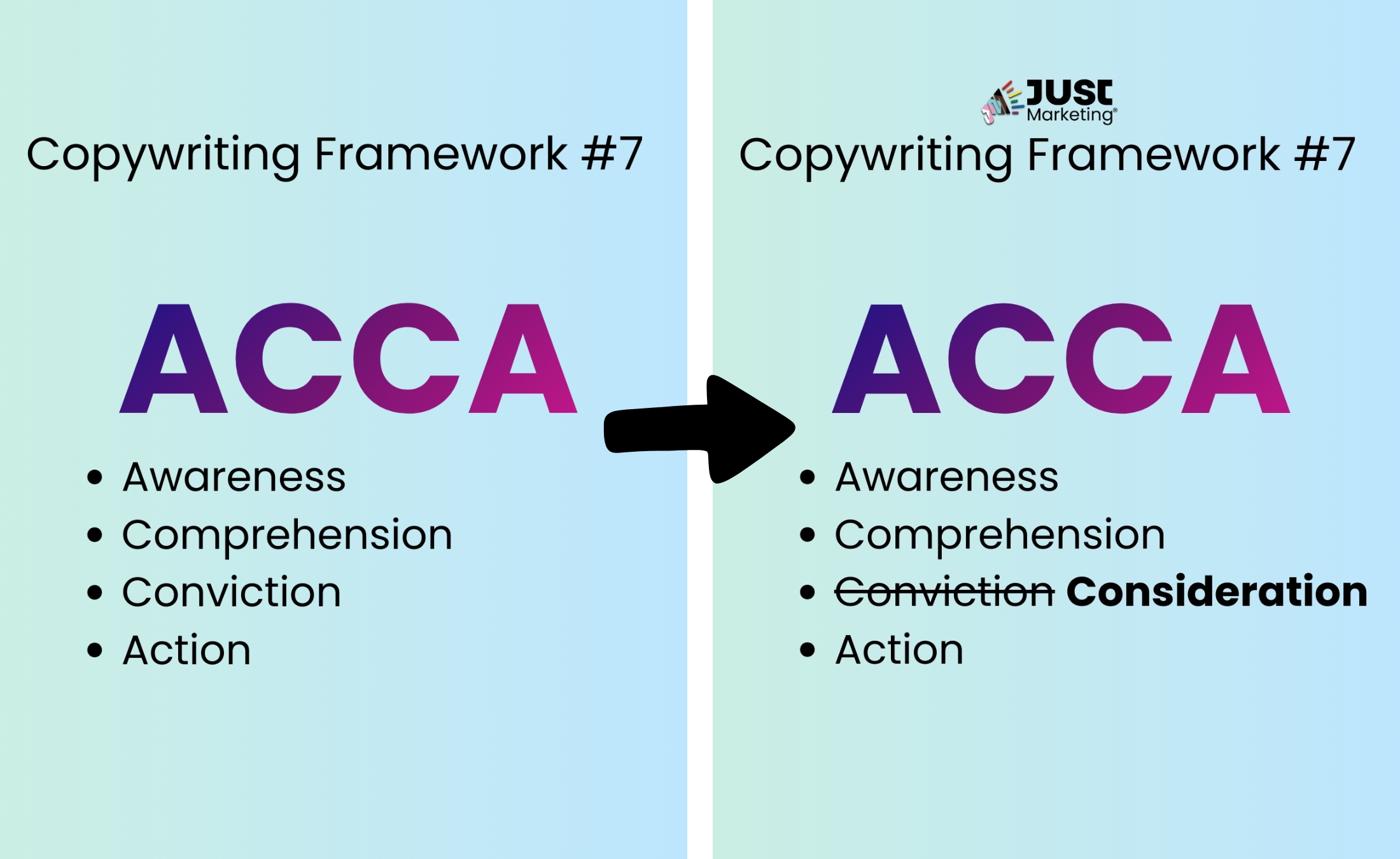
Just Marketing® Reframe: Awareness – Comprehension – Consideration – Action
- Invite reflection, not conversion.
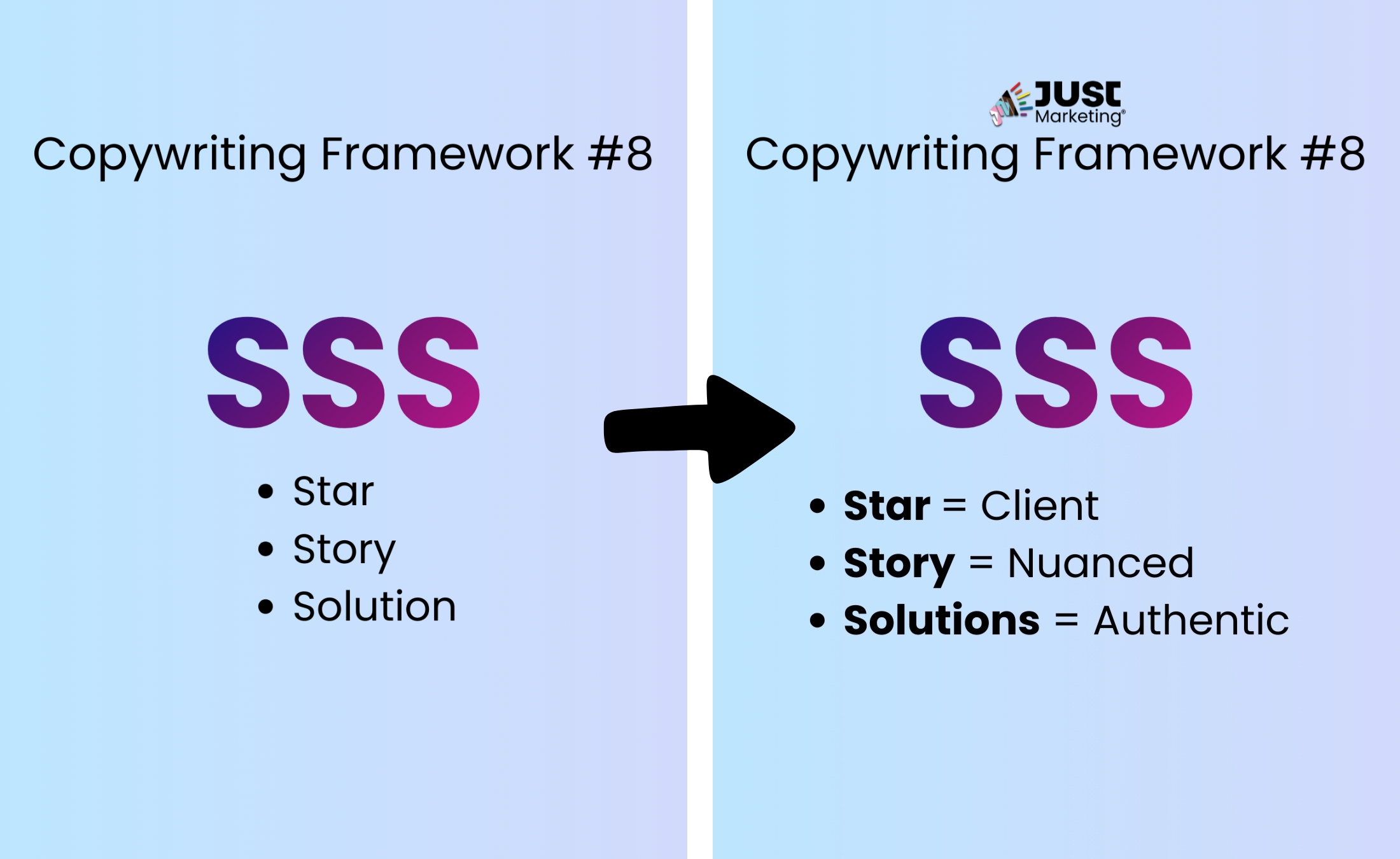
8. Star–Story–Solution
A softer, narrative-driven structure: introduce the star (hero), tell their story, then reveal the solution. Works well for testimonials or case studies.
Example:
- Star: Meet Jenna, a busy coach who was struggling to stay visible online.
- Story: She came to me feeling totally stuck – posting inconsistently, getting no engagement, and second-guessing everything. After just one session, she had a content calendar, new confidence, and landed 3 new clients in her first week.
- Solution: That’s the power of my Visibility Accelerator. If you’re ready to get seen and start signing clients, this is for you.
Why it works: Highlights transformation through story
What’s problematic:
- If the “star” is always the brand, the audience becomes secondary.
- Real client stories can be tokenized – especially when using marginalized voices for social proof.
- Overly neat transformations can erase the complexity of real change.
Just Marketing® Reframe:
- Keep the client or community as the hero.
- Use ethical storytelling that centers the client’s agency and complexity.
- Use stories with consent and honesty, showing nuance and ongoing growth.
Read the full Star–Story–Solution breakdown
9. GRAB (Grab–Relate–Agitate–Bridge)
A modern twist for social media or emails. Start with a scroll-stopping line, connect to the reader’s experience, remind them why it matters, then show how you help.
Example:
- Grab: Tired of wasting hours creating content that no one engages with?
- Relate: You start the week with good intentions, but end up ghosting your audience – again.
- Agitate: If you keep showing up inconsistently, your dream clients won’t find you – and your business will suffer.
- Bridge: That’s why I created my Content Clarity Session – to help you build a content system that finally works.
Why it works: Great for social and short-form content
What’s problematic:
- The “Grab” can use clickbait or emotional triggers to stop the scroll.
- “Agitate,” again, can exploit discomfort or insecurity.
- It’s often used in social ads where manipulation is normalized.
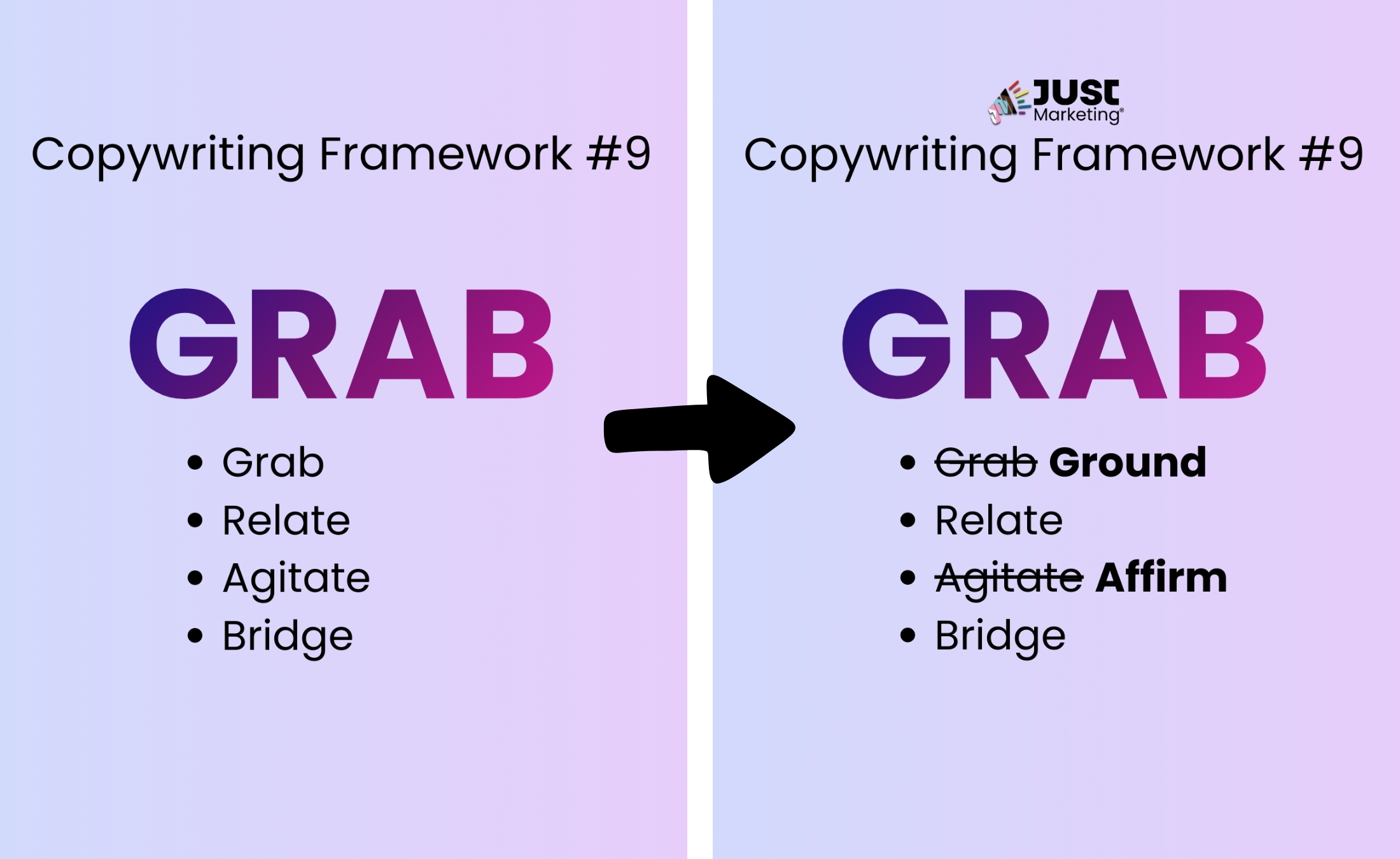
Just Marketing® Reframe: Ground – Relate – Affirm – Bridge
- Ground the reader with truth
- Relate through shared humanity
- Affirm their autonomy
- Bridge to support.
These reframes don’t just feel better – they work better. They help you attract right-fit clients who trust you, feel safe with you, and say “yes” from a place of alignment (not anxiety). So keep what works. Toss what doesn’t. And tweak every tool to reflect the kind of business – and world – you’re building.
What These Reframes Have in Common
While each framework has its own structure, the Just Marketing® reframes share a few powerful throughlines. These aren’t just tweaks to make things sound nicer – they’re foundational shifts that make your marketing more ethical, more inclusive, and more sustainable for everyone involved (including you).
Here’s what ties them all together:
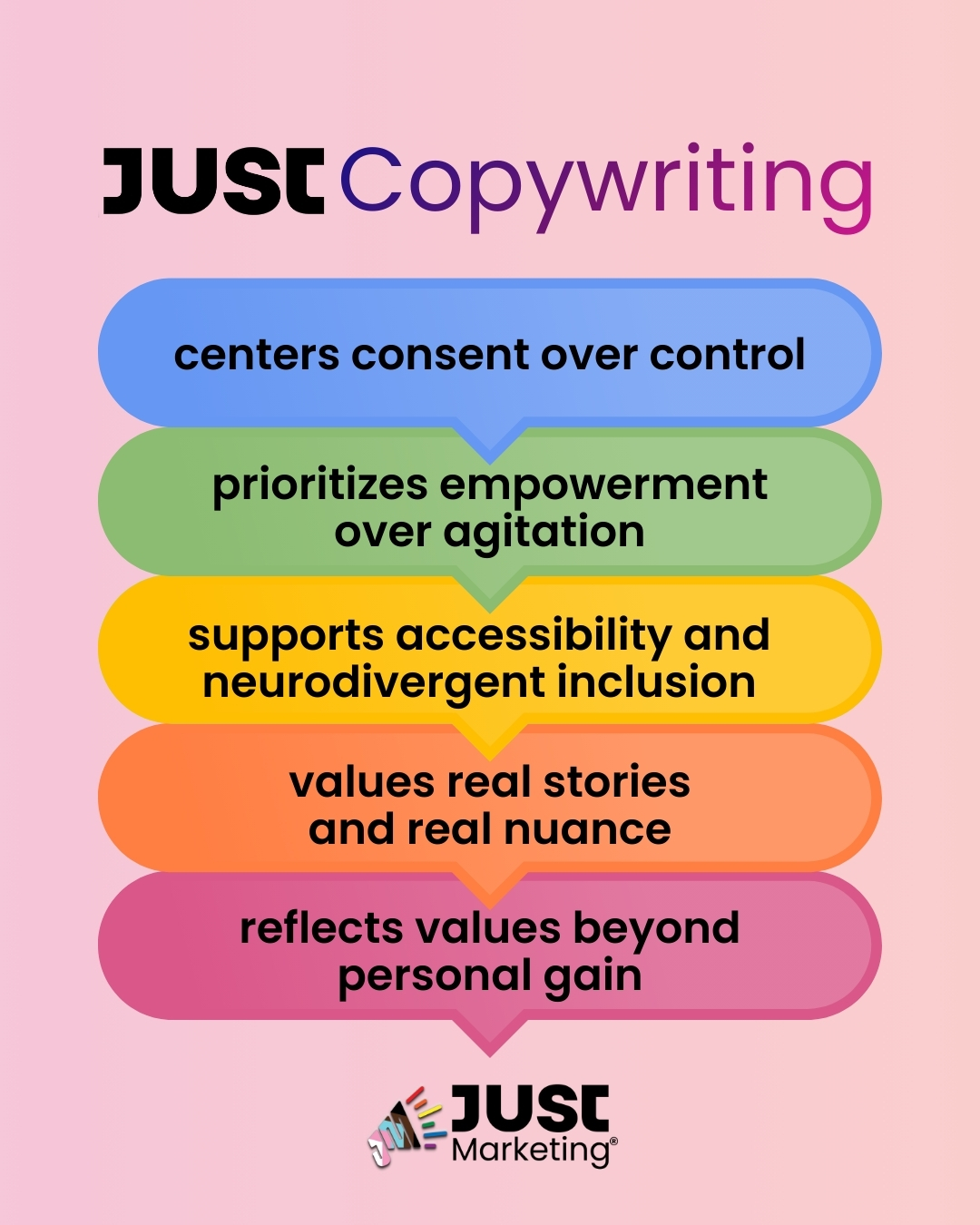
They center consent over control.
Instead of pushing people toward a “yes” at all costs, these reframes create space for reflection, autonomy, and informed decision-making. No FOMO. No pressure. Just an open door.
They prioritize empowerment over agitation.
Fear-based marketing might trigger a quick action, but it rarely builds lasting trust. These reframes invite action through clarity, not coercion – focusing on hope, possibility, and personal agency.
They support accessibility and neurodivergent inclusion.
High-pressure copy can feel overwhelming, especially for folks with ADHD, anxiety, or trauma. These ethical frameworks honor different processing speeds, decision-making styles, and energy levels – making space for people to engage in ways that work for them.
They value real stories and real nuance.
No more polished perfection or rags-to-riches clichés. These reframes hold space for the messy middle, for progress at your own pace, and for client stories told with full consent and context.
They reflect values beyond personal gain.
Instead of framing benefits around status, speed, or profit alone, these reframes expand the conversation to include justice, sustainability, and community impact. It’s not just “what’s in it for me?” – it’s “what kind of world are we building together?”
Together, these shifts move us from manipulation to mutual respect – from quick wins to long-term relationships – and from hustle to humanity.
Because ethical persuasion isn’t about sounding nice. It’s about being in integrity – with your message, your mission, and your people.
How Do I Choose the Right Copywriting Framework?
First, a gentle reminder: you don’t have to follow any of these formulas perfectly.
Frameworks are meant to support you, not stifle you. Especially if you’re neurodivergent or navigating limited capacity, having a structure can be helpful – but only if it feels like a helpful container, not a creative cage.
Here’s how to choose and use the right framework for you:
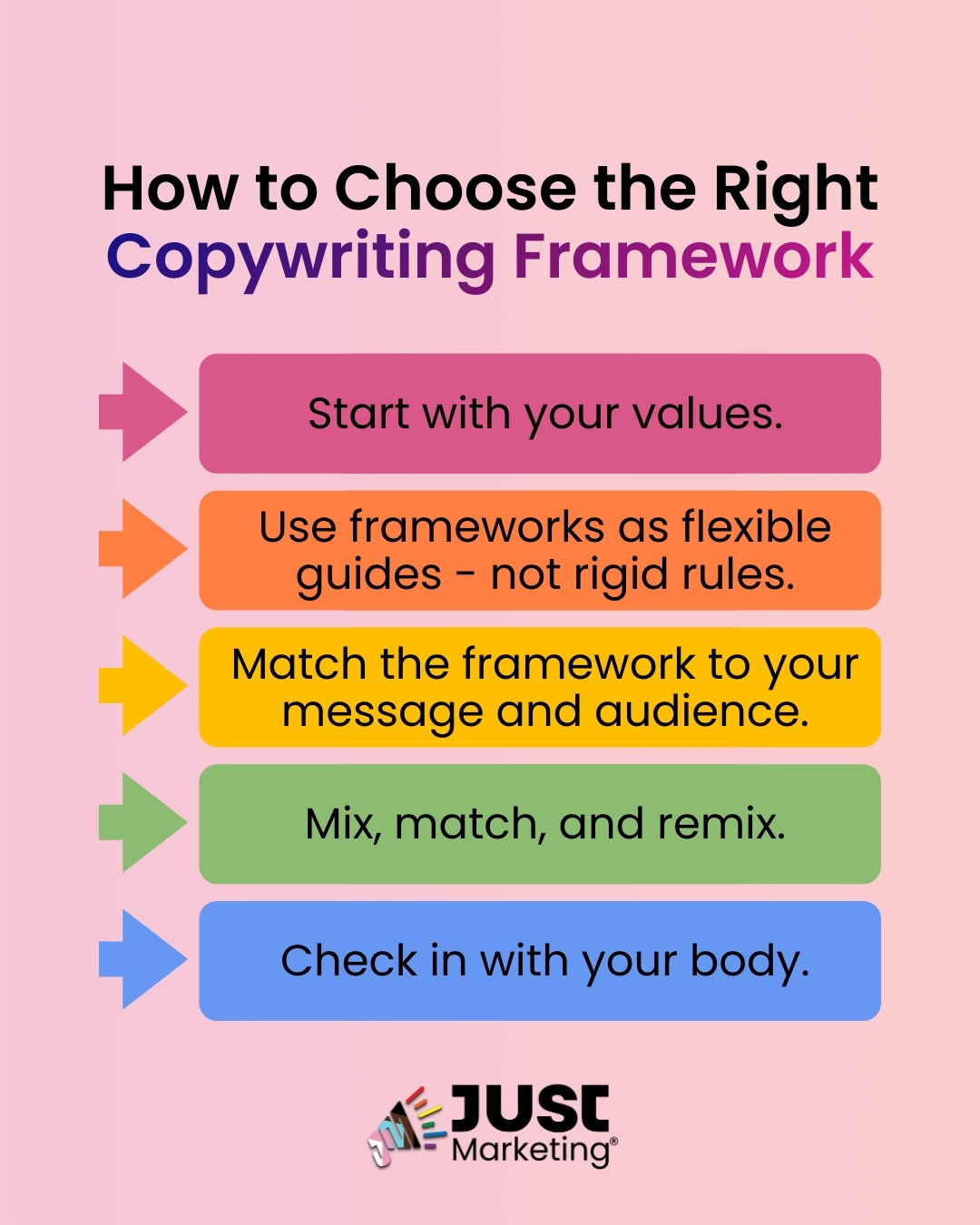
Start with your values.
Before you write a single word, check in:
- Am I honoring my audience’s autonomy?
- Am I inviting action, or pushing for compliance?
- Does this copy reflect who I am and what I stand for?
If the answer is no, no framework will save it.
Use frameworks as flexible guides – not rigid rules.
Think of copywriting frameworks like recipes. You can follow the steps and add your own spice. Some days you might follow the formula closely. Other times, you might mix and match or skip a step altogether.
Match the framework to your message and audience.
Ask yourself:
- Are you telling a story? → Maybe use Star–Story–Solution.
- Offering education or shifting beliefs? → Try ACCA (or the reimagined Awareness–Comprehension–Consideration–Action).
- Launching something new? → 4P’s or AIDA (ethically reframed) can create clarity without pressure.
- Naming a challenge your audience already recognizes? → Try PAS, reimagined as Understand–Empathize–Empower.
- Writing a long-form sales page or launch email? → PASTOR, with Acknowledge and Reflection in place of Amplify and Response, gives your story room to breathe.
- Want a quick, hopeful story for a caption or email opener? → Before–After–Bridge, told with compassion, is a lovely fit.
- Posting on social and hoping to stop the scroll kindly? → Ground–Relate–Affirm–Bridge, the Just Marketing® take on GRAB, is made for short-form content.
- Describing what's included in your offer? → FAB helps you explain it clearly, especially with a “benefit” that includes community impact.
If you serve neurodivergent, trauma impacted, or values-aligned communities, lean into frameworks that invite trust, not urgency.
Mix, match, and remix.
Don’t be afraid to blend frameworks. For example:
- Use FAB to outline your offer clearly…
- Then layer on the Ground–Relate–Affirm–Bridge model for your social post.
- Or combine Understand–Empathize–Empower with Story–Transformation to build connection in a sales email.
Your copy doesn’t have to fit into one box – especially if you don’t.
Check in with your body.
If a framework feels gross, forced, or disconnected – even the reframed ones – that’s good data. You get to pause. Shift. Or try something different.
Because sustainable marketing isn’t just about what your audience needs – it’s about what you need, too.
TL;DR: The “right” framework is the one that helps you communicate clearly, ethically, and in alignment with your capacity and community. No shame. No manipulation. Just conscious, consent-based connection.
Can Persuasive Copy Be Ethical?
You don’t need to rely on shame, urgency, or fear to create conversions.
Those outdated formulas that prioritize pressure over people? They’re not your only option.
And selling your offers shouldn’t mean compromising your values.
It’s absolutely possible to guide people toward action without bypassing their agency.
And when your marketing is rooted in clarity, compassion, and consent, it doesn’t just feel better – it works better, too.
Because persuasion isn’t the problem.
Manipulation is.
When you reframe your copywriting through a Just Marketing® lens, you’re not watering it down – you’re building it up. Rooting it in relationship. Anchoring it in trust. And creating space for the right-fit people to say yes because it feels aligned, not because they felt pressured.
This isn’t about perfection. It’s about intention.
So as you experiment with these reframes, come back to this question:
“Does this copy respect the reader’s humanity while still inviting them to take action?”
If the answer is yes, you’re on the right track. You’re creating marketing that feels good – for you and for your audience. And that’s the kind that lasts.
Let’s Keep This Conversation Going
If this post had you nodding along, scribbling notes, or breathing a sigh of relief – let’s stay connected.
That’s where I share ongoing insights on ethical marketing, ADHD-friendly business strategies, and behind-the-scenes examples of Just Marketing® in action.
- Want thoughtful, values-aligned content delivered straight to your inbox?
Join my email list for marketing tips that are trauma-informed, neurodivergent-friendly, and actually fun to read. No pressure, no overwhelm – just steady support.
- Curious about working together?
Explore my 1:1 offers right here. Whether you need strategy, structure, or sustainable systems, I’d be honored to support you. No hype. Just possibilities.
You can market ethically and be persuasive without being pushy.
And your business is allowed to feel like yours – all the way down to the copy.
Let’s build that together.
FAQs
A copywriting framework is a step-by-step structure for organizing persuasive writing, such as a sales page, email, or social post. Each framework is usually named with an acronym, like PAS or AIDA, that spells out its steps. Frameworks make writing faster by giving you a reliable starting point.
Some of the most widely used include PAS, AIDA, FAB, the 4Ps, Before–After–Bridge, PASTOR, ACCA, Star–Story–Solution, and GRAB. Each one suits a different job, from short social captions to long-form sales pages. All nine can be adapted to fit ethical, values-aligned marketing.
FAB (Features, Advantages, Benefits) is a friendly place to start, since it simply helps you explain what your offer includes and why it matters. Before–After–Bridge is another easy option for short posts. Learn more about writing FAB copy that centers people.
Ethical persuasion shares honest information and invites people to make the choice that's right for them. Manipulation leans on fear, shame, or false urgency to override someone's judgment. Just Marketing® is ethical, inclusive, and accessible, so your audience feels supported and your business grows sustainably. Explore the complete guide to Just Marketing®.
Yes! You might use FAB to outline your offer clearly, then shape a social post around Ground–Relate–Affirm–Bridge. Treat frameworks as flexible guides you can mix to fit your message, your audience, and your capacity.
GRAB and Before–After–Bridge both work well for short, scroll-friendly content. For sales pages, PASTOR or the 4Ps give you more room, while Star–Story–Solution shines in testimonials. Check out the ethical take on GRAB for social-ready examples.