Today's episode was originally recorded and broadcast on the FamilyPreneur podcast in 2022 and because the content was so relevant to Just Marketing I am re-releasing it for you today. Also, April is Autism Acceptance Month, so another great reason to revisit this topic!
In this episode I will introduce Brianne Leeson and we’ll have a conversation around Autistic communication and the way that Autistic brains work. Your marketing is reaching an audience that includes Autistic people and so learning more about what Autism is and isn't and how to better accommodate Autistic people, can help us market more inclusively.
The gist: Autism is a lifelong neurological difference in how people process information and experience the world, and it looks different for every Autistic person. In this Just Marketing® episode, writer and advocate Brianne Leeson breaks down common stereotypes and shares simple ways to communicate more inclusively, like offering written options and sharing questions ahead of time.
How to Make Your Marketing More Autism-Inclusive
Your audience includes Autistic people, whether or not they’ve shared it with you. These practices from the episode make your marketing and client experience more welcoming:
- Say exactly what you mean. Brianne describes her communication as quite literal, with no subtext. Clear, specific wording in your marketing, like stating exactly what’s included and when, leaves less room for guesswork than hints or implied meaning.
- Offer written options. Many Autistic people, Brianne included, communicate more comfortably by email than by phone. Adding an email or form option alongside discovery calls opens the door wider.
- Share questions ahead of time. For interviews, podcast guest spots, or consultations, sending questions in advance gives people time to process and respond thoughtfully.
- Welcome clarifying questions. A question about a task or offer is usually a request for context. Treating questions as a sign of care makes collaboration smoother for everyone.
- Keep plans steady. Last-minute changes can be especially disruptive, so give as much notice as you can when schedules shift.
- Pause before judging. Research shows people often form quick negative impressions of Autistic people, called thin-slice judgments. Taking a moment to ask whether something was rude, or simply felt unfamiliar, builds trust.
- Create room to unmask. Letting people show up as themselves, with no pressure to make eye contact or perform a particular tone, takes real strain off Autistic clients and collaborators.
These practices help whether or not someone has shared that they’re Autistic, and they make communication clearer for your whole audience.
Watch/Listen & Subscribe
The following YouTube video is from the original broadcast on the FamilyPreneur podcast.
Meg Brunson
Hello, FamilyPreneurs, thank you for joining me on another episode today. I'm very excited to be joined by Brianne Leeson. We are going to be talking about Autistic brains, squashing stereotypes, and speaking the language with Brianne. We're going to go through what autism actually means, how to understand and appreciate the way that Autistic brains work, and more. Brianne is a writer and artist and a voice actor from Dallas, Texas. She is the writer of the queer supernatural comedy audio drama, Today's Lucky Winner. After she was diagnosed as Autistic and ADHD at 30, she became fascinated with evaluating the ableism she has experienced daily, before she knew that it was ableism. Combining her passion for social justice, a linguistics degree, and experience as a sensitivity editor for fiction writers, she has become a passionate advocate for helping people better understand the beauty and nuances of Autistic brains. And I feel very grateful and lucky that we have you with us today. Thanks, Brianne.
Meg Brunson
Now, I'd love to just start with a quick discussion about your podcast. I have to be honest, I'm not an audio drama listener, so I'd love for you to just introduce us to the podcast. What it's kind of like to listen? Is it like watching Netflix, like a show on Netflix? Tell me a little bit about the podcast.
Brianne Leeson
Yeah. It actually has an Autistic main character and main character. I made sure I named it after I learned that I had sort of sublimated two parts of my personality into those characters. But yeah, it is all of the parts of listening or watching a show, but it's got sound effects, background music. We have a composer who works on the show to do stuff. We have a full cast of voice actors. It's comedy. It's got vampires and shapeshifting, demons and lots of spoofs of different TV shows. And I voice a grim Reaper on the show as one of the main characters I voice. But it's lots of fun.
Meg Brunson
And it's geared for adults, correct?
Brianne Leeson
Very much for adults, yes. Very much, like not family friendly. I earned that explicit tag.
Meg Brunson
We have a lot of parents listening. So just to make sure because I instantly think, oh, my kids would love this. Possibly give it a listen first.
Brianne Leeson
Yeah, for sure. I think one of the prevailing comparisons we get is like Stoner Buffy. So if that gives you some sort of idea, like Raunchy, Stoner Buffy.
Meg Brunson
That's awesome. It brings me back. Let's talk about now. Can you tell me a little bit about the process of being diagnosed at 30? I know for me, I'm a little bit older than 30, a little bit, but I've had some questions about whether I have ADHD like that's, something that has come up a lot in the past years. I've never gotten a formal diagnosis. You went through those steps, though, and did the formal diagnosis. I'd love to just hear a little bit about that.
Brianne Leeson
Yeah. So at the beginning of the pandemic with my routine in shambles, which was my number one coping mechanism for both, I started sort of behaving in ways that I didn't really understand, and I couldn't focus on a lot of stuff. So I started looking into why am I behaving this way? Like, what is happening? And in talking with my therapist, I was like, I think I might have ADHD. And that was a hard process to get going because the very first doctor that I spent all the time and the money to talk to said, hey, I think you're just depressed. Try this medication that you've been on before and had no luck with. And then finally after that one, I was really discouraged. But then one of my partners started looking up more doctors, and I finally found one to do the full assessment. And they said, yeah, you very clearly have ADHD. You just have sort of inadvertently done a lot of things in your life to help work around it and cope with it. And now lots of those things have kind of fallen apart. So, of course, it's more of an issue now.
Brianne Leeson
So the ADHD diagnosis, I choose to be on medication because it does help, and being on medication for my ADHD actually does help with my autism and help me cope with stuff. But I got an official diagnosis for that just because I wanted access to be able to get those medical resources. But even after the ADHD diagnosis, there are some parts of how I was behaving that just hadn't been answered. So I researched more, and that led me to finding some things that made me go, oh, I think I might be Autistic. And it was learning things that were different from the stereotype that really sort of shook the foundation of what I knew about myself, because one of my early jobs was nannying Autistic kids, because I was just good with them for some reason. And I thought autism looked one specific way. So it was really learning that Autistic people are as diverse as allistic people, which just means not Autistic people. That really started that process. And I chose to get an official diagnosis for autism. And there are a lot of hurdles to that, and there are a lot of reasons someone might not want an official diagnosis on their medical records.
Brianne Leeson
So I think for anyone who is questioning the autism, part of that, do evaluate whether or not an official diagnosis is really something that A, you need and B, is safe for you to get.
Meg Brunson
That makes sense. I appreciate that breakdown, and it's good things to think about as you're going through that process of figuring out whether that's something you want to pursue. Now, what are some of the we talked about, you mentioned stereotypes, and I know I was raised with a lot of stereotypes that have since – there's been holes poked in it. So can we talk about some of the stereotypes that we have, those common assumptions and then some of the dispelling of that what the reality is?
Brianne Leeson
Yeah, I think the biggest assumption is that the autism spectrum is something that everyone is on, because if I had a nickel for every time I've heard someone say, I think we're all a little bit Autistic, but that's not how the spectrum works. You either have an Autistic brain or you don't have an Autistic brain. And the spectrum actually refers to all of our Autistic traits. It's more of like a little pie circle chart. And for each of our traits, it shows which end of the spectrum of that trait that we kind of fall on, whether it's repetitive behaviors or social differences or communication differences or routines and rituals. We all have our own mix of that to different degrees. And that's the spectrum and very much in research and diagnosis of autism. It is centered around a cis-het white child who is assumed to be male. And that is deeply problematic because that is one view of what autism might look like in specific presentations. And it ignores anyone who isn't white, who isn't cis, who isn't male. And Autistic people are six times more likely to be transgender, too. So 70% of us are under the LGBTQIA umbrella.
Brianne Leeson
So there are a large number of us who are not those cis-het white boys who later in life go, oh, I was missed because the actual test they use to determine whether or not you're Autistic didn't account for anyone like me. So I think people have an assumption that you are either Autistic and carry an intellectual disability as well, which is the truth for a lot of people. But I think a lot of people assume that it must come with an intellectual disability, and that's the people who generally get labeled as “severely Autistic,” which is not a thing like, I am just as Autistic as someone's cousin who also has an intellectual disability. It's just they also have an intellectual disability. So if you don't fall into that category or you don't fall into the Rain Man or Love on the Spectrum, stereotype sort of thing where I'm great at counting cards or something, like, I suck at math. Like, if you fall anywhere between those, I think you kind of get ignored. And a lot of people assume you must not really be Autistic.
Meg Brunson
In your research, have you found that it's getting better for our children, for children currently, than it was for people like you and I who are in our 30s? As I know the medical community, clearly we can talk about that, too. Clearly has some issues with the way that they approach autism and other diagnoses even. But is it getting better? Is it easier for those non cis boys, white boys to get diagnoses now, or is that still a challenge for our children?
Brianne Leeson
I think it's not nearly the challenge. It was simply because people are recognizing there are gaps. There's actually research now looking at like, hey, lots of this diagnostic criteria is also very Eurocentric. So some countries it's rude to make eye contact, and differences in eye contact are on the diagnostic criteria here. So how would that look for someone who's from a different culture? So I think it's also broadening to say, like, our diagnostic criteria is a very narrow view, and I think it is more recognized in children. It's definitely not where it needs to be. The reason a lot of the hate groups call it an autism epidemic and say that it's getting worse and thinking more people are becoming Autistic is simply because more people who are Autistic anyway are getting diagnosed. It's not that there are more of us, it's that more of us are getting recognized. So that's why autism consistently looks like there are more and more Autistic people. Well, we always been here. You're just recognizing more of us now.
Meg Brunson
The fact that there are hate groups, that even is shocking to me. But once you said that and once you broke it down, I recall hearing things like that from people who use autism to fuel how they feel about vaccines and other things.
Brianne Leeson
I'll go ahead and say it. Autism Speaks looks like a charity to the outsider, but they have a few Autistic people they have hired since they've been critiqued about not having Autistic people on the board. But their main goal is to find the gene for autism and to be able to test for autism in utero – eugenics, quite frankly. And they want to find a cure for us when it's labeled as a disorder. But it's not. It's just a type of person. And we have a harder time in certain environments. But we've always existed. And Autism Speaks had a commercial that compared us to cancer, said we would ruin marriages, said that autism would steal your child and just made it look like we're a burden. And most of their money goes to either making sure we don't exist anymore or therapy from the person who invented conversion therapy for gay people to make us act like we're neurotypical.
Meg Brunson
Which is disturbing and disgusting to even think about. And you mentioned this in another podcast I listened to where you were guesting. But autism isn't the problem. The problem is how the neurotypical world perceives and interacts with Autistic people. Did I get that right?
Brianne Leeson
Yeah. Like, there are certain things about the world that would be harder for me in general. Like, there are certain things where being Autistic would still make some things harder in general. But I think a lot of my life would be made a lot easier and a lot of many Autistic people's lives would be made a lot easier just because, if the neurotypical world made more of an effort. And it's in such basic things. Globally, there is an 85% unemployment rate for Autistic people with a University education, and the vast majority who are in a job are what would be called underemployed. So for me, I have a degree in linguistics, but the social aspect and the politics of academia kept me from being able to even access the idea of going to go get my Masters and then trying to find a job in linguistics after that relies on a lot of social stuff. Like you had to be in good with someone who is a professor to get this TA job and you had to do this. So for me, after College, I ended up making more using my Autistic special interest of comics, working at a comic book store, and my degree, I don't even know where it is. But the reality is that our social differences and the fact that people won't meet us in the middle, that is possibly one of the hardest parts because it affects everything in your life.
Meg Brunson
Many of our listeners are entrepreneurs. Some host podcasts. Like I'm doing like this one. What are some tips, some strategies that we can start to implement or practice that would help us be more inclusive towards Autistic people and the Autistic population, whether that's potentially a podcast guest or a contractor or somebody that we want to work with on our team.
Brianne Leeson
Yeah. I think one big thing is don't assume the worst. They have done studies where they showed allistic people, Autistic people, and before even speaking to us, the people decided they didn't like us. And a lot of that is based on this sort of structure of ableism that allistic people tend to quickly filter things through stereotypes and social constructs they know. And a lot of our behavior just puts up red flags. And rather than taking a second to say, hey, is this really a red flag that isn't a good person? Or am I looking at characteristics of a disabled person and making a snap judgment? And that's called a thin slice judgment. So that goes into communication too. So I'm quite literal I'm actively manually choosing each word I say. I don't use subtext, but in the workplace a lot, anywhere, really subtext gets added for us where there was none and people make assumptions. So I think just challenging. Like, has this person said something rude or have I perceived it as rude? I think learning to stop and pause and manually evaluate interactions with Autistic people would go a long way because I'm masking, because I at this point can't totally turn it off all of the time, but I have to manually add tone to my voice.
Brianne Leeson
I have to tell myself to make certain facial expressions that are deemed appropriate. For some Autistic people, eye contact is painful. For me, it's uncomfortable because it feels like someone seeing me naked. I think that's the closest comparison. I don't like it, but we have to force ourselves to do this stuff during work stuff and masking is directly linked to our high rate of self harm. Like self harm is our second leading cause of death. And if more people went a longer way to just understand how we communicate and not make snap judgments and not assume what we mean by our face, I think that would go a long way just to be understood. Sticking with plans, like changing plans last second is super disruptive to a lot of Autistic people. I think being comfortable with having someone ask you questions. I don't know how many workplaces I've been in where I have asked a question after I've been given a task and I've been met with hostility because they've assumed like I'm challenging them or that I'm saying the thing they're asking me to do is wrong, but I need the full context of something.
Brianne Leeson
I need to know why I'm doing it so I can figure out the details in my head because my brain will not filter out well, this is the one way I'm going to do it. I'm thinking of all these variables unintentionally and asking questions is how I'm making sure I'm doing it the right way. And I think one thing that some people might find pretty controversial, but I think it would help a lot of Autistic people is if you're looking to hire someone for something, consider sending your interview questions ahead of time. Because even questions, it takes me longer to process what's actually being asked because when allistic people ask questions, I think a lot of people will be quite surprised how often they're not actually asking the thing they're asking. And I don't know how many times someone said I wasn't really asking you that, I was asking you this. So being able to look at questions ahead of time and being able to say, oh, I think this is what this person is asking, gives the time to process and come up with a genuine answer. It's not that Autistic people don't know or have to make something up.
Brianne Leeson
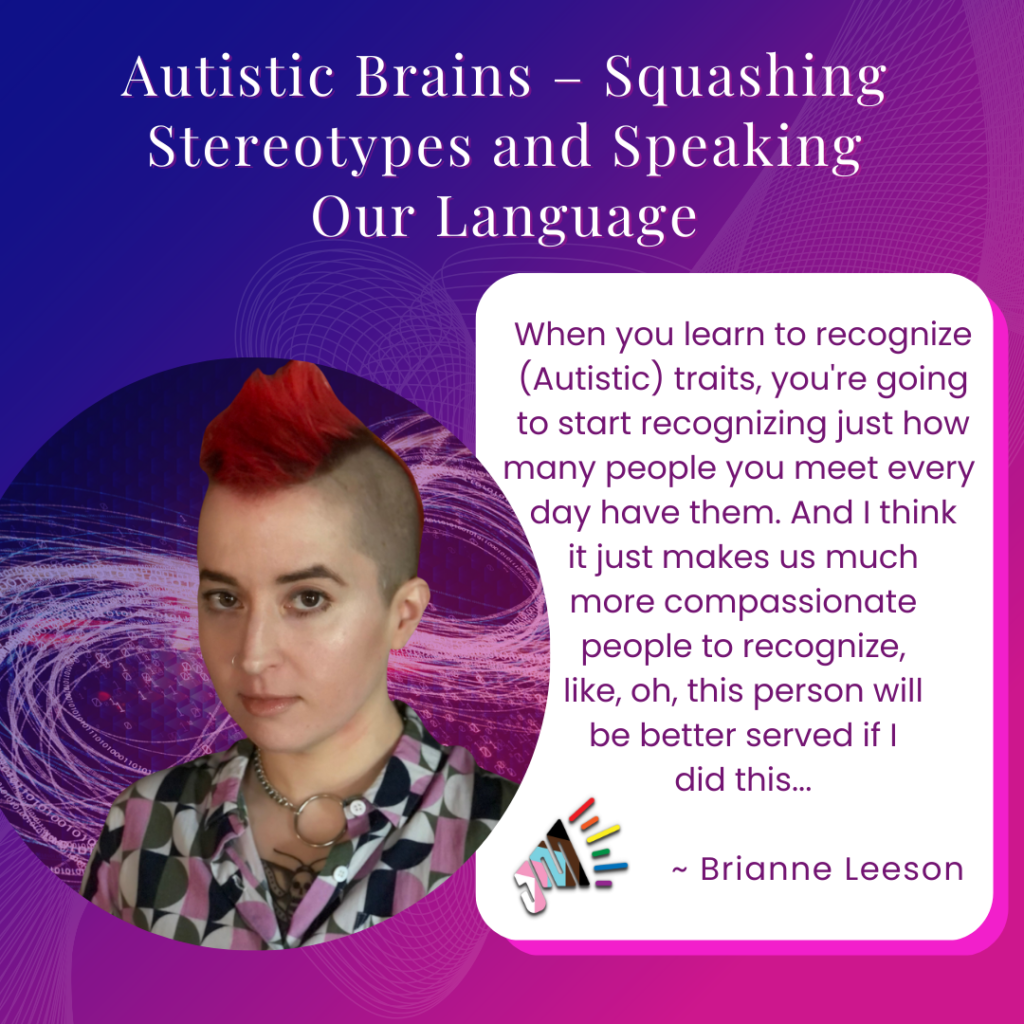
We process things differently and verbal communication differences are one of the spectrum traits. So it's an immense help. I can't speak for every Autistic person, but I know I communicate much better over email like phone calls. I full body reject because I can't see the person's face and I have to manually look to say, oh, they're making this face, they could be feeling this way. I don't have all the data. I need to really understand the conversation well. And written communication helps give me more time to process and edit and ask questions. And really, those are the cursory things. I think just not assuming the worst and learning our communication. And also someone doesn't have to disclose to you that they're Autistic for you to recognize those traits and realize, okay, maybe this person needs this sort of communication because I think when you learn to recognize those traits, you're going to start recognizing just how many people you meet every day who have them. And I think it just makes it much more compassionate people to recognize, like, oh, this person will be better served if I did this right?
Meg Brunson
So people don't need to have a label. You don't need to have justification to be kind and patient and open minded. Now, I do have a few questions.
Meg Brunson
I apologize. There's a little lag
Meg Brunson
Before we continue. I just want to get some clarification. You're saying holistic?
Brianne Leeson
Allistic.
Meg Brunson
Okay. And can you just define that for me so that I can make sure I'm understanding it correctly?
Brianne Leeson
Allistic just means not Autistic. So someone with ADHD would be neurodivergent, but they would be allistic meaning they're not Autistic.
Meg Brunson
That is not something I've heard before I really appreciate you bringing that up.
Brianne Leeson
Yeah, I think that word is very useful.
Meg Brunson
Thank you.
Meg Brunson
Hold on 1 second.
Brianne Leeson
Okay.
Meg Brunson
Sorry, I lost my train of thought. I apologize staff
Meg Brunson
And hearing that response to, like, what we can do. If you're watching the video, you probably caught a face of mine because I'm like, oh, I should have. As a podcaster, providing questions ahead of time would have been a way that I could have helped you better prepare. And not just you, but all guests. Right. That's one way that a podcaster could potentially make an interview easier.
Brianne Leeson
Yeah. And like, for me, I'm very fortunate that my communication set, verbal communication was not always the easiest for me. One of the reasons I kind of led to autism was learning about hyperlexia. So it just means I started reading far too early and had a fascination with words and stuff. But I got better at verbal communication, and I also got a linguistics degree, which made it easier for me. But for a lot of Autistic people, it is very much a challenge. And I have to manually go in my brain and try to choose the exact word I want. When most people say, oh, well, I'm getting the basic idea across. So getting things ahead of time. And I know a lot of people are like, oh, but I want a natural conversation. Natural conversation is different for Autistic people. It just is. And there's nothing unnatural because we naturally script conversations. So if I know I'm about to have to go do something in the background, like a program running in the background, my brain starts going, so if I go here, I say this. And if they say this, I say that. But if they say this, I'm going to change to this response.
Brianne Leeson
So I have a flow chart of scripts for everything that I do on a regular basis. And that is part of masking, but it's part of how we manage to communicate. So giving questions ahead of time, is it going to make a conversation any more or less natural – we just, we're prepared.
Meg Brunson
And just in case, I'm familiar with the term masking, but just in case people aren't, that's trying to fit in, right?
Brianne Leeson
So masking gets used by a lot of neurodivergent group like people under the neurodivergent umbrella. But I think there should be a really big distinction because it originated as Autistic masking. And Autistic masking is hiding our Autistic traits, including stims and stuff, to a degree where there was a recent study that said intense masking, and I forget the metric they use, but can take 14 years off of our life like it's directly linked to our suicide rate. (Statistics shared reflect the guest’s research at the time of recording). And we will go so far as to, for me, a lot of it is just hiding discomfort. So I thought everyone was miserable when they ate at a restaurant and it's just hiding that discomfort. It's adding tone to my voice, it's forcing myself to make eye contact. It's making sure I'm making the right face, trying to hold my body in a certain way, making myself smile at things. I go access these scripts in my head. And there are a lot of people who mask so hard they mimic TV characters or fictional characters because people like that person, they think that person is okay and that's what you do. So there are Autistic people who have no sense of identity by the time they're- for late diagnosed people have no sense of identity because we have to mask. And it's especially insidious because BIPOC, Autistic people have to mask more than white Autistic people because Autistic people are more likely to be victims of police violence. And also, of course, BIPOC folks are. So when you're at the intersection of both of those identities, you can't hide the color of your skin, but you can try to hide that you're Autistic. So it's hard because we all have to do it to different degrees and not all of us can do it. It's very much a privilege to be able to, and I know it's open doors for me that wouldn't have been open otherwise. But if someone can provide a safe space where we can let that mask down a little, that is taking such strain off of us just to be able to relax some. For me, sometimes I have Autistic meltdowns and Autistic shut down sometimes, and sometimes it's just suppressing a meltdown, which is a neurological event where my brain has said I've had too much. But when you're masking for your own safety, it gets perceived as violent behavior. So your brain says save it for later, and that can supplement into a bunch of other mental health problems because we're not letting those things out when we're uncomfortable.
Brianne Leeson
So masking for Autistic people is a much different animal than it gets talked about for other neurodivergent groups. And it's hard. It's unfortunately a necessary evil to survive in this world for us to differing degrees. But if you can be someone that's safe for an Autistic person to communicate with and just simply ask questions and admit when something's confusing, you'll be helping. You'll be helping a lot.
Meg Brunson
That's great to know. I really appreciate your willingness to be vulnerable, to share all of this information with us. I just appreciate you putting yourself out there and helping in a way to help us allistic people – I'm going to use my new word of the day – to be more open and accepting and compassionate so that we can hopefully make the world a better place for everybody.
Brianne Leeson
Yeah. Thank you. I think I like talking about it and I've had people message me going, hey, I'm actually seeking an autism diagnosis now Because I didn't know everyone didn't operate that way. So I also think if the way I described how I operate resonates to anyone, go do some research. Go do some research for yourself.
Meg Brunson
Yeah. Having those answers, now I can't remember. Isn't that awful? I can't remember if you mentioned it in this episode or in another one Because I've listened to a few of yours, but having those answers has helped you to understand why your brain works and makes sense out of things so you no longer feel like, I think you called it broken.
Brianne Leeson
Yeah, because it's like I was trying to use just the owner's manual to something that I'm not – like a Jeep to operate. And it's like, oh, by the way, you're not a Jeep, you're a Vespa. That's why this didn't work. And I'm like, oh, okay, well, now I have the language and the access to the information I need to know how to take care of myself. And just having access to that language, I think, can help people quite a bit and to be more compassionate with yourself and know like, hey, there's nothing wrong with you. You were just you're on a different operating system.
Meg Brunson
I love that example. I love that example. Now where can our listeners obviously they can find your podcast. Wherever they're listening to this podcast, they'll likely be able to find your podcast, Today's Lucky Winner. Where can people connect with you if they want to learn more or continue this conversation with you?
Brianne Leeson
Yeah, on Twitter, my handle is @HotSauceGhost and on Instagram it's @Brianne_Leeson
Meg Brunson
Perfect. Again, I want to thank you so much for being here. I enjoyed this conversation a ton and I hope that it opens the eyes, the ears of our listeners and our viewers to change the way that we're showing up in the world and what we're expecting of other people, regardless of what labels they've may or may not come to us with. So thank you very much.
Brianne Leeson
Yeah, thank you.
About Brianne Leeson
Brianne is a writer, artist, and voice actor from Dallas, Texas. She’s the writer of the queer, supernatural comedy audio drama, Today’s Lucky Winner. After she was diagnosed as Autistic and ADHD at 30, she became fascinated with evaluating the ableism she had experienced daily, before she knew it was ableism. Combining her passion for social justice, linguistics degree, and experience as a sensitivity editor for fiction writers, she’s become a passionate advocate for helping people better understand the beauty and nuances of Autistic brains.
Let’s Keep This Conversation Going
You can build a business rooted in consent, clarity, and connection – and you don’t have to do it alone.
Here are a few ways we can stay connected:
Let’s connect on social: Come say “hi” on LinkedIn or Instagram.
Curious what it’s like to work together? If you’re craving more support with ethical, ADHD-friendly marketing systems that actually feel good – explore how we can co-create something sustainable and aligned.
Join the email list: Want weekly-ish tips on content strategy, Just Marketing®, and marketing with ADHD? Sign up for my emails and get real-talk guidance, delivered with kindness and clarity.
FAQs
Allistic means not Autistic Someone can be neurodivergent, such as having ADHD, and still be allistic. The word gives people a neutral, respectful way to talk about the difference between Autistic and non-Autistic experiences.
Autism is a specific neurotype, so a person either has an Autistic brain or doesn’t. The “spectrum” describes how each Autistic person’s traits vary, across areas like communication, social interaction, routines, and sensory experiences. Two Autistic people can look very different from each other.
Autistic masking is hiding Autistic traits to fit in, like forcing eye contact, scripting conversations, or suppressing stims. It takes a lot of energy and is linked to burnout and mental health challenges. Creating spaces where people feel safe to drop the mask is a meaningful way to help.
Use clear, literal language and say exactly what you mean. Offer written options alongside phone calls, keep schedules consistent, and give advance notice when plans change. Captions on videos and avoiding flashing or autoplay content help many Autistic people, along with everyone else. Learn how to write in plain language.
Share interview questions or meeting agendas ahead of time, and welcome clarifying questions as a sign of care and thoroughness. Offering email or chat as an alternative to calls can make a big difference. Someone doesn’t need to disclose they’re Autistic for these practices to help.
Growing awareness and a broader understanding of how autism presents mean more Autistic people are being recognized, especially those who don’t fit the old stereotype of a young white boy. Many adults, including women and trans people, are receiving diagnoses later in life.