You’ve probably seen it before in a sales page or launch email:
- “This isn’t for everyone…”
- “Only the most committed need apply.”
- “This program is for high-vibe, action-taking winners ready to invest NOW.”
Yikes.
The gist: Exclusivity pressure is a marketing tactic that makes an offer feel valuable by suggesting only certain people deserve access, using lines like “This isn't for everyone.” An inclusive approach describes who your offer is designed for with warmth and clarity, so the right people feel welcome to say yes.
Part of the Persuasion Tactics series.
These phrases are meant to build desire and position offers as exclusive, but let’s be real – they also build walls. They can make folks feel unworthy, excluded, or like they have to prove their worth just to access support. And that’s not the vibe.
In traditional marketing, exclusivity pressure is often used to create urgency or establish authority. But when we look at this tactic through a Just Marketing® lens, it becomes clear that it can reinforce harmful hierarchies, perpetuate ableism, and alienate the very people we claim to want to serve – especially those who’ve already been systemically excluded.
This post is digging into exclusivity pressure – how it shows up in marketing, why it’s problematic, and what to say instead if you want to sell with integrity and invite folks in without the gatekeeping.
Let’s rewrite the rules together.
What Is Exclusivity Pressure in Marketing?
Exclusivity pressure is a marketing tactic that plays on the idea that scarcity equals value. The more limited or “elite” something seems, the more people are supposed to want it.
It shows up in messaging that suggests only a certain type of person is allowed in – whether that’s someone who’s “ready to invest at the highest level” or “serious about taking massive action.” The goal? To make your offer feel desirable by making it feel just out of reach.
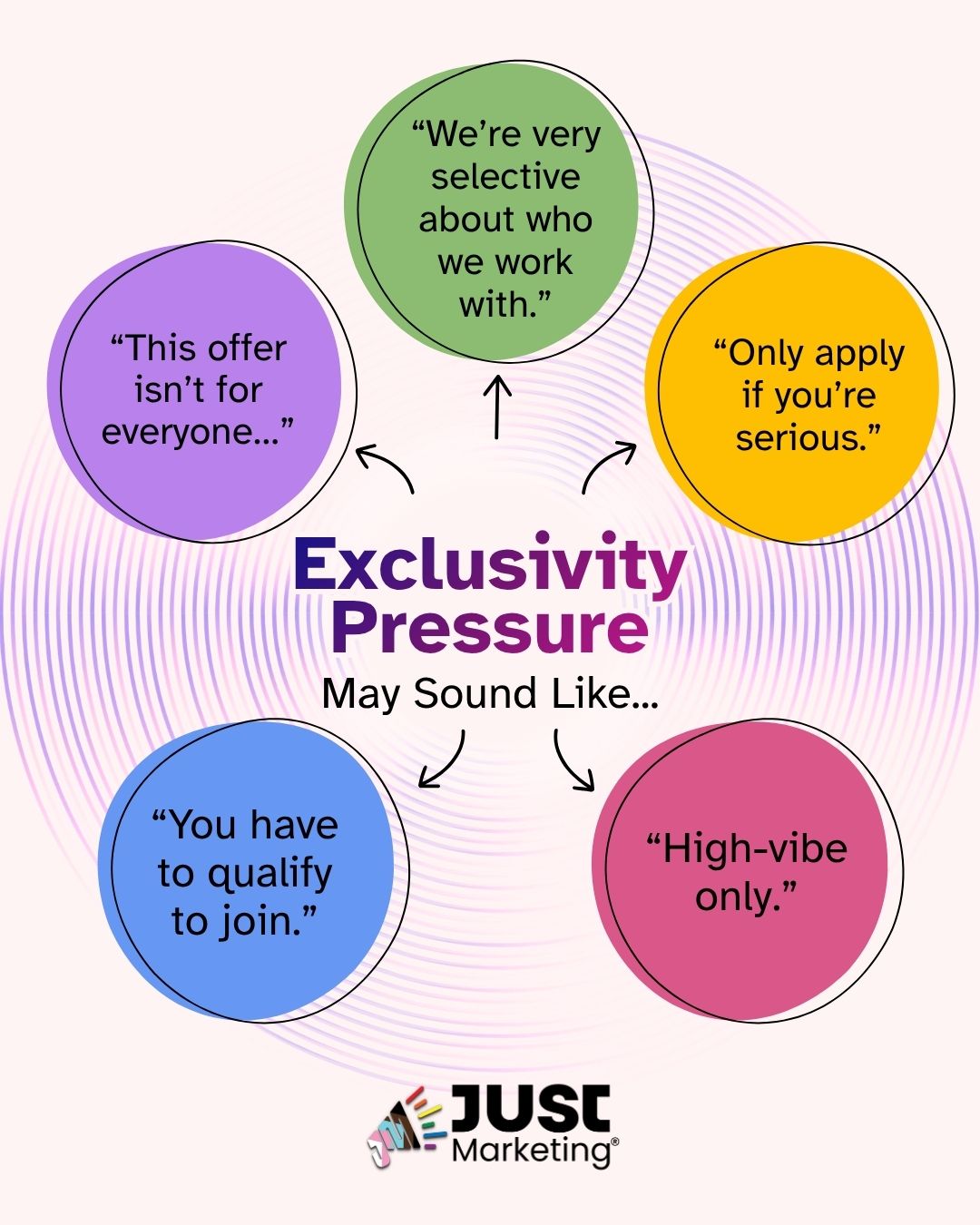
Some common exclusivity-pressure phrases include:
- “This offer isn’t for everyone…”
- “Only apply if you’re serious.”
- “We’re very selective about who we work with.”
- “High-vibe only.”
- “You have to qualify to join.”
At first glance, this type of language might sound confident or even helpful – it filters out folks who aren’t a good fit, right?
But there’s a difference between clarity and gatekeeping. Between communicating who your offer is best for… and implying that people need to earn the right to access your support.
In practice, exclusivity pressure can create an unnecessary power dynamic that favors certain traits, behaviors, or levels of privilege – whether intentional or not. And that’s where the harm creeps in.
Why Is Exclusivity Pressure Harmful?
Exclusivity pressure isn’t just about filtering clients. It’s often rooted in urgency, hierarchy, and worthiness narratives that reinforce harm – especially for those already navigating systemic exclusion.
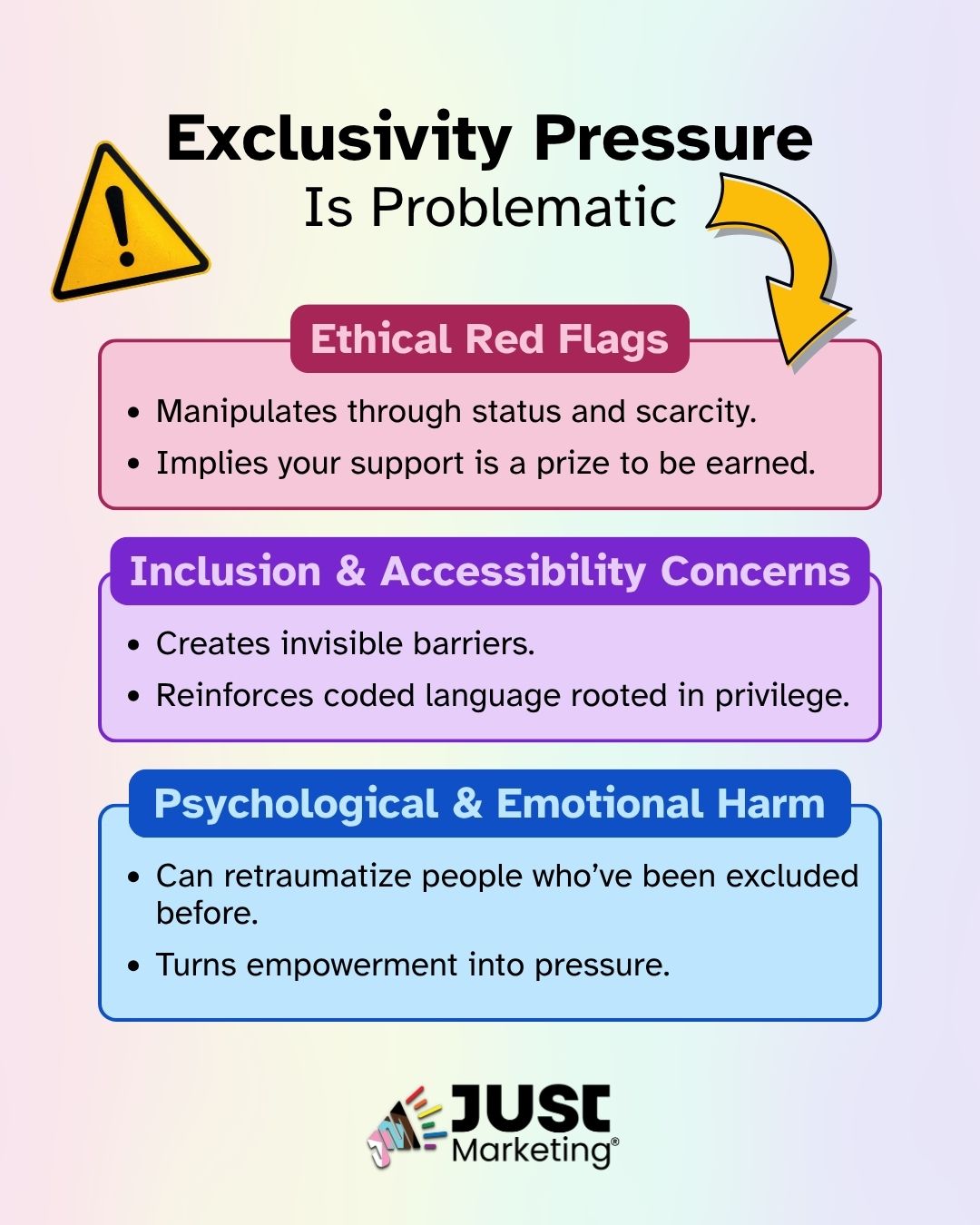
Here’s how it misses the mark ethically, inclusively, and accessibly:
Ethical Red Flags
- It manipulates through status and scarcity.
Framing something as “not for everyone” taps into a deep psychological need to belong – but instead of offering belonging, it positions the offer as a badge of worthiness.
- It implies your support is a prize to be earned.
When entrepreneurs talk about how selective they are, it can create a power imbalance that says, “You’re lucky if I choose you” – instead of fostering mutual alignment.
Inclusion & Accessibility Concerns
- It creates invisible barriers.
Language like “high-vibe only” or “action-takers only” excludes neurodivergent folks, disabled people, or anyone who doesn’t operate at a mainstream pace or energy level.
- It reinforces coded language rooted in privilege.
Terms like “serious entrepreneurs” or “only for go-getters” often align with capitalist, white-centric, neurotypical definitions of success. That’s a narrow – and harmful – filter.
Psychological & Emotional Harm
- It can retraumatize people who’ve been excluded before.
Many marginalized folks have internalized the message that they’re “too much” or “not enough.” Exclusivity pressure can trigger shame and self-doubt, especially when it’s framed as a reflection of their readiness or worth.
- It turns empowerment into pressure.
Tactics that sound confident may actually push people into making decisions that aren’t fully aligned – just to prove they’re worthy.
Exclusivity pressure may boost conversions in the short term, but it does so by reinforcing the very systems Just Marketing® aims to dismantle. You can call in aligned clients without calling out the rest.
What Can I Say Instead of ‘This Isn't for Everyone'?
You don’t have to choose between being clear and being kind. Ethical marketing doesn’t mean being vague or letting anyone and everyone in – it means communicating who your offer is for in a way that’s rooted in clarity, consent, and care.
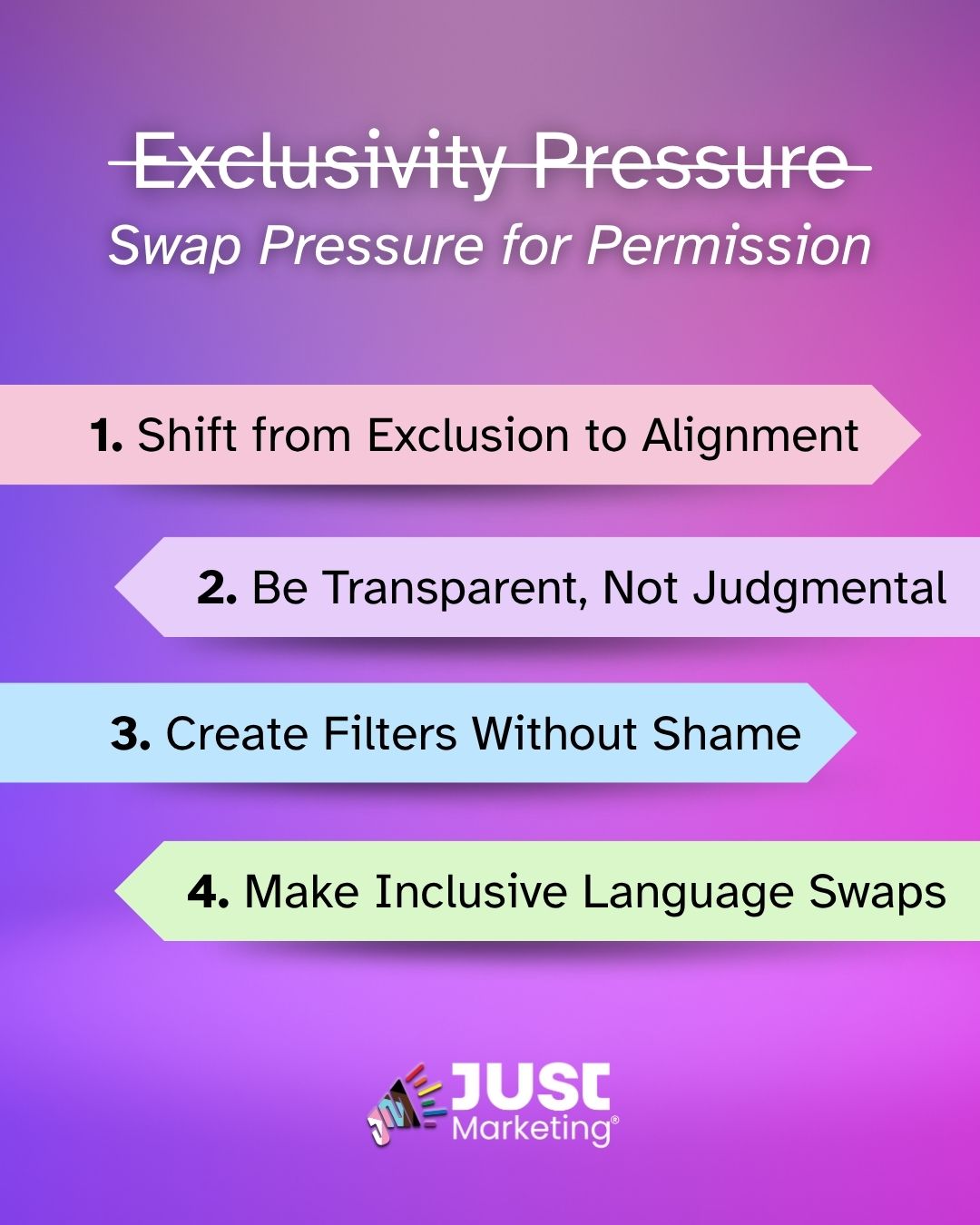
Let’s swap the pressure for permission. Here’s how:
1. Shift from Exclusion to Alignment
Instead of saying “This isn’t for everyone,” try:
“This is designed for [describe values, identity, or stage of business] who are looking for [desired outcome or experience].”
This reframes your message as an invitation – not a challenge.
2. Be Transparent, Not Judgmental
Instead of “Only apply if you’re serious,” try:
“This is a good fit if you’re ready to dedicate a few hours a week to implementing new strategies – and okay with progress over perfection.”
You’re still setting expectations, but in a way that welcomes neurodivergence, diverse energy levels, and different definitions of “serious.”
3. Create Filters Without Shame
Think values-aligned checkpoints – not status-based gates. Try:
- An FAQ with real talk about what to expect
- A quiz to help folks self-identify alignment
- A “Who this is for / Not for” list framed around capacity and compatibility – not worthiness
4. Make Inclusive Language Swaps
| Traditional Phrase | Just Marketing® Alternative |
|---|---|
| “This isn’t for everyone” | “This is ideal for folks who…” |
| “You must qualify to work with me” | “Let’s explore if we’re a fit” |
| “Only action-takers apply” | “This is best for folks ready to try something new” |
| “High-vibe only” | “Come as you are – your full self is welcome here” |
| “Only for serious entrepreneurs” | “Great for business owners ready to show up imperfectly” |
When you speak directly to your people without shaming or excluding others, you build deeper trust – and better conversions. Because people don’t want to feel pressured. They want to feel seen.
It’s Not About Being Perfect
If reading this is making you side-eye your past sales pages or cringe at a launch email you wrote in 2021… you’re not alone.
Most of us have used exclusivity pressure at some point. Not because we’re out here trying to be manipulative – but because it’s what we were taught. It’s what the big-name marketers modeled. And it’s what gets praised in a lot of high-ticket circles.
But Just Marketing® isn’t about shame or finger-pointing. It’s about unlearning harmful norms and rewriting our strategies so they actually reflect our values.
So no, you don’t need to scrub your website in a panic. Start where you are. Notice the patterns. Make conscious shifts.
This is iterative work. And every small change you make – to your language, your offers, your approach – ripples outward. That’s how we build a more inclusive, ethical business culture. One sentence at a time.
What Does Inclusive Sales Copy Look Like?
Theory is great – but let’s talk real-world application. Here’s what shifting from exclusivity pressure to values-aligned clarity can look like in your copy:
Before (Exclusivity Pressure): After (Just Marketing® Approach): “This program isn’t for everyone. We only accept driven, action-taking entrepreneurs who are 100% committed to doing the work. If you’re not ready to go all-in, this isn’t the space for you.” “This program is designed for values-driven entrepreneurs who are looking for a supportive space to build sustainable systems. If you’re navigating inconsistency, overwhelm, or burnout – you’re not broken, and you’re not alone. We’ll work together at a pace that honors your capacity.” What it communicates: There's one “right” way to be. If you don’t fit that mold, you’re not welcome. Readiness = constant hustle or intensity. What it communicates: Clear audience focus without judgment. Openness to different energy levels and lived experiences. Support without shame.
Practical Tips for Reframing Your Copy
- Instead of “qualify to work with me,” try “explore if we’re aligned.”
- Instead of “we only want serious clients,” try “we co-create a space where showing up imperfectly is welcome.”
- Ditch the “prove yourself” energy and opt for “permission to be fully yourself.”
Want to test your current messaging? Ask yourself
- Does this language invite or exclude?
- Who might feel “not enough” after reading this?
- Would someone with different access needs or energy levels feel safe here?
These questions can help guide intentional, inclusive edits – without sacrificing clarity or professionalism.
Connection Over Gatekeeping
Your offers can be clear and compassionate. Your messaging can be firm and flexible. And your business can grow without replicating the same harmful dynamics so many of us came here to disrupt.
When we let go of exclusivity pressure and lean into inclusive, empowering language, we don’t just attract the “right” people – we create safer, more welcoming spaces where people can truly thrive.
Because Just Marketing® isn’t about convincing people they belong – it’s about reminding them they always have.
Let’s Keep the Conversation Going
If this post got you thinking (or cringing a little at old copy – no shame), let’s connect:
- I’m hanging out on LinkedIn and Instagram – come say hi and share your thoughts.
- Want more ethical marketing tips you can actually use? Join my email list.
- Ready to shift your messaging to reflect your values and get results? Explore how we can work together.
FAQs
Being clear about who your offer serves is genuinely helpful. You can share that clarity warmly with a line like “This is designed for business owners who are looking for a supportive space to build sustainable systems.” It helps the right people recognize themselves while leaving everyone else feeling respected.
Focus on values, stage of business, and the kind of support someone is looking for. A “Who this is a great fit for” list centered on capacity and compatibility helps readers self-select with confidence. Clear, kind descriptions attract aligned clients naturally.
An application can be a helpful way to make sure an offer is a good fit for both of you. Framing it as a conversation, like “Let's explore if we're a fit,” keeps it welcoming. Keeping the form short and explaining what happens next makes it more accessible, too.
Try “Come as you are, your full self is welcome here,” or “This is best for folks ready to try something new.” Both describe the experience you offer and welcome people with different energy levels, access needs, and paces.
Scarcity marketing suggests there's a limited amount of something, like spots or time. Exclusivity pressure suggests only certain kinds of people are worthy of joining. Both can create stress, and both can be replaced with honest, transparent messaging. Learn more about using social proof without FOMO.
Read your copy and ask whether it invites or excludes, and who might feel “not enough” after reading it. Considering whether someone with different access needs would feel safe there is another helpful check. Just Marketing® is ethical, inclusive, and accessible, so your audience feels supported and your business grows sustainably. Explore the complete guide to Just Marketing®.