You’ve probably seen this play out before – a bold promise, a dreamy transformation, glowing testimonials, and then… a not-so-subtle nudge to “Act now before it’s too late!”
The gist: The 4Ps copywriting framework, short for Promise, Picture, Proof, Push, is a sales formula that makes a bold claim, paints a vivid outcome, backs it up with evidence, and nudges readers to act. The Just Marketing® reframe, Possibility, Picture, Proof, Permission, keeps that flow while inviting readers to decide when they're ready.
Part of the Conversion Copywriting Framework guide.
That’s the 4Ps copywriting framework in action: Promise the outcome, Picture the vision, offer Proof it works, and Push the reader to act.
It’s a formula that’s long been praised for its power to convert – especially on sales pages and in email marketing. And honestly? It can be compelling. But here’s the thing:
Compelling doesn’t always mean consensual.
When used without care, this framework can rely on inflated promises, emotionally manipulative urgency, and oversimplified success stories – tactics that feel icky at best, and predatory at worst. That’s not the vibe we’re going for around here.
In this post, we’re unpacking the 4Ps through a Just Marketing® lens – exploring what’s problematic, especially from an ethical, inclusive, and accessibility standpoint. And (because we’re all about solutions, not shame), I’ll share a grounded alternative that swaps pressure for permission – so your marketing can still convert, without the coercion.
What is the 4Ps Copywriting Framework?
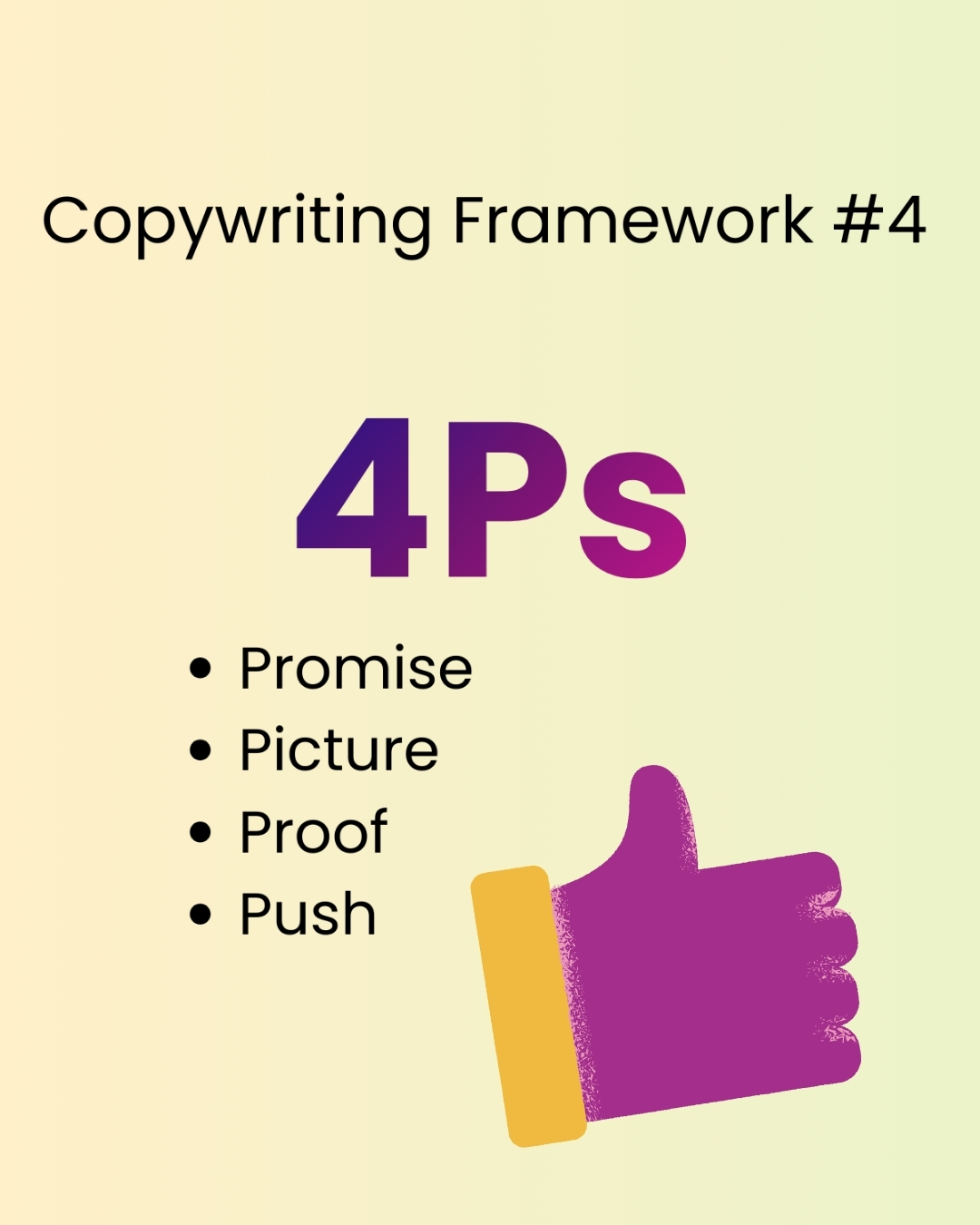
4Ps is short for Promise, Picture, Proof, Push. It is a sales formula that makes a bold claim, paints a vivid outcome, backs it up with evidence, and nudges readers to act.
1. Promise
Start with a bold, benefit-driven statement. This is the big hook – the transformation or result your offer can deliver. Think: “Double your income in 30 days” or “Finally ditch burnout for good.”
2. Picture
Paint a vivid image of what life looks like after they say yes. This step taps into the reader’s imagination. You want them to feel what’s possible – whether it’s sipping coffee with no inbox anxiety, scaling without hustle, or having more time for family.
3. Proof
Now that you’ve inspired them, it’s time to back it up. This often looks like client testimonials, data, or success stories. You’re building trust and showing that you (or your offer) can deliver what you say.
4. Push
This is the final nudge to act – often using urgency (“Doors close Friday!”), scarcity (“Only 3 spots left!”), or time-limited bonuses. The goal is to prompt quick decisions by adding a bit of pressure.
Where it shows up:
The 4Ps is especially common in:
- Long-form sales pages
- Email sales sequences
- Webinar scripts
- Product launches
It’s classic. It works. But it also comes with some sticky ethical issues – especially if you care about consent, accessibility, and trauma-informed communication.
Let’s take a look at what can go sideways… and how to do better.
What's Wrong With the 4Ps Copywriting Framework?
Even though the 4Ps framework works from a conversion standpoint, that doesn’t automatically make it ethical – or inclusive. When we pause to consider how it lands with real humans (especially those navigating marginalization, neurodivergence, or past experiences with manipulation), a few red flags pop up.
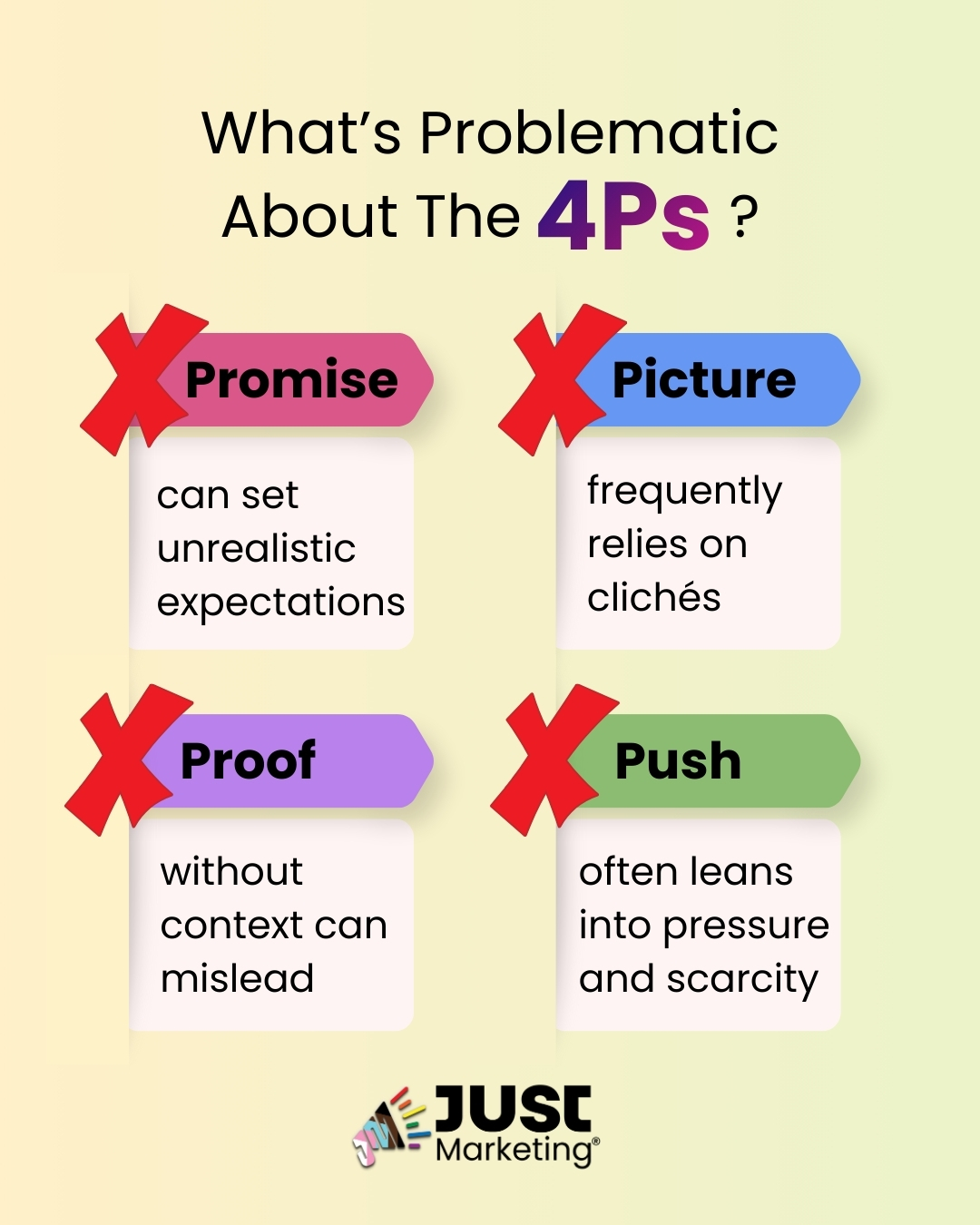
1. “Promise” Can Set Unrealistic Expectations
Marketing that leads with bold promises – like “Six figures in six weeks” – may sound enticing, but it can create false hope, especially for people who don’t have access to the same privileges, time, or resources.
When results are presented as guaranteed or universal, it can feel dismissive of the complexities people face – like chronic illness, caregiver duties, systemic barriers, or simply a different definition of success.
Just Marketing® Question: Are we offering hope… or setting someone up for disappointment?
2. “Picture” Often Leans on Clichés and Narrow Success Narratives
When marketers paint the “Picture” of what’s possible, they often fall back on tired tropes: working from the beach, passive income dreams, luxury lifestyles, or being “booked out” months in advance.
But here’s the problem:
These visions of success are not only overused — they’re also exclusionary.
They assume everyone wants the same things, ignore the nuance of lived experience, and reinforces a hyper-capitalist narrative of what it means to “make it.”
For many folks — especially neurodivergent entrepreneurs, caregivers, chronically ill folks, or anyone with a different set of values — success might look more like:
- Working fewer hours without guilt
- Having energy at the end of the day
- Creating stability, not scale
- Feeling safe, seen, and sovereign in their work
When we default to cliché success stories, we alienate the very people we say we want to serve.
Just Marketing® Question: Are we reflecting real, diverse visions of success — or just copying what we’ve seen others sell?
3. “Proof” Without Context Can Mislead
Testimonials and case studies are often cherry-picked to highlight only the most dramatic results – without any context around:
- The client’s starting point
- The support systems they had
- How long it actually took
- What privileges contributed to their outcome
This creates a distorted picture – one that can leave readers feeling like they must be the problem if they don’t get the same results.
Just Marketing® Question: Are we telling the full story… or just the shiny parts?
4. “Push” Often Leans Into Pressure and Scarcity
The “push” step is usually where urgency, scarcity, and FOMO show up. That might look like:
- Countdown timers that reset when you refresh the page.
- “Only 2 spots left!” messages (that magically never change).
- Language like “Don’t miss out!” or “This is your only chance!”
These tactics are designed to bypass thoughtful decision-making by tapping into anxiety and fear. For folks with trauma histories, executive dysfunction, or anxiety, this kind of pressure can feel deeply uncomfortable – even manipulative.
Just Marketing® Question: Are we inviting empowered decisions… or trying to corner someone into saying yes?
The good news? You don’t have to throw out the whole framework. We can keep the clarity and flow of the 4Ps – and shift it into something that centers autonomy, inclusion, and transparency.
Let’s explore an alternative: Possibility–Picture–Proof–Permission.
What's a More Ethical Version of the 4Ps?
The goal here isn’t to scrap the 4Ps – it’s to soften it.
Because the core structure is solid: you’re helping someone see what’s possible, trust your offer, and take action.
The problem isn’t the framework – it’s the force.
So let’s reimagine it through a Just Marketing® lens – one that replaces pressure with permission, and persuasion with partnership.
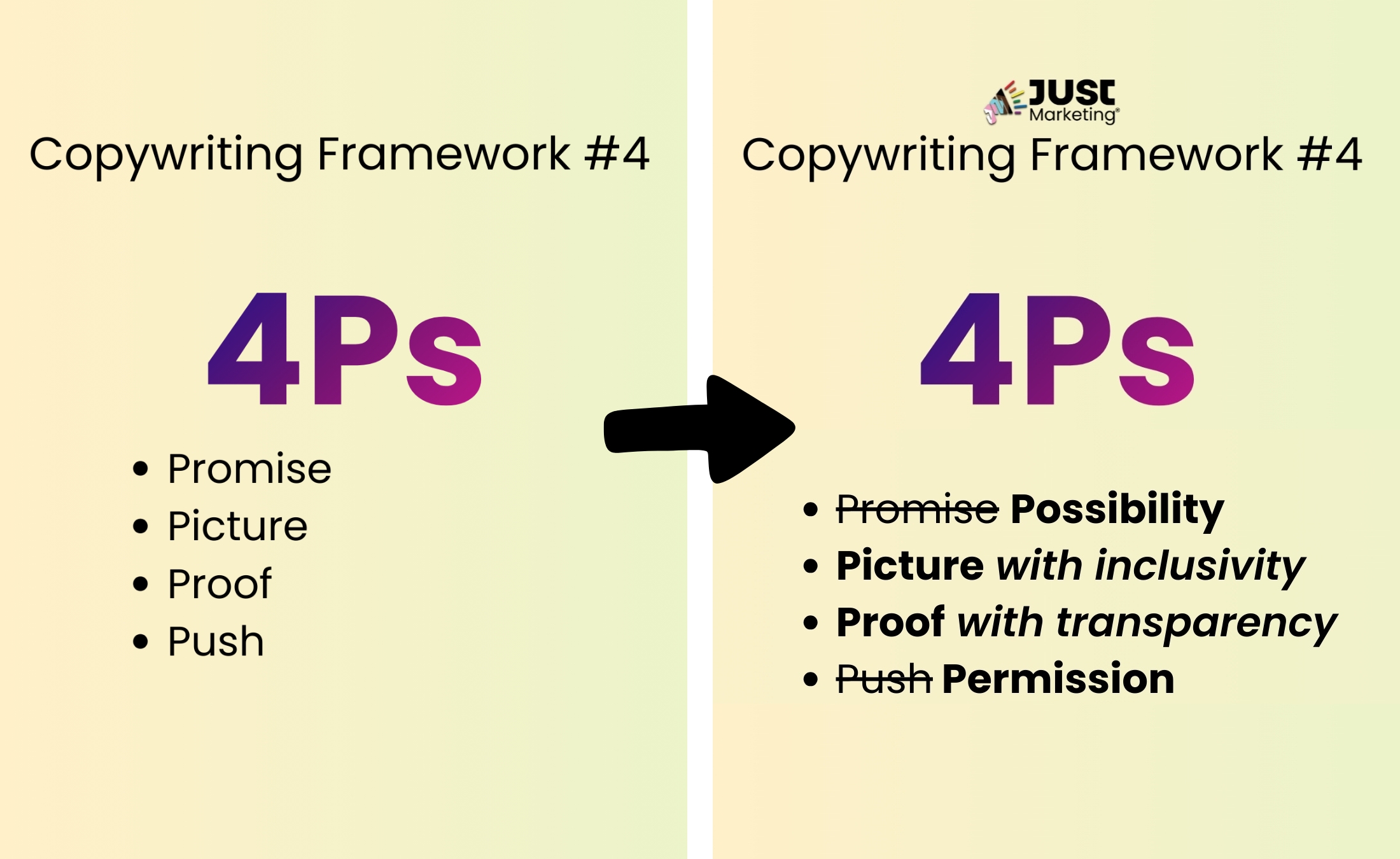
1. Promise → Grounded Possibility
Instead of bold, sweeping guarantees (“Make $10K in your first month!”), offer hope rooted in honesty.
Ethical promises focus on potential, not perfection. They communicate value without assuming universal results.
Try this instead:
- “You could see more consistent clients once your message clicks.”
- “Many of my clients experience greater ease and clarity in their marketing.”
- “Here’s what’s possible when you have the right systems in place.”
Grounded possibility allows room for nuance – and that nuance builds trust.
2. Picture → Paint with Inclusivity
When painting the picture, avoid the cliché “laptop on the beach” scene or a one-size-fits-all version of success. Invite your reader to imagine their version of thriving – whatever that looks like.
Try this instead:
- “Imagine having space in your week to rest – or pursue projects that light you up.”
- “Picture your marketing feeling sustainable and in flow with your energy.”
- “What does ‘success’ look like for you? That’s the vision we’ll co-create.”
By expanding what “success” can mean, you open the door for more people to see themselves in your story.
3. Proof → Transparent Testimony
Proof is powerful – but context makes it ethical.
Instead of cherry-picking wins or exaggerating outcomes, share stories that reflect the range of client experiences.
Try this instead:
- “Here’s what helped this client reach her goal – and what she’s still working on.”
- “This result came after 6 months of consistent effort and coaching.”
- “Our clients’ outcomes vary based on their time, energy, and access to support – and that’s okay.”
Transparency not only sets realistic expectations – it models honesty as a strength, not a risk.
4. Push → Permission
This is the biggest shift – and the heart of Just Marketing®. Instead of pushing for an immediate “yes,” you create space for consent, reflection, and alignment.
Try this instead:
- “If this feels like a fit, I’d love to chat more.”
- “No rush – explore the details and reach out when it feels right.”
- “You deserve to make marketing decisions that feel good in your body.”
Permission-centered marketing acknowledges that no is a valid answer – and that’s what makes the eventual yes so much more meaningful.
When we trade pressure for permission, we’re not weakening our marketing – we’re strengthening our relationships. We’re showing up with integrity, empathy, and transparency – the kind of energy that attracts clients who are truly aligned (and stick around).
What Does Ethical 4Ps Copy Look Like?
Let’s bring this framework to life with a side-by-side comparison.
Here’s what the traditional 4Ps often sounds like: Here’s how the same structure can be rewritten with Just Marketing® principles: Promise: Want to triple your income in just 30 days? Possibility: Curious about building a business that supports your energy and values? Picture: Imagine quitting your 9–5, working just 10 hours a week from anywhere in the world. Picture: Picture your schedule finally aligning with your capacity – space to rest and get things done. Proof: Our program helped Sarah hit $15K her first month – and she started with zero audience. Proof: After working together for 3 months, one of my clients reclaimed 10 hours a week and increased their income sustainably – after we clarified their messaging and built systems around their neurodivergent strengths. Push: Only 2 spots left – doors close tonight! Don’t miss out on this once-in-a-lifetime opportunity. Permission: If this feels like something you’d like support with, I’d love to connect. No rush – the next step is here when you’re ready.
See the difference? The tone is still inviting – still persuasive – but it prioritizes clarity, consent, and care over pressure and urgency.
This is how we market ethically without sacrificing results. Because real results are rooted in relationship, not manipulation.
Redefining Persuasion with Permission
The 4Ps framework isn’t inherently “bad” – it’s just often misused.
When we rely on pressure, inflated promises, and urgency, we risk turning our marketing into something that feels extractive or manipulative – and that’s the opposite of what we’re here to do.
But when we shift to Possibility–Picture–Proof–Permission, we’re not abandoning effectiveness. We’re choosing a version of persuasion that honors agency, supports accessibility, and respects the beautiful diversity of our audiences.
Marketing can feel good. It can be honest, spacious, and still wildly effective. And it starts with how we write.
Let’s Keep the Conversation Going
- Let’s connect
I’d love to hear your thoughts on this framework – or how you’ve seen it used (or misused!) in the wild. Come say hey on LinkedIn or Instagram. Let’s talk about what ethical marketing looks like in real life.
- Want more like this?
Join my email list for actionable Just Marketing® tips, neurodivergent-friendly strategies, and honest conversations about doing business differently.
- Curious about working together?
If you’re ready to build marketing systems that feel sustainable and values-aligned, learn more about working together here. I’d be honored to support you.
FAQs
They're two different tools that share a name. The 4Ps of marketing (Product, Price, Place, Promotion) describe the marketing mix for a business. The 4Ps copywriting framework (Promise, Picture, Proof, Push) is a structure for writing persuasive sales copy.
Try a permission-based invitation, like “If this feels like a fit, I'd love to chat,” or “Take your time exploring the details and reach out when it feels right.” If there's a genuine deadline, share it honestly with context. For more, see why countdown timers can backfire.
Use language that describes real possibilities, such as “you could” or “many of my clients experience,” and skip guaranteed outcomes. Specific income claims deserve extra care, since in the US the FTC expects them to be truthful and backed up. Honest expectations build lasting trust.
Ethical proof includes context, like how long a result took and where the client started. Sharing a range of experiences helps readers set realistic expectations for their own journey. Learn more about sharing client wins without exploitation.
Invite readers to picture their own version of thriving, which might mean more rest, steady income, or energy left at the end of the day. Asking “What does success look like for you?” welcomes people whose goals look different from the usual beach-and-laptop image.
The 4Ps works well for sales pages and launch emails, especially with a permission-based close. For story-driven pages, the PASTOR framework with a Just Marketing® remix is another great fit, and ACCA suits offers that need more explanation.