Have you ever clicked “buy now” on a $7 offer – thinking heck yeah, what a steal! – only to be immediately bombarded with upsells, countdown timers, and a guilt trip if you dare say no? Yeah… that is a tripwire in action.
The gist: A tripwire is a low-cost offer designed to turn browsers or subscribers into first-time buyers, often followed by upsells. It becomes manipulative when it's mainly bait for pressure-filled upgrades. An ethical tripwire delivers complete value on its own, with any next step offered as a clear, optional invitation.
Tripwires are a common sales tactic in the online business world. On the surface, they look like a win-win: low-cost, high-value offers meant to turn browsers into buyers. But here’s the thing – when they’re designed only to funnel folks toward higher-ticket purchases, they can cross the line from strategic to shady real quick.
(Note: Trip wires may also be called a “low-ticket offer,” “self-liquidating offer,” or “front-end offer.”)
Especially for neurodivergent buyers or anyone navigating financial insecurity, these tactics can feel manipulative, overwhelming, and downright deceptive.
In this post, we’re breaking down the truth about tripwires – how they work, why they can be problematic, and how you can either ditch them or use them in a way that builds trust instead of friction.
Because when it comes to sales funnels, it’s cool to be kind – and profitable.
What’s Wrong With Traditional Tripwires?
Tripwires can be useful tools – but too often, they’re built with the wrong intention. Instead of offering meaningful value, they’re designed to trigger an impulse buy and immediately shove people further down a sales funnel they didn’t consent to enter.

Let’s unpack some of the common issues that pop up when tripwires are used unethically:
1. The Bait-and-Upsell Trap
Tripwires are often just bait. The second someone clicks “buy,” they’re met with a barrage of offers, upgrades, and “just one more thing”s.
What started as a clear, low-cost offer suddenly turns into a confusing maze of decisions. This tactic doesn’t honor the buyer’s time, attention, or autonomy. Instead, it banks on fatigue and FOMO to squeeze out a bigger sale.
2. Preying on Impulse & Neurodivergence
Let’s be real: a $7 offer feels easy to say yes to. And many marketers count on that – especially when targeting audiences they know are juggling a lot (aka all of us).
This becomes especially harmful when those tripwires are followed by high-pressure, time-sensitive upsells that play on executive dysfunction or emotional urgency. It’s not strategy – it’s exploitation.
3. Undermining Your Own Value
If your $7 offer is truly valuable (and we hope it is!), why are you trying to immediately upsell people?
Tripwires often send the message that the “real” transformation only happens if folks upgrade. That can unintentionally devalue your low-ticket offer and leave people wondering if the first purchase was just a glorified commercial.
4. Prioritizing Profit Over People
At the heart of it, unethical tripwires prioritize conversion metrics over connection.
They assume every buyer is a lead to push through a funnel – not a whole human who deserves clarity, consent, and respect.
And that’s not the vibe we’re going for.
What Happens When Tripwires Are Used Unethically?
It’s easy to justify sketchy tripwire tactics in the name of “conversion rates” or “maximizing customer value”… but what happens when those short-term wins cause long-term harm?

Here’s what we see all too often when tripwires prioritize profits over people:
1. Buyer’s Remorse & Broken Trust
Sure, someone might say “yes” to that $7 offer – but if they immediately feel duped, overwhelmed, or tricked, you’ve likely lost them for good.
Even worse? They may start warning others to steer clear. (Word-of-mouth works both ways.)
2. Declining Engagement
When folks feel like your funnel is a trap, they’ll start ghosting your emails, ignoring your content, and tuning you out altogether.
High unsubscribe rates? Low open rates? That could be a signal that your funnel is doing more harm than good.
3. Lower Long-Term Conversions
Yes, aggressive upsells might boost revenue in the moment – but they rarely build loyal, aligned clients. Sustainable businesses are built on relationships, not one-time wins.
4. Burnout – for You and Your Audience
Let’s not forget your experience here. If your funnel relies on constant hustle, emotional manipulation, or techy trickery to work… that’s not a sustainable system.
It’s draining for everyone involved – and it pulls you further from the values that made you start your biz in the first place.
When tripwires are used unethically, they don’t just harm your audience – they sabotage your business’s integrity and impact.
But don’t worry: it is possible to use low-cost offers without falling into these traps.
How Do You Create an Ethical Tripwire?
If you’ve been side-eyeing your current funnel setup after reading this… you’re not alone. The good news? You don’t have to toss tripwires out completely – you just have to rebuild them with intention.
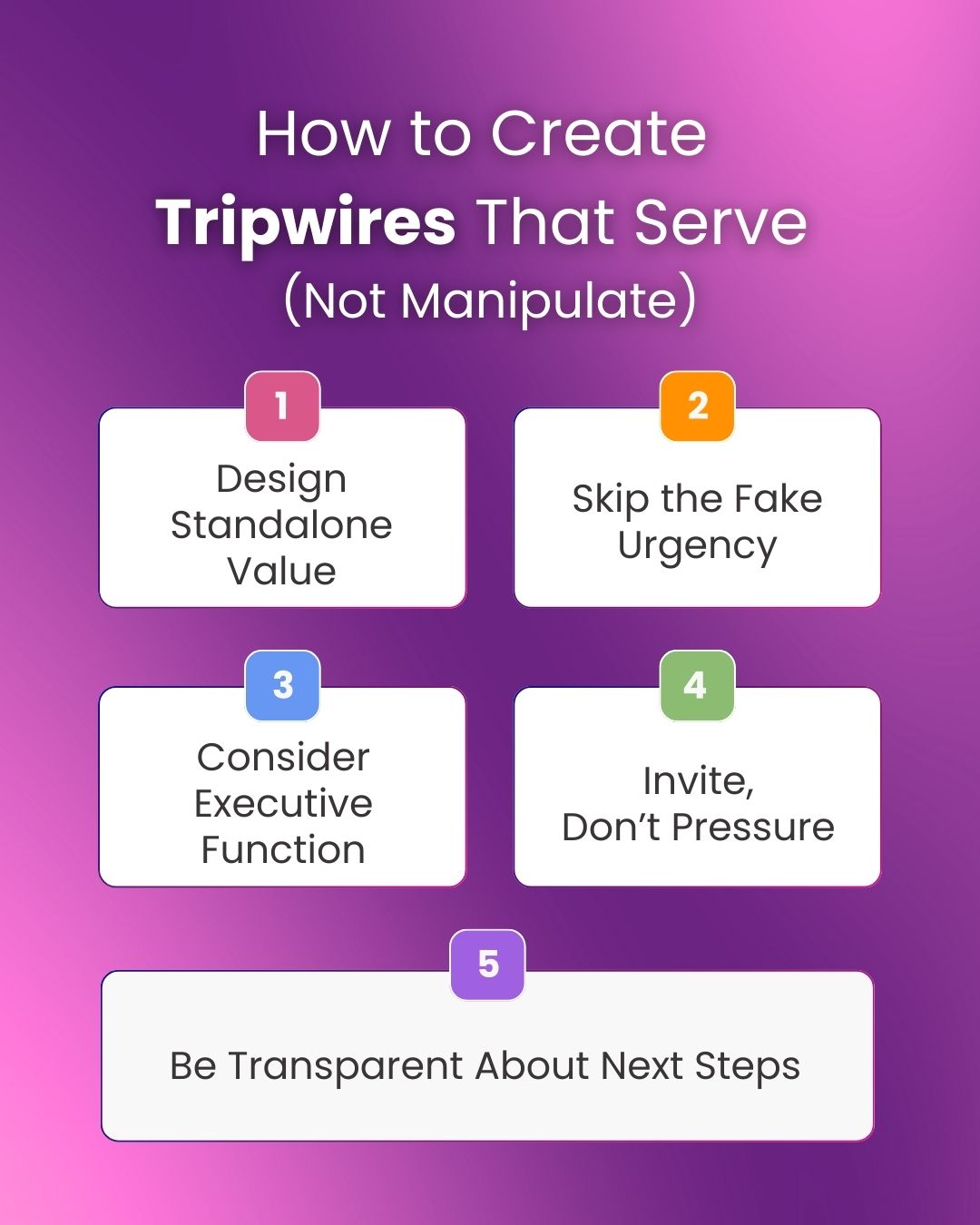
Here’s how to create tripwires that feel aligned for you and safe, accessible, and respectful for your audience.
1. Design Standalone Value
Your tripwire should not be a teaser. It should be something your buyer can use right away and get a tangible win from – without buying anything else.
Ask yourself:
- “If this were the only thing they ever bought from me, would they still feel supported?”
- “Would I feel proud if someone screenshot this and shared it with a friend?”
If the answer’s no – it’s time to rework the offer.
2. Skip the Fake Urgency
Those countdown timers and “one-time offer” pressure tactics? They might boost short-term conversions, but they do long-term damage to trust – especially for folks with trauma histories or decision anxiety.
If there is a legitimate deadline, explain why. Otherwise? Let people decide on their own timeline. Trust is more powerful than panic.
3. Consider Executive Function
Ethical funnels are neurodivergent-friendly funnels. That means:
- No overwhelming tech mazes.
- No 3-page upsell sequences.
- No guilt for clicking “no thanks.”
Keep things clear, calm, and optional.
4. Invite, Don't Pressure
If there is an upsell, frame it as a choice, not a consequence.
Try language like:
- “Want to go deeper with this?”
- “If this was helpful, here’s what’s next – no pressure.”
- “You can always come back when you're ready.”
This builds autonomy and shows respect for your audience’s capacity and boundaries.
5. Be Transparent About Next Steps
Don’t assume that someone who buys your $7 offer wants to be on your launch list, in your webinar funnel, or sold to daily. Let them choose what kind of contact they want from you.
Use preference centers, clear opt-ins, and let your values shine in your welcome messaging.
At the end of the day, your tripwire can be a tool for good – a way to help people say “yes” to themselves without feeling manipulated into something they didn’t want or need.
And isn’t that the kind of business you want to run?
What If You’ve Used Tripwires Before?
Let’s take a collective deep breath and say it together: “I didn’t know what I didn’t know.”
If you’ve used tripwires the traditional way – upsells, countdown timers, all the things – that doesn’t make you unethical. It makes you someone who was taught a system that’s been normalized in the online business world. A system that doesn’t always center people, consent, or accessibility.
Now that you do know better, you get to do better. That’s not shame – it’s growth.
Your values can evolve. Your systems can shift. And your audience will feel the difference when you lead with care and clarity.
Build Funnels That Serve, Not Manipulate: Keep the Conversation Going
Have you ever bought a low-cost offer and instantly regretted it once the upsells started flying at you?
Or maybe you’ve experimented with tripwires in your own funnel – trying to walk the line between strategy and sleaze – and you’re wondering if there’s a better way?
I’d love to hear your thoughts. What felt good? What hasn’t? Let’s connect on LinkedIn or Instagram and talk about how we can build funnels that honor consent, capacity, and community.
And if you're ready to create ethical, pressure-free marketing systems that reflect your values and serve your people with integrity – let’s talk – and keep building marketing systems that feel good for everyone!
FAQs
A lead magnet is free and usually given in exchange for an email address. A tripwire is a paid low-cost offer, sometimes called a low-ticket or self-liquidating offer, that turns someone into a first-time buyer. Both work best when they deliver real value on their own.
Many low-cost offers fall somewhere between $10 and $50, depending on what's included. Price it based on the value it delivers and what feels fair to your audience. Round, transparent pricing builds trust from the very first purchase. Here's why many values-driven businesses skip charm pricing.
A one-time offer (OTO) is an upsell shown right after someone buys, often with a discount that supposedly disappears if they leave the page. A genuinely helpful, clearly optional offer can be fine, and artificial pressure is where it turns manipulative. Learn more about one-time offers and how to use them ethically.
A good low-cost offer solves one specific problem completely, like a template or a short, focused training. Buyers should be able to use it right away and see a real result. If someone never bought anything else from you, they'd still feel their money was well spent.
You can, as long as it's clearly optional and easy to decline with a neutral “No thanks” button. One relevant offer is plenty, and a simple thank-you page with a link to learn more works beautifully too. Here's how to build consent-based funnels.
Tripwires are completely optional. Many values-driven businesses move people from a free opt-in to a thoughtful welcome sequence and then to their core offer. Choose the path that fits your offers and your audience. Here's how to write welcome sequences that nurture without manipulating.