Meg Brunson

  • Let’s GoHome
  • #AllTheThingsAbout Me
  • Read | Listen | WatchContent Library
  • Join TheMembership
  • Let’s WorkTogether

Making Better Marketing Decisions with ADHD

As an entrepreneur with ADHD, making marketing decisions can feel like a double-edged sword. On one hand, you’re quick-thinking, creative, and ready to dive headfirst into bold ideas. On the other hand, impulsivity and overwhelm can sometimes derail even the best intentions. Sound familiar?

Here’s the good news: When you understand how your brain works and embrace the strengths ADHD brings to the table, you can make marketing decisions that not only stand out but also drive results.

In this blog, we’ll dive into the unique strengths and challenges ADHD entrepreneurs face in decision-making, particularly when it comes to marketing. We’ll also explore practical strategies to help you harness your ADHD superpowers to build campaigns and strategies that truly shine.

Let’s turn what you may see as a challenge into your secret weapon for marketing success!


The Strengths and Challenges of Making Marketing Decisions with ADHD

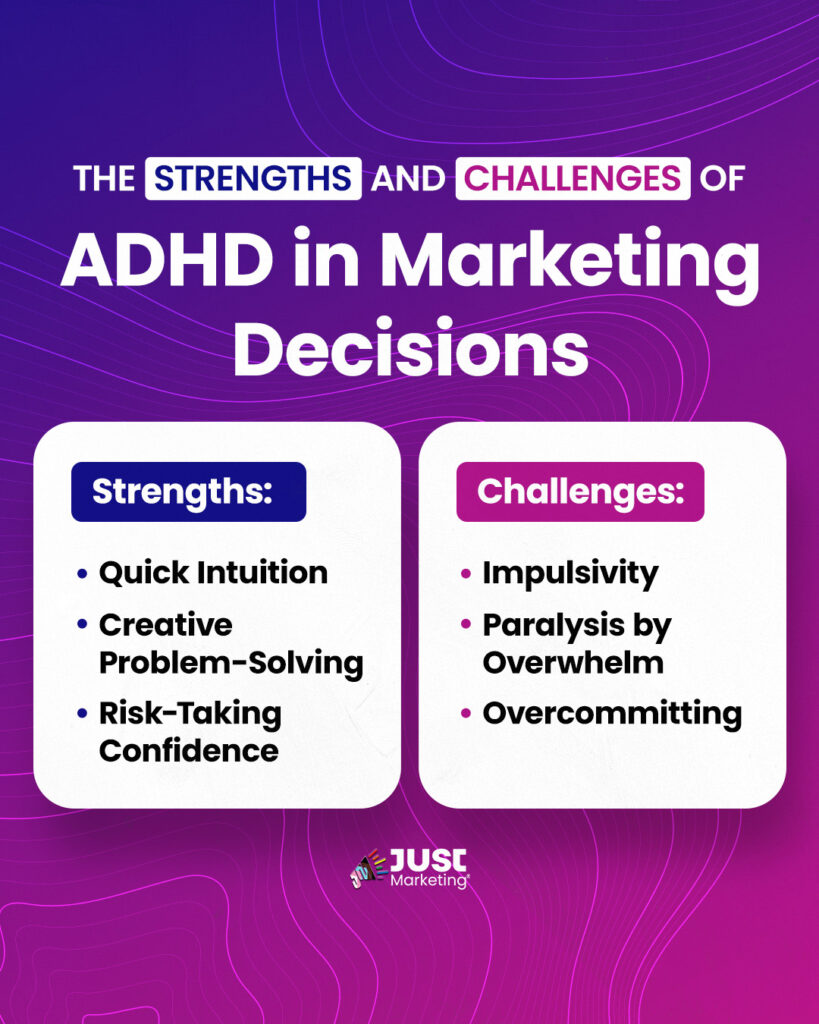
The strengths and challenges of ADHD in marketing decisions. Strengths: quick intuition, creative problem-solving, risk-taking confidence. Challenges: impulsivity, paralysis by overwhelm, and overcommitting.

ADHD brings a unique blend of strengths and challenges to the decision-making process, especially in marketing. Understanding both sides of the coin is the key to turning potential hurdles into opportunities. 

ADHD Strengths in Marketing DecisionsADHD Challenges in Marketing Decisions
Quick Intuition
ADHD brains thrive in fast-paced environments, making you naturally skilled at thinking on your feet. This ability allows you to adapt quickly to changing trends and market demands, often putting you ahead of the curve.
Impulsivity
While acting quickly can be a strength, it can also lead to decisions made without enough information or planning. This can result in wasted resources or missed opportunities to fine-tune a strategy for better results.
Creative Problem-Solving
Your mind’s ability to connect seemingly unrelated dots is a superpower when brainstorming innovative marketing strategies. While others stick to tried-and-true methods, you’re coming up with ideas that are fresh, exciting, and uniquely your own.
Paralysis by Overwhelm
With a million ideas swirling in your head, narrowing down your options can feel impossible. This can lead to analysis paralysis, leaving you stuck and unsure of where to start.
Risk-Taking Confidence
What others may see as impulsivity can translate into bravery for you. Your willingness to experiment with bold campaigns or unconventional approaches can help you stand out in a crowded marketplace.
Overcommitting
Your enthusiasm for exciting new ideas might lead you to say “yes” to too many opportunities. The result? You’re stretched too thin to give each project the attention it deserves, which can impact execution and outcomes.

By recognizing these strengths and challenges, you can harness what makes your ADHD brain special while implementing strategies to counterbalance the hurdles. 


Strategies for Harnessing ADHD Strengths in Marketing Decisions

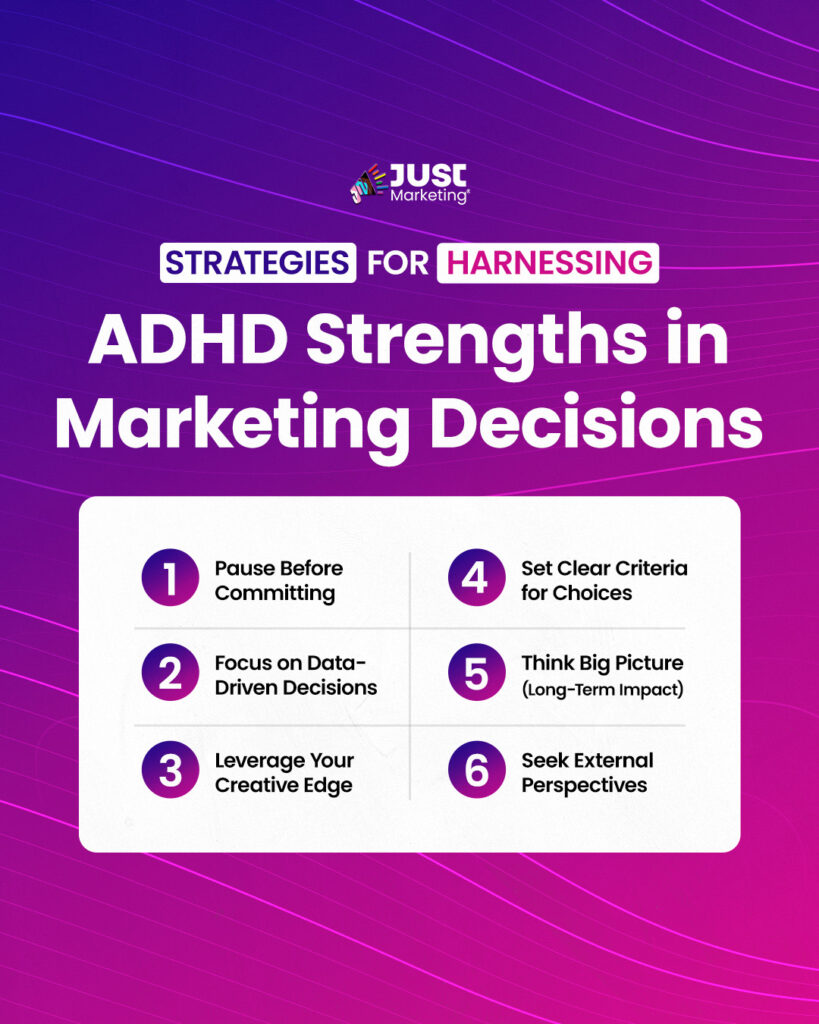
Strategies for harnessing ADHD strengths in marketing decisions: pause before committing, focus on data-driven decisions, leverage your creative edge, set clear criteria for choices, thing big picture (long-term impact), and seek external perspectives.

Let’s explore actionable strategies to help you harness your strengths, mitigate your challenges, and make marketing decisions that feel aligned, effective, and uniquely you.

1. Pause Before Committing

ADHD brains are wired for action. While this instinct can spark bold, creative moves, it can also lead to decisions made in the heat of the moment—decisions you might wish you’d reconsidered once the excitement wears off. By pausing before committing to a choice, you give yourself the opportunity to shift from reaction to reflection. This pause creates space for deliberate, thoughtful decision-making that aligns with your goals and values.

Pausing doesn’t have to mean grinding your momentum to a halt. Instead, it’s about building micro-moments of reflection into your process:

  • Set a Countdown Timer: When faced with a decision, set a timer for 10–15 minutes (or longer if the choice is complex). Use this time to step back and assess the situation before committing.
  • Take a Short Walk: Physical movement can help your brain process emotions and ideas more clearly. Even a quick lap around the room can create enough distance to reset your perspective.
  • Journal Your Thoughts: Write down what excites you about the decision, what concerns you, and how it fits into your overall goals. This simple act of putting thoughts on paper often reveals insights you might have overlooked.

By intentionally pausing, you’ll gain clarity and confidence, ensuring your decisions are grounded in strategy, not impulsivity.

2. Focus on Data-Driven Decisions

As an ADHD entrepreneur, your intuition is a powerful asset, helping you make quick decisions and take creative leaps. However, relying solely on gut feelings can sometimes lead to choices that don’t fully align with your goals or miss key opportunities. Incorporating data into your decision-making process balances your natural instincts with concrete evidence, ensuring your choices are both inspired and informed.

Grounding your decisions in data doesn’t mean stifling your creativity—it’s about giving your ideas a solid foundation. Here’s how to make data work for you:

  • Use Analytics Tools: Platforms like Google Analytics, social media insights, or email marketing dashboards can provide a clear picture of what’s working and what’s not. Before launching a new campaign or strategy, review the metrics to identify trends or areas of opportunity.
  • Create Checklists: Develop a simple checklist of questions to review before committing to a decision. For example:
    • What does the data say about this idea?
    • Have similar approaches worked well in the past?
    • How does this align with current audience needs or preferences?
  • Set Measurable Goals: Define specific outcomes you want to achieve with your decision. Instead of saying, “I want more engagement,” aim for something tangible like “Increase Instagram engagement by 20% in the next month.” Use this goal to evaluate whether your decision supports your desired results.

Data doesn’t replace your intuition—it enhances it. By combining your creative instincts with measurable insights, you can make marketing decisions that are both bold and backed by evidence.

3. Leverage Your Creative Edge

ADHD brains excel at seeing connections where others might not, making you a natural innovator. This creative edge thrives on novelty, helping you develop marketing ideas that stand out in a crowded marketplace. By intentionally tapping into this strength, you can create campaigns that captivate your audience and reflect your unique perspective.

Harnessing your creativity requires creating an environment that encourages and structures your brainstorming process. Here’s how:

  • Schedule Dedicated Brainstorming Sessions: Set aside time specifically for idea generation, free from distractions. Use tools like mind maps, sticky notes, or digital apps to capture your thoughts visually and keep the process fun.
  • Explore Unconventional Strategies: Think outside the box when planning campaigns. Could you use humor, storytelling, or unexpected formats like memes or user-generated content? Give yourself permission to experiment.
  • Collaborate with Others: Partnering with a colleague or friend can help refine your ideas while adding fresh perspectives. ADHD creativity often thrives in collaborative settings where energy and ideas bounce off each other.
  • Capture Inspiration as It Strikes: ADHD creativity isn’t limited to formal brainstorming sessions. Keep a notebook, app, or voice memo handy to jot down ideas whenever they hit. You’ll build a treasure trove of inspiration to revisit later.

Your creative edge is an advantage that can help your marketing not just succeed but shine. By giving your ideas structure and space to flourish, you’ll turn your novelty-driven thinking into strategies that captivate and convert.

4. Set Clear Criteria for Choices

When you have ADHD, the flood of ideas can feel exhilarating—but it can also be overwhelming. Without a clear framework, it’s easy to get lost in the excitement of possibilities, leading to choices that don’t align with your goals or stretch your capacity too thin. Setting clear criteria helps cut through the chaos, giving you structure and focus to evaluate options effectively.

Creating a simple decision-making framework can guide your choices, ensuring they’re intentional and strategic. Here’s how to implement it:

  • Use a Decision Template: Develop a go-to list of questions to evaluate each idea or opportunity. For example:
    • Does this align with my long-term business goals?
    • What’s the potential return on investment (ROI)?
    • How much time, energy, or resources will this require?
    • Are there any risks I need to consider?
  • Prioritize What Matters Most: Decide on non-negotiable criteria for your choices. For instance, if aligning with your values is essential, weigh that heavily in your decision-making process.
  • Visualize the Impact: Use tools like a pros-and-cons list or a simple scoring system to compare options. Assign scores based on how well each idea meets your criteria, helping you objectively identify the best fit.
  • Keep It Accessible: Save your template in a place where you can easily access it—whether that’s a physical notebook, a notes app, or a digital tool. Making it easy to refer to ensures you’ll actually use it when decisions arise.

By setting clear criteria, you can turn your big-picture vision into actionable steps, ensuring that your decisions support your goals while respecting your capacity. It’s not about limiting your creativity—it’s about channeling it into choices that move you forward.

5. Think Big Picture (Long-Term Impact)

ADHD brains are wired for excitement and novelty, which makes it tempting to chase short-term wins or quick gratification. However, marketing success often requires playing the long game. By focusing on the big picture, you ensure that your decisions not only feel good in the moment but also contribute to sustainable growth and long-term goals.

Shifting your focus to long-term impact doesn’t mean ignoring short-term results—it’s about balancing immediate needs with future outcomes. Here’s how to make this perspective part of your decision-making process:

  • Tie Decisions to Your Goals: Before committing to an idea, ask yourself:
    • Does this align with my long-term business vision?
    • How will this decision help me achieve my key goals over the next six months, year, or beyond?
      Writing these goals down and keeping them visible can help you stay focused on the bigger picture.
  • Project Future Outcomes: Consider how your choice will play out over time. For example:
    • Will this decision build lasting connections with my audience?
    • How will I feel about this decision a month or a year from now?
      Taking a moment to project the impact can help you avoid decisions driven by fleeting excitement.
  • Schedule Regular Reviews: Block time monthly or quarterly to evaluate how your recent decisions have impacted your progress toward long-term goals. This habit allows you to adjust your strategies and ensures your decisions remain aligned with your overarching vision.

By keeping the long-term impact in mind, you can make choices that support lasting success and growth. It’s about creating a balance—honoring the thrill of the present while building a foundation for the future.

6. Seek External Perspectives

ADHD can make it difficult to see the full picture when you’re deep in the decision-making process. Whether it’s hyperfocus on one detail or impulsivity driving a choice, blind spots can creep in. Seeking external perspectives from trusted mentors, peers, or accountability partners helps counteract these blind spots, offering fresh insights and helping you avoid potential pitfalls.

Collaboration doesn’t mean giving up control of your decisions—it’s about using outside input to strengthen your ideas. Here’s how to incorporate this into your process:

  • Identify Trusted Allies: Build a network of people you trust—mentors, colleagues, or even friends—who understand your goals and can provide honest, constructive feedback.
  • Share Your Thought Process: When seeking input, explain your ideas, goals, and concerns clearly. Transparency allows others to offer feedback that’s both relevant and actionable.
  • Ask the Right Questions: Guide the conversation with specific questions like:
    • Do you see any risks I might be missing?
    • How does this idea align with my long-term goals?
    • What’s your honest opinion of this approach?
  • Be Open to Feedback: ADHD can make rejection or criticism feel personal, but remember that external input is meant to help, not hinder. Focus on the value of the insight rather than how it’s delivered.
  • Use Accountability to Stay Grounded: Regular check-ins with an accountability partner can help you pause, reflect, and refine decisions before acting on them.

By tapping into the wisdom and perspectives of others, you’ll create a more balanced, informed decision-making process. External insights don’t diminish your creativity—they enhance it, providing a safety net for your boldest ideas.


Next Steps: Make Better Marketing Decisions with ADHD
ADHD is a unique advantage. Transforming the way you make decisions. 3d icon of a computer with a bar graph displayed, one hand doing audience research, and another hand assembling a puzzle.

ADHD isn’t a limitation—it’s a unique advantage that can transform the way you make marketing decisions. By understanding your strengths, navigating your challenges, and implementing intentional strategies, you can channel your creativity, intuition, and energy into decisions that align with your goals and drive meaningful results.

Remember, the key is to work with your brain, not against it, so that you can make marketing decisions that feel both bold and strategic.

If you found these tips helpful, there’s plenty more where that came from! Subscribe to the blog to stay inspired with ADHD-friendly marketing strategies.

Categories: All Categories, Marketing with ADHD

Tags: Avoiding Burnout, Marketing Clarity, Marketing Confidence, Marketing Consistency, Marketing Productivity, Overcome Marketing Overwhelm, Time Management

Prev
Next

About Meg Brunson

Online marketing authority and former Facebook employee Meg Brunson combines their mission to build a more accessible and inclusive world, with their expertise in the digital marketing space.

Meg is on a mission to disrupt the status quo of marketing so that financial success is the byproduct of a genuine commitment to justice, rather than an end goal in itself.

Through Meg’s signature approach, Just Marketing®, businesses are implementing ethical, inclusive, and accessible marketing campaigns that make a positive impact on society and their bottom line, creating a virtuous cycle where profitability and responsible practices reinforce each other.

Meg is a professional speaker, children’s book author, host of the Just Marketing® podcasts, CMO of BetterCEO.app and CEO of Just Marketing®.

Follow me on Instagram @theMegBrunson
Five small shifts change how "lifetime access" lan Five small shifts change how "lifetime access" language actually lands with your audience.

1. Concrete timelines beat vague forever-language every time… a real end date, even a generous one, gives people something to actually plan around.

2. Skipping countdown-clock urgency, including the all-caps "gone forever" scare tactics, keeps the message calm instead of anxiety-inducing, especially for anyone already managing decision fatigue or a dysregulated nervous system.

3. Flexibility helps too. A downloadable version, an extension option, or an accommodation when someone needs one shows your policy in practice, not just on paper.

4. Presentation matters just as much as the message itself. A quick FAQ, a comparison chart, or a simple graphic (hi, this post) makes access terms easy to actually find, and…

5. Repeating that information across your offer page, emails, and onboarding means nobody has to go hunting through fine print to know what they signed up for.

This is communication that respects how people actually process information, especially neurodivergent and disabled folks who benefit most from clarity over cleverness.

Read the blog for the complete list plus copy-and-paste templates: MegBrunson.com/lifetime-access

Which of these five do you already do well in your marketing?

One small change is a great place to start if the answer is none yet.

ID: 'Just Marketing Lifetime Access Tips' sit over a large purple number five on a purple-to-magenta gradient background. Five tips: 'Use concrete timelines, Avoid urgency triggers, Offer flexibility when you can, Use visual aids or bullets, and Repeat important info in multiple places.'

#JustMarketing #EquityForAll #MarketingWithHeart #MarketingWithIntegrity #EquityCenteredBusiness #SocialJustice #AlignedBusiness #EthicalMarketing #OnlineBusinessMarketing #EthicalBusiness #OnlineMarketingTips #MarketingWithADHD #ContentMarketing #ContentMarketingMembership #WeeklySocialContent #a11y #ContentStrategy #InclusiveMarketing #AccessibleMarketing #DEIMarketing #SocialMediaForAll #ContentCreation
Moving away from "lifetime access" doesn't mean yo Moving away from "lifetime access" doesn't mean your offer suddenly sounds complicated. 

It just means naming your actual access window out loud.

Instead of promising forever, try something specific: "You'll have access for 12 months, with a reminder before it ends," or "Access runs through December 2026, and I'll give you 90 days' notice if anything changes." 

That kind of clarity respects your business's real capacity while still giving buyers something solid to plan around.

Explaining the reason behind an access window turns a limit into information instead of a loss. 

A line like "I've capped this at two years so I can keep the content updated and manageable for my small team" tells people exactly what they're getting and why.

A defined timeline is simply kinder than an undefined one. 

Buyers get to make an informed choice about what they're purchasing, plan for what happens after access ends, and trust the terms won't shift without warning.

Read the blog for templates you can copy straight into your next offer: MegBrunson.com/lifetime-access

If you've replaced "lifetime" with a real access window, what language did you land on? 
Share it below.

ID: The heading reads 'Lifetime Offers, Setting Clear Limits Without Scarcity Tactics' over a soft rainbow gradient background. Four speech-bubble boxes arranged in a grid read 'Be Direct, Not Dramatic' in blue, 'Lead with Why' in purple, 'Remember, Boundaries Are Kind' in pink, and 'Respect Their Autonomy' in green. The Just Marketing logo is at the bottom.

 #JustMarketing #EquityForAll #MarketingWithHeart #MarketingWithIntegrity #EquityCenteredBusiness #SocialJustice #AlignedBusiness #BeTheChange #DismantleWhiteSupremacy #DiversityEquityInclusion #EthicalMarketing #OnlineBusinessMarketing #EthicalBusiness #OnlineMarketingTips #DEI #ValuesMatter #MarketingWithADHD #adhdBusiness #adhdBusinessOwner #ContentMarketing #ContentMarketingMembership #WeeklySocialContent #a11y #ContentStrategy #InclusiveMarketing #AccessibleMarketing #DEIMarketing #SocialMediaForAll #ContentCreation
How often should you actually post on social media How often should you actually post on social media?

The advice out there is loud and contradictory: post daily, hit three posts a day, batch a month of content in one sitting, stay consistent or the algorithm forgets you exist.

Here's what's true: platforms do reward consistency, but a pace that burns you out isn't a sustainable strategy - it's a countdown to an abandoned account.

One post a week for a year gives you 52 touchpoints with your audience and a content library that reflects who you are. 

Three posts a day for two weeks followed by two months of silence gives your audience a pattern they can't rely on.

A realistic starting point: two posts a week, rotating through educational, credibility, engagement, and promotional content. That rhythm builds a balanced mix without becoming a second job.

Give any new rhythm 60-90 days before evaluating it. Growth on social is slow and nonlinear, and momentum favors whoever stayed consistent long enough to build it.

What posting frequency has actually felt realistic for you? 

Curious whether people tend to overcommit or underestimate themselves... let me know in the comments.

ID: I'm standing in front of a crowd of people at a Pride festival. I have long pink hair pulled to one side and an undercut. I'm wearing rainbow glasses and a  pink T-shirt reading 'Erase Transphobia'. I'm smiling and resting one hand on my hip, displaying rainbow bracelets and a colorful tattoo on my forearm.

 #JustMarketing #EquityForAll #a11y #EquityCenteredBusiness #DiversityInMarketing #SocialJustice #RacialJustice #BeTheChange #DismantleWhiteSupremacy #DiversityEquityInclusion #EthicalMarketing #InclusiveMarketing #AccessibleMarketing #MarketingAccessibility #SocialMediaMarketer #EthicalBusiness #MarketingCoach #CommunityOverCompetition #MarketingWithPurpose #MarketingWithImpact #DEI #DEIMarketing #SocialMediaForAll #ContentCreation #ContentMarketing #ContentMarketingMembership #WeeklySocialContent  #MarketingWithADHD #adhdBusiness #adhdBusinessOwner
"Lifetime access" isn't automatically a red flag. "Lifetime access" isn't automatically a red flag. 

Plenty of offers use it well, and the ones that work tend to share a few things in common.

1. Some are built entirely from evergreen material - pre-recorded videos, worksheets, guides - content that doesn't need live support or constant updates to stay valuable. That structure lets people move through it on their own timeline, which happens to be wonderfully ADHD- and spoonie-friendly.

2. Others simply fit the business behind them. A low-ticket, set-it-and-forget-it product that doesn't require ongoing moderation can support a lifetime promise without quietly burning out the person running it.

3. And for a lot of people, flexible access is simply kinder than a countdown timer. Long-term access gives room to pause, restart, and return whenever life allows, which matters for anyone managing fluctuating energy or a non-linear way of processing information.

A generous access window, a promise of advance notice before anything changes, and a downloadable backup plan keep "lifetime" both flexible and genuinely dependable.

Read the full post on the blog for the exact language we'd recommend if your offer fits this bill: MegBrunson.com/lifetime-access

Does your offer check any of these boxes? 

ID: The heading reads 'Lifetime Access, Is Helpful When...' over a soft, cloudy pastel background. Three rounded boxes list conditions: 'The Content Is Evergreen and Self-Paced' in pink, 'It Aligns with Your Business Model and Capacity' in purple, and 'It Serves Accessibility and Reduces Pressure' in blue. The Just Marketing logo is below.

 #JustMarketing #EquityForAll #MarketingWithHeart #MarketingWithIntegrity #EquityCenteredBusiness #SocialJustice #AlignedBusiness #BeTheChange #DismantleWhiteSupremacy #DiversityEquityInclusion #EthicalMarketing #OnlineBusinessMarketing #EthicalBusiness #OnlineMarketingTips #DEI #ValuesMatter #MarketingWithADHD #adhdBusiness #adhdBusinessOwner #ContentMarketing #ContentMarketingMembership #WeeklySocialContent #a11y #ContentStrategy #InclusiveMarketing #AccessibleMarketing #DEIMarketing #SocialMediaForAll #ContentCreation
Before adding "lifetime access" to your next offer Before adding "lifetime access" to your next offer, run it through four honest questions.

1. Ask yourself whether you've actually spelled out what "lifetime" means in this specific offer, rather than leaving it as a feel-good phrase doing all the heavy lifting. 

2. Consider whether what you can realistically sustain today, and years from now, lines up with what you're promising.

3. Get honest about what you can actually deliver and for how long.

4. And check whether your audience has enough real information to make an informed choice about what they're buying.

Answering yes across the board is a great sign you're already doing this ethically. 

Pausing on any one of them points to exactly where your offer could use more clarity before it goes live.

Save this post and run your own offers through it before your next launch.

Read the blog for more: MegBrunson.com/lifetime-access

Which question was hardest for you to answer honestly? 
I’m curious which one trips people up most.

ID: 'Lifetime Access, Questions to Ask Yourself' Four boxes list reflection questions: '1, Have I clearly defined what I mean by lifetime? 2, Does my current and future capacity align with this promise? 3, Am I being honest about what I can realistically deliver, and for how long? and 4, Am I respecting my audience's right to informed consent?' The Just Marketing logo is at the bottom.

 #JustMarketing #EquityForAll #MarketingWithHeart #MarketingWithIntegrity #EquityCenteredBusiness #SocialJustice #AlignedBusiness #BeTheChange #DismantleWhiteSupremacy #DiversityEquityInclusion #EthicalMarketing #OnlineBusinessMarketing #EthicalBusiness #OnlineMarketingTips #DEI #ValuesMatter #MarketingWithADHD #adhdBusiness #adhdBusinessOwner #ContentMarketing #ContentMarketingMembership #WeeklySocialContent #a11y #ContentStrategy #InclusiveMarketing #AccessibleMarketing #DEIMarketing #SocialMediaForAll #ContentCreation
I don’t take feedback like this lightly - because I don’t take feedback like this lightly - because I know how many entrepreneurs have been burned by rigid content formulas, bloated templates, or support that disappears once you pay.

The Content Marketing Membership is built differently:
~ Real strategy that adapts to your energy
~ Designed for neurodivergent brains
~ Made to support your voice - not replace it
~ And grounded in community care, not hustle culture

So when a member says I’ve gone above and beyond?
That’s the goal. Always.

If you’re ready for content support that actually feels supportive...
Visit ContentMarketingMembership.com or DM me!

ID: A red heart-shaped hot air balloon floats over a scenic landscape with trees and houses. The balloon has the words ‘Client Love’ on it. Overlaid text reads: ‘You’ve Really Gone Above & Beyond With This One.’ At the bottom is the website: ContentMarketingMembership.com. The image has a purple and pink gradient overlay.

 #JustMarketing #EquityForAll #a11y #EquityCenteredBusiness #DiversityInMarketing #SocialJustice #RacialJustice #BeTheChange #DismantleWhiteSupremacy #DiversityEquityInclusion #EthicalMarketing #InclusiveMarkeitng #AccessibleMarketing #MarketingAccessibility #SocialMediaMarketer #EthicalBusiness #MarketingCoach #CommunityOverCompetition #MarketingWithPurpose #MarketingWithImpact #DEI #DEIMarketing #SocialMediaForAll #ContentCreation #ContentMarketing #ContentMarketingMembership #WeeklySocialContent  #MarketingWithADHD #adhdBusiness #adhdBusinessOwner
Ever notice how many businesses run on someone els Ever notice how many businesses run on someone else's software? 

That's one of the first cracks in a "lifetime access" promise - platforms shut down, get bought out, or raise prices past what's sustainable, and a seller doesn't fully control that timeline no matter how confident the sales page sounds.

Then there's capacity. 

What felt manageable with five students can feel impossible with five hundred. A promise to support something "forever" can quietly turn into unpaid labor and burnout for the person running the show.

The pitfall that actually breaks trust, though: saying "lifetime" when what you really mean is "until I stop running this program." 

That gap between the word and the reality is where people feel misled, especially anyone who takes "forever" literally instead of as a marketing flourish.

Lifetime access can absolutely work… when a seller's capacity and a platform's reality can actually back up the promise being made.

Read the blog for how to spot these gaps in your own offers before they become a problem: MegBrunson.com/lifetime-access

Which one feels most relevant to your business right now: the platform risk, the capacity limit, or the clarity gap? 

ID: Heading reads, 'Lifetime Access Ethical Concerns.' A numbered timeline lists three colored boxes: '1, The Platform Problem' in pink, '2, The Capacity Conundrum' in purple, and '3, The Clarity Gap' in blue, with a yellow sticky note overlapping the third box reading 'AKA, The Trust Breaker.'

 #JustMarketing #EquityForAll #MarketingWithHeart #MarketingWithIntegrity #EquityCenteredBusiness #SocialJustice #AlignedBusiness #BeTheChange #DismantleWhiteSupremacy #DiversityEquityInclusion #EthicalMarketing #OnlineBusinessMarketing #EthicalBusiness #OnlineMarketingTips #DEI #ValuesMatter #MarketingWithADHD #adhdBusiness #adhdBusinessOwner #ContentMarketing #ContentMarketingMembership #WeeklySocialContent #a11y #ContentStrategy #InclusiveMarketing #AccessibleMarketing #DEIMarketing #SocialMediaForAll #ContentCreation
I want you to know something about me and my work: I want you to know something about me and my work:

I am on a mission to disrupt the status quo of marketing so that financial success is the byproduct of a genuine commitment to justice, rather than an end goal in itself.

Through Just Marketing®, equity-centered entrepreneurs and small businesses will implement ethical, inclusive, and accessible marketing campaigns that make a positive impact on society and their bottom line, creating a virtuous cycle where profitability and responsible practices reinforce each other.

I envision a world where Just Marketing® is *just* marketing.

A world where marketing is no longer synonymous with exploitation and manipulation.

Instead, every person is seen, respected, and celebrated through the buying process.

A world where ethical entrepreneurs and small businesses (not billionaires) set the standard for success, earn abundantly for their work, and align their impact toward advancing equity for all intersectional identities.

If this mission speaks to you…
Pull up a seat.
You belong here.

ID: Top section labeled 'Mission': ‘I am on a mission to disrupt the status quo of marketing so that financial success is the byproduct of a genuine commitment to justice, rather than an end goal in itself.’ Bottom section labeled ‘Vision’: ‘I envision a world where Just Marketing® is just marketing.’ Meg is smiling and standing among the cherry blossoms.

 #JustMarketing #EquityForAll #a11y #EquityCenteredBusiness #DiversityInMarketing #SocialJustice #RacialJustice #BeTheChange #DismantleWhiteSupremacy #DiversityEquityInclusion #EthicalMarketing #InclusiveMarkeitng #AccessibleMarketing #MarketingAccessibility #SocialMediaMarketer #EthicalBusiness #MarketingCoach #CommunityOverCompetition #MarketingWithPurpose #MarketingWithImpact #DEI #DEIMarketing #SocialMediaForAll #ContentCreation #ContentMarketing #ContentMarketingMembership #WeeklySocialContent  #MarketingWithADHD #adhdBusiness #adhdBusinessOwner
"Lifetime access" sounds simple until you start as "Lifetime access" sounds simple until you start asking who it's actually about… 

Nobody's timeline matches up, and most sellers never clarify which one they mean. 

That leaves buyers filling in their own definition of "forever," which rarely holds up once a platform changes hands or a business shifts direction. 

This gap hits especially hard for anyone who takes language at face value - you said lifetime, so that's what you expected.

Read the blog post for the exact questions worth asking before you use this phrase in your own marketing: MegBrunson.com/lifetime-access

Question for you: when you hear "lifetime access," whose lifetime do you assume it means? 

ID: Heading reads, 'The Vagueness of Lifetime Access,' with arrows pointing down to bold text asking 'Who's Lifetime?' Below, five colored questions read 'The buyer? The creator? The program? The platform it's hosted on? and Your Dropbox account?' A pensive, realistic capybara with question marks above its head sits beside the Just Marketing logo.

 #JustMarketing #EquityForAll #MarketingWithHeart #MarketingWithIntegrity #EquityCenteredBusiness #SocialJustice #AlignedBusiness #BeTheChange #DismantleWhiteSupremacy #DiversityEquityInclusion #EthicalMarketing #OnlineBusinessMarketing #EthicalBusiness #OnlineMarketingTips #DEI #ValuesMatter #MarketingWithADHD #adhdBusiness #adhdBusinessOwner #ContentMarketing #ContentMarketingMembership #WeeklySocialContent #a11y #ContentStrategy #InclusiveMarketing #AccessibleMarketing #DEIMarketing #SocialMediaForAll #ContentCreation
What should you actually post today? Most people What should you actually post today?

Most people assume their content struggles come from running out of ideas. Usually the real issue is different: no filter for sorting the ideas already sitting in your notes app.

Without a framework, every post turns into a dozen small decisions - topic, angle, tone, goal - all at once. That decision fatigue is what makes content creation exhausting, not a shortage of things to say.

A simple content mix solves this. Instead of asking "what should I post today?", ask "what type of content comes next in my rotation?" The blank page suddenly has a shape.

Try rotating through four content types:

1. Educational: teach something your ideal client needs to know. Builds trust and positions you as worth following.

2. Credibility: testimonials, case studies, results, stories that show your expertise in action.

3. Engagement: questions, polls, behind-the-scenes moments that spark conversation and help people feel like they know you.

4. Promotional: your offers and services. Letting people know how you can help is part of showing up for them.

Cycle through the four, and the blinking cursor stops being a problem. You've got a rotation and a plan... showing up is the only job left. 💕

Which of these four feels most natural to you? 
And what's the one you tend to dodge?

ID: I'm smiling with pink hair in an undercut style, pink glitter glasses, and purple lipstick, standing in front of a glass block and mesh window. I wear a pink t-shirt printed repeatedly with 'Abortion is healthcare' and have colorful tattoos on one forearm.

 #JustMarketing #EquityForAll #a11y #EquityCenteredBusiness #DiversityInMarketing #SocialJustice #BeTheChange #DiversityEquityInclusion #EthicalMarketing #InclusiveMarketing #AccessibleMarketing #MarketingAccessibility #SocialMediaMarketer #EthicalBusiness #MarketingCoach #CommunityOverCompetition #MarketingWithPurpose #MarketingWithImpact #DEI #DEIMarketing #SocialMediaForAll #ContentCreation #ContentMarketing #ContentMarketingMembership #WeeklySocialContent  #MarketingWithADHD
"Lifetime access"... One payment, and a promise th "Lifetime access"... One payment, and a promise that's supposed to last forever. 

It's the kind of phrase marketers love because it removes hesitation instantly, wrapping a purchase in the comfort of forever.

But a promise this big is worth examining. 

Is offering "lifetime access" actually ethical, or is it a feel-good shortcut that sounds better than it holds up?

Short answer: it depends entirely on what happens after someone hits "buy." 

A seller can call something "lifetime" and still build real trust, as long as the promise is specific enough to actually keep.

Just Marketing® is proven in the follow-through - the phrasing is just the opening line.

Read the full breakdown, including where this phrase tends to go sideways and what we'd recommend instead: MegBrunson.com/lifetime-access 

Have you ever offered (or bought) “lifetime access?” 
What was your experience actually like.

ID: 'Is Lifetime Access Ethical?' appears in bold purple and pink text, with 'Lifetime Access' stamped inside a purple badge beneath an open padlock icon. A faded, repeating 'Sale' pattern fills the light lavender background throughout the graphic.

 #JustMarketing #EquityForAll #MarketingWithHeart #MarketingWithIntegrity #EquityCenteredBusiness #SocialJustice #AlignedBusiness #BeTheChange #DismantleWhiteSupremacy #DiversityEquityInclusion #EthicalMarketing #OnlineBusinessMarketing #EthicalBusiness #OnlineMarketingTips #DEI #ValuesMatter #MarketingWithADHD #adhdBusiness #adhdBusinessOwner #ContentMarketing #ContentMarketingMembership #WeeklySocialContent #a11y #ContentStrategy #InclusiveMarketing #AccessibleMarketing #DEIMarketing #SocialMediaForAll #ContentCreation
You don't have to wait to start making your market You don't have to wait to start making your marketing more accessible.
You can start this week.

Here are six low-lift, high-impact shifts worth putting on your radar:

1. Simplify your language
Write the way you actually talk. If someone has to re-read a sentence twice to understand what you're offering, that's friction.

2. Add alt text and captions
To every image and every video. This one is genuinely non-negotiable, and it takes less time than you think, especially once it becomes a habit.

3. Use legible fonts and strong contrast
High contrast isn't just accessible; it's effective.

4. Reduce decision fatigue
If someone lands on your offers page and immediately feels overwhelmed by choices, they're likely to close the tab rather than figure it out. Simplify, and make it easy to say yes.

5. Offer flexible payment options
Sliding scale pricing, payment plans, and community-funded scholarships aren't just generous - they're strategic. They open your work to people who are deeply values-aligned but navigating real financial constraints.

6. Give people time
Countdown timers and "only 3 spots left!" language create urgency… but they also create stress, especially for folks with time blindness or anxiety. The right people will make empowered decisions when they're ready.

These are all small, intentional choices that add up to a meaningfully more accessible business over time.

Pick one, and make that shift this week.

The blog goes deeper on the biggest offer-level accessibility barriers and how to address them in a way that supports both your audience and your sustainability: MegBrunson.com/marketing-accessibility

Which of these six feels most doable for you right now?

ID: 'Quick Wins for More Accessible Marketing' appears in bold purple. Six rectangles with checkmarks, list tips: 'Simplify your language, Add alt text and captions, Use legible fonts and strong contrast, Reduce decision fatigue, Offer flexible payment options, and Give people time.'
Follow on Instagram


Links

CMM Log In
Mission, Vision, & Values

DEI Statement
Leadership Philosophy
Community Agreements
Press & Media


Beliefs

Black lives matter.
Love is love.
Abortion is healthcare.
No human is illegal.
Free Palestine.
I also Believe…

Circular badge has the name "Meg" in the middle and is surrounded by: "CEO, author, speaker, marketer, leader, & advocate"

Let’s Connect

  • facebook-official
  • instagram
  • bluesky
  • linkedin
  • youtube-play
  • email
Copyright © 2026|All Rights Reserved|Meg Brunson, LLC| Privacy & Terms