If you’ve spent any time around conversion copywriting, you’ve probably met FAB. It stands for Features, Advantages, Benefits – a classic framework designed to move your messaging from “here’s what it is” to “here’s why you care.”
And, it does work. FAB helps us translate what we offer into real-life relevance for our audience. Instead of listing dry product specs or service details, we start highlighting what people actually gain.
The gist: The FAB framework, short for Features, Advantages, Benefits, is a copywriting formula that translates what your offer includes into why it matters to your audience. The Just Marketing® approach expands the “benefit” to include community and collective impact, so your copy reflects your values alongside personal results.
Part of the Conversion Copywriting Framework guide.
Take this example:
Feature: A 6-week coaching program
Advantage: You’ll get structured support each week
Benefit: You’ll finally follow through without burning out
Nice, right? Clear. Concise. And relatable.
But here’s the thing: traditional marketing stops there. The framework assumes every benefit should appeal to personal gain – productivity, profit, status, ease. And when that’s the only goal, it can quietly reinforce extractive patterns and leave justice, accessibility, and community impact out of the picture.
So in this post, we’re digging into the FAB framework with a Just Marketing® lens:
- What makes it work
- Where it can go sideways
- And how to flip the script so your copy supports people and collective progress
Let’s make FAB more ethical – and more fabulous.
What Is the FAB Copywriting Framework?
FAB is a go-to framework in the copywriting world because it helps shift focus from the thing you’re selling to the reason someone might want it. It’s about translating features into outcomes, helping your audience see themselves in your offer.
Let’s break it down:
- Feature – What your offer is or includes. Think: the nuts and bolts. Tangible details like “6 weekly calls,” “lifetime access,” or “custom templates.”
- Advantage – What the feature does for the user. This is where you connect the dots: “Weekly calls mean you have consistent, structured support.”
- Benefit – Why it matters. Here’s where the emotional resonance comes in: “So you can follow through on your goals without burning out.”
This framework works because it helps your audience understand how your offer fits into their life. It’s clear. It’s structured. And when done well, it makes your copy feel less salesy and more supportive.
In short: FAB helps you move from “Here’s what I do” → “Here’s how it helps.”
But just because something works, doesn’t mean it works for everyone. And that’s where we start to unpack things…
What Are the Problems With FAB?
FAB has its strengths – but like many traditional marketing tools, it wasn’t designed with ethics, inclusion, or accessibility in mind. When we use it uncritically, it can end up reinforcing some pretty harmful dynamics.
Here’s what gets sticky:
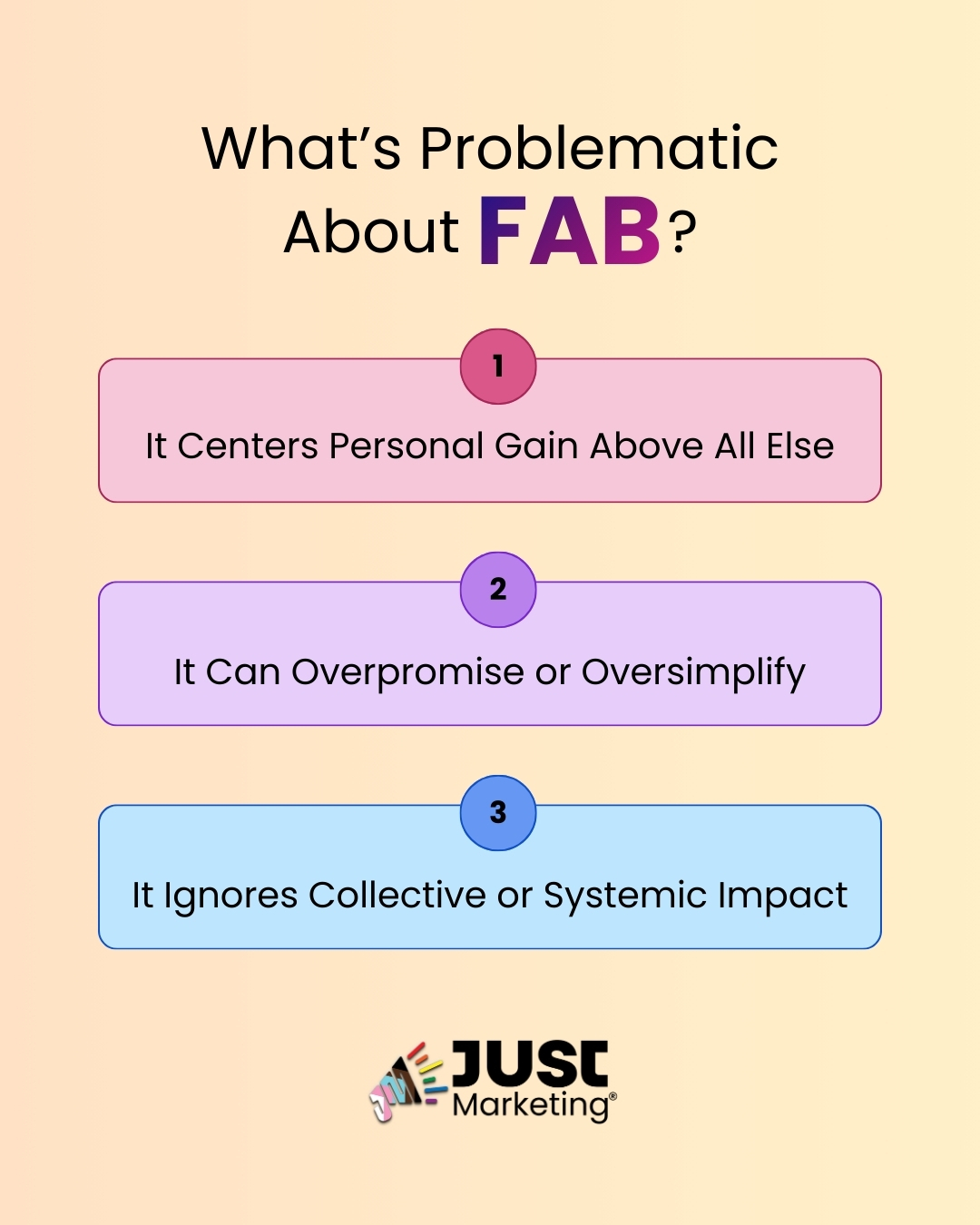
1. It Centers Personal Gain Above All Else
FAB is often used to answer the question, “What’s in it for me?”
And while that’s not inherently bad, it can become a problem when personal gain is the only focus. This kind of messaging can unintentionally promote individualism, competition, and even entitlement.
Instead of: “Sign up now to get ahead!”
Try: “Join us in creating more accessible, sustainable systems.”
In a justice-centered business, we want to inspire action without centering extraction or self-interest as the primary motivator.
2. It Can Overpromise or Oversimplify
FAB is great at making things sound appealing. But when we’re too benefit-heavy, there’s a risk of making promises that gloss over nuance – especially when talking to folks who’ve been burned by hustle culture, neurotypical productivity expectations, or predatory marketing.
“You’ll double your revenue by working less!” That’s a red flag. That kind of messaging can be manipulative – and it’s rarely one-size-fits-all.
We need to be especially mindful of the power dynamics at play. Benefits that feel exciting to one person might feel exclusionary or misleading to another.
3. It Ignores Collective or Systemic Impact
Most FAB copy stops at “Here’s how YOU win.” But for values-led buyers, that’s not enough. They want to know:
- Who else benefits from this offer?
- How does this support equity, sustainability, or community?
- Am I contributing to something bigger than my own success?
Instead of: “You’ll finally reach your goals.”
Try: “You’ll reach your goals while helping dismantle systems that keep others out.”
FAB can feel shallow if we don’t expand it to reflect a more holistic understanding of impact. And that’s where our ethical rewrite begins.
How Can You Make FAB Copy More Ethical?
Here’s the good news: FAB itself isn’t the problem. It’s how we use it.
When you apply it with awareness and integrity, it can absolutely align with ethical, inclusive, and people-centered marketing.
The key? Redefine what “benefit” means.
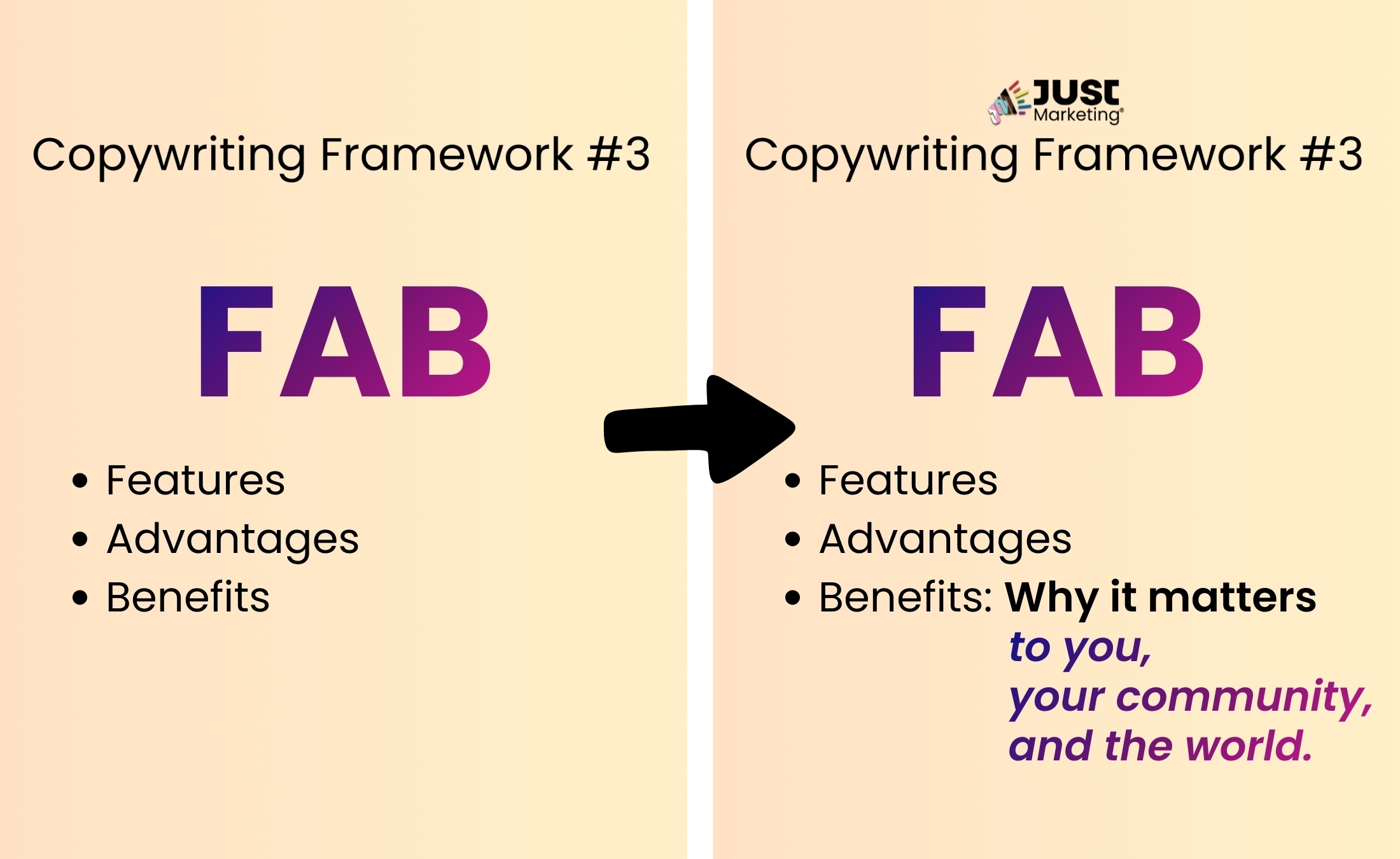
Traditionally, benefits are all about personal gain – more money, less stress, better results. But Just Marketing® expands the “B” to include collective and ethical impact.
Let’s reimagine it:
- Feature: What you’re offering (the structure, service, or resource)
- Advantage: How it helps your client on a practical level
- Benefit: How it supports human, community, and systemic well-being
In other words, your benefits don’t have to stop at “you.”
They can also reflect values, justice, and sustainability – the ripple effect your offer creates.
How to Write FAB the Just Marketing® Way
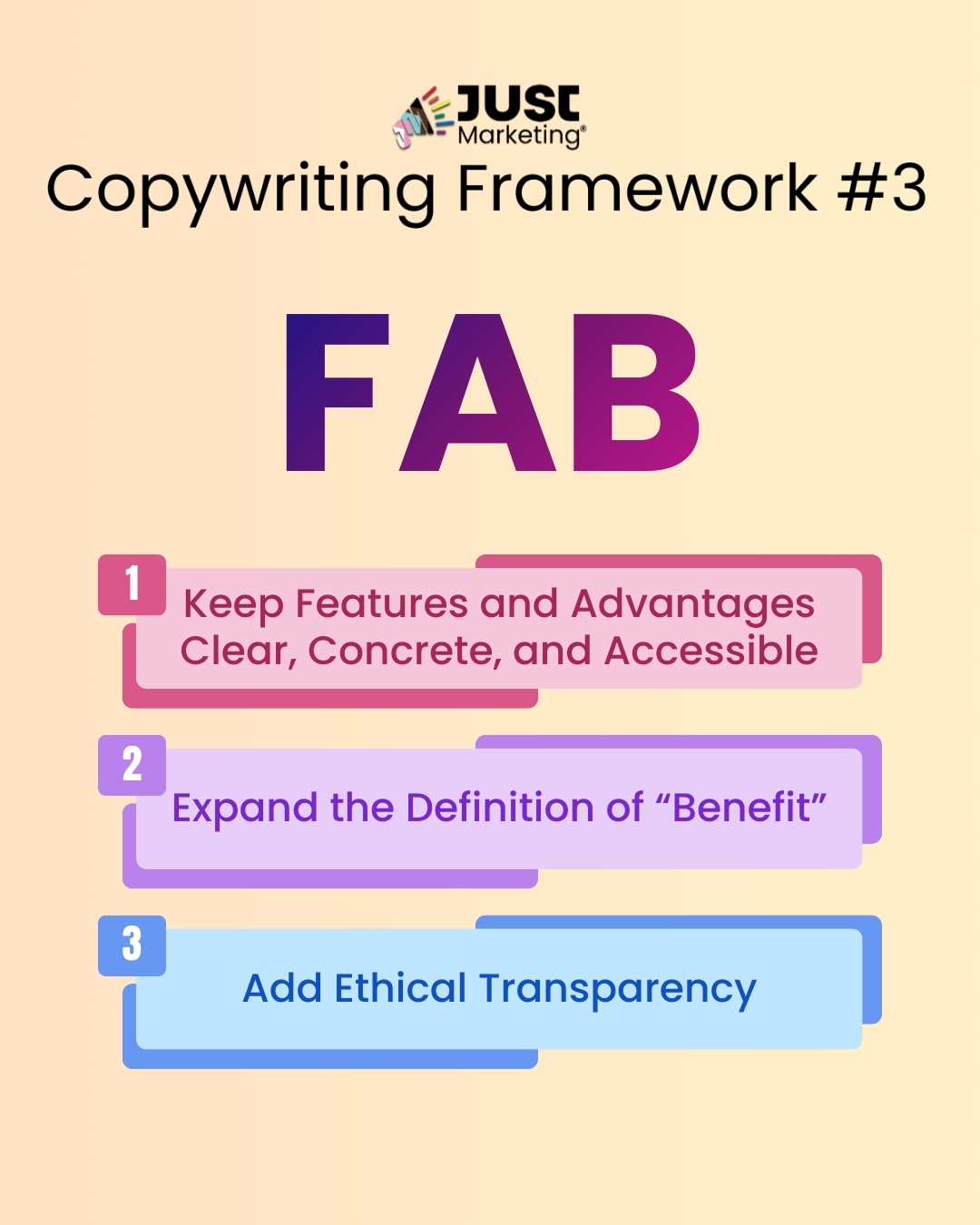
1. Keep Features and Advantages Clear, Concrete, and Accessible
- Avoid jargon or insider language.
- Use plain, inclusive language so everyone can understand what you offer.
- Make sure accessibility is built in, not an afterthought.
Example: “Six weekly coaching sessions with live captions and replays available for flexible, accessible participation.”
2. Expand the Definition of “Benefit”
Instead of focusing only on what the buyer gets, consider:
- How does this offer align with shared values?
- What kind of world does this purchase help create?
- How does it contribute to equity, accessibility, or sustainability?
Example: “You’ll develop a marketing strategy that honors your capacity – and contributes to a business ecosystem built on justice, not hustle.”
3. Add Ethical Transparency
People feel more connected when you share your values and practices openly.
Example:
- “A portion of each enrollment supports scholarships for underrepresented founders.”
- “We use inclusive design principles to make this program accessible to diverse learning styles.”
That’s the kind of benefit that builds trust and drives meaningful action.
Quick Formula: FAB, but Make It Ethical
- Feature: What it is
- Advantage: How it helps
- Benefit: Why it matters – to you, your community, and the world
Final Thoughts: People Over Profit, Always
FAB is a solid framework – and when we use it with care, it can absolutely support ethical, inclusive messaging. But we’ve got to stay mindful of the why behind the how.
When we center people over profit, benefits become more than just shiny promises. They become reflections of our values. Our commitment to justice. Our desire to build something bigger than just a bottom line.
So the next time you sit down to write copy, don’t just ask, “What’s in it for them?”
Ask, “What kind of impact will this create – for them, and beyond?”
That’s how we make our marketing truly FAB – fabulous and future-focused.
Let’s keep this conversation going
If this resonated with you, here are a few ways to stay connected:
- Follow me on LinkedIn and Instagram for more real talk on ethical marketing, ADHD-friendly business tips, and behind-the-scenes of Just Marketing® in action.
- Join my email list to get content like this delivered in a low-pressure, neurodivergent-friendly way.
- Curious about working together? Learn more here and see if we’re a good fit.
No urgency. No pressure. Just an open door.
FAQs
A feature is what your offer is or includes, like “six weekly coaching calls.” A benefit explains why that matters to the person buying it, such as “you'll follow through on your goals without burning out.” Strong copy connects the two so readers can picture the offer in their own lives.
Here's one: “Six weekly coaching sessions with live captions and replays (feature) give you consistent support you can join live or catch up on later (advantage), so you can build a marketing plan that fits your energy (benefit).” Each piece builds on the one before it.
AIDA (Attention, Interest, Desire, Action) maps out the flow of an entire piece of copy, from the opening line to the call to action. FAB zooms in on how you describe the offer itself. Many copywriters use FAB inside the “Desire” stage of AIDA. Learn more about the AIDA framework through a Just Marketing® lens.
Include both! Clear, concrete features help readers understand exactly what they're getting, which many neurodivergent buyers especially appreciate. Benefits then show why those details matter, making the offer feel personal and relevant.
Share specific, verifiable details, like a scholarship fund you actually run or accessibility practices built into your program. Honest, concrete examples build far more trust than sweeping claims about changing the world. For more on keeping promises grounded, see the 4Ps copywriting framework with a permission-based reframe.
Use plain language and skip insider jargon so everyone can quickly understand what you offer. Mention accessibility features, like captions or replays, right in the feature list. Just Marketing® is ethical, inclusive, and accessible, so your audience feels supported and your business grows sustainably. Learn more in the complete guide to Just Marketing®.