AIDA is one of the OGs of conversion copywriting. If you’ve ever written an email, ad, or sales page, chances are you’ve used some version of it:
Grab attention. Build interest. Spark desire. Drive action.
Boom – copy that converts.
The gist: AIDA, short for Attention, Interest, Desire, Action, is one of the oldest copywriting formulas, guiding readers from a first glance to a clear next step. The Just Marketing® alternative, IIDA (Invite, Inspire, Decide, Act), keeps that journey while inviting curiosity and giving readers space to choose.
Part of the Conversion Copywriting Framework guide.
But here’s the thing: just because something works doesn’t mean it works ethically.
AIDA was built for a marketing era that prioritized clicks over consent and urgency over understanding. And while it’s helped shape modern marketing, it can also fuel manipulation, overwhelm, and exclusion – especially for neurodivergent folks or anyone navigating a world that’s already full of noise and pressure.
In this post, we’re taking a fresh look at AIDA through a Just Marketing® lens – breaking down what still holds up, what needs to go, and how we can rewrite the script in a way that’s honest, inclusive, and human-centered.
What is AIDA?
AIDA stands for Attention – Interest – Desire – Action, and it’s one of the oldest – and most widely used – copywriting formulas out there. It was originally designed for direct-response advertising and has since become a go-to framework for crafting persuasive content.
You’ll see AIDA show up everywhere – from Facebook ads to email funnels to sales pages. The goal? Guide someone from first glance to final click using a step-by-step structure that taps into curiosity, emotion, and action.
Let’s break it down:
- Attention → Grab your reader’s attention with a headline, bold statement, or question.
- Interest → Keep them engaged by highlighting benefits or intriguing details.
- Desire → Create an emotional connection. Make the reader want what you’re offering.
- Action → Prompt a clear next step – click, buy, sign up, or schedule.
A typical AIDA-style flow might look like:
- “Feeling stuck in your business? You’re not alone.” (Attention)
- “Thousands of entrepreneurs are breaking through overwhelm with our proven system.” (Interest)
- “Imagine waking up with clarity and confidence, knowing exactly what to do.” (Desire)
- “Join the free workshop now.” (Action)
It’s punchy. It’s persuasive. And yes – it can absolutely drive results.
But at what cost?
The Problem with AIDA (Through a Just Marketing® Lens)
AIDA wasn’t designed with ethics, accessibility, or inclusion in mind – it was built to sell. And while selling isn’t inherently bad (you deserve to make money doing what you love!), the way we persuade matters.
When we zoom in through a Just Marketing® lens, a few red flags pop up – especially around how AIDA can unintentionally exploit emotions, override consent, or create pressure that doesn’t feel aligned.
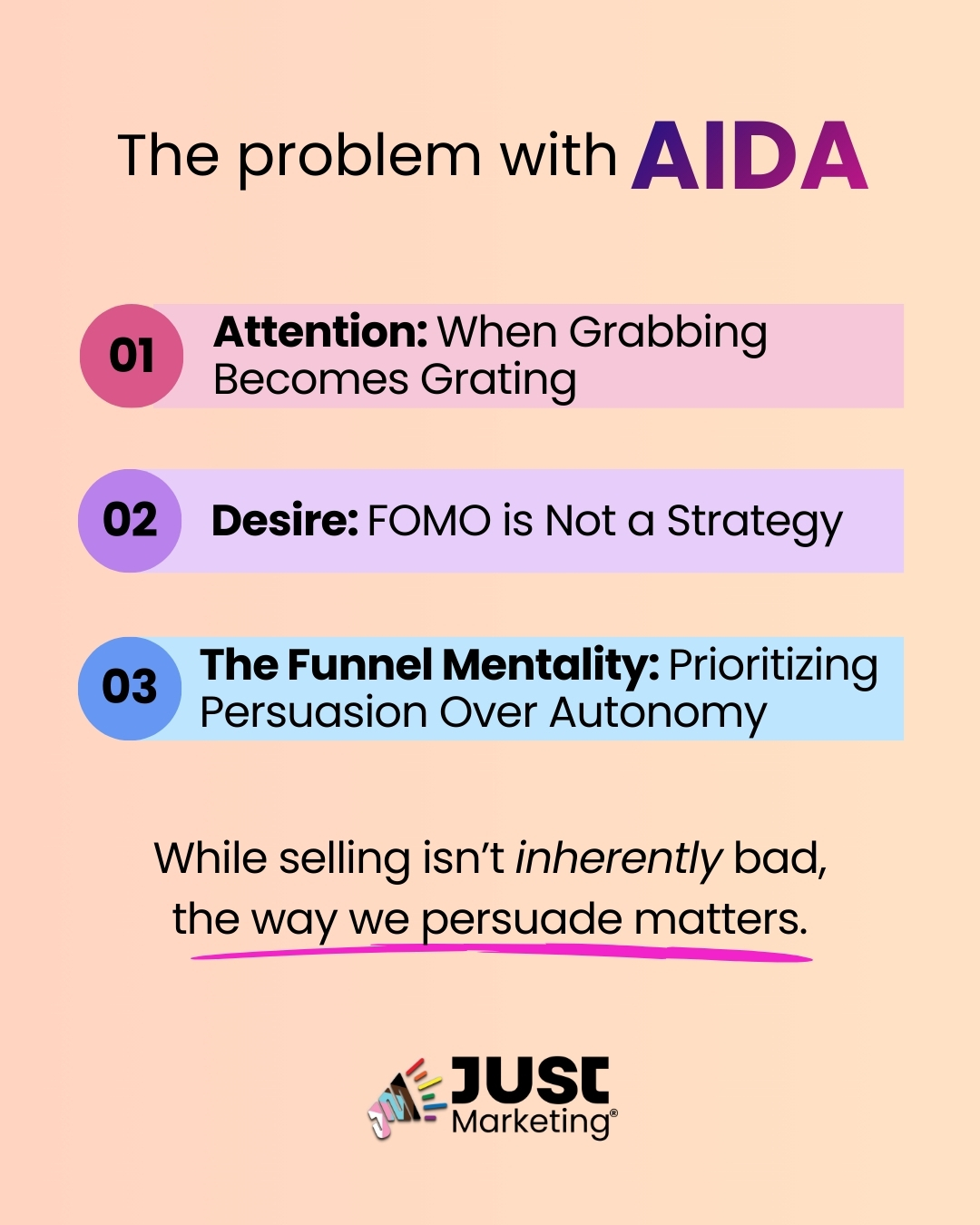
1. Attention: When Grabbing Becomes Grating
The “attention” phase often rewards the loudest voice in the room – think shock value, fear-mongering, or straight-up clickbait.
- Sensational headlines like “You’re Doing Everything Wrong” or “This Will Ruin Your Business” might stop the scroll… but at what cost?
- These tactics can feel jarring or manipulative – especially for neurodivergent folks who may already be filtering out sensory overload or emotional pressure.
- Attention shouldn’t be stolen – it should be invited with intention and respect.
2. Desire: FOMO is Not a Strategy
AIDA’s “desire” step is where things often slide into manipulation. Marketers are taught to tap into envy, comparison, or fear of missing out (FOMO) to stir up action.
- You’ll hear things like:
“Everyone’s already doing this – why aren’t you?”
“Seats are filling fast. Don’t get left behind.”
Yikes. These messages prey on insecurity and scarcity, not alignment or consent. That kind of pressure might boost short-term conversions, but it rarely builds long-term trust.
3. The Funnel Mentality: Prioritizing Persuasion Over Autonomy
AIDA’s structure assumes your job is to lead someone from attention to action – as if they’re on a conveyor belt toward conversion.
- But what if someone isn’t ready?
- What if they need time, space, or more information?
- What if “action” for them today is saving the post, reflecting, or walking away?
Traditional marketing frameworks often prioritize your goal (a sale, a signup) over the reader’s autonomy. Just Marketing flips that. We ask: Does this copy support informed decision-making – or just nudge someone toward a yes, whether or not it’s right for them?
A Just Marketing® Alternative: IIDA (Invite – Inspire – Decide – Act)
Just because AIDA has some flaws doesn’t mean we toss the whole structure in the trash. The core idea – guiding someone through a thoughtful journey – is still super useful. The difference? We lead with consent, not control.
Introducing: IIDA
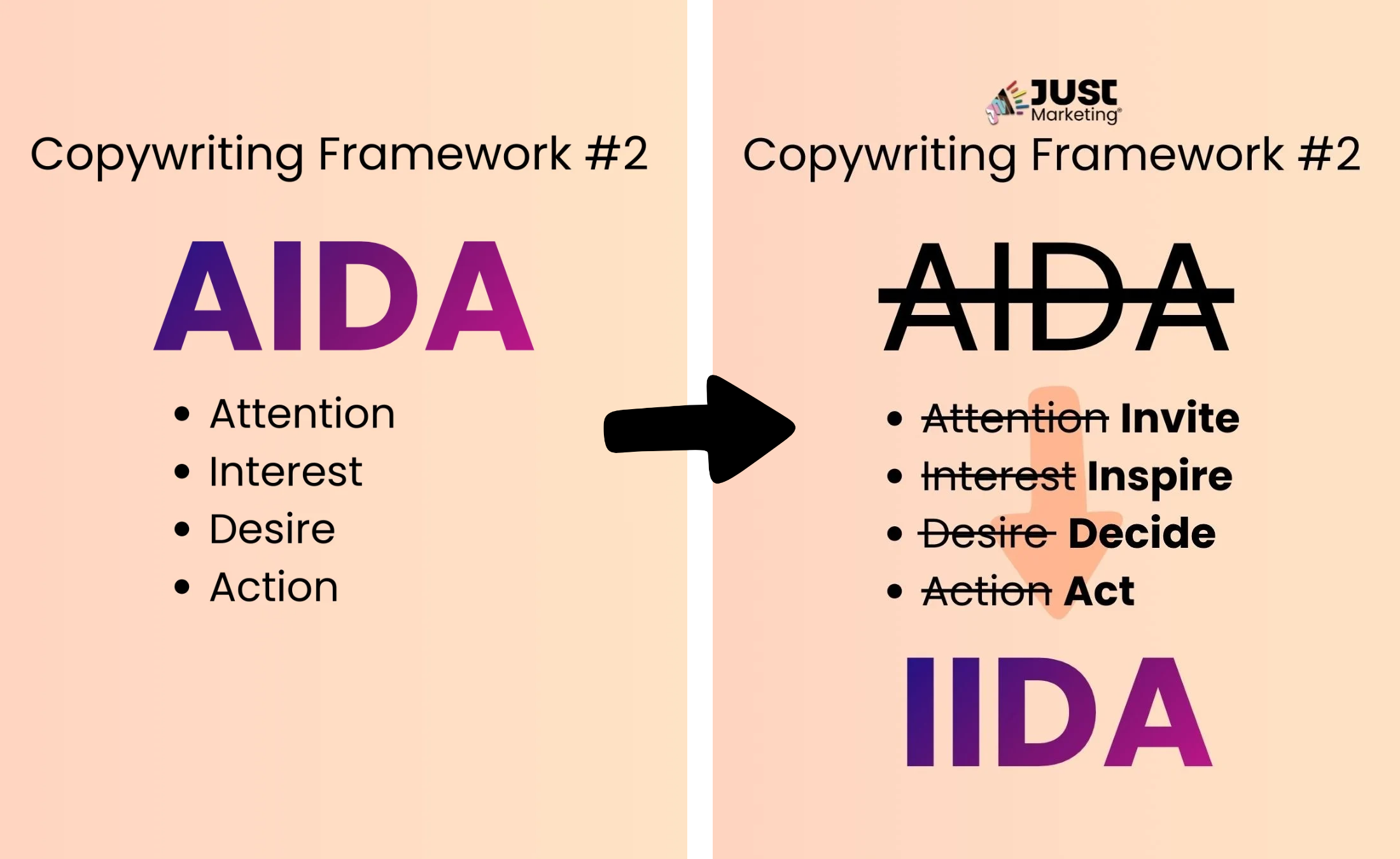
A gentler, more inclusive spin on the original – built to honor autonomy, support accessibility, and still guide your audience toward aligned action.
1. Invite (instead of Attention)
Let’s replace “grabbing” attention with inviting curiosity.
- Use honesty, shared values, or a thoughtful question to draw someone in – without resorting to fear or hype.
- Remember: your people are already paying attention to what matters to them. Your job isn’t to shout louder – it’s to connect more clearly.
Examples:
Instead of: “Are you making this HUGE mistake in your business?”
Try: “Let’s talk about a common challenge I see in business – and a kinder way to handle it.”
2. Inspire (instead of Interest)
Now that they’re here, offer something meaningful – not just interesting.
- Share insights, lived experiences, or solutions that uplift and inform.
- Keep it digestible, especially for folks who are neurodivergent or overwhelmed.
- Value alignment goes deeper than surface-level intrigue – it’s about resonance.
Examples:
Share a small, relatable story.
Offer a practical tip with room for interpretation or adaptation.
3. Decide (instead of Desire)
Rather than pushing someone toward emotional urgency, create space for informed choice.
- Respect that your audience can think for themselves. (Because they can.)
- Lay out clear information, accessible options, and give them permission to pause.
Examples:
Instead of: “This offer won’t last – get it NOW!”
Try: “Here’s what’s available. If it feels like a fit, I’d love to welcome you in.”
4. Act (still Action – but with alignment)
Yes, we still want to encourage action – but not at the expense of comfort or clarity.
- Make your CTA supportive, not pushy.
- Offer multiple ways to engage (learn more, save for later, follow along) – not just “buy now.”
Examples:
“Want to explore this more deeply?”
“Ready to take the next step? Here’s how.”
With IIDA, you’re not pushing people through a funnel – you’re walking with them, offering signposts along the way. You’re building relationships rooted in respect, not urgency. And that? That’s marketing with integrity.
Why Ethical Copy Still Converts
Let’s bust the myth right now: ‘ethical is ineffective’ is a lie that the old-school marketing world loves to push. But here’s the truth…
- You don’t have to manipulate people to motivate them.
- You don’t need pressure tactics to increase conversions.
- You can write honest, inclusive copy and make sales.
In fact, ethical copy often converts better – especially with values-aligned, thoughtful clients (you know, the kind you actually want to work with).
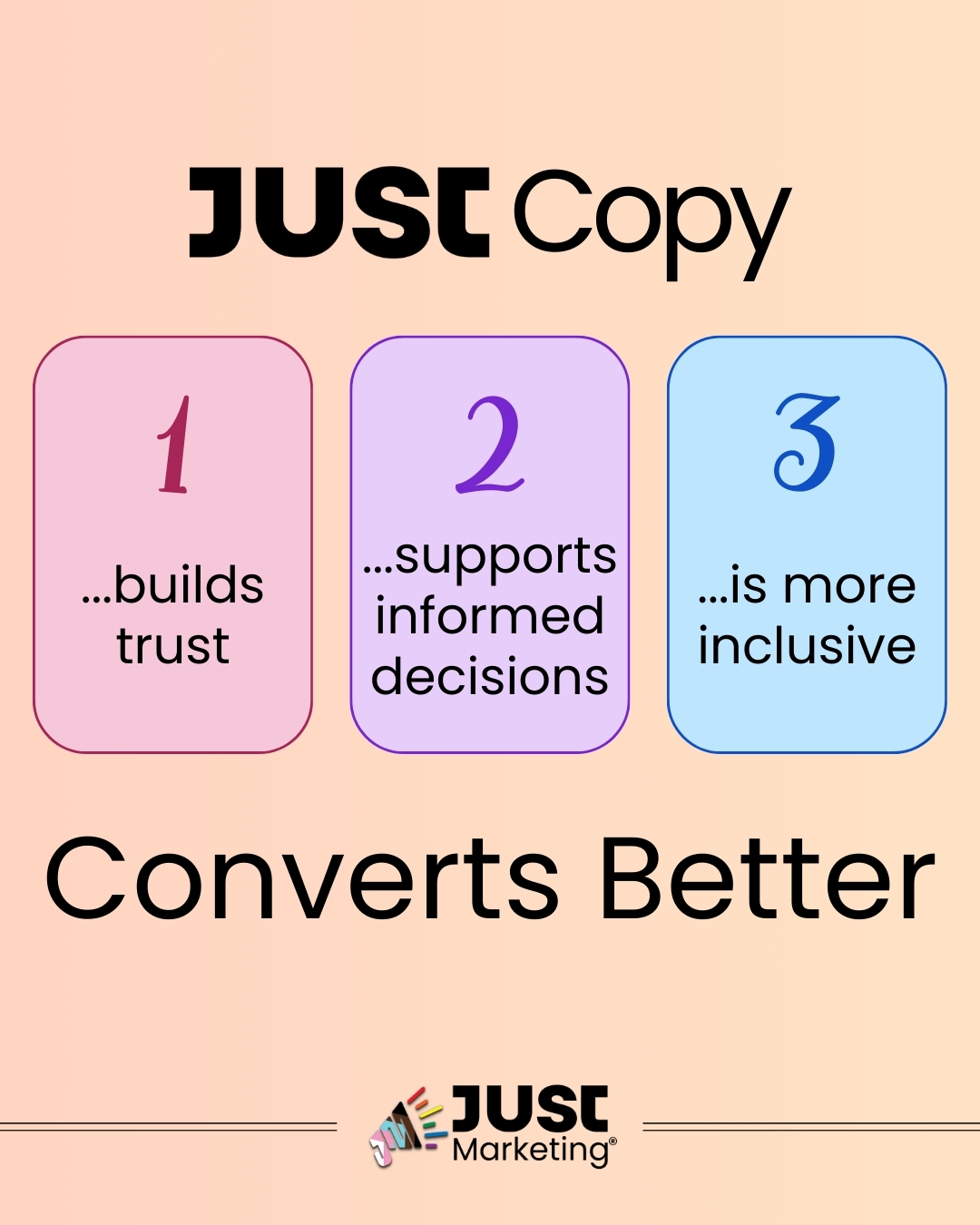
Ethical copy builds trust.
When your words feel safe, clear, and respectful, your audience doesn’t just feel seen – they feel respected. And trust is the real conversion tool.
People don’t buy because they were tricked into clicking. They buy because they believe you, and believe in what you’re offering.
Ethical copy supports informed decisions.
Instead of pushing for a fast “yes,” Just Marketing gives your people the space to consider their needs, energy, and timing.
And when folks say “yes” from a place of alignment – not urgency – they’re more likely to:
- Follow through
- Get great results
- Refer others
- Stick around long-term
Sounds like sustainable growth, doesn’t it?
Ethical copy is more inclusive.
Pressure-heavy tactics can alienate neurodivergent folks, trauma survivors, or anyone who needs more time or clarity before committing.
When your copy is grounded in consent and compassion, you create access – not just attention.
That’s not just good ethics – it’s good business.
So yes, you can ditch the hype, skip the scarcity, and still write high-converting copy that feels like you. Because people don’t need to be convinced. They need to be invited.
And when you invite the right people in the right way, they show up ready.
You Don’t Have to Choose Between Ethics and Impact
AIDA gave us a blueprint – but it wasn’t built for the kind of business you’re running today.

You care about consent, not just conversion. You want your audience to feel safe, seen, and supported – not pushed, prodded, or pressured.
The good news? You can still guide people toward action – without sacrificing your values.
By swapping AIDA for IIDA – Invite, Inspire, Decide, Act – you’re choosing a path that’s not only more ethical, but more sustainable, more inclusive, and more aligned with how you actually want to show up in the world.
And that kind of marketing? It doesn’t just attract clients. It builds community.
Let’s Keep the Conversation Going
If this resonated with you, here are a few ways to stay connected:
- Follow me on LinkedIn and Instagram for more real talk on ethical marketing, ADHD-friendly business tips, and behind-the-scenes of Just Marketing® in action.
- Join my email list to get content like this delivered in a low-pressure, neurodivergent-friendly way.
- Curious about working together? Learn more here and see if we’re a good fit.
No urgency. No pressure. Just an open door.
FAQs
AIDA is generally credited to advertising pioneer E. St. Elmo Lewis, who developed it in the late 1800s to describe how a salesperson guides a customer toward a purchase. It later became a cornerstone of advertising and copywriting.
IIDA stands for Invite, Inspire, Decide, Act. It's the Just Marketing® alternative to AIDA, designed to draw people in with honest curiosity and leave the final decision in their hands. It works anywhere you'd normally use AIDA, from emails to sales pages.
Yes! Its basic flow from first impression to next step still helps organize emails, ads, and sales pages. The biggest opportunity lies in how you approach each stage, using honest hooks and supportive calls to action that respect your reader's timing.
AIDA builds toward a positive outcome by sparking interest and desire. PAS (Problem, Agitate, Solution) starts with a pain point and intensifies it before presenting a fix. Learn more about the PAS framework through a Just Marketing® lens.
Lead with an honest question, a shared value, or a challenge your audience genuinely recognizes. For example: “Let's talk about a common business challenge and a kinder way to handle it.” Clear, curious headlines attract the people most likely to connect with your work.
Offer a few ways to engage, such as learning more, saving the post for later, or following along. Supportive prompts like “Want to explore this more deeply?” let people take whatever next step fits their readiness. For more ideas, see how to rethink sales funnels with consent.