Ever read a sales page that felt a little… off? Like it was trying to stir up your insecurities a little too hard, just to sell you something?
You’ve probably experienced PAS in action.
PAS – short for Problem, Agitate, Solution – is one of the oldest and most popular copywriting frameworks out there. It’s simple, familiar, and widely used to hook attention and drive conversions. The idea is to name your audience’s problem, stir up the discomfort around it, then swoop in with your solution.
And sure, it works.
But here’s the thing: Just because something works doesn’t mean it’s ethical.
Especially when copy leans on shame, exaggeration, or urgency tactics that leave people feeling broken, unworthy, or desperate for a fix.
As ethical entrepreneurs and values-driven brands, we have to ask:
Is this really how we want to connect with our communities?
In this post, we’re rethinking PAS through a Just Marketing® lens – exploring what makes the traditional framework problematic, and how to reframe it in a way that respects your audience’s humanity while still converting with compassion.
What is PAS (Problem–Agitate–Solution)?
The PAS framework is a go-to in copywriting circles – and for good reason. It’s simple, direct, and designed to grab attention fast. The formula looks like this:
- Problem – Call out a specific challenge your audience is facing.
- Agitate – Dig into that problem. Emphasize the emotional or practical consequences of ignoring it.
- Solution – Present your product, service, or idea as the fix.
This framework plays on emotional urgency. By making the reader feel the problem more deeply, the copy builds momentum toward the “solution” – your offer.
Here’s a classic example:
Problem: You’re posting on social every day but seeing no engagement.
Agitate: It’s discouraging to put in all that effort and feel invisible.
Solution: My content plan helps you post less but get better results.
You’ll see PAS show up everywhere:
- On landing pages (“Struggling to lose weight?”)
- In ad copy (“Tired of wasting hours on content that doesn’t convert?”)
- Inside email funnels (“You’re not alone – and it’s not your fault…”)
It's efficient, emotionally charged, and aims to push the reader toward action – fast.
But here’s where things get complicated: while PAS is undeniably persuasive, it often crosses ethical lines when used without care or intention.
What’s Problematic About PAS?
PAS is effective because it taps into emotion – but when used carelessly, it can weaponize emotion. The “Agitate” step is where things often go sideways. Instead of creating understanding, it amplifies discomfort. Instead of connecting with empathy, it can exploit vulnerability.
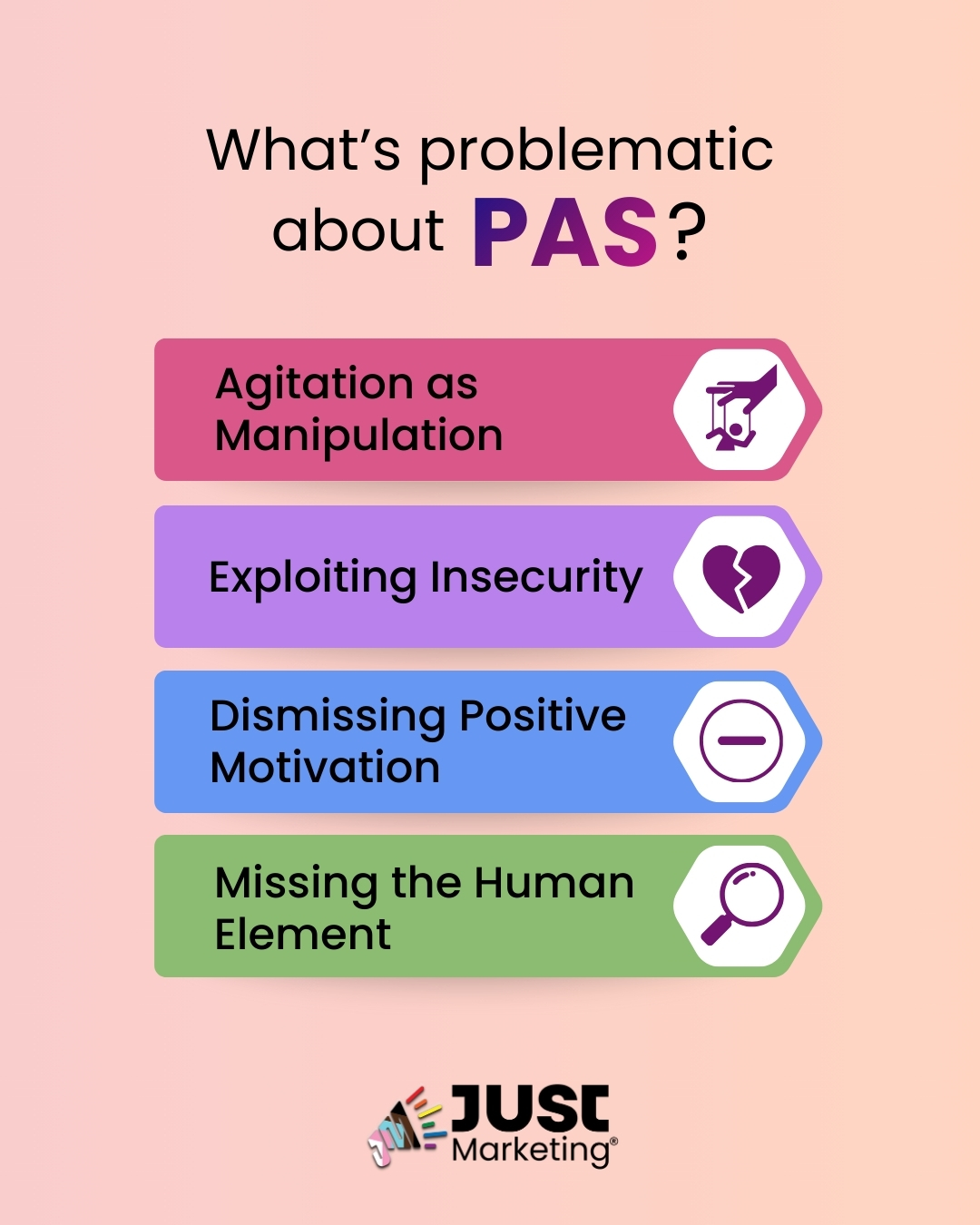
Here’s what that looks like through a Just Marketing® lens:
1. Agitation as Manipulation
Traditional PAS encourages marketers to “twist the knife” – to make the problem feel so painful that the reader needs relief. But that relief often comes at the cost of dignity.
When marketing uses language rooted in fear (“You’ll never succeed if you don’t act now”) or shame (“If you really cared about your business, you’d invest in this”), it crosses from persuasion into pressure.
2. Exploiting Insecurity
So much of conventional marketing relies on the idea that people act from lack – that we have to convince them they’re broken, behind, or not enough. This not only harms individuals, but also reinforces systemic narratives about worthiness, productivity, and perfectionism.
For folks who are neurodiverse, disabled, or part of marginalized communities, this kind of messaging can hit especially hard.
3. Dismissing Positive Motivation
PAS assumes that people won’t take action unless they’re uncomfortable – that pain is the only motivator. But what about curiosity, hope, creativity, or joy? When we lead with fear, we miss the chance to inspire action through empowerment.
4. Missing the Human Element
People aren’t problems to be solved; they’re whole humans navigating complex experiences. When marketing centers only on pain, it can flatten nuance and disconnect from real empathy. The result? Copy that feels manipulative instead of meaningful.
You don’t need to agitate pain to activate action.
You can connect through understanding, compassion, and empowerment – and still get results.
A Just Marketing® Reframe: Understand – Empathize – Empower
If traditional PAS relies on stirring discomfort, a Just Marketing® approach centers compassionate clarity. It respects the complexity of your audience’s lived experiences – and trusts that people don’t need to be manipulated to take action. They just need to feel seen, supported, and in control of their choices.
So what’s the alternative?
We replace Problem – Agitate – Solution with:
Understand – Empathize – Empower
Understand
Start by naming the challenge – clearly, accurately, and respectfully. Your goal here isn’t to poke at pain, but to show that you get it. Describe the experience using words your audience would use themselves.
You’ve been showing up on social consistently, but the engagement just isn’t there.
Empathize
Instead of turning up the volume on discomfort, reflect on the emotional impact without amplifying distress. Show that you understand how it feels – without making your reader feel worse about it.
That kind of mismatch between effort and outcome can feel discouraging, even disheartening – especially when you’re already stretched thin.
Empower
Now offer your solution – not as a magic fix, but as a supportive tool. Highlight what’s possible with your help, and invite action through hope, not fear.
You deserve a content strategy that works with your capacity – not against it. Let’s simplify your approach so your content connects with less stress.
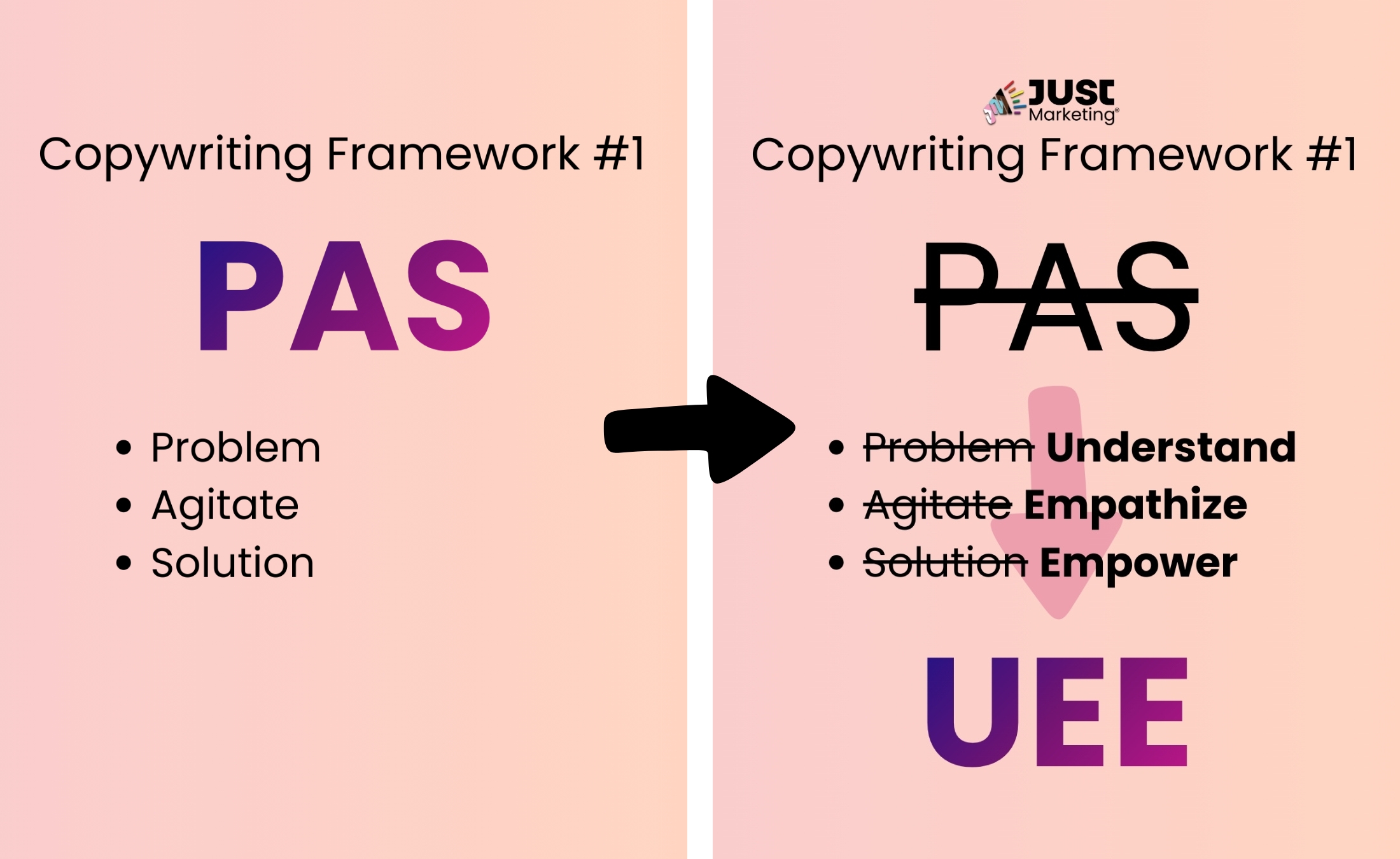
A Side-by-Side Comparison:
| Traditional PAS | Just Marketing® Alternative |
| Problem: You’re posting every day but getting no engagement. | Understand: You’re posting consistently, but the engagement isn’t there. |
| Agitate: It’s exhausting to put in all that effort and feel invisible. | Empathize: It’s frustrating to pour energy into content that feels like it’s going nowhere. |
| Solution: My strategy fixes that. | Empower: Let’s build a strategy that honors your energy and helps your message land with the right people. |
This isn’t just feel-good fluff. This is trauma-informed, values-driven marketing that builds real trust – without relying on shame, scarcity, or sleazy sales pressure.
Your audience doesn’t need to be agitated to take action. They need to feel seen. They need agency. They need an invitation that aligns with their values.
Let’s stop twisting the knife – and start extending a hand.
Why This Matters
If you’ve been taught that pain sells, you’re not alone.
Many of us – especially those navigating business with ADHD, neurodivergence, or a deep desire to do things differently – have inherited marketing playbooks that just don’t feel right. They center urgency, scarcity, and discomfort as the default tools for persuasion. And honestly? That can leave us feeling gross, stuck, or inauthentic.
But here’s the good news: You don’t have to manipulate to motivate.
When we choose empathy over agitation, we:
- Build trust that leads to lasting relationships (not just one-time sales)
- Create safer, more inclusive spaces for our communities
- Align our marketing with our values – without sacrificing results
If our goal is to support, serve, and empower – our marketing should reflect that at every step.
The best part? Shifting away from fear-based frameworks doesn’t mean giving up conversions. It means attracting the right-fit people who resonate with your message and feel good about saying yes.
PAS is a classic for a reason – but it’s not without its flaws. The “agitate” step, in particular, often relies on outdated, unethical tactics that don’t align with inclusive, trauma-informed, or values-based businesses.
By reimagining PAS as Understand – Empathize – Empower, we open the door to marketing that connects without coercion and converts without shame.
Let’s Stay Connected
If this post got you thinking about how to market more ethically and still get results – I’d love to keep the convo going.
- Let’s connect on LinkedIn or Instagram – I share content there regularly that supports neurodiverse, values-driven entrepreneurs.
- Want content like this in your inbox? Join my email list for marketing tips that are ADHD-friendly, trauma-informed, and actually fun to read.
- Curious about working together? Learn more about my 1:1 services and offers here – no pressure, just possibilities.
Your content can still be powerful. Persuasive. Effective.
And it doesn’t have to hurt anyone to get there.