Marketing funnels are misaligned with how real people make decisions. Most funnels are designed to push, prod, and pressure. They treat people like leads to be “captured” instead of humans to be supported.
But what if your customer journey could feel good – for both you and the folks you're hoping to serve?
This isn’t about throwing out strategy. It’s about shifting the focus from persuasion-as-manipulation to persuasion-as-clarity. From trying to convince people to buy, to helping them feel confident in their decision to say yes (or no). That’s the foundation of ethical marketing – and it requires trust at every stage of the journey.
The gist: An ethical customer journey is a path from discovery to conversion built on consent and transparency, where people can explore at their own pace and leave whenever they choose. It replaces the pressure-driven funnel with clear pricing and honest invitations, so buyers feel confident saying yes and often become loyal clients.
In this post, we’ll go beyond the funnel and explore what it really looks like to build customer journeys rooted in consent, transparency, and connection – from that first moment of discovery through to conversion and beyond.
How Is An Ethical Customer Journey Different From A Sales Funnel?
The traditional funnel assumes a linear path: attract → nurture → convert. It’s built on the idea that everyone moves through the same rigid stages and ends up in the same place – ideally, as a paying customer.
But people aren’t widgets. They’re curious, cautious, neurodivergent, complex. Their needs shift. Their timelines vary. And their decisions are rarely a straight line.
That’s why ethical marketing moves beyond the funnel model. A more inclusive approach looks more like a map – where people can enter and exit freely, revisit content, and engage at their own pace.
In this model, persuasion isn’t about pressure. It’s about creating clarity, building connection, and honoring consent every step of the way. You’re not pulling people down a chute. You’re walking alongside them as they explore whether you’re the right fit.
That’s not just more humane. It’s more effective in the long run.
Ready to see how this plays out across the journey?
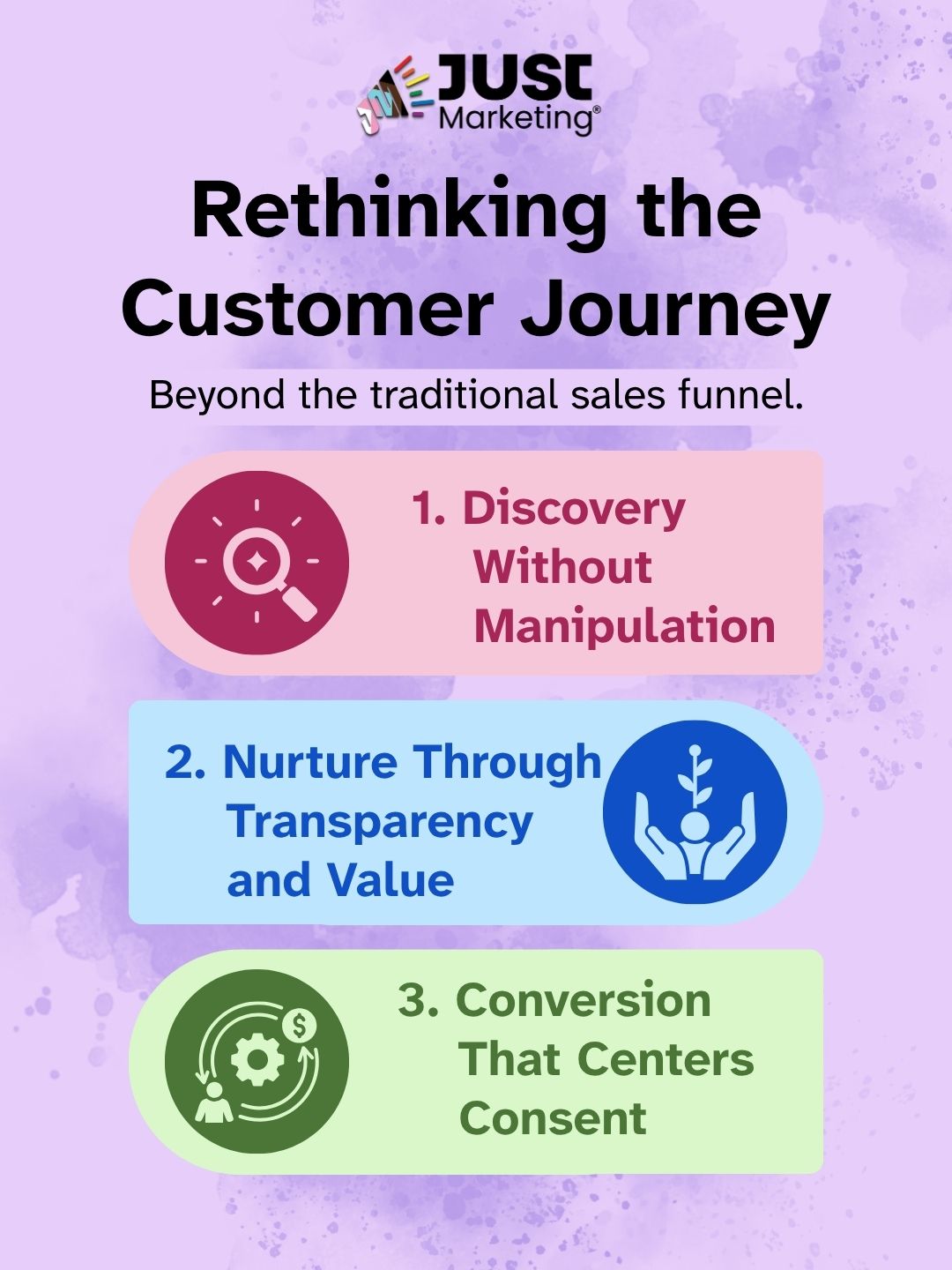
Stage One: Discovery Without Manipulation
Discovery is that first spark. Someone stumbles across your blog, hears you on a podcast, or sees your post shared by a friend. In that moment, they’re not a “lead” – they’re a person asking, Is this for me?
This stage sets the tone. If you rely on clickbait, overpromising, or vague messaging, it chips away at trust before the relationship even begins.
Instead, ethical discovery is about being findable, relatable, and real:
- Be findable through inclusive SEO and accessible content that meets people where they’re already looking.
- Be relatable by creating content that reflects your values and speaks to real struggles (not manufactured pain points).
- Be real with clear offers, no fine print, and honest previews of what you do and who you serve.
At this point, persuasion is about resonance, not pressure. It’s giving folks the information and energy they need to decide if they want to learn more – no guilt-tripping, no urgency countdowns, no games.
When people feel safe and seen at the discovery stage, they’re more likely to stick around for what’s next.
Stage Two: Nurture Through Transparency and Value
This is where so many marketers slip into manipulation mode – using drip campaigns loaded with urgency, FOMO, and carefully crafted scarcity. But ethical nurturing takes a different path. It’s rooted in honesty, consistency, and service.
At this stage, your job isn’t to convince. It’s to clarify.
What do you stand for? Who do you really help? What does working with you look and feel like? The more you answer these questions openly, the more trust you build – and the less pressure you need.
Here’s what ethical persuasion looks like in this phase:
- Share stories that affirm and invite, rather than agitate or shame.
- Offer value with no strings – whether it’s a how-to post, a quick tip in your newsletter, or a thoughtful response on social.
- Name your values and your boundaries. Be clear about what you offer, who it's for, and what it costs. Transparency is powerful.
- Make it easy to ask questions or walk away. People feel more confident when they know they’re in control.
This is the slow-burn part of the journey. The goal isn’t to rush people toward a yes. It’s to support them in moving at their own pace, with all the info they need to feel good when the time is right.
Stage Three: Conversion That Centers Consent
Conversion doesn’t have to be the cringiest part of the journey. When done ethically, it’s not a trap – it’s an invitation. One that respects autonomy and honors timing.
This is where many business owners feel stuck. You want to sell, but not push. You want to encourage action, but not pressure. The good news? You can do both – without sacrificing your values.
Here’s how ethical persuasion shows up at the conversion stage:
- Lead with clarity. Be upfront about your offer, your process, your pricing, and what someone can expect. No vague promises or “DM me for the price” games.
- Frame your offer as a choice, not a test. This isn’t a “right” or “wrong” decision – it’s a fit check.
- Avoid fake urgency or manipulation. If you have a real deadline, name it. If not, don’t invent one. Scarcity only works when it’s true – and when it’s not, it erodes trust fast.
- Normalize ‘no’ as a healthy part of the journey. Not everyone is meant to buy from you right now, or ever. And that’s okay.
The truth is, when your whole journey builds trust, your audience doesn’t need to be pushed – they’re already paying attention. Ethical conversion happens when someone feels seen, informed, and empowered to say yes on their terms… which also makes them more likely to stick around.
How Do You Keep Building Trust After The Sale?
Too many marketers treat trust like a checkbox. Add a testimonial here. Toss in a guarantee there. But real trust isn’t built by sprinkling in proof – it’s built by showing up consistently, clearly, and compassionately over time.
Trust is earned before, during, and after the sale.
Here’s how to keep that trust alive across the full journey:
- Follow through on your promises – from the first freebie to the final deliverable.
- Design systems that feel good – accessible onboarding, clear next steps, flexible support, and transparent communication.
- Stay values-aligned even after the conversion. Keep consent and autonomy front and center. Make it easy to give feedback or leave your offer if needed.
- Center accessibility and inclusion always. That means your processes, content, and tech should welcome people in – not shut them out.
Trust isn’t about perfection. It’s about alignment. When your values and your actions match, your clients feel safe, respected, and supported – and that’s what makes them stick around, refer others, and come back when they’re ready for more.
Ethical Persuasion Is Possible – And Powerful
Marketing has a reputation problem. So much of what we’ve been taught relies on fear, urgency, and control. But you don’t have to follow that script. You can build a business rooted in trust, respect, and values that actually feels good to run.
Ethical persuasion isn’t about doing less. It’s about doing better. When your customer journey is built on clarity and consent, people don’t feel sold to – they feel supported. And that creates relationships that are more sustainable, more joyful, and more aligned.
So here’s your invitation: Take a fresh look at your own customer journey. Where does it feel pushy, unclear, or disconnected from your values? What small shifts could make it more honest, inclusive, and human?
You don’t need a funnel. You need a framework that fits you – and the people you're here to serve.
Let’s Keep This Conversation Going
Let’s connect on LinkedIn or Instagram and keep the conversation going. I’d love to hear how you are redefining the journey.
Curious what it’s like to work together? Learn more about my approach and services – no pressure, just transparency.
Want more feel-good, values-driven marketing support? Join my email list and get tips, insights, and real talk delivered straight to your inbox.
FAQs
A traditional sales funnel moves everyone down the same linear path toward a purchase, often using pressure to speed things along. An ethical customer journey works more like a map, where people can enter at any point, revisit content, and take their time deciding whether you’re the right fit.
Ethical persuasion helps people make confident decisions by giving them clear, honest information about your offer. It relies on transparency and genuine invitations, and it treats “no” as a healthy outcome. The result is buyers who feel supported in their choice and stay connected longer.
Share genuinely helpful content with no strings attached, like a how-to post or a quick newsletter tip. Be open about your values, pricing, and who your offer serves. Making it easy to ask questions or unsubscribe helps people feel in control, which builds trust over time.
Sharing your pricing upfront is one of the clearest ways to build trust at the conversion stage. It saves people the awkward “DM me for the price” step and lets them decide whether your offer fits their budget before reaching out. You can pair prices with payment plans or sliding scale options.
Follow through on every promise, from your first freebie to your final deliverable. Accessible onboarding and clear next steps help new clients settle in, and an easy way to share feedback keeps communication open. Consistent, values-aligned follow-through turns clients into referral sources.
Yes! Ethical customer journeys tend to attract better-fit clients who already trust you by the time they buy. Sales may build more gradually than with pressure tactics, and those clients are more likely to stick around, come back for more, and recommend you to others.