Meg Brunson

  • Let’s GoHome
  • #AllTheThingsAbout Me
  • Read | Listen | WatchContent Library
  • Join TheMembership
  • Let’s WorkTogether

Clear Is Kind: How to Write Direct, Consent-Based CTAs

You’ve seen them. Those pushy buttons that scream “Buy now or miss out forever!” or pop-ups that hijack your screen with guilt – “Are you sure you want to say no to growing your business?”

Yikes.

For many of us – especially those who are neurodivergent, trauma-informed, or just trying to do business in a more ethical way – those calls-to-action feel less like invitations and more like ultimatums. And let’s be honest. That kind of pressure doesn’t build trust. It builds resistance.

Here’s the truth. You don’t need manipulation to make your marketing work. In fact, the opposite is true. Clear, direct, and consent-based calls-to-action (CTAs) create safety. They show respect. And they help your audience make informed decisions – without the second-guessing, sensory overload, or guilt spiral.

The gist: A consent-based CTA is a call to action that invites people to take a next step, with clear details about what they’ll get and what happens after they click. It replaces pressure tactics like fake urgency with invitational language and respect for “not right now,” which builds trust and attracts better-fit leads.

In this post, we’re breaking down what consent-based CTAs are, why they matter (especially for inclusive and trauma-aware brands), and how to write them in a way that feels good and converts.

Let’s make clarity the default. Because clear isn’t just kind – it’s powerful.
The Just Marketing logo at top. Text reads ‘How to Write Direct, Consent-Based CTAs’ with ‘CTAs’ in large navy-to-magenta gradient letters. Below, colorful icons show a green speech bubble, a pink button with a blue cursor clicking it, a yellow megaphone, and a purple gear. A pastel rainbow banner at the bottom reads ‘Clear is Kind’ on a soft lavender textured background.

What Is a Consent-Based CTA?

A consent-based call-to-action is exactly what it sounds like. It’s an invitation – not a demand. It gives your audience all the information they need to make a confident, pressure-free decision. It honors their autonomy. And it builds trust from the very first click.

Most traditional CTAs are designed to override hesitation. They lean on urgency (“Only 2 spots left!”), scarcity (“Don’t miss this once-in-a-lifetime offer!”), or shame (“You’d regret missing this!”). These tactics might get clicks – but often at the cost of connection. Especially for people who are neurodivergent or navigating trauma, that pressure can feel manipulative or even triggering.

Consent-based CTAs flip that script.

Instead of using fear or FOMO, they:

  • Clearly state what’s being offered.
  • Explain what the next step looks like.
  • Respect that “no” (or “not right now”) is always a valid choice.

This shift matters. Neurodivergent folks often need time to process and appreciate transparency to feel safe. Trauma-informed marketing requires an awareness of how urgency and ambiguity can feel coercive. And honestly? Most people – regardless of neurotype – prefer to be invited, not cornered.

When your CTA feels like a clear “door” instead of a trapdoor, the right people will walk through it. On their terms.

Why Does Clarity Matter In A Call To Action?

Confusion kills action. If your audience doesn’t immediately understand what you're offering, what they’ll get, or what comes next, they’re likely to freeze, bounce, or scroll past. And for folks dealing with decision fatigue, executive dysfunction, or a general distrust of sleazy marketing? That moment of uncertainty is often a dealbreaker.

This is why clarity isn’t just nice – it’s non-negotiable.

A clear CTA answers three unspoken questions:

  1. What exactly am I being invited to do?
  2. What happens when I click?
  3. What will I walk away with?

Let’s look at a quick example:

Instead of: “Join now!”
Try: “Sign up to get weekly ADHD-friendly marketing tips, no fluff – just actionable, ethical insights delivered to your inbox.”

The second one is longer, yes – but it respects your reader’s brain. It removes the guesswork. It sets expectations. That’s the kind of clarity that builds trust.

And here's the kicker. Clarity is not the same as oversimplifying or talking down to your audience. It's about giving them what they need to make an informed choice – without overwhelm, ambiguity, or spin.

When your CTA is clear, it does the emotional labor for your audience. It says, “Here’s the next step, and here’s what you can expect if you take it.” No pressure. Just permission.

Do Ethical CTAs Still Convert?

Let’s bust a myth real quick. There’s this tired assumption in the marketing world that if you’re not pushing hard, you’re not selling. That gentle = weak. That transparency kills conversions.

Not true.

In fact, for values-aligned audiences – like the ones you’re probably trying to reach – ethical marketing is more effective, because people are tired of being sold to. They want to feel seen, respected, and empowered to choose.

When you ditch urgency tactics and lean into clarity and consent, you're doing three powerful things:

  • You reduce resistance by giving people space.
  • You build credibility through honesty.
  • You increase follow-through because your audience knows exactly what they’re saying yes to.

Ethical, consent-based CTAs may not always create instant results – but they do build deeper trust and better-qualified leads. And over time? That trust compounds.

Especially for neurodivergent, disabled, or trauma-impacted folks, pushy tactics aren’t just uncomfortable. They’re a signal to opt out. Clear, invitational CTAs send the opposite message: You're safe here. You’re in control. This is for you – if and when you’re ready.

That kind of energy? It converts the right people.

How Do You Write A Consent-Based CTA?

You don’t need a copywriting degree or a clever gimmick to write a CTA that works. You just need to slow down and write like you’d speak to someone you care about. Someone you want to empower, not push.
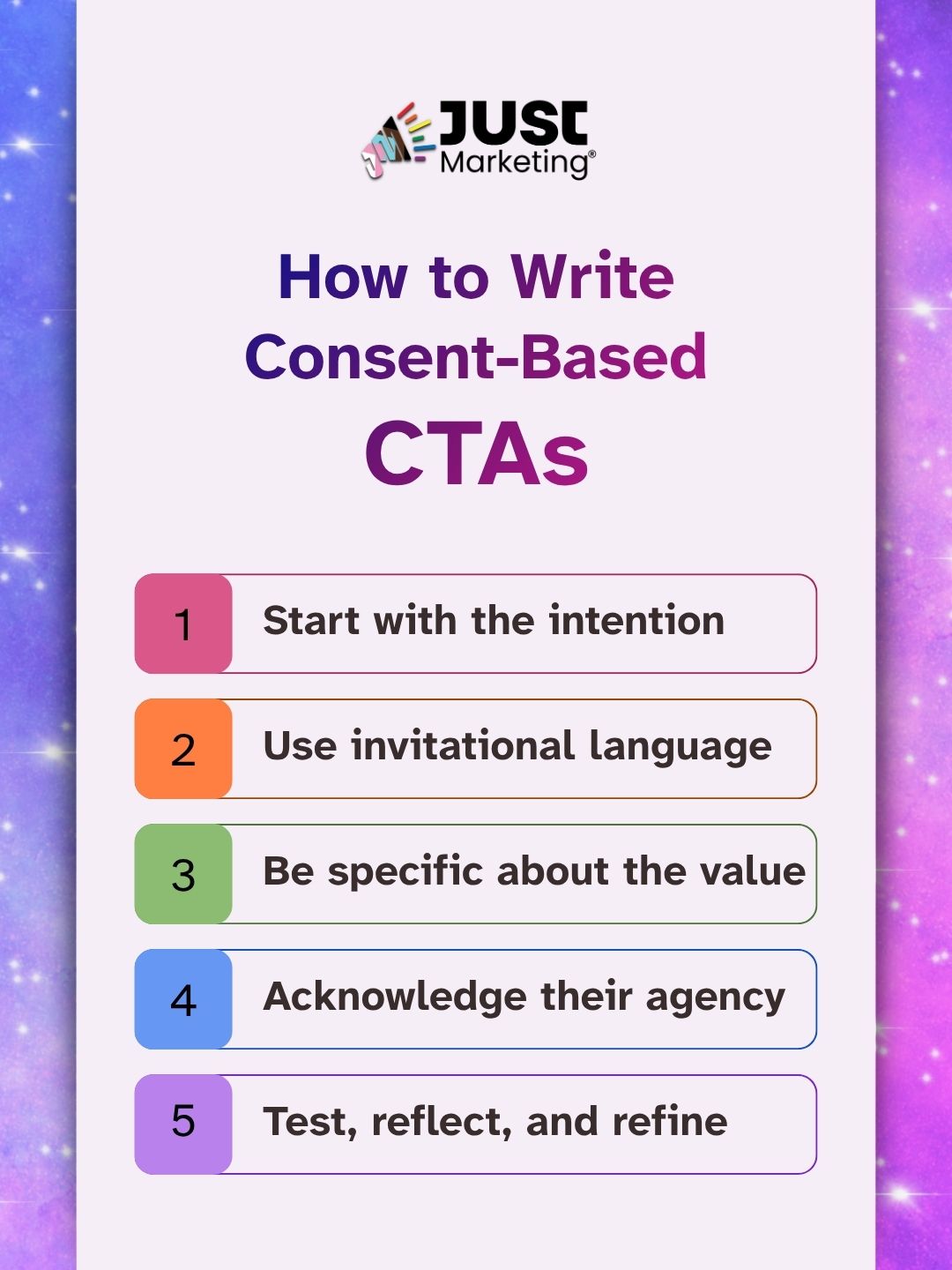
The Just Marketing logo at top of a light lavender card framed by a starry purple and blue galaxy background. Title reads ‘How to Write Consent-Based CTAs’ in navy-to-magenta gradient text. Five numbered, color-coded rows list: 1 start with the intention, 2 use invitational language, 3 be specific about the value, 4 acknowledge their agency, and 5 test, reflect, and refine.

Here’s how to do that in five simple steps:

1. Start with the intention

What action are you inviting them to take – and why? Be specific. Is it to follow you on social? Schedule a discovery call? Join your email list for ongoing support?

Knowing your purpose helps you write with clarity and confidence.

Example: “I want them to follow me on LinkedIn to keep the conversation going around ethical marketing.”

2. Use invitational language

Skip the pressure and go for language that honors autonomy. Phrases like:

  • “You’re invited to…”
  • “If this sounds like a fit…”
  • “Feel free to…”
  • “You’re welcome to join me…”

They all offer a choice – not a command.

3. Be specific about the value

What’s in it for them? Spell it out. Be direct. Avoid vague words like “amazing” or “exciting” – say what they’ll actually get.

Instead of: “Click here to learn more”
Try: “Click to explore what it’s like to work with me, including pricing, process, and client wins.”

4. Acknowledge their agency

Not everyone will be ready – and that’s okay. Let your copy reflect that.

Phrases like:

  • “Only if it feels right for you…”
  • “No pressure, ever…”
  • “Take what you need, leave the rest…”

These make a huge difference for people who are used to being manipulated or rushed.

5. Test, reflect, and refine

Try different variations. See what feels best to write – and what resonates with your people. Ethical marketing isn’t about getting it perfect. It’s about trying better, consistently.

What Are Some Examples Of Consent-Based CTAs?

Below are three consent-based CTAs you can adapt or use as-is – each aligned with a common goal: building relationships, generating leads, and growing your email list. None of them rely on hype, pressure, or gimmicks. Just clarity and kindness.

1. Connect on Social

You’re building a community, not a follower count. So invite connection like you would in real life – casually, with an open door.

Example: “Want to keep this conversation going? I share behind-the-scenes thoughts and ADHD-friendly marketing tips on LinkedIn and Instagram. You’re always welcome to follow and say hi!”

2. Explore What It’s Like to Work Together

Whether someone’s just curious or seriously ready, clarity makes your offer feel safe to explore. No guessing. No pressure.

Example: “Wondering what it’s like to work with me? Here’s a peek at how I support neurodivergent and mission-driven entrepreneurs with ethical content strategies that actually stick.”

Link to your services, sales page, or intro offer.

3. Join the Email List

If your newsletter is a source of value, say so. Frame it as a resource – not a funnel.

Example: “Want ADHD-friendly marketing tips and real talk in your inbox? You’re welcome to subscribe below. No spam, no pressure – just useful stuff when you’re ready for it.”

Each of these CTAs:

  • Centers your audience’s autonomy.
  • Sets clear expectations.
  • Uses friendly, invitational language.
  • Feels like a human wrote it (because one did).

How Can You Tell If Your CTA Is Consent-Based?

Your CTA doesn’t have to be clever. It doesn’t have to be flashy. And it definitely doesn’t need to rely on urgency, shame, or manipulation.

It just needs to be honest.

Because when your message is clear, your audience feels safe. When your invitation is kind, they feel respected. And when your CTA is rooted in consent, it builds trust that lasts longer than any one click or conversion.

This approach isn’t just more inclusive. It’s more sustainable. It honors neurodivergence, trauma-awareness, and human dignity – all while supporting your business goals.

So next time you write a CTA, ask yourself:

  • Am I being clear about what happens next?
  • Am I offering a real choice?
  • Am I speaking like I care about the person reading?

If so – you’re doing it right.

Let’s Keep This Conversation Going:

Let’s connect on your favorite platform!
Find me on Instagram or LinkedIn for more real talk, resources, and connection.

Curious about working together?
Explore my services and see how I help mission-driven, neurodivergent entrepreneurs market with clarity and confidence.

Want more insights like this?
Subscribe to my email list for ADHD-friendly marketing tips and inclusive strategy support – sent with care, never spam.

FAQs

How is a consent-based CTA different from a traditional CTA?

Traditional CTAs often rely on urgency or guilt to push people past hesitation. Consent-based CTAs explain what you’re offering and what happens next, then leave the decision with your reader. That transparency helps people say yes with confidence when the offer is a good fit.

Do consent-based CTAs actually convert?

Yes! Consent-based CTAs tend to attract better-qualified leads, since people know exactly what they’re agreeing to. Results may build more gradually than with pressure tactics, and the trust you earn compounds over time into stronger follow-through and long-term client relationships.

Why do consent-based CTAs matter for neurodivergent audiences?

Many neurodivergent people need time to process information and rely on transparency to feel safe making decisions. Clear CTAs reduce guesswork, which helps with decision fatigue and executive dysfunction. Invitational language also helps people with trauma histories engage at their own pace.

Can a consent-based CTA include a deadline?

Yes, when the deadline is real and explained. A program start date or a limited number of client spots are honest reasons for a timeline. Sharing the date in advance and what happens afterward lets people plan ahead and decide without feeling rushed.

Is it okay for a CTA to be longer than a few words?

Absolutely. A slightly longer CTA that explains what people will get often works better than a vague “Join now!” Aim for one or two clear sentences on emails and social posts, and keep button text short and descriptive, like “Download the free guide.”

What phrases work well in a consent-based CTA?

Invitational phrases like “You’re welcome to join me,” “If this sounds like a fit,” and “Take what you need” leave room for choice. Pair them with specific details about the value, such as “weekly ADHD-friendly marketing tips,” so readers know exactly what they’re saying yes to.


Categories: All Categories, Just Marketing®

Tags: Accessible Marketing, Ethical Marketing, Inclusive Marketing, Lead Generation, Promotional Content, Values-Aligned Promotions

Prev

About Meg Brunson

Meg Brunson is a marketing strategist and the creator of Just Marketing®, a justice-centered approach to marketing for impact-driven businesses.

Just Marketing® is ethical, inclusive, and accessible, so your audience feels supported and your business grows sustainably.

Follow me on Instagram @theMegBrunson
If your marketing isn’t hitting your goals, the pr If your marketing isn’t hitting your goals, the problem probably isn’t your graphics.
It’s not your captions.
It’s not that you need more content.

What you need is a strategy.

One that’s tied to your business goals, aligned with your values, and flexible enough to evolve as you grow.

That’s the difference between someone who just posts for you
…and someone who partners with you to actually grow your business.

– Strategy
– Testing
– Tuning
– Real results

And impeccable work, every step of the way.

If you’re ready to stop guessing and start growing, let’s talk: YourMarketingPerson.co 

(or DM me!)

ID: Mia P. holding a coffee cup, ‘I was going through social media manager after social media manager, until Meg came in with a strategic perspective on how our marketing could achieve our goals and KPIs. We crafted a plan and Meg was there every step of the way to test and tweak until we got the results we wanted. Her work is impeccable, her expertise is top notch.’ YourMarketingPerson.co

#JustMarketing #EquityForAll #a11y #EquityCenteredBusiness #DiversityInMarketing #SocialJustice #RacialJustice #BeTheChange #DismantleWhiteSupremacy #DiversityEquityInclusion #EthicalMarketing #InclusiveMarkeitng #AccessibleMarketing #MarketingAccessibility #SocialMediaMarketer #EthicalBusiness #MarketingCoach #CommunityOverCompetition #MarketingWithPurpose #MarketingWithImpact #DEI #DEIMarketing #SocialMediaForAll #ContentCreation #ContentMarketing #ContentMarketingMembership #WeeklySocialContent  #MarketingWithADHD #adhdBusiness #adhdBusinessOwner
November is here, and with it comes a season of re November is here, and with it comes a season of reflection, gratitude, and connection.

Here’s a look at some of the meaningful holidays and observances this month:

Native American Heritage Month (All November) - A time to celebrate the rich histories, cultures, and contributions of Native American communities while recognizing the resilience and strength that continue to define them. Let’s amplify Indigenous voices, learn from their stories, and commit to supporting their movements for justice.

Diwali (November 8) - Known as the Festival of Lights, Diwali celebrates the triumph of light over darkness and good over evil. This vibrant holiday is marked with candles, fireworks, and family gatherings. It’s a beautiful reminder of hope and renewal that resonates far beyond the cultures that celebrate it.

Transgender Day of Remembrance (November 20) - This solemn observance honors the lives of transgender people lost to violence and prejudice. It’s a call to action to protect and uplift trans voices, ensuring that every member of our community is seen, valued, and safe.

Thanksgiving (November 26) - Yes, Thanksgiving is about gathering, feasting, and expressing gratitude - but it’s also a chance to reflect on its history and recognize the complexities of this holiday for Indigenous communities. Pair your gratitude with education and action to make this day truly meaningful.

The Inclusive Holiday Content Bundle is your go-to resource for creating marketing that matters. Packed with observances and ideas, it’ll help you craft content that connects authentically while celebrating the diversity of your audience.

Instant Access: CelebrateOnSocial.com

Which holiday or observance will you be honoring this month?
I’d love to hear how you’re making November meaningful.

ID - A 6-card carousel highlighting 'Diverse & Inclusive Holidays' in November. Promotional graphic encourages planning inclusive holiday content year-round. Text promotes access to Canva templates, graphics, and guidance for over 470 inclusive holidays. CelebrateOnSocial.com appears in a purple bar.
Titles don’t make leaders. Practice does. Here’s Titles don’t make leaders.
Practice does.

Here’s a look at my own Leadership Philosophy:

I make decisions by …

(1) Leveraging my knowledge & experiences, researching new ideas, and listening to feedback from all who are impacted.

(2) Asking questions & considering the most marginalized community members.

(3) Getting creative and considering innovative & unconventional options. 

I believe …

(1) In being transparent about my feelings and actions, including owning up to my mistakes & lessons learned.

(2) In collaboration & empowering each other so that we’ll become stronger as a collective & as individuals.

(3) We should be asking tough questions & calling out inequities, even when it's uncomfortable.

(4) Through small daily actions, we will influence broad long-term outcomes.

My leadership liberates others by …

(1) Providing a space for marketers & business owners to make mistakes, learn, and grow.

(2) Supporting the growth of business revenue & personal profits.

(3) Changing the landscape of marketing so all feel seen, supported, and respected through the buying process.

Marketers are trendsetters with platforms and influence. By leading the charge with the way we ethically represent our brands, we can help spark a more inclusive & accessible future into existence. That’s Just Marketing®.

💕

Whether you’re leading a team, a classroom, or a solo business…
You are a leader.

And you get to define what leadership looks like - on your own terms.

Take a moment: How would you finish these sentences?

I make decisions by...
I believe...
My leadership liberates others by...

Drop yours in the comments or journal it out. There’s no wrong answer - just truth.

Title: ‘Leadership Philosophy’ on a purple and pink gradient. A smartphone frame displays Meg with pink and purple hair sitting outdoors with a laptop covered in stickers. Their shirt reads “People > Profit.” On the right are three speech bubbles: 'I make decisions by…' 'I believe…' and 'My leadership liberates others by…'
At its heart, marketing is about connection. And l At its heart, marketing is about connection. And language sits right at the center of every connection we make with the people we hope to serve.

When we slow down and notice whose voices we center, we can start building brands that reflect the world we want to live in: one where multilingual, multicultural, and neurodiverse communities are welcomed from the very beginning.

If that feels like a big goal, here's the encouraging part. Language justice is an ongoing practice, and you get to begin at your current capacity. A few low-lift places to start:

– Add captions and transcripts to your videos, in more than one language if you can

– Translate one key page, like your homepage, booking page, or lead magnet

– Poll your community about the languages they speak at home and whether multilingual content would help them

– Choose plain, clear language that works well for neurodivergent readers, multilingual audiences, and translation tools

Pick one and let it be enough for now. A single thoughtful change creates more impact than a dozen performative gestures, and each step makes it more likely someone feels seen and respected by your brand.

You can move toward language justice with the skills you have today. Curiosity and a willingness to learn will carry you a long way.

Find more small, sustainable shifts at MegBrunson.com/language-justice 

Which of these shifts feels most doable for you this month? 
Tell me in the comments, and I'll cheer you on!

ID: Large handwritten-style text on a purple-to-magenta gradient reads 'Language is a Justice Issue, and a Relationship Tool,' with the Just Marketing logo centered below.

#JustMarketing #EquityForAll #a11y #EquityCenteredBusiness #DiversityInMarketing #DiversityEquityInclusion #EthicalMarketing #InclusiveMarketing #AccessibleMarketing #MarketingAccessibility #EthicalBusiness #MarketingWithPurpose #MarketingWithImpact #DEI #SocialMediaForAll #ContentCreation #ContentMarketing #ContentMarketingMembership #WeeklySocialContent  #MarketingWithADHD
Google Translate can help you get the gist of some Google Translate can help you get the gist of something… and when your message really matters, you'll want people who live in the languages and cultures you hope to honor.

Hiring a translator or interpreter works best when you approach it as a relationship grounded in shared values and clear communication. Here are four ways to do that ethically:

1. Hire values-aligned professionals
Look for people who understand your audience and your mission. Experience in marketing or your industry is a big plus. Prioritize the person who gets what you're trying to say and knows how to say it in a way that resonates culturally.

2. Pay fairly and credit contributors
Language work is skilled labor. Translators adapt tone, catch cultural missteps, and often keep you from saying something unintentionally harmful. Compensate them accordingly, and give credit when their work shapes your content.

3. Co-create instead of extract
Invite collaboration from the start with questions like:
– Does this phrase translate well?
– Would this example resonate with your community?
That kind of conversation turns a technically correct translation into one that feels emotionally and culturally right.

4. Expand your definition of "language access"
Language justice includes people who communicate nonverbally or process language differently. Consider ASL interpreters for live events and videos, accurate captions and transcripts (auto-captions miss a lot), alt text and image descriptions, and plain language for neurodivergent readers.

Learn more about ethical translation and inclusive messaging: MegBrunson.com/language-justice 

Have you worked with a translator, interpreter, or language consultant? 
Share what made the collaboration great, or tag someone you'd recommend!

ID: Title, 'Working with Translators, Interpreters, and Creators Ethically.' 4 numbered boxes: hire values-aligned professionals, pay fairly and credit contributors, co-create instead of extract, and expand your definition of 'language access.'
According to the U.S. Census Bureau, about 20% of According to the U.S. Census Bureau, about 20% of people in the U.S. speak a language other than English at home. Zoom out to a global audience and that number climbs dramatically.

Still, much of the online business world treats English as the default. When your marketing only shows up in English, your reach shrinks, even when your services are technically open to anyone.

Language shapes how we process information and whether we feel welcomed or shut out. For some people, English is a second or third language. For others, it carries memories of exclusion in schools, healthcare, and other systems that were supposed to serve them. And for many neurodivergent readers, even "simple" English content can feel dense and hard to follow.

When we treat language as a bridge, we open the door to people who've been left outside the "ideal client" box for far too long.

Here's a quick self-check for your own marketing:
– Do I know which languages my audience speaks or prefers?
– Have I tested whether my message stays clear in translation?
– Would someone using a screen reader or translation app understand my offer?
– Is my writing as plain and direct as it could be?

Centering access starts with asking better questions. From there, you can build marketing that meets people where they are, one thoughtful change at a time.

Explore more ways to make your messaging accessible: MegBrunson.com/language-justice

What languages are spoken in your home or in the communities you serve?

ID: Title, 'Language as Access,' an illustrated smiling mouth has speech bubbles reading 'Annyeong' in Korean, 'Hello,' and 'Bonjour.' The Just Marketing logo appears at bottom right, with text below reading 'Not Everyone Speaks (or Thinks in) English.'

#JustMarketing #EquityForAll #EquityCenteredBusiness #DiversityInMarketing #DiversityEquityInclusion #EthicalMarketing #InclusiveMarketing #AccessibleMarketing #MarketingAccessibility #EthicalBusiness #MarketingWithPurpose #MarketingWithImpact #DEI #ContentCreation #ContentMarketing #ContentMarketingMembership #WeeklySocialContent  #MarketingWithADHD
Most online marketing defaults to English and assu Most online marketing defaults to English and assumes everyone shares the same cultural context. 

That default feels efficient, and it also quietly shrinks the room. 

Multilingual folks, immigrant communities, Deaf audiences, and neurodivergent readers often end up outside messages that were supposedly meant for everyone.

Language justice starts with a simple question: who gets left out of our message? 
Then comes the more hopeful follow-up: how do we invite them back in?

Here's a quick example. Say you're a coach who helps clients "get off the hamster wheel." Plenty of U.S. English speakers will nod along. For someone outside that cultural context, or someone reading through a translation app, the phrase might land as pure confusion. 

"Break free from the cycle of burnout" carries the same meaning to far more people.

Words carry culture, humor, tone, and emotion, so a literal translation only gets you partway there. 

Localization and transcreation help your message arrive with the meaning you intended.

Start small. 
Swapping one idiom for clearer language is a real step toward more inclusive marketing, and it makes your content easier for everyone to read.

The blog walks through:
– Why language is an access issue
– How cultural nuance shapes the way your message lands
– How to work with translators and interpreters ethically
– Small, sustainable shifts you can make right away

Read more: MegBrunson.com/language-justice 

What's a phrase or idiom you use often that might not translate well? 
Let's brainstorm clearer alternatives together.

ID: Title, 'Language Justice in Marketing,' an illustrated globe surrounded by speech bubbles greeting in different languages: 'Ni Hao' in Chinese, 'Hola,' 'Hello,' Arabic script, and 'Namaste' in Hindi. Italic text below asks 'How Inclusive is Your Messaging?' against a soft pastel gradient.

#JustMarketing #EquityCenteredBusiness #DiversityInMarketing #DiversityEquityInclusion #EthicalMarketing #InclusiveMarketing #AccessibleMarketing #MarketingAccessibility #MarketingWithPurpose #MarketingWithImpact
You’re the visionary. You shouldn’t have to be the You’re the visionary.
You shouldn’t have to be the marketing department, too.

Erica came to me with two businesses and one goal: grow without burning out, and she got:
– Real results
– Clear strategy
– No extra work dumped on her lap

Just Marketing® is about collaboration that respects your capacity.
Strategy that doesn’t rely on hustle.
Support that feels good.

You don’t need to do it all alone.
You just need a plan (and a partner) that actually works.

Ready to grow your biz without burnout?

Let’s chat!

ID: Testimonial: ‘We’ve used Meg's marketing services for two businesses over a couple years and she did a fantastic job. She's laid back. She listens. And she doesn't add more work to my plate to get the job done. We had great results and would definitely recommend her to a small business looking for growth!’ A small circular photo and text, ‘Erica 'Poindexter' Gunderson recommends Meg Brunson.’

 #JustMarketing #EquityForAll #a11y #EquityCenteredBusiness #DiversityInMarketing #SocialJustice #RacialJustice #BeTheChange #DismantleWhiteSupremacy #DiversityEquityInclusion #EthicalMarketing #InclusiveMarkeitng #AccessibleMarketing #MarketingAccessibility #SocialMediaMarketer #EthicalBusiness #MarketingCoach #CommunityOverCompetition #MarketingWithPurpose #MarketingWithImpact #DEI #DEIMarketing #SocialMediaForAll #ContentCreation #ContentMarketing #ContentMarketingMembership #WeeklySocialContent  #MarketingWithADHD #adhdBusiness #adhdBusinessOwner
Ever rolled a suitcase down a curb cut? You can t Ever rolled a suitcase down a curb cut? 
You can thank disability activists for that!

In the early 1970s, Michael Pachovas and a few friends poured their own cement ramp onto a Berkeley curb. Berkeley installed its first official curb cut in 1972, and before long, parents with strollers and travelers with luggage were heading straight for them too.

PolicyLink CEO Angela Glover Blackwell later named this the curb-cut effect: when you design for people who’ve been left out, everyone benefits.

Marketing follows the same pattern. 

Most content gets built for an imagined “average” person who sees every image, hears every video, and scrolls at top speed. 

That person is mostly a myth. 

When you start with the folks at the edges of the bell curve, like disabled and neurodivergent people, your content gets clearer for your whole audience.

Designing for the edges sits at the heart of the accessibility pillar of Just Marketing®. 

The blog covers eight marketing curb cuts you can start using today: MegBrunson.com/design-for-the-edges 

What’s an accessibility practice you started for one reason that ended up helping way more people than you expected?

ID: Just Marketing logo above the title ‘Design for the Edges,’ with ‘Design’ in purple-to-magenta script and ‘Edges’ in bold magenta. Two curved arrows point from ‘Edges’ down to both tails of a bell curve filled with rows of gray person icons. Icons in the outer edges are shaded magenta, highlighting people at the margins. Pastel gradient background.

#JustMarketing #EquityForAll #a11y #EquityCenteredBusiness #DiversityInMarketing #SocialJustice #RacialJustice #BeTheChange #DismantleWhiteSupremacy #DiversityEquityInclusion #EthicalMarketing #InclusiveMarketing #AccessibleMarketing #MarketingAccessibility #SocialMediaMarketer #EthicalBusiness #MarketingCoach #CommunityOverCompetition #MarketingWithPurpose #MarketingWithImpact #DEI #DEIMarketing #SocialMediaForAll #ContentCreation #ContentMarketing #ContentMarketingMembership #WeeklySocialContent  #MarketingWithADHD #adhdBusiness #adhdBusinessOwner
You fold one load of marketing content… … and some You fold one load of marketing content…
… and somehow 3 more are waiting in your inbox.

Blog post.
Instagram carousel.
Email newsletter.

…Oh wait. Now the algorithm wants video again?

Tell me why marketing feels like digital laundry.

You finally get “caught up,” and then…
– You launch something new
– The season shifts
– You pivot your offer
– Or let’s be honest… you’re just tired

And suddenly your content pile has become Mt. Overwhelm.

Listen, you’re not doing anything wrong.
Marketing really is never-ending.
But that doesn’t mean you have to do it all yourself.

I work with entrepreneurs who are ready to stop guessing.

Who want structure that still leaves room for creativity.

Who are done with the hustle and want a system that works with their brain and bandwidth.

Whether you need a full strategy, ongoing support, or someone to hand you the calendar so you just show up and press post…
I’ve got you.

Let’s talk → YourMarketingPerson.co 
(or DM me!)

Or if you’re the DIY type: Check out the Content Marketing Membership - it was literally made for this kind of thing: ContentMarketingMembership.com 

ID: A circular graphic with laundry-related icons, including a washing machine, basket, gloves, spray bottle, ironing board, hanger, shirt, iron, clothespin, and wash basin surrounded by soap bubbles. Center text reads: ‘Do you ever feel like… marketing is constant digital laundry?’ The words ‘marketing,’ ‘constant,’ and ‘digital’ are emphasized in different fonts and colors.

 #JustMarketing #EquityForAll #a11y #EquityCenteredBusiness #DiversityInMarketing #SocialJustice #RacialJustice #BeTheChange #DismantleWhiteSupremacy #DiversityEquityInclusion #EthicalMarketing #InclusiveMarketing #AccessibleMarketing #MarketingAccessibility #SocialMediaMarketer #EthicalBusiness #MarketingCoach #CommunityOverCompetition #MarketingWithPurpose #MarketingWithImpact #DEI #DEIMarketing #SocialMediaForAll #ContentCreation #ContentMarketing #ContentMarketingMembership #WeeklySocialContent  #MarketingWithADHD #adhdBusiness #adhdBusinessOwner
Designing for neurodivergent folks often comes dow Designing for neurodivergent folks often comes down to thoughtful simplifying. And a simpler offer tends to work better for every person who buys it.

Here are seven ADHD-friendly elements:

1. Flexible access options
Replays and extended access let people learn whenever their focus shows up. Downloadable audio or transcripts make offline learning easy too.

2. Built-in support for time-blindness
Calendar invites and visual progress bars help folks stay oriented. Deadlines can exist with zero pressure or shame attached.

3. Energy-conscious design
Short, modular lessons with planned pause points let people move at a slower pace and still keep up.

4. Clear visual structure
Checklists and roadmaps with one action per step keep decision fatigue low.

5. Consent-based communication
Let clients choose how much interaction they want. A "quiet mode" and a clearly stated check-in schedule show you respect their boundaries.

6. Optional, low-pressure community
Opt-in spaces off social platforms, where lurking counts as valid participation.

7. Pricing that respects real life
Shame-free payment plans and sliding scale options, with the price listed right on the sales page. Transparency builds trust.

Bonus: these systems usually make delivery smoother for you too. Fewer fires to put out, more breathing room for the whole business.

And you can start with just one. Add a replay this month, or extend access by a couple of weeks. Small changes add up fast, and your audience will notice.

Save this post for your next offer build or refresh.

Which of these seven does your current offer already include, and which one feels like the easiest next step?

The blog breaks down each element and includes a section for buyers on what to look for before investing: MegBrunson.com/adhd-friendly-offers

ID: Title, 'ADHD-Friendly Elements for Inclusive Offers.' Numbered list includes flexible access options, built-in support for time-blindness, energy-conscious design, clear visual structure, consent-based communication, optional low-pressure community, and pricing that respects real life.
Many courses and coaching programs get built for a Many courses and coaching programs get built for a hypothetical client with steady energy and a calendar that behaves itself. For those of us with ADHD, reality includes time-blindness and motivation that arrives in surprise bursts (sometimes at 11pm, sometimes three weeks after the cohort ended). Those traits deserve accommodation in the offers we create and the offers we buy.

Here's where traditional offers tend to trip up neurodivergent folks:

– Urgency overload. 
Countdown timers and "last chance" emails can trigger shutdown in a brain that experiences time differently.

– Complexity. 
Twelve modules, bonus masterclasses, and a Slack channel per cohort? Plenty of people check out before they figure out what's included.

– Rigid scheduling. 
Live-only sessions with no replays leave behind anyone who works in windows of focus.

– Invisibility. 
When an offer never mentions neurodivergence, buyers have a harder time trusting their access needs will be respected.

Good news: small, thoughtful shifts make a big difference.

This blog is written for both sides of the checkout page: MegBrunson.com/adhd-friendly-offers 

I'd love to hear from you: What's one offer feature that helped you actually finish something you signed up for? 

Replays, transcripts, a forgiving deadline, something else entirely? Tell me in the comments.

ID: Text on a taped-up note reads 'How to Create (or Choose) Offers That Work for Neurodiverse Humans,' with 'Neurodiverse' in rainbow lettering. Below, a purple silhouette of a head shows a white brain containing a rainbow infinity-symbol butterfly, set against a pastel rainbow gradient background.

#JustMarketing #EquityForAll #MarketingWithHeart #MarketingWithIntegrity #EquityCenteredBusiness #AlignedBusiness #DismantleWhiteSupremacy #DiversityEquityInclusion #EthicalMarketing #EthicalBusiness #OnlineMarketingTips #DEI #MarketingWithADHD #ContentMarketing #ContentMarketingMembership #WeeklySocialContent #a11y #ContentStrategy #InclusiveMarketing #AccessibleMarketing #SocialMediaForAll #ContentCreation
Follow on Instagram


Links

CMM Log In
Mission, Vision, & Values

DEI Statement
Leadership Philosophy
Community Agreements
Press & Media


Beliefs

Black lives matter.
Love is love.
Abortion is healthcare.
No human is illegal.
Free Palestine.
I also Believe…

Circular badge has the name "Meg" in the middle and is surrounded by: "CEO, author, speaker, marketer, leader, & advocate"
Copyright © 2026|All Rights Reserved|Meg Brunson, LLC| Privacy & Terms